

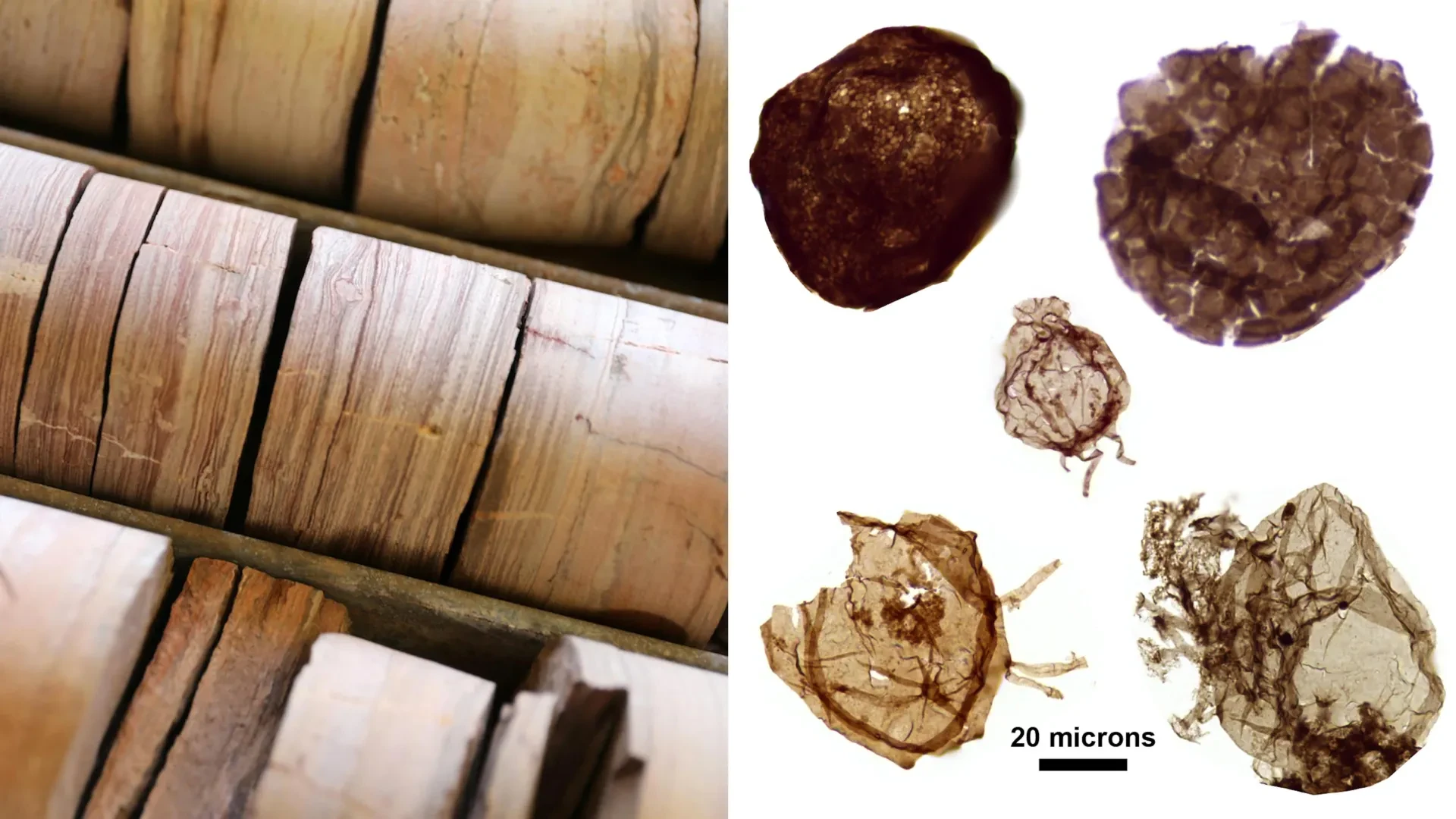
DARWIN, AUSTRALIA — Tucked away in an open-air warehouse in the humid, tropical climate of Darwin, rows of heavy wooden pallets hold a silent archive of Earth’s deep past. Neatly arranged within these pallets are long, cylindrical trays containing cores of rock bored hundreds of meters beneath the Australian surface decades ago by mineral exploration companies.
To the mining engineers who originally pulled them from the earth, these dull grey and brown cylinders of mudstone—a sedimentary rock formed from ancient seafloor silt—held little commercial value. Unbeknownst to them, the rock was a time capsule. Trapped within the hardened mud were microscopic ghosts: the exquisitely preserved fossils of single-celled organisms that once drifted through a vast inland sea covering much of northern Australia more than 1.5 billion years ago.
According to a groundbreaking new study published in the prestigious journal Nature, these forgotten drill cores are proving to be nothing short of a scientific treasure trove. They contain the oldest known eukaryote fossils on Earth, pushing the timeline of complex cellular life further back than previously imagined. More importantly, analyzing these microfossils alongside the chemical signature of the rocks that encase them has resolved a long-standing evolutionary debate: the fundamental relationship between oxygen and the rise of complex life.
Main Facts: The Origin of Eukaryotes and the Australian Microfossil Archive
All life on Earth is partitioned into two fundamentally different categories at the cellular level: prokaryotes and eukaryotes.
Prokaryotes, which include bacteria and archaea, possess a simple cellular architecture. They lack internal compartmentalization and are predominantly single-celled. Eukaryotes, by contrast, represent a staggering leap in biological complexity. Encompassing all animals, plants, fungi, and algae, eukaryotic cells feature a distinct nucleus that houses genetic material, alongside specialized internal machinery known as organelles—such as mitochondria—that perform dedicated cellular tasks.
The emergence of the eukaryotic cell was arguably the most transformative evolutionary event in Earth’s history, paving the way for multicellularity, animal life, and eventually, human consciousness. Genetic analyses of living organisms have led evolutionary biologists to a broad consensus: the last common ancestor of all modern eukaryotes was forged through an ancient symbiotic union between at least two prokaryotic microbes—an archaeon and a bacterium.
While genetic studies of modern microbes offer vital clues about this primordial merger, they cannot tell the whole story. To understand when and how these lineages diverged, scientists must turn to the fossil record.
Globally, eukaryote fossils are found in strata dating back roughly 1.5 billion years. However, the mudstone cores curated by the Northern Territory Geological Survey (NTGS) in Darwin shatter that timeline. The oldest of these Northern Territory microfossils date back an astonishing 1.75 billion years, making them the oldest verified records of eukaryotic life anywhere on the planet.
Chronology: From Ancient Inland Seas to Modern Laboratories
To appreciate the significance of the Darwin warehouse cache, scientists had to re-examine a geological timeline stretching back nearly two billion years.
- 1.75 Billion Years Ago: A vast, shallow inland sea covers large swathes of northern Australia. As microscopic single-celled eukaryotes drift, die, and settle onto the seafloor, they are buried in fine-grained mud, protecting them from total decomposition. Over immense spans of time, the layers of mud harden into sedimentary mudstone.
- Decades Past: Mineral exploration companies, searching for valuable ore deposits across northern Australia, drill deep exploratory holes. They extract cylindrical rock cores, catalog them, and eventually deposit representative samples with the Northern Territory Geological Survey, where they sit in open-air storage for years, largely overlooked by paleontologists.
- The Recent Breakthrough: A multidisciplinary team of geologists and evolutionary biologists turns its attention to the NTGS archives. Recognizing that fine-grained mudstones are ideal for preserving delicate organic microfossils, the researchers select core samples spanning a geological window from roughly 1.7 to 1.4 billion years ago.
- Publication in Nature: The team publishes its findings, detailing the analysis of more than 12,000 individual microfossils extracted from the Darwin cores. The study establishes a definitive link between the distribution of these ancient eukaryotes and the presence of oxygen in Proterozoic oceans.
Supporting Data: Inside the Process of Unearthing 12,000 Fossils
Extracting microscopic evidence from rocks that have been baked under the tropical sun of Darwin for decades is no small feat. The research team employed rigorous chemical and microscopic methodologies to unlock the secrets held within the mudstone.
Rather than attempting to spot microscopic fossils embedded within solid rock faces, the scientists crushed the mudstone cores into fine powders. They then dissolved the mineral matrix using powerful acids, leaving behind only the acid-resistant organic residue.
When examined under high-powered microscopes, this residue revealed an astonishing wealth of biological data. The researchers identified and cataloged more than 12,000 individual microfossils. These specimens displayed a remarkable array of complex morphological structures—spines, ridges, and intricate wall designs—that far exceeded the simple, featureless morphologies typically observed in ancient prokaryotes.
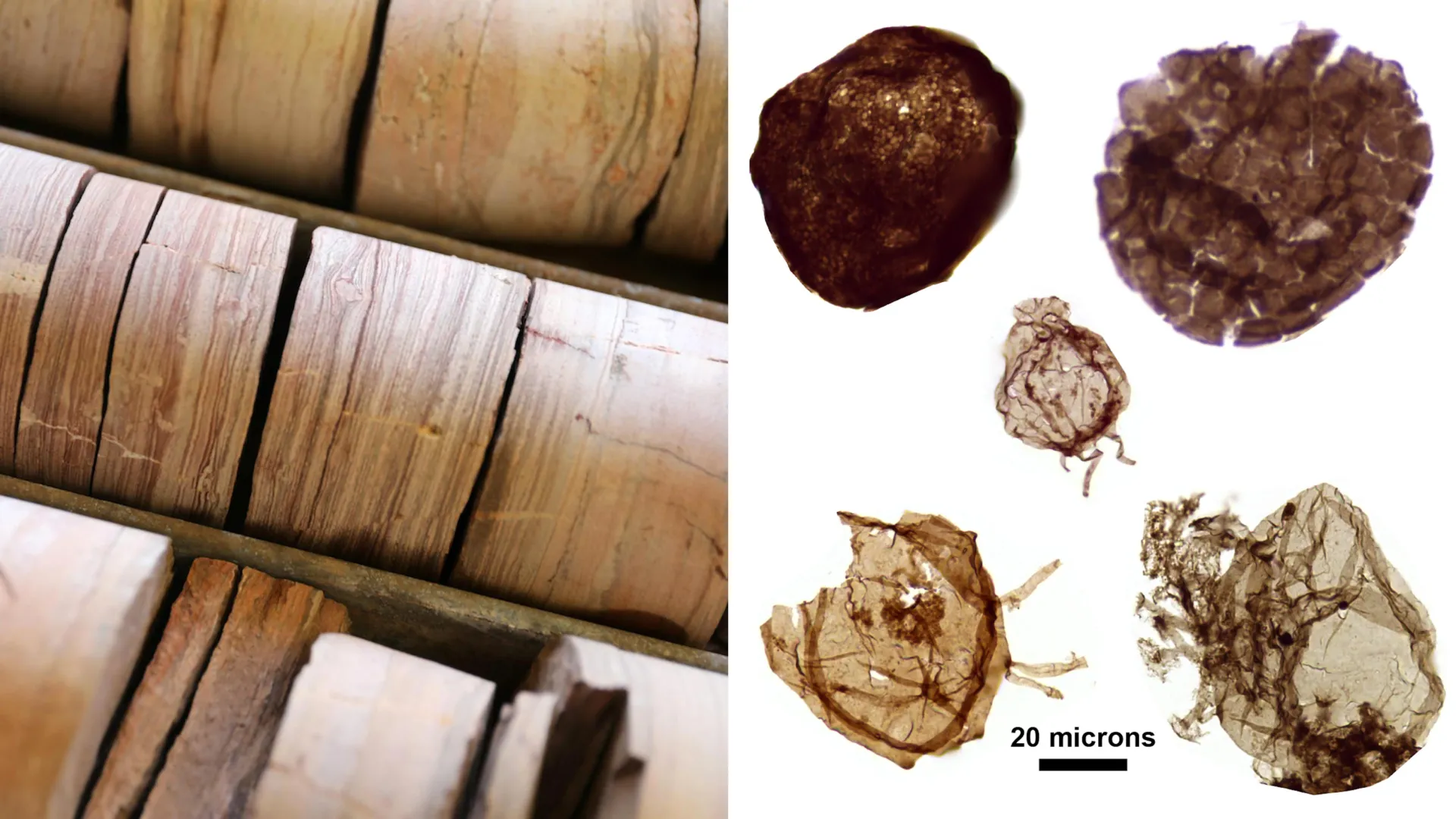
Simultaneously, the team performed geochemical analyses on the surrounding mudstones. By measuring the chemical composition of the rocks, the scientists were able to reconstruct the environmental conditions of the ancient seafloor, specifically determining whether dissolved oxygen was present in the seawater when the sediments were laid down.
The results revealed a stark spatial and environmental divide. Eukaryote fossils were discovered across a variety of habitats, ranging from coastal mudflats to open-marine environments. However, they appeared exclusively in samples derived from oxygenated settings. Samples originating from anoxic (oxygen-free) environments contained only simple, prokaryotic bacterial and archaeal forms.
Official Responses and Expert Perspectives
The publication of the Nature study has sent ripples through the paleontological and astrobiological communities, breathing new life into debates that have spanned decades.
Dr. Jochen Brocks, a prominent geobiologist who was not directly involved in the study, noted that bridging the gap between molecular clocks and the physical fossil record is one of the greatest challenges in modern science. "For a long time, we have relied heavily on modern genetic signatures to infer when eukaryotes arose," he explained. "Having physical, fossilized proof preserved in ancient Australian rocks gives us hard data points that theories must answer to."
Meanwhile, lead researchers behind the study emphasize that the findings directly address a controversial pivot point in evolutionary theory: the role of oxygen.
For years, conventional wisdom dictated that complex life could only flourish once Earth’s atmosphere and oceans became thoroughly oxygenated. However, recent discoveries of enigmatic modern eukaryotes capable of surviving—and even thriving—in oxygen-free environments had called this assumption into question. Furthermore, geological proxies suggested that during the early evolution of eukaryotes, global oxygen levels were likely quite low.
"Our data suggests that while certain modern lineages may have secondary adaptations allowing them to tolerate anoxia, the foundational roots of eukaryotic complexity were firmly tied to oxygen," the researchers noted in their study. The massive energy demands required to run a complex eukaryotic cell—complete with internal membrane trafficking, cytoskeletons, and aerobic respiration—appear to have necessitated an oxygen-rich niche from the very beginning.
Implications: Rewriting the History of Complex Life on Earth
The implications of the Darwin core analysis stretch far beyond the borders of Australia’s Northern Territory. By confirming that the earliest known eukaryotes relied on oxygen-bearing marine environments, the study provides a vital missing puzzle piece in the chronicle of how our planet transformed from a microbial wasteland into a home for complex ecosystems.
First, it validates the long-held hypothesis that fluctuations in Earth’s atmospheric and oceanic oxygen acted as an evolutionary gas pedal. While prokaryotes could easily navigate low-oxygen or anoxic worlds, the thermodynamic engine of the eukaryote cell demanded an oxygen-rich fuel source to drive the innovations that eventually led to multicellular organisms, animals, and humanity.
Second, the study highlights the immense, unrealized scientific value of archival geological samples. Around the world, government geological surveys and mining companies store millions of meters of drill cores in warehouses and core sheds. These repositories, created primarily to locate commercially viable minerals, are increasingly being recognized as vast archives of planetary history. As analytical techniques improve—allowing scientists to extract ancient DNA fragments, microfossils, and subtle chemical signatures from tiny slivers of rock—these industrial archives are transforming into windows through which we can view prehistoric ecosystems.
Finally, solving the environmental context of early eukaryotes has profound implications for astrobiology. As space agencies search for life on Mars and the icy moons of the outer solar system, understanding the precise geochemical thresholds that permitted the birth of complex life on Earth serves as a baseline. If complex life inherently requires specific oxygen tipping points, it narrows the cosmic search parameters for complex biospheres elsewhere in the universe.
As researchers continue to clean, crush, and analyze the endless trays of rock housed in Darwin and beyond, one thing is certain: the silent stones of the Australian outback still have extraordinary stories to tell about our deep evolutionary origins and our place in the cosmos.
