

By Science & Environment Desk
Published in partnership with geological research updates
Main Facts
In a discovery that forces geologists to redraw timelines of ancient planetary impacts and biological evolution, researchers at The University of Texas (UT) at Austin have upended a decades-old consensus regarding the Ames impact structure in Oklahoma. Hidden miles beneath the surface of rural Major County, this massive, ring-shaped geological feature—famous not only for its scientific intrigue but also for its prolific oil and gas production—was long believed to be a premier relic of the Middle Ordovician period, dating back approximately 467.5 million years.
However, a meticulous new geochronological analysis tells a radically different story. By examining microscopic minerals extracted from granite altered by the ancient collision, the UT Austin research team has determined that a meteorite struck the region roughly 370 million years ago, during the Late Devonian period. This revision shears nearly 100 million years off the age of the crater.
The findings, published in the journal Meteoritics & Planetary Science, do more than simply correct a local historical ledger. By removing the Ames structure from the roster of the Ordovician Meteor Event—a cluster of impacts that once fueled the hypothesis that Earth may have possessed a Saturn-like ring of asteroid debris—the study repositions the crater remarkably close to the Frasnian-Famennian mass extinction. This cataclysmic biological crisis, which occurred approximately 372 million years ago, devastated a massive proportion of Earth’s marine life.
The research carries profound implications for how scientists interpret the triggers of ancient mass extinctions, the reliability of fossil-based dating methods in impact zones, and the methodology used to map the bombardment history of the inner solar system.
Chronology
To understand the magnitude of the revision, geologists must look at how the Ames structure was formed, discovered, and eventually misinterpreted over millions of years and decades of modern study.
The Impact (c. 370 Million Years Ago)
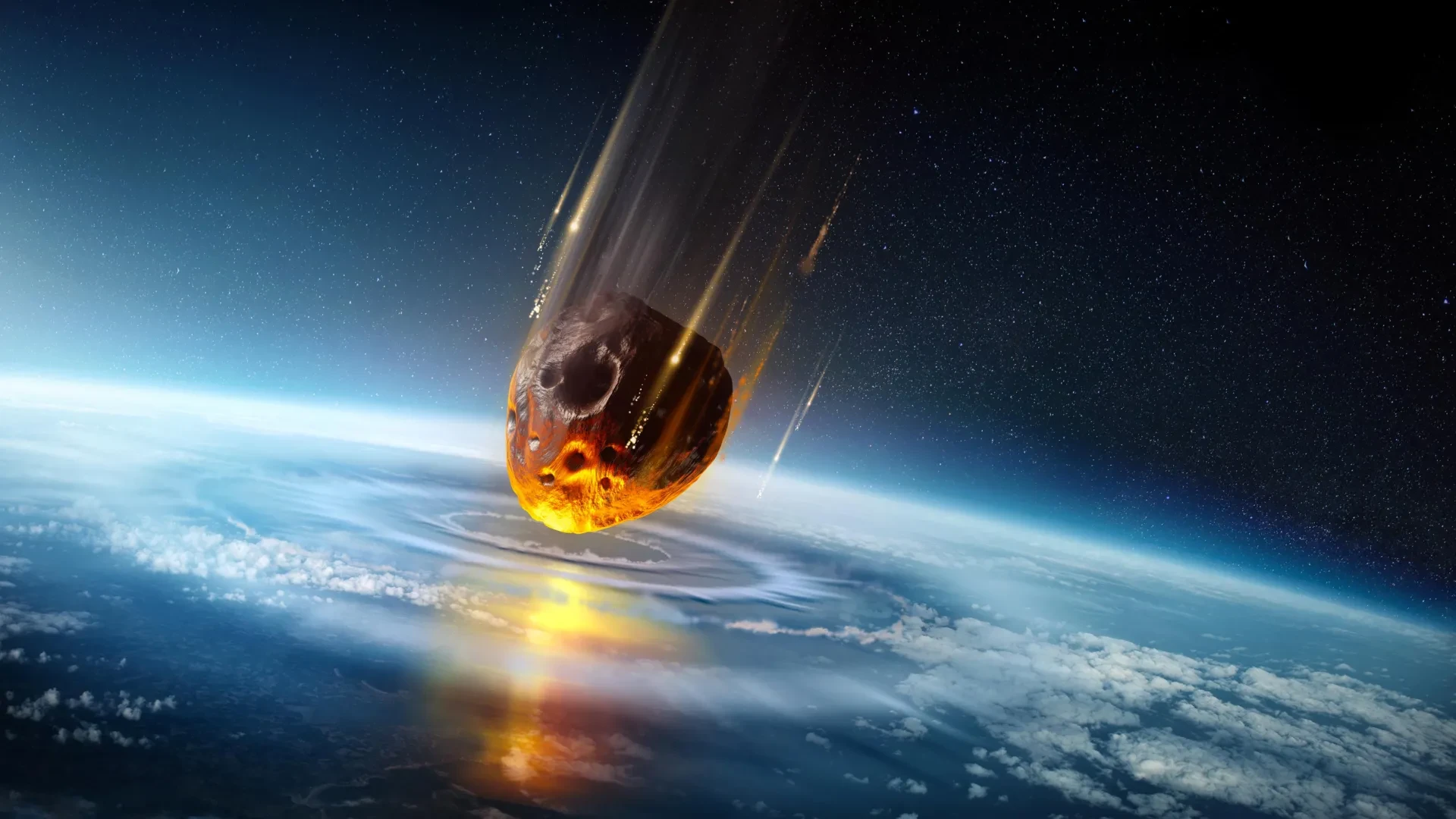
During the Late Devonian period, long before the rise of dinosaurs or even the first sprawling forests, an extraterrestrial body—likely an asteroid or a fragment of one—plunged out of the sky and slammed into the shallow seas covering what is now North America. The violent kinetic energy vaporized rock, triggered towering tsunamis, and fractured the underlying granitic basement floor, carving out a massive depression several miles wide. Over subsequent geological epochs, layers of sedimentary rock sealed the crater, hiding it completely from the surface world.
Discovery and the Fossil Misleading (Late 20th Century)
Millennia later, the buried crater revealed its economic value when drillers discovered that its fractured rim and surrounding breccia formed an exceptional trap for hydrocarbons. As the Ames structure became a billion-dollar oil and gas producer, geologists flocked to study its subsurface architecture.
Lacking direct radiometric dates from the impact melt or altered basement rock, early researchers relied on biostratigraphy—the dating of rock layers through the fossils contained within them. Scientists recovered tiny, tooth-like microfossils belonging to conodonts, an extinct group of eel-like chordates, trapped in the impact-affected strata. Because these conodont species were known to have lived during the Ordovician period, science locked in a timeline: the Ames crater was christened as an Ordovician impact, matching the age of other major North American craters like the Slate Islands structure in Canada and the Ames structure’s purported peers.
The Spark of New Research (2018)
The journey toward correcting this timeline began years ago when Andrew Parisi, then a graduate student at UT Austin’s Jackson School of Geosciences, recognized inconsistencies in the crater’s historical record. Driven by scientific curiosity, Parisi traveled to the Oklahoma Geological Survey to acquire core samples drilled from the deep Ames structure. He successfully extracted microscopic zircon crystals from the impact-altered granite, setting the stage for advanced laboratory analysis. (Parisi tragically passed away before the culmination of the project, but his foundational fieldwork proved instrumental to the study’s success.)
Modern Radiometric Dating and Publication (July)
Using cutting-edge uranium-lead (U-Pb) dating techniques, alongside advanced imaging in collaboration with NASA, the UT Austin research team subjected the zircon crystals to rigorous scrutiny. Every analytical path pointed toward the same undeniable conclusion: the crystals had been reset not 467.5 million years ago, but approximately 370 million years ago. The findings were officially published in July, setting off ripples across the global geological community.
Supporting Data
The scientific validation of the Ames crater’s true age rests on the microscopic behavior of zircon ($textZrSiO_4$) and the precision of modern mass spectrometry.
The Power of Zircon U-Pb Dating
Zircon is a mineral renowned by geologists for its durability. It incorporates uranium into its crystal lattice when it first forms, while actively rejecting lead. Over time, radioactive isotopes of uranium decay into stable isotopes of lead at a known, immutable rate. By measuring the ratio of uranium to lead (U-Pb dating), scientists can determine with extraordinary precision when the crystal last experienced temperatures high enough to reset its internal clock.
However, zircon can do something even more remarkable: it can record the extreme shock pressures of a hypervelocity meteor impact. When an asteroid strikes the Earth, the localized heat and shockwaves cause zircon to recrystallize in distinctive structural patterns.
NASA Imaging and Verification
To ensure the dated zircons had indeed recorded the meteor impact rather than an unrelated thermal event, lead author Elizabeth Catlos and her team partnered with NASA researchers. They utilized two sophisticated imaging technologies:
- Cathodoluminescence (CL): This technique uses an electron beam to cause minerals to emit visible light, revealing internal growth zoning and micro-fractures created by shock pressures.
- Electron Backscatter Diffraction (EBSD): This method maps the crystallographic orientation of the mineral at a microscopic level, confirming the presence of shock-induced crystal deformation.
Through these techniques, the team confirmed that the zircons possessed the unmistakable physical signatures of an impact event that occurred roughly 370 million years ago.
Resolving the Conodont Paradox
How did conodont fossils from the Ordovician period end up in a Devonian impact structure? Catlos and her co-authors solved this geological riddle quite simply: the fossils were already millions of years old when the asteroid struck.
When the meteor slammed into the region, the colossal energy of the impact churned up older sedimentary layers, incorporating ancient, pre-existing microfossils into the chaotic slurry of ejecta and breccia. Early geologists mistook the deposition age of these accidentally entrained fossils for the age of the impact itself, illustrating the inherent risks of relying solely on biostratigraphy in complex, catastrophic geological settings.
Official Responses
The implications of the study have drawn commentary from leading geoscientists, highlighting both the triumph of the methodology and the bittersweet nature of scientific discovery.
Dr. Elizabeth Catlos, associate professor in UT’s Department of Earth and Planetary Sciences and lead author of the study, emphasized the profound shift the paper introduces to the historical catalog of impacts:
"No matter what technique we used, it was coming back to this younger signal. With this research, we’re basically taking a major pawn out of the Ordovician Meteor Event and dumping it into the Frasnian-Famennian event, and saying, ‘This is where this impact belongs.’"
Dr. Danny Stockli, dean of the Jackson School of Geosciences and co-author of the research, underscored the broader methodological value of applying high-resolution geochronology to North America’s hidden impact structures:
"These small crystals allow us to go back in time and learn about the major changes to Earth’s ancient landscapes. It would be great to do this for more of the meteor impact sites across the continent so we could get a more accurate timeline for these major events."
The research team also paid tribute to the late colleagues whose contributions helped bring the project to fruition. In addition to graduate student Andrew Parisi, co-author Michael Brookfield, an affiliated researcher at the Jackson School, passed away prior to publication. Their foundational efforts, alongside contributions from Research Professor Sean Gulick and Professor Emeritus Mark Cloos, ensured that the complex dataset was meticulously collected and verified.
Implications
The rewriting of Oklahoma’s geological history extends far beyond state lines, touching upon fundamental debates in paleontology, climatology, and planetary science.
Rethinking the Ordovician Meteor Event
For years, the apparent clustering of multiple meteor impacts around 467 million years ago led some scientists to hypothesize that Earth, much like Saturn today, may have been encircled by a temporary ring of asteroid debris. This hypothesis relied heavily on the inclusion of the Ames structure in the Ordovician cluster. By stripping Ames of its Ordovician status and reassigning it to the Devonian, the UT Austin study weakens the empirical foundation of the ancient ring hypothesis, suggesting that some purported impact clusters may be artifacts of flawed dating rather than synchronized cosmic bombardments.
Clues to the Frasnian-Famennian Mass Extinction
Perhaps the most tantalizing implication of the new date is its proximity to the Frasnian-Famennian mass extinction, which unfolded roughly 372 million years ago. This devastating event wiped out a staggering percentage of marine species, particularly reef-building organisms like stromatoporoids and early corals.
For decades, paleontologists and geochemists have debated the primary driver of mass extinctions: were they triggered by extraterrestrial impacts, or by endogenous Earth processes such as massive continental-scale volcanism (known as Large Igneous Provinces)? While the new 370-million-year date for Ames does not definitively prove that the impact caused the Frasnian-Famennian extinction, it places the Oklahoma cataclysm in temporal alignment with the crisis. Researchers now have a compelling new data point to investigate whether a cosmic impact played a synergistic role alongside climatic shifts and volcanic activity in shaping one of Earth’s worst ecological bottlenecks.
A Call for Global Re-Evaluation
Finally, the study serves as a cautionary tale and a call to action for economic geologists and planetary scientists alike. Many impact structures around the world have been dated using relative stratigraphic or biological markers rather than direct radiometric analysis of impact-melted or shocked minerals.
By demonstrating that a major structural anomaly can be misdated by nearly 100 million years due to fossil contamination, the UT Austin team has highlighted the necessity of revisiting classic geological sites with modern micro-analytical tools. As geoscientists continue to decode the archives stored within microscopic zircon crystals, Earth’s turbulent history—written in stone, shockwaves, and stardust—continues to come into sharper, more astonishing focus.
