

By Global Consciousness Desk
Published in partnership with In5D
Main Facts
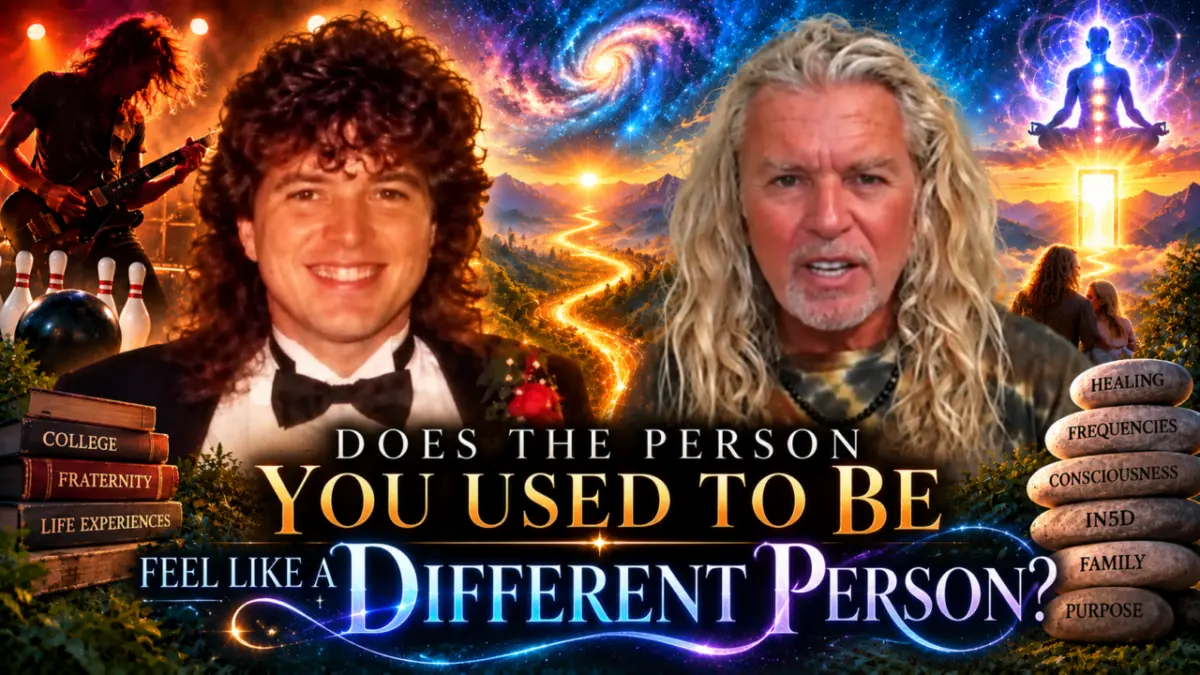
When spiritual researcher, author, and media pioneer Gregg Prescott placed a photograph of himself from 1993 side-by-side with a recent portrait from 2026, the visual discrepancy was jarring. At 32 years old, the man in the first photo was navigating the frantic, foundational middle-ground of young adulthood. At 65, the man looking back from the modern frame carries the accumulated weight of decades spent chronicling human consciousness, building alternative media networks, and pioneering digital tools for spiritual evolution.
Yet, beneath the shifting external markers—the evolution of hair color from blonde to auburn, back to brown, and touched by the Florida sun—a profound internal question emerged: Does the person you used to be feel like a completely different person? Or do we eventually find our way back to the authentic self that existed before life’s conditioning got in the way?
This central inquiry forms the basis of a widespread cultural and metaphysical conversation sparked by Prescott’s recent reflections. Rather than viewing personal evolution as a linear departure from one’s origins, contemporary metaphysical thought increasingly suggests that life is an eccentric, circular journey. We spend our formative decades acquiring societal conditioning, experiencing triumphs and failures, healing unseen wounds, and collecting specialized life experience, only to circle back to the core essence of who we were as children before external authorities told us who we were supposed to be.
Chronology: A Lifetime of Questioning Reality
To understand Prescott’s trajectory—and the broader generational awakening it mirrors—one must trace a timeline defined by an unrelenting drive to peer behind the cultural curtain.
1. The Early Metaphysical Spark (Childhood)
Long before founding platforms dedicated to alternative thought, a young Prescott was already clashing with conventional paradigms. Growing up embedded in traditional structures, he nearly found himself expelled from Sunday school. His offense? Asking too many probing questions about orthodox theology. The inquiries became so persistent that his instructor ultimately contacted his parents, requesting they intervene to curb his theological curiosity. Unbeknownst to the classroom instructors, questioning institutional authority was not an optional elective in young Prescott’s internal curriculum; it was his default setting.
By age 12, this curiosity expanded beyond conventional religion into the esoteric. While other children focused strictly on mainstream entertainment, Prescott acquired a book on "magic"—not focused on sleight-of-hand illusions, but on the principles of astral travel and unseen dimensions. An inner compass was already calibrated toward realities invisible to the naked eye.
2. The Wilderness Years (Adolescence and Young Adulthood)
Like many seekers, Prescott’s path diverged from his spiritual roots as he entered the kinetic reality of modern life. His teenage and young adult years were defined by rock-and-roll culture—playing guitar in hard rock bands—followed by university life and fraternity memberships.

Yet, these seemingly secular detours were far from wasted. They provided the psychological armor, social literacy, and real-world resilience necessary for a future public figure. The pivotal turning point arrived with fatherhood. Becoming a father to his daughter introduced an unconditional emotional depth that superseded any academic degree, career milestone, or external accolade.
3. The Catalyst of Modern Metaphysics (Mid-Life Awakening)
In the mid-2000s, a chance encounter with the cultural phenomenon The Secret—introduced to him by his daughter’s mother—lit a fuse. Captivated by the concepts of manifestation and conscious reality-creation, Prescott ordered the documentary immediately. That single piece of media opened a gateway to deeper esoteric studies, alternative history, and quantum consciousness.
This intellectual and spiritual renaissance culminated in the founding of In5D.com in 2009, born out of what Prescott describes as a profound "galactic download." What began as a modest digital repository for spiritual awakening rapidly expanded into a global network.
4. Expansion into Global Media and Tech (The Senior Chapter)
Over the next decade and a half, Prescott’s footprint scaled dramatically. The platform fostered partnerships, most notably with his wife, Ali, and birthed three distinct metaphysical radio networks: In5D Radio, WIN5D, and In5D Talks. The audience grew into hundreds of thousands across social media, accumulating tens of millions of views on YouTube and alternative video platforms.
Entering his mid-sixties, rather than slowing down, Prescott pivoted into software development. He launched In5D Infinite, an interactive spiritual journey application designed to track dreams, synchronicities, astrology, and numerology over time. He is currently developing a suite of subsequent applications focused on healing sound frequencies, Solfeggio tones, Rife frequencies, binaural beats, sacred geometry visualization, and breathwork.
Supporting Data & Generational Astrology
Prescott’s narrative is not isolated; it aligns closely with macro-level sociological and astrological frameworks that categorize collective human consciousness by generational planetary alignments.
- The Pluto in Virgo Generation (1957–1972): Born into a transitional era of intense societal restructuring, civil rights movements, and technological leaps, this demographic—to which Prescott belongs—often bridges the gap between structured analog traditions and the digital age. Virgo energy is intrinsically analytical, service-oriented, and devoted to systemic improvement. This manifests in Prescott’s lifelong compulsion to dissect, research, and systematically organize metaphysical data for public consumption.
- The Intergenerational Hand-Off: Sociological and metaphysical commentators often view the Pluto in Leo generation (born 1939–1957) as cultural standard-bearers of individual expression, who paved the way for the Pluto in Virgo cohort to build analytical frameworks, healing tools, and alternative educational infrastructures.
- Digital Reach and Engagement: The resonance of Prescott’s reflections on social media—generating thousands of deeply emotional responses from users worldwide—demonstrates a universal collective fatigue with superficial identity. Millions of adults are currently confronting the same mirror: recognizing the vast chasm between their childhood innocence and their current corporate or social adaptations.
Official Responses and Community Resonance
When Prescott published his side-by-side photographic comparison across his social media channels, the response served as an informal psychological barometer for his audience of conscious seekers.
Community feedback clustered around two dominant psychological themes:

- The Disconnect of Identity: A significant percentage of respondents reported feeling almost entirely disconnected from their younger selves. Many noted that marriages, divorces, career pivots, physical injuries, and the loss of loved ones had fundamentally re-architected their personalities, leaving their 20- or 30-year-old avatars feeling like complete strangers.
- The Immutable Core: Conversely, an equally vocal faction argued that despite the accumulation of wrinkles, grey hair, and emotional scars, the core observer—the inner child who asked inconvenient questions—remained entirely intact.
Psychologists specializing in narrative identity theory note that reconciling these two viewpoints is essential for healthy aging. True psychological integration occurs when an individual acknowledges how much they have changed while honoring the continuous thread of consciousness that bore witness to all of it.
Implications: What It Means for the Modern Seeker
The philosophical implications of Prescott’s retrospective stretch far beyond personal nostalgia. They challenge conventional paradigms of personal development, aging, and spiritual maturity.
1. Re-evaluating Life’s "Detours"
Mainstream self-help often treats non-spiritual or hyper-materialistic phases of life as wasted time or "falling off the path." Prescott’s journey—spanning hard rock bands, fraternities, and corporate-adjacent pressures—suggests otherwise. Without the friction of worldly experience, abstract metaphysical concepts remain purely theoretical. True wisdom requires testing philosophies against the brutal realities of heartbreak, financial stress, and societal friction.
2. The Reclamation of Childhood Wonder
The core thesis of Prescott’s reflection is an invitation to perform a psychological excavation: Find a photograph of yourself at half your current age and ask what that person would think of who you’ve become.
For many adults, the exercise is confronting. It forces a confrontation with unfulfilled childhood dreams, compromised integrity, and lost innocence. However, from a metaphysical standpoint, this exercise serves as an activation protocol. It bridges the conscious adult mind with the uncorrupted imagination of the inner child, bridging the gap between who we were forced to become and who we truly are.
3. Aging as an Ascension Catalyst
In a culture youth-obsessed to a pathological degree, conscious aging offers an alternative paradigm. Growing older is reframed not as a process of physical decline, but as a compounding of spiritual bandwidth. When individuals reach their sixties and beyond with their curiosity intact, they wield decades of accumulated emotional mastery combined with the unyielding inquisitiveness of youth. As demonstrated by Prescott’s pivot into frequency-based application development later in life, creative output and spiritual innovation do not have expiration dates.
Conclusion
Ultimately, the mirror test is universal. Whether one is 30, 50, or 65, looking back at past versions of the self provides a mirror for soul evolution. As Prescott notes, looking at his 32-year-old self in 1993 reveals a man utterly oblivious to the profound twists, digital frontiers, and personal heartbreaks awaiting him. Yet, he would not change a single trial.
Every error, every triumph, and every unexpected door opened was a necessary coordinate on a map designed to lead one back to the starting point: the curious child who refused to stop asking questions.
