

By Global Consciousness Dispatch
Published: October 2026
Main Facts
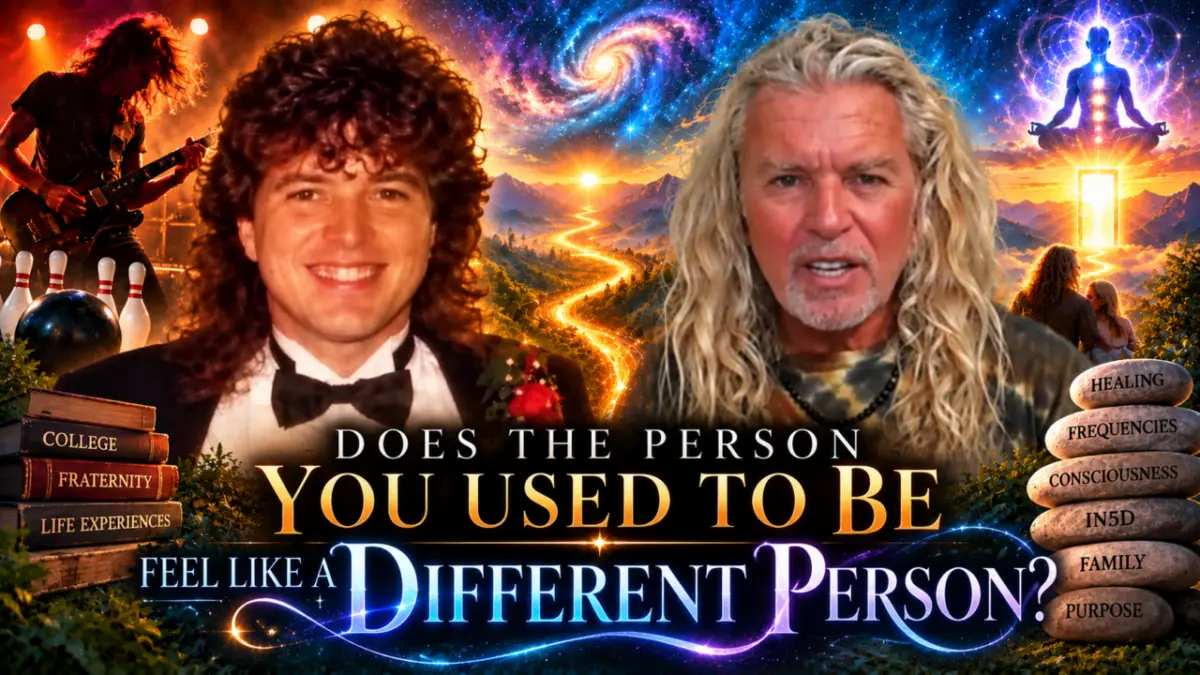
In an era defined by rapid technological acceleration and shifting cultural paradigms, the journey of individual consciousness remains an uncharted frontier. Recently, In5D.com founder and metaphysical researcher Gregg Prescott sparked a viral digital conversation by publishing a side-by-side photographic comparison of himself at age 32 in 1993 and at age 65. The post—capturing the visible passage of time alongside an unchanged head of wavy hair—ignited a profound global dialogue among thousands of readers regarding identity, aging, and spiritual evolution.
At its core, the discourse raises a fundamental existential question: Does the person you used to be feel like a stranger, or have you simply circled back to the authentic self that existed before societal conditioning took root?
For Prescott, whose professional life has been dedicated to exploring alternative paradigms, metaphysics, and human awakening, this visual juxtaposition served as a catalyst for a broader philosophical inquiry. Rather than viewing life as a linear accumulation of disparate identities, his reflections suggest that human maturation is an elaborate circular journey. Individuals spend the formative and mid-decades of their lives gathering experiences, absorbing institutional conditioning, enduring hardship, and healing trauma, only to potentially rediscover the unadulterated curiosity of their youth in their later years.
Chronology: From Sunday School Inquisitions to Digital Metaphysics
To understand the trajectory of Prescott’s philosophical evolution, one must trace a timeline spanning more than six decades of questioning conventional dogmas and exploring fringe philosophies.
-
Early Childhood (Circa 1960s–1970s): The Inquisitive Child
Long before founding a digital platform dedicated to consciousness, a young Prescott displayed an innate skepticism toward orthodox structures. His relentless questioning of religious doctrine during Sunday school classes famously led his instructors to contact his parents, requesting that he cease asking so many disruptive theological questions. At age 12, an early encounter with a book on "magic"—which transcended stage tricks to explore astral travel and alternate dimensions—cemented a lifelong fascination with the metaphysical unseen. -
Adolescence and Young Adulthood (1970s–1990s): The Material Diversion
Like many seekers, Prescott’s path deviated from pure metaphysics into the standard milestones of modern life. He played guitar in hard rock bands, attended college, joined a fraternity, and navigated the socio-cultural landscape of late 20th-century America. By 1993, at age 32—the era captured in his viral photographic comparison—he was entrenched in the responsibilities and distractions of early adulthood, seemingly far removed from the philosophical curiosity of his 12-year-old self. The birth of his daughter introduced a transformative emotional depth that eclipsed conventional career milestones.
-
The Turning Point (Mid-2000s): Awakening to The Secret
A pivotal shift occurred when his former wife shared the trailer for the seminal consciousness documentary The Secret. Captivated instantly, Prescott ordered the film, opening a floodgate of research and synchronicity. This intellectual and spiritual renaissance directly inspired the founding of In5D.com in 2009, creating an online sanctuary for millions of individuals seeking answers outside mainstream narratives. -
Expansion and Evolution (2010s–Present): Building the Infrastructure of Awareness
Over the subsequent decade and a half, Prescott’s footprint expanded. The platform grew to encompass multiple metaphysical radio networks (In5D Radio, WIN5D, and In5D Talks), an active social media community boasting hundreds of thousands of followers, and strategic partnerships—most notably with his wife, Ali. Entering his mid-60s, Prescott achieved a technological milestone by transitioning from writer to developer, launching In5D Infinite, an interactive spiritual journey application designed to track dreams, synchronicities, and esoteric studies over time. He is currently developing a suite of frequency-based applications exploring Solfeggio tones, binaural beats, and sacred geometry.
Supporting Data and Generational Demographics
The conversation initiated by Prescott’s self-reflection taps into broader sociological and astrological frameworks frequently analyzed within alternative research communities.
The Pluto Generation Framework
Within metaphysical astrology, generational shifts are often categorized by the transit of outer planets. Prescott identifies as part of the Pluto in Virgo generation (individuals born roughly between 1957 and 1972), which was preceded by the Pluto in Leo generation (1939–1957).
Sociologists and generational researchers note distinct traits across these cohorts:
- Pluto in Leo Generation: Characterized by expressive individualism, cultural revolutions, and a drive to redefine societal leadership and artistic expression.
- Pluto in Virgo Generation: Defined by an analytical approach to systems, health, service, and deconstruction. Members of this cohort frequently pioneer alternative healing, holistic wellness, and investigative methodologies, acting as bridge-builders between institutional pragmatism and esoteric reclamation.
Digital Engagement Metrics
The resonance of Prescott’s reflections is mirrored in the quantifiable engagement across In5D’s digital channels:
- Social Media Reach: Over 370,000 followers on Facebook and more than 146,000 subscribers on YouTube, accumulating tens of millions of views.
- Community Feedback: The initial photographic comparison generated an immediate surge of comments from readers across the globe, indicating a universal psychological phenomenon: the profound dissonance—and ultimate reconciliation—people feel when confronting visual evidence of their own aging process.
Official Responses and Community Perspectives
The viral nature of the post prompted a decentralized wave of commentary from the global consciousness community. Rather than offering a monolithic reaction, respondents split into distinct philosophical camps regarding the nature of identity across a lifespan.

- The Disconnection Thesis: A significant portion of respondents stated that they barely recognized their younger selves. For these individuals, the trials of divorce, career shifts, bereavement, and personal reinvention created a definitive break between their past personas and their present consciousness. In essence, they felt they had lived multiple distinct lifetimes within a single biological container.
- The Core Essence Thesis: Conversely, another cohort echoed Prescott’s secondary realization: that the core personality—the inner child’s innate curiosity, quirks, and fundamental worldview—remains remarkably constant. Proponents of this view argue that external events, psychological defenses, and social conditioning act merely as temporary overlays or "rust" that accumulates over time, which the aging process eventually strips away.
- The Therapeutic Consensus: Mental health professionals and life-transition coaches monitoring the discourse noted that looking at photographs of oneself at half current age is a recognized therapeutic exercise in self-compassion. It allows individuals to view their past mistakes, insecurities, and struggles not with self-judgment, but with the objective empathy of an external observer.
Implications: The Psychological and Metaphysical Aftermath
As humanity navigates an increasingly complex socio-technological landscape, the implications of Prescott’s retrospective inquiry extend far beyond personal nostalgia. They touch upon core tenets of human psychology, spiritual evolution, and holistic aging.
1. Reframing Life’s Traumas as Curatorial Experiences
A primary takeaway from Prescott’s narrative is the radical acceptance of life’s difficult chapters. By concluding that he would not alter the "good, the bad, and the ugly" of his past, he champions a philosophy of radical integration. In psychological terms, this mirrors the concept of individuation—reconciling the conscious and unconscious aspects of the psyche to form a unified whole. Every hardship encountered during the middle decades of life acts not as a detour, but as necessary curriculum for the soul’s development.
2. The Fusion of Ancient Wisdom and Modern Technology
The evolution of Prescott’s work—moving from raw philosophical questioning in Sunday school to developing interactive smartphone applications utilizing Solfeggio frequencies and sacred geometry—illustrates a growing trend within the modern consciousness movement. Rather than rejecting technology in favor of ascetic withdrawal, contemporary spiritual leaders are increasingly leveraging digital tools to democratize access to mindfulness, frequency therapy, and self-reflection tools.
3. Redefining Late-Age Productivity
In a culture that frequently equates aging with irrelevance, the active output of a 65-year-old developer and writer challenges conventional retirement paradigms. The implication is clear: spiritual awakening and creative output have no expiration date. As life expectancy shifts and older generations remain cognitively active, the archetype of the "elder" is transforming from one of passive withdrawal to one of active technological and philosophical innovation.
Conclusion
When Gregg Prescott looked at his 1993 photograph from the vantage point of 2026, he was not merely observing changes in hair texture or facial structure; he was witnessing the culmination of a six-decade arc that brought a curious child full circle.
His journey—from an inquisitive boy challenging religious dogma to a hard-rock musician, a father, a digital pioneer, and an application developer—serves as an invitation for all individuals to pull out their old photographs. By confronting the visages of their younger selves, readers are challenged to ask the ultimate question: Are you living the life you were designed to live, and have you finally made peace with the person who started the journey?
