

Main Facts
Deep beneath the rolling terrain of Major County, Oklahoma, rests a geological anomaly of staggering proportions. Spanning miles underground, the Ames impact structure is a buried meteor crater hidden beneath thick layers of younger sedimentary rock. While scientifically fascinating, the crater is also of immense economic value, serving as a prolific producer of oil and natural gas that has drawn the attention of the energy industry for decades. For generations, geologists believed this subterranean scar was carved into the Earth during the Ordovician period, roughly 467.5 million years ago.
However, a groundbreaking study led by researchers at The University of Texas (UT) at Austin has completely rewritten this chapter of North American geologic history. Published in the journal Meteoritics & Planetary Science, the new research reveals that the Ames impact structure is actually about 370 million years old, placing its origin in the Late Devonian period. This revision strips the crater of its long-held status as a key piece of evidence for the historic "Ordovician Meteor Event"—a hypothetical epoch when Earth may have featured a Saturn-like ring of asteroid debris. Instead, the newly established timeline places the Oklahoma impact alarmingly close to the Frasnian-Famennian mass extinction, a catastrophic event that wiped out a significant proportion of marine life on Earth.
The discovery stems from meticulous radiometric dating of microscopic zircon crystals extracted from granite altered by the impact. By leveraging advanced analytical techniques and high-resolution imaging in collaboration with NASA, the UT Austin team proved that previous dating methods—which relied heavily on fossilized microfauna—were fundamentally misleading. The findings not only solve a decades-old geological puzzle in the American Midwest but also force scientists to re-evaluate how impact craters are dated globally and how cosmic collisions interact with terrestrial mass extinctions.
Chronology
To understand the magnitude of the recent discovery, geologists must trace the timeline of how the Ames crater was formed, discovered, exploited, and ultimately re-evaluated.
370 Million Years Ago: The Late Devonian Impact
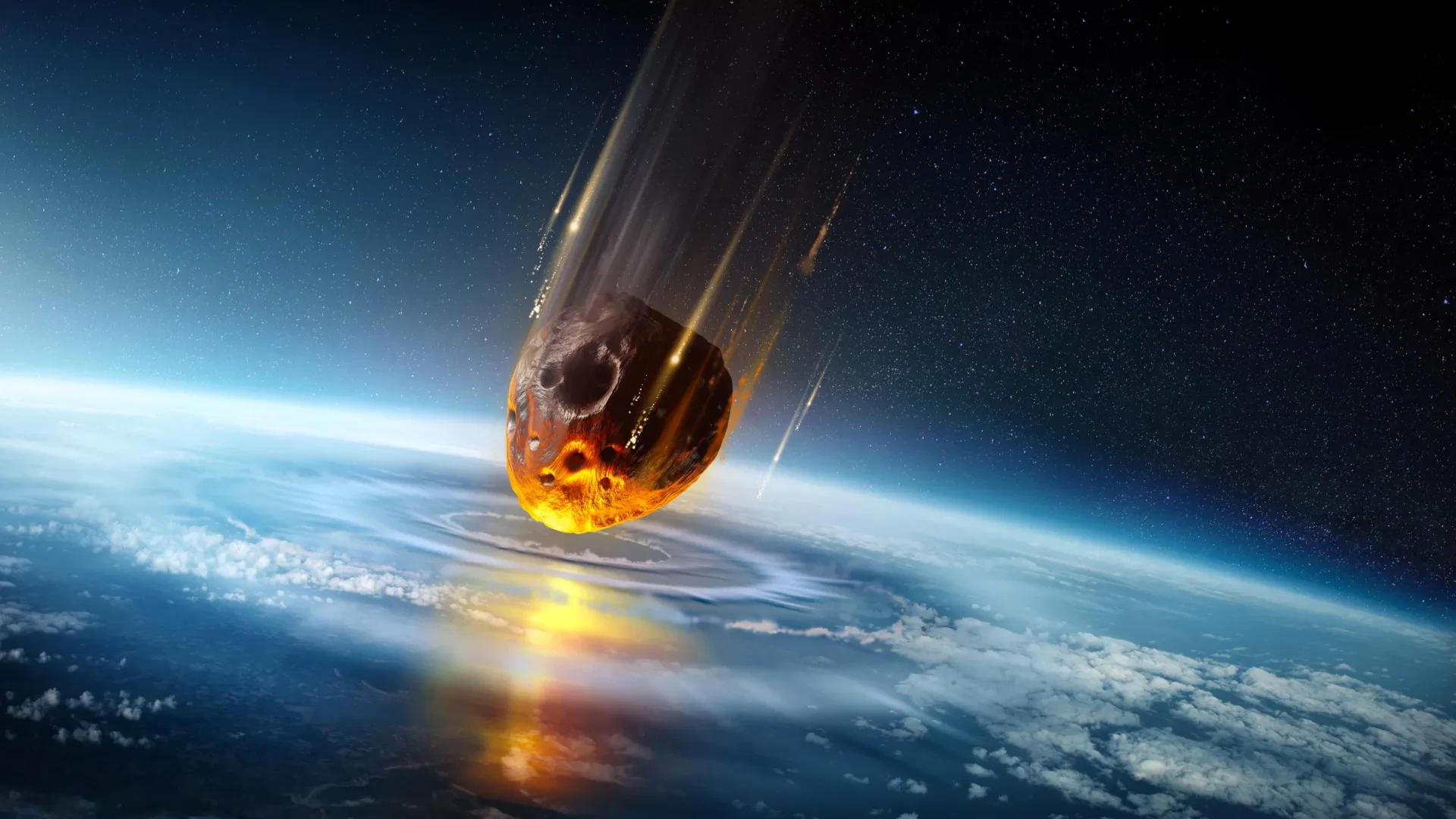
During the Late Devonian period, long before the rise of dinosaurs or even the first forests, a massive extraterrestrial body plummeted through the atmosphere and slammed into the ancient continental crust of what is now northwestern Oklahoma. The force of the collision was cataclysmic, instantly vaporizing rock, generating extreme shock pressures, and pulverizing the underlying granite. Molten rock, seismic waves, and ejecta reshaped the local landscape, leaving behind a massive circular depression. Over the ensuing tens of millions of years, the crater was gradually buried beneath thick blankets of sedimentary strata, sealing it away from the surface world.
1990s: Economic Discovery and Early Scientific Assumptions
The buried Ames structure remained hidden from human knowledge until the late 20th century, when intensive oil and gas exploration pierced the subsurface. Geologists and petroleum engineers realized that the fractured, chaotic rock of the impact crater created exceptional porosity and permeability, making it an ideal reservoir for hydrocarbons. As drilling operations intensified, core samples were brought to the surface, sparking intense academic interest.
During the initial scientific evaluations of the crater, researchers attempted to determine its age. They examined fossilized teeth embedded in the surrounding rocks. These teeth belonged to conodonts—an extinct group of jawless, eel-like chordates that flourished in Paleozoic seas. Because the conodont species recovered from the rock layers dated back to the Ordovician period (roughly 467 to 470 million years ago), geologists concluded that the impact must have occurred during that same timeframe.
The Ordovician Meteor Event Hypothesis
With the Ames crater officially stamped as Ordovician, it was quickly slotted into a broader global narrative. Around 467.5 million years ago, a remarkably high concentration of meteorite impact structures appeared across North America and Baltica. This clustering led several prominent geologists to propose a dramatic hypothesis: perhaps Earth, much like Saturn today, was temporarily encircled by a ring of planetary debris or an asteroid belt following the breakup of a massive parent body in the inner solar system. The Ames crater was frequently cited as a premier North American anchor for this celestial phenomenon.
2018–2024: The UT Austin Investigation and Re-dating
The unraveling of the Ordovician hypothesis began when Andrew Parisi, a graduate student at UT Austin’s Jackson School of Geosciences, traveled to the Oklahoma Geological Survey. Parisi acquired crucial rock core samples from the Ames structure, intending to study the mineralogical signatures of the impact. Although Parisi tragically passed away in 2018 before the project reached completion, his foundational groundwork set the stage for a comprehensive re-examination.
Led by Dr. Elizabeth Catlos, associate professor in UT’s Department of Earth and Planetary Sciences, a research team set out to date the crater using modern geochronological techniques rather than relying solely on fossil evidence. They extracted tiny zircon crystals from the impact-altered granite. Utilizing Uranium-Lead (U-Pb) radiometric dating—the gold standard for determining the age of ancient mineral formations—the team processed sample after sample.
Consistently, the data refused to align with the Ordovician timeline. Every analytical pathway pointed to a younger signal: roughly 370 million years ago, deep within the Late Devonian. Following peer review and rigorous verification, the study was officially published in July, permanently altering the scientific consensus surrounding the Ames structure.
Supporting Data
The scientific rigor behind the UT Austin study relies heavily on advanced mineralogy, isotopic chemistry, and sophisticated imaging technologies. Radiometric dating and microstructural analysis formed the bedrock of the team’s conclusions.
Uranium-Lead (U-Pb) Zircon Geochronology
Zircon ($ZrSiO_4$) is a remarkably resilient mineral that frequently incorporates uranium into its crystal lattice while systematically excluding lead during formation. Because uranium radioactively decays into lead at a known, constant half-life, scientists can measure the ratio of uranium-to-lead isotopes within a zircon crystal to determine precisely when that crystal last crystallized or underwent thermal resetting.
Co-authored by Danny Stockli, dean of the Jackson School of Geosciences and an expert in geochronology, the study utilized U-Pb dating to pierce through the ambiguity of the Ames rock cores. The zircon crystals extracted from the impact-altered granite yielded ages clustering around 370 million years. This radiometric clock left no room for a 467-million-year-old Ordovician origin.
NASA Collaboration and Microstructural Verification
A critical challenge in impact geochronology is proving that the minerals being dated were actually altered by the specific impact event in question, rather than inherited from older regional geological processes. To confirm that the zircons had experienced the hyper-velocity shock of a meteor strike, the UT Austin researchers partnered with NASA to deploy advanced imaging methodologies:
- Cathodoluminescence (CL): This technique involves bombarding the mineral with an electron beam, causing it to emit visible light. Because shock pressures physically alter the internal chemical zoning and structure of zircon crystals, CL imaging reveals distinct shock-induced textures, recrystallization patterns, and micro-fracturing.
- Electron Backscatter Diffraction (EBSD): EBSD provides crystallographic orientation data at the microscale. It allows researchers to map out crystal lattice deformation, confirming whether the mineral experienced the extreme, localized shock waves characteristic of a hypervelocity impact.
Through these combined techniques, the research team verified that the zircon crystals had indeed been shocked and recrystallized by the Ames meteor collision roughly 370 million years ago, authenticating the younger radiometric timeline beyond a shadow of a doubt.
Solving the Fossil Paradox
The pivotal question raised by the new date was simple: If the crater is 370 million years old, why did earlier researchers find Ordovician conodont fossils in the impact strata?
Dr. Elizabeth Catlos explained that the fossil evidence was technically accurate, but its interpretation was flawed. The conodont teeth belonged to animals that lived during the Ordovician period, but those fossils were already millions of years old and entombed in pre-existing sedimentary layers by the time the asteroid struck in the Late Devonian. When the extraterrestrial body slammed into the ancient continental shelf, the catastrophic energy of the impact churned up, pulverized, and mixed older sedimentary rock into the impact breccia, seamlessly incorporating ancient fossils into a much younger geological formation.
Official Responses
The publication of the study has sent ripples through the geological and planetary science communities, prompting reflections from the lead researchers and academic leadership at UT Austin.
Reflecting on the persistence of the data during the analytical phase, lead author Elizabeth Catlos noted the surprise the team experienced when every test pointed away from the long-accepted history:
"No matter what technique we used, it was coming back to this younger signal."
Highlighting the broader implications of shifting the Ames crater from the Ordovician period to the Late Devonian, Catlos used a striking analogy to describe the tectonic shift in planetary science:
"With this research, we’re basically taking a major pawn out of the Ordovician Meteor Event and dumping it into the Frasnian-Famennian event, and saying, ‘This is where this impact belongs.’"
Dr. Danny Stockli emphasized the unmatched power of modern geochronology in correcting historical misconceptions about Earth’s evolution and underscored the necessity of applying these methods broadly:
"These small crystals allow us to go back in time and learn about the major changes to Earth’s ancient landscapes. It would be great to do this for more of the meteor impact sites across the continent so we could get a more accurate timeline for these major events."
Stockli also paid tribute to the collaborative nature of the research, which bridged generations of scientists at the Jackson School. The project was originally conceived by graduate student Andrew Parisi, whose dedication to field collection and sample preparation laid the groundwork before his passing in 2018. Additionally, co-author Michael Brookfield contributed vital insights before passing away prior to publication. The finalized study stands as a testament to their enduring contributions, alongside co-authors Research Professor Sean Gulick and Professor Emeritus Mark Cloos.
Implications
The re-dating of the Ames impact structure is far more than a localized correction for Oklahoma geology; it carries profound implications for our understanding of Earth’s deep past, asteroid impact mechanics, and the history of life.
Reassessing the Ordovician Meteor Event
For years, the hypothesis that Earth was surrounded by an asteroid ring during the Middle Ordovician relied on the assumption that a cluster of craters—including Ames—formed simultaneously. By removing the Ames structure from this cluster and moving it nearly 100 million years forward in time, the UT Austin study weakens the empirical foundation of the Ordovician ring hypothesis. Scientists must now re-examine other North American and global impact sites from that era to determine whether the clustering was a genuine cosmic coincidence or the result of similar dating errors elsewhere.
A New Link to Mass Extinctions
Perhaps the most tantalizing aspect of the new 370-million-year timeline is its proximity to the Frasnian-Famennian mass extinction event. Occurring roughly 372 million years ago, the Frasnian-Famennian extinction was one of the "Big Five" mass extinction events in Earth’s history, devastating shallow marine ecosystems and wiping out vast numbers of coral reef-building organisms and brachiopods.
A central debate in paleontology revolves around the primary drivers of mass extinctions: Were they triggered predominantly by extraterrestrial forces, such as asteroid impacts, or by terrestrial mechanisms, such as massive continental flood basalt volcanism, global climate shifts, or oceanic anoxia?
By aligning the Ames impact structure chronologically close to the Frasnian-Famennian boundary, the study introduces a compelling new data point. While the Ames impact alone may not have been global enough to trigger a worldwide extinction, it demonstrates that large-scale cosmic bombardments occurred during or immediately preceding critical biotic crises. Establishing ultra-precise, absolute dates for impact structures is the only way scientists can correlate cosmic events with biological turnovers in the fossil record.
Setting a New Standard for Impact Research
Finally, the research establishes a methodological blueprint for future planetary science. Too many impact craters around the globe have been dated using relative stratigraphic markers, fossil assemblages, or poorly constrained sedimentary contexts. The success of the UT Austin team in coupling U-Pb zircon geochronology with NASA-backed cathodoluminescence and electron backscatter diffraction demonstrates that even heavily altered, economically exploited subsurface structures can yield absolute, definitive timelines.
As geologists apply these rigorous techniques to other buried and weathered craters across the globe, the timeline of Earth’s violent cosmic history will undoubtedly continue to sharpen, providing humanity with a clearer picture of how celestial collisions have shaped the evolution of our planet and the life upon it.
