

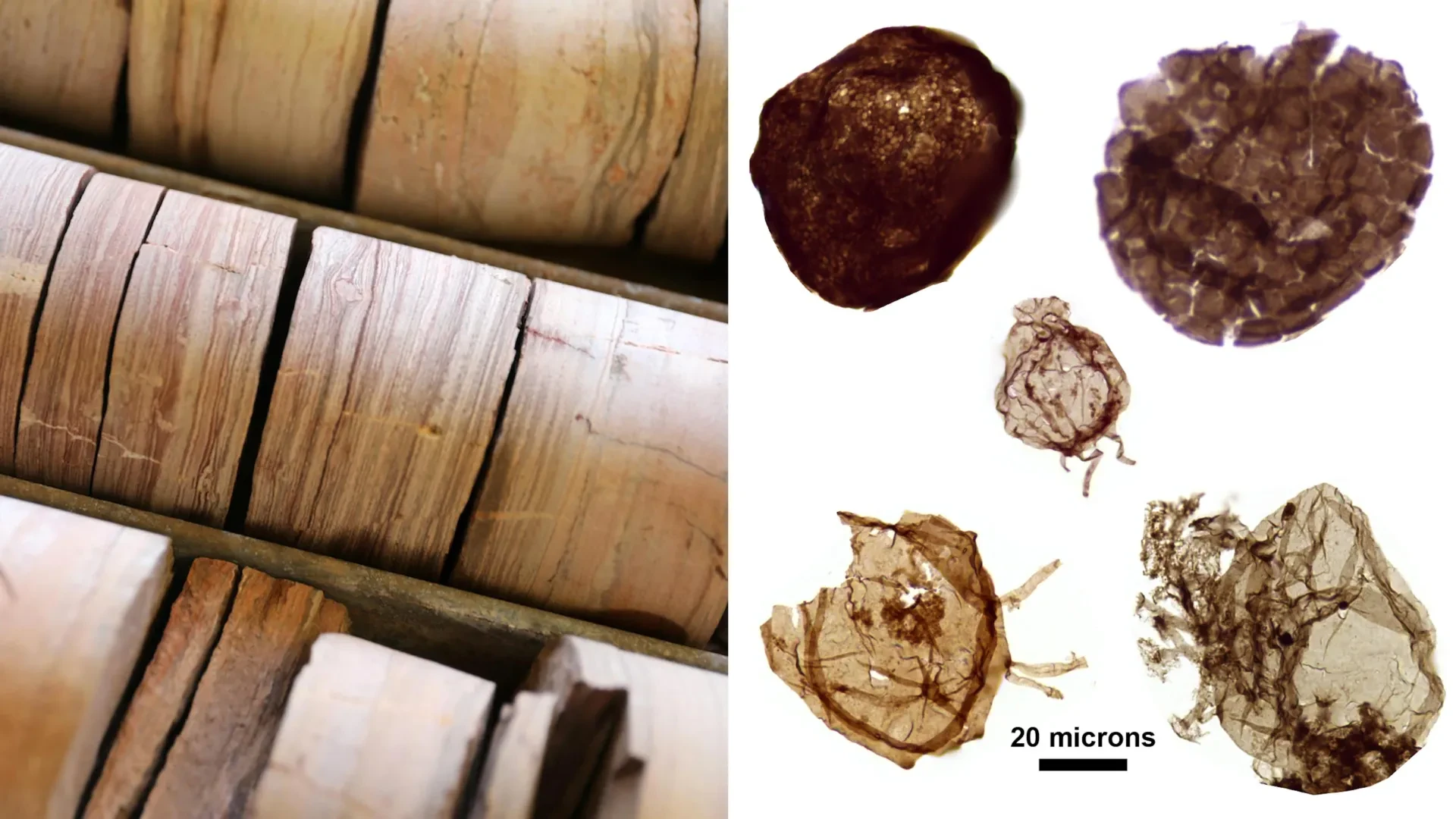
DARWIN, AUSTRALIA — Tucked away in an open-air warehouse in the tropical climate of Darwin, Australia, rows of wooden trays hold a treasure trove of geological history. Inside these trays sit cylindrical cores of rock, extracted from drill holes bored hundreds of meters beneath the surface by mineral exploration companies over the past several decades.
To the casual observer, these unpretentious rock samples—chiefly mudstones formed from hardened seafloor sediment—might look like little more than industrial debris. For generations, the mining companies that pulled them from the Earth were completely unaware that trapped within the mineral matrix lay microscopic time capsules. These tiny remnants are the fossilized remains of ancient single-celled organisms that once thrived on the seafloor of an inland sea, blanketing much of northern Australia more than 1.5 billion years ago.
Now, a groundbreaking study published in the prestigious journal Nature has thrust these overlooked industrial archives into the global scientific spotlight. By examining these microscopic remains, an international team of researchers has shed dramatic new light on one of the greatest evolutionary mysteries in planetary history: the exact origin of eukaryotes, the foundational building blocks of all complex life on Earth.
Main Facts: The Blueprint of Complex Life
To understand the magnitude of the discovery in Darwin, one must first understand the fundamental divide that governs all life on Earth. Every living organism falls into one of two distinct categories at the cellular level:
- Prokaryotes: Encompassing bacteria and archaea, these are predominantly single-celled organisms characterized by a simple cellular organization. They lack a true nucleus and complex internal machinery.
- Eukaryotes: This domain includes all animals, plants, fungi, and algae. Eukaryotic cells are vastly more sophisticated, featuring a distinct nucleus that houses genetic material, alongside specialized internal compartments called organelles that execute specific metabolic and structural jobs.
The emergence of the eukaryotic cell—often termed the eukaryotic revolution—fundamentally transformed our planet. Without this evolutionary leap, multicellularity, animals, and ultimately human consciousness would never have arisen.
Genomic studies of living organisms have long established that the last common ancestor of all modern eukaryotes was forged through an ancient, intimate partnership: a symbiotic union between at least two prokaryotic microbes—an archaeon and a bacterium. While geneticists can reconstruct the family trees of modern microbes, they cannot capture extinct lineages or paint a picture of the physical environments that shaped them. For that, science must turn to the fossil record.
The oldest known eukaryote fossils globally are found within the Northern Territory of Australia, with specimens dating back an astonishing 1.75 billion years. These microfossils display an intricate level of cellular architecture utterly foreign to simple prokaryotes. Yet, despite their monumental importance, the ancient ecological world in which these primordial organisms first experimented with complexity has remained deeply shrouded in mystery.
Chronology: From Industrial Drilling to a Nature Breakthrough
The journey from obscure mining core to landmark scientific revelation spans decades of geological exploration and cutting-edge laboratory analysis.
- Decades Ago: Mineral exploration companies drill deep exploratory holes across northern Australia, extracting core samples to map the region’s mineral wealth. These cores are cataloged and eventually archived at the Northern Territory Geological Survey (NTGS) facility in Darwin.
- The Pre-Cambrian Era (1.75 to 1.4 Billion Years Ago): A sprawling inland sea covers much of northern Australia. In its waters, early eukaryotic microorganisms flourish, eventually dying and settling onto the muddy seafloor, where they are preserved under layers of sediment.
- Recent Years: Scientific debate intensifies over the role of oxygen in early evolution. While traditional theory dictates that oxygen is mandatory for eukaryotes, the discovery of oxygen-tolerant microbes and geochemical evidence of low-oxygen ancient oceans sparks a fierce controversy regarding whether early complex life truly needed oxygen.
- The Study Phase: Researchers target the NTGS mudstone cores, recognizing their immense age and pristine preservation. They crush and chemically dissolve the rock samples to isolate organic residues.
- Present Day: Publishing in Nature, the research team analyzes more than 12,000 individual microfossils, successfully correlating their presence with ancient oxygen levels and rewriting our understanding of early evolutionary pressures.
Supporting Data: Uncovering 12,000 Ancient Microfossils
To decode the environmental conditions of a world 1.5 billion years old, the research team employed a rigorous, multi-pronged methodology using the mudstone cores stored in Darwin.
The process began by pulverizing small samples of the mudstone cores. Researchers then dissolved the mineral matter using powerful chemical acids, leaving behind an organic residue. When viewed under high-powered laboratory microscopes, this residue revealed a staggering abundance of life. In total, the team identified and cataloged more than 12,000 distinct microfossils.
However, simply counting the fossils was not enough; the scientists needed to reconstruct the ancient habitats. By analyzing the physical structure and chemical composition of the mudstones themselves, the team could paint a detailed picture of the depositional environments. Crucially, geochemical tracers allowed them to determine whether dissolved oxygen was present in the seawater at the exact moments the sediment layers formed.
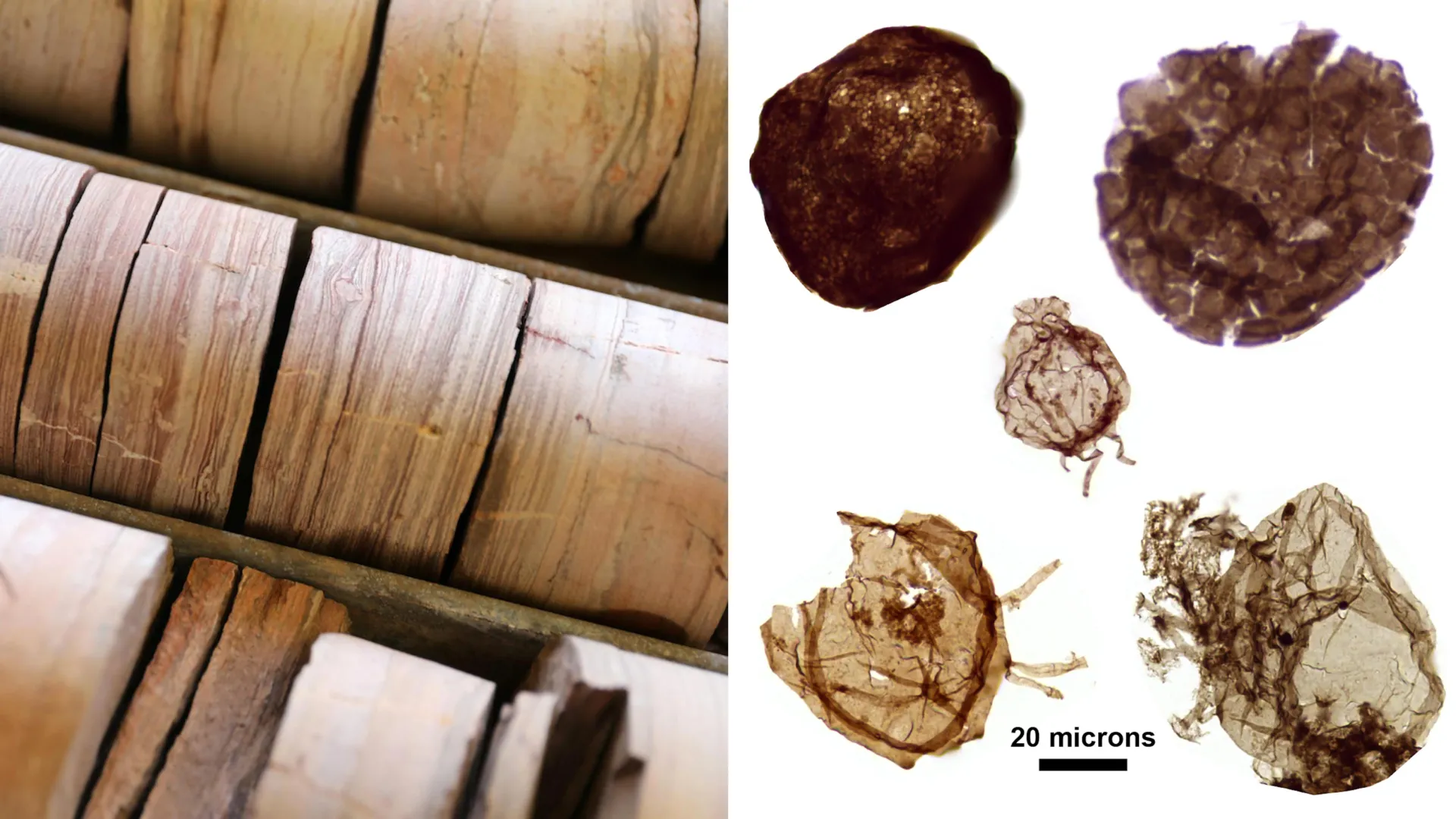
The results of this microscopic and geochemical census were clear and profound:
- Habitat Range: Eukaryote fossils were discovered across a diverse array of settings, ranging from shallow coastal mudflats to deeper, open-marine environments.
- The Oxygen Divide: Eukaryotic microfossils were exclusively found in rock samples that geochemical analysis indicated were deposited in oxygenated settings.
- Prokaryotic Resilience: In sharp contrast, rock samples originating from oxygen-free (anoxic) environments contained only simple, prokaryotic forms (bacteria and archaea), with zero trace of eukaryotic complexity.
Official Responses and Scientific Context
The findings directly challenge a growing trend in evolutionary biology that sought to minimize the necessity of oxygen during the dawn of complex life.
For decades, standard biological theory held that aerobic respiration—the process of breaking down food using oxygen—is what yields the massive amounts of metabolic energy required to sustain complex, multicellular life. However, recent discoveries of enigmatic modern eukaryotes thriving in low-oxygen or anoxic environments, paired with geological data suggesting early Earth was largely oxygen-poor, led some scientists to theorize that eukaryotes might have evolved independently of oxygen.
The new data from the Darwin cores decisively push back against that counter-theory.
"Our data lend robust support to the long-held hypothesis that oxygen played an indispensable, driving role in the evolution of early eukaryotes," noted lead members of the research team. Even among the oldest known representatives of our evolutionary lineage—those living between 1.7 and 1.4 billion years ago—survival and diversification were strictly tethered to the presence of oxygenated micro-niches in an otherwise largely oxygen-depleted world.
Independent geobiologists not involved in the study have praised the research for bridging the gap between genetic phylogenetics and geological reality. By utilizing neglected industrial archives, the study demonstrates how vital museum and geological survey collections are to answering fundamental questions about planetary history.
Implications: Rethinking Our Place in the Cosmos
Resolving the drivers and precise ecological context of the eukaryotic revolution remains one of the holy grails of the modern life sciences.
The realization that oxygen acted as the ultimate catalyst for complex life fundamentally shapes how astrobiologists search for life beyond Earth. If complex, eukaryotic-equivalent life demands localized or planetary oxygenation to spark and sustain its evolution, planetary hunts for extraterrestrial biosignatures must carefully look beyond mere water to focus heavily on atmospheric and marine oxygen dynamics.
Furthermore, the study serves as a humbling reminder of the interconnected nature of scientific discovery. Exploration companies drilling for base metals and minerals in the scorching Australian outback decades ago inadvertently preserved the most critical chapters of our own biological lineage.
As ongoing and future studies continue to probe these enigmatic, ancient microfossils, humanity steps a little closer to solving the ultimate puzzle of its own genesis—illuminating the long, improbable chain of events that transformed simple seafloor mud into the complex, conscious observers looking back at the stars today.
