

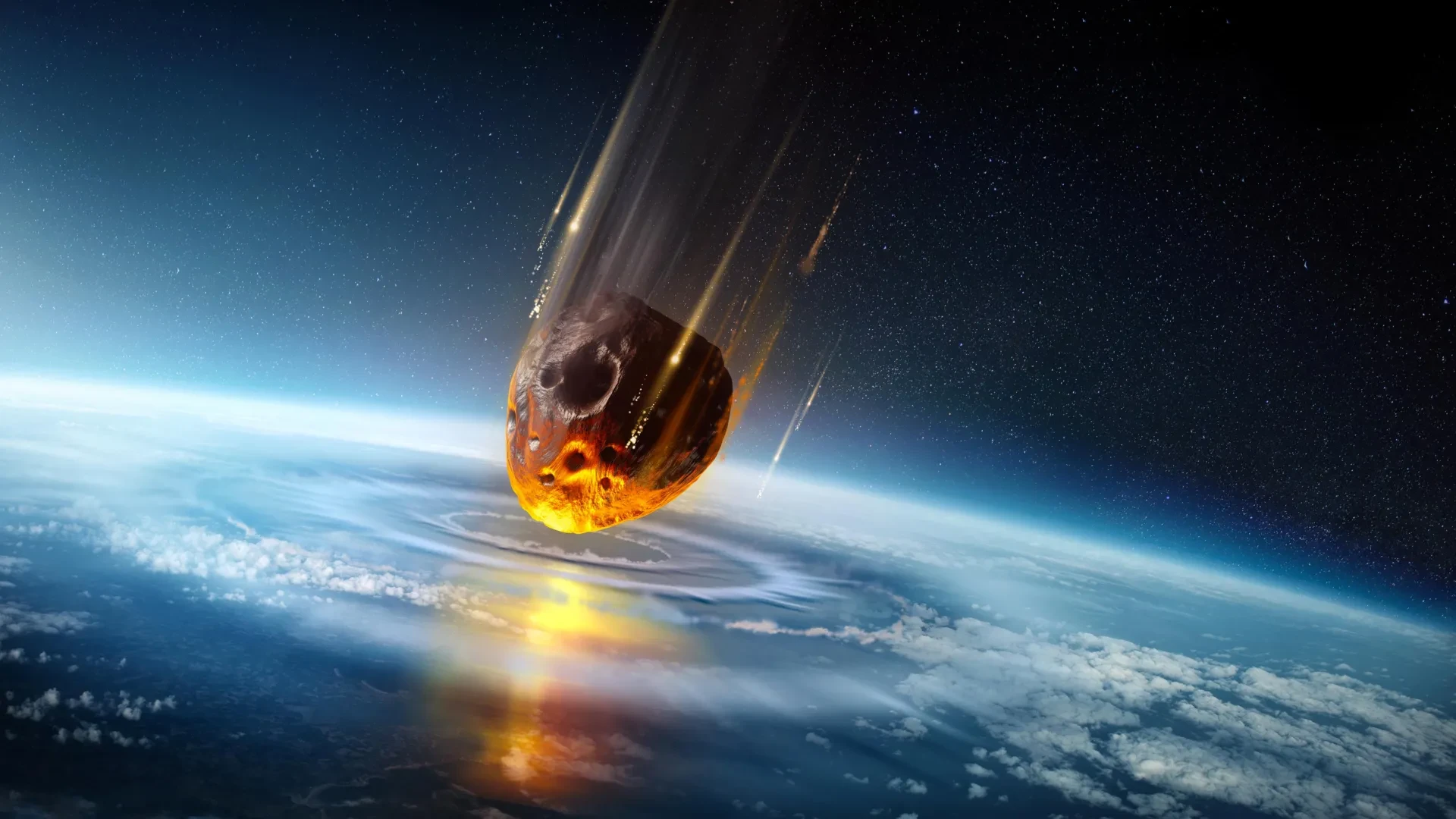
AUSTIN, Texas — In a discovery that upends decades of conventional geologic wisdom, researchers at The University of Texas (UT) at Austin have dramatically revised the timeline of one of North America’s most prominent subsurface features. The Ames impact structure—a sprawling, buried meteor crater hidden beneath the rolling terrain of Major County, Oklahoma—is not nearly as ancient as scientists once believed.
According to a groundbreaking study published in Meteoritics & Planetary Science, new high-precision radiometric dating techniques reveal that the meteorite impact that formed the Ames crater occurred approximately 370 million years ago, during the Late Devonian epoch. For generations, the geological community firmly categorized the crater as part of the Ordovician Meteor Event, a cluster of cosmic collisions dating back roughly 467.5 million years.
By lopping nearly 100 million years off the age of the Ames structure, the UT Austin research team has removed a foundational pillar from a popular paleogeological hypothesis: the theory that Earth was once encircled by a Saturn-like ring of asteroid debris. More critically, the revised timeline shifts the Ames impact uncomfortably close to the Frasnian-Famennian mass extinction, a catastrophic event that devastated the planet’s marine ecosystems roughly 372 million years ago.
This deep-time revision carries sweeping implications. It forces geologists, paleontologists, and astrobiologists to reevaluate how they interpret the synchronization of extraterrestrial impacts, major biological bottlenecks, and the chaotic evolution of life on Earth.
Main Facts: Unearthing the Ames Structure
Buried deep beneath the town of Ames, Oklahoma, sits a geological anomaly stretching miles across. Though completely obscured by thousands of feet of younger sedimentary rock, the Ames impact structure is far from an academic curiosity; it is a major economic engine, functioning as a prolific producer of oil and natural gas trapped within the fractured, chaotic rim of the ancient crater.
For decades, the standard scientific consensus held that the Ames structure was punched into the North American craton during the Middle Ordovician period. This classification placed it alongside other major impact sites across the continent, binding it into a neat chronological package that fueled fascinating, if speculative, theories about Earth’s ancient cosmic neighborhood.
However, the new UT Austin study shatters that framework. By isolating and analyzing microscopic mineral crystals from granite altered by the shock of the impact, researchers established that the meteor struck during the Late Devonian period—some 370 million years ago.
The investigation was spearheaded by Elizabeth Catlos, lead author of the study and associate professor in UT’s Department of Earth and Planetary Sciences, alongside a multidisciplinary team from the Jackson School of Geosciences.
"No matter what technique we used, it was coming back to this younger signal," Catlos said, emphasizing the undeniable consistency of the data derived from the rock samples.
Chronology: From Biological Guesswork to Radiometric Precision
To understand why the scientific community got the age of the Ames crater wrong for so long, one must examine how the site was originally dated.
The Flawed Biological Timeline
Prior to the UT Austin study, the Ames impact structure had never been dated using direct mineralogical methods. Instead, geologists relied on biostratigraphy—dating the rock layers by analyzing the biological remains preserved within them.
Researchers examining rock cores retrieved from the crater discovered fossilized teeth belonging to conodonts, an extinct group of eel-like, jawless chordates that thrived in ancient Paleozoic seas. Because these specific conodont fossils were characteristic of the Ordovician period, geologists naturally assumed the impact occurred during that same window.
Yet, as Catlos and her team demonstrated, fossils can be deeply deceptive. Conodont teeth preserved in the strata were likely already millions of years old by the time the meteorite struck. The titanic energy of the impact pulverized local bedrock, churning up older sedimentary layers and mingling ancient fossils into the impact breccia while miraculously keeping the delicate micro-fossils intact. This geological "blender" effect fooled researchers into assigning an Ordovician birthdate to a much younger wound.
The Radiometric Breakthrough
To pierce through the fog of biological misdirection, the research team turned to absolute geochronology: the dating of minerals using radioactive decay. Specifically, they focused on zircon ($ZrSiO_4$), an exceptionally durable mineral that frequently incorporates trace amounts of uranium as it forms. Uranium naturally decays into lead at a known, constant rate, allowing scientists to measure uranium-lead ($U-Pb$) ratios to pinpoint the exact time a mineral formed or was profoundly altered.
The project began when Andrew Parisi, then a graduate student at the Jackson School of Geosciences, traveled to the Oklahoma Geological Survey. Parisi acquired critical rock cores extracted from the Ames structure, isolated the microscopic zircon crystals hidden within the impacted granite, and laid the groundwork for determining their true ages. Tragically, Parisi passed away in 2018 before the research could reach its conclusion, but his foundational fieldwork set the stage for the team’s ultimate success.
Supporting Data: Advanced NASA Imaging and Mineralogy
Extracting zircon crystals is only half the battle; proving that those crystals actually recorded the shock of a hypervelocity meteor impact requires rigorous verification. Extreme impact events generate unimaginable pressures and temperatures that structurally alter minerals in ways that normal tectonic processes cannot replicate.
To confirm that their zircon samples bore the physical scars of the Ames impact, the UT Austin team collaborated with NASA to utilize advanced analytical imaging techniques:
- Cathodoluminescence (CL): This technique uses an electron beam to induce luminescence in minerals, revealing internal zoning, growth patterns, and structural disruptions invisible under standard optical microscopes.
- Electron Backscatter Diffraction (EBSD): EBSD provides detailed crystallographic orientation data, allowing researchers to map microscopic lattice deformations caused by extreme shock pressures.
When zircon experiences the cataclysmic energy of a meteor strike, it undergoes a distinct recrystallization process. The NASA-assisted imaging confirmed that the crystals extracted from the Ames core exhibited these telltale shock signatures, verifying that the uranium-lead clocks had indeed been reset by the impact event itself.
Danny Stockli, dean of the Jackson School of Geosciences and co-author of the study, noted that $U-Pb$ zircon dating represents the gold standard for peering into Earth’s deep past.
"These small crystals allow us to go back in time and learn about the major changes to Earth’s ancient landscapes," Stockli said. "It would be great to do this for more of the meteor impact sites across the continent so we could get a more accurate timeline for these major events."
Official Responses and Collaborative Effort
The publication of the study in Meteoritics & Planetary Science marks the culmination of years of meticulous laboratory work and interdisciplinary collaboration. Behind the breakthrough is a team of dedicated geoscientists, though the project was touched by sorrow with the loss of two key contributors.
In addition to the passing of graduate student Andrew Parisi, co-author Michael Brookfield—an affiliated researcher at the Jackson School—passed away before the final manuscript was published. Their legacies, however, are permanently etched into this revision of North American geology.
Other prominent members of the research team included Research Professor Sean Gulick and Professor Emeritus Mark Cloos, both of the Jackson School of Geosciences, whose expertise in impact craters and structural geology helped contextualize the findings.
The team’s collective efforts have effectively dismantled a major structural anchor of the Ordovician Meteor Event hypothesis. For years, scientists pointed to the clustered ages of several North American impact structures—including Ames—to argue that Earth had passed through a dense cloud of space debris, potentially developing a temporary ring system similar to Saturn’s. By removing Ames from that cluster and shifting it forward in time by 100 million years, the UT researchers have forced proponents of the Saturn-like ring theory to recalculate their models.
Implications: A New Piece of a Mass Extinction Puzzle
Beyond rewriting the local geologic history of Oklahoma, the down-dating of the Ames structure has profound implications for how scientists understand global environmental crises.
The newly established age of ~370 million years places the Ames impact uncomfortably close to the Frasnian-Famennian extinction event, which occurred approximately 372 million years ago. This major biological catastrophe wiped out a massive proportion of Earth’s marine species, particularly devastating shallow-water coral reef ecosystems and altering the course of vertebrate evolution.
For decades, paleoclimatologists and geologists have debated the primary drivers behind Earth’s major mass extinction events. The central question remains a fierce point of contention: Were these global die-offs triggered predominantly by extraterrestrial forces, such as devastating asteroid and comet impacts, or by internal terrestrial processes, such as massive volcanic outpourings (traps volcanism) that choked the atmosphere with greenhouse gases?
By repositioning the Ames impact, researchers have injected a tangible piece of cosmic evidence directly into the Late Devonian timeline.
"With this research, we’re basically taking a major pawn out of the Ordovician Meteor Event and dumping it into the Frasnian-Famennian event, and saying, ‘This is where this impact belongs,’" Elizabeth Catlos explained.
While the researchers do not claim that the Ames impact alone caused the Frasnian-Famennian extinction, the coincidence in timing opens up critical new avenues of inquiry. Could multiple impacts have occurred in close succession during the Late Devonian? Did a cosmic collision synergize with terrestrial volcanic stress to push marine ecosystems past their tipping point?
Ultimately, the study underscores a humbling truth about our planet’s deep history: the timeline of Earth is written in stone, but that stone is easily misread. Through the fusion of advanced radiometric dating, NASA-backed micro-imaging, and relentless detective work, UT Austin researchers have turned back the clock on Oklahoma’s most famous crater, proving that even a well-studied landscape can still harbor seismic secrets.
