

By Sam Anderson
Published September 22, 2026
As the internet turns its collective gaze toward the whimsical spectacle of Katmai National Park’s Fat Bear Week 2026—celebrating the robust, salmon-fed ursine residents that captivate millions worldwide—a far more serious and permanent transformation is quietly taking shape just 100 miles to the north.
In the rugged wilderness of Lake Clark National Park and Preserve, a controversial mining venture known as the Johnson Tract is moving forward. Backed by an expedited federal permitting track and fresh off a crucial legal victory, the project aims to tap rich mineral deposits sitting squarely on private land within the park’s boundaries.
While proponents champion the economic necessity of responsible resource extraction, conservationists, local business owners, and wildlife advocates are sounding the alarm. They warn that the mine—and the industrial infrastructure required to service it—threatens pristine waterways, fragile ecosystems, and iconic species, potentially setting a dangerous precedent for the integrity of the entire American national park system.
Main Facts: The Johnson Tract Project at a Glance
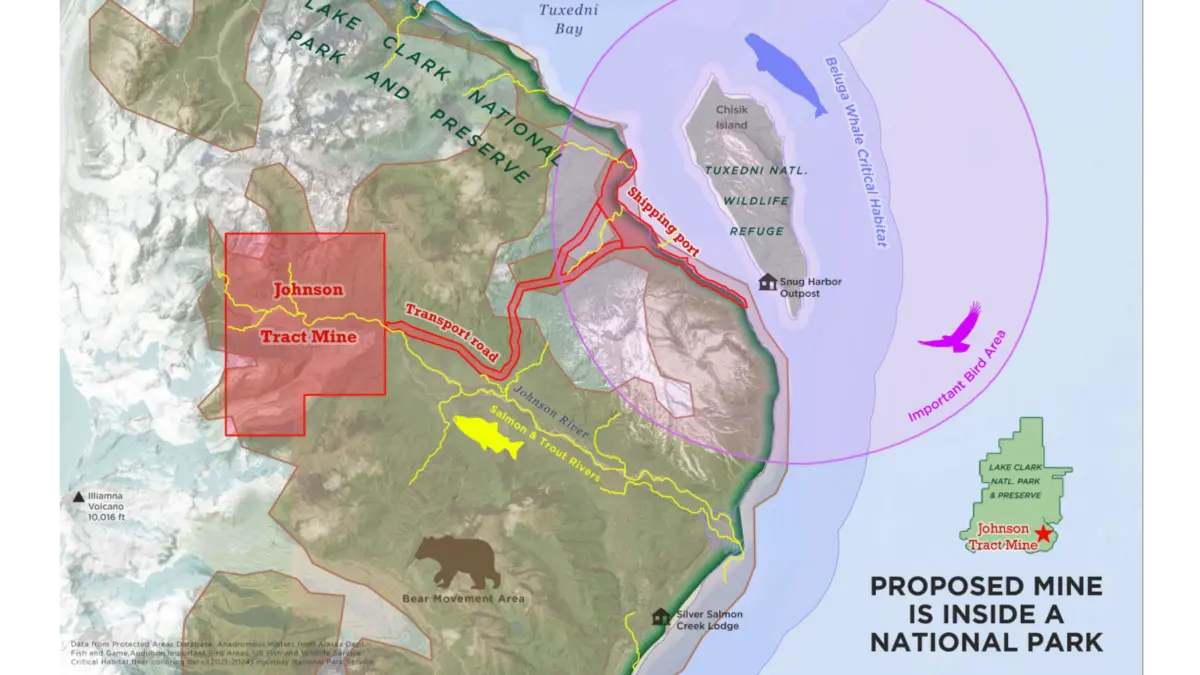
The Johnson Tract is a 21,000-acre parcel of private land situated deep within the boundaries of Lake Clark National Park and Preserve. It encompasses the vital headwaters of the Johnson River, a pristine watershed that flows into the marine ecosystems of Cook Inlet.
- The Developers: The land is owned by Cook Inlet Region Inc. (CIRI), an Alaska Native regional corporation. CIRI has partnered with Fairbanks-based Contango Ore to spearhead the development, with commercial digging tentatively targeted for 2029.
- The Scope: The project involves an active mine site, a network of transportation roads crossing federal public lands, a shipping port on Tuxedni Bay, and the expansion of an existing airstrip currently used for exploratory phases.
- The Extraction Model: Contango Ore plans to utilize a trucking-heavy extraction model. By hauling raw, unprocessed ore away from the site rather than constructing industrial mills, storage tailing facilities, or power plants locally, the company aims to minimize the physical footprint at the mine itself—though it necessitates heavy industrial traffic across public lands.
- The Legal Landscape: The project’s timeline received a massive boost when the U.S. District Court for the District of Alaska dismissed a lawsuit challenging the U.S. Army Corps of Engineers’ permitting process, clearing the way for road construction and airstrip upgrades.
Chronology: A Half-Century in the Making
The roots of the Johnson Tract conflict stretch back decades, interwoven with the complex legal frameworks governing public and private lands in modern Alaska.
1976: The Cook Inlet Land Exchange
The foundational ownership of the Johnson Tract was established through the Cook Inlet Land Exchange, a government-sanctioned agreement designed to settle land claims under the Alaska Native Claims Settlement Act (ANCSA). Through this deal, CIRI acquired ownership of the tract along with underlying mineral rights, which included provisions to negotiate access across surrounding public lands to bring those minerals to market.
1980: The Passage of ANILCA
Congress cemented the region’s protected status with the passage of the Alaska National Interest Lands Conservation Act (ANILCA). This landmark legislation triggered the largest expansion of the National Park System in U.S. history, adding approximately 43.5 million acres of protected federal land—including the establishment of Lake Clark National Park and Preserve. Ironically, the very legislation that created the park also preserved the pre-existing private rights and access pathways that now threaten its ecological continuity.
2025–2026: The Legal Battle and Judicial Ruling
Anticipating environmental fallout, the Center for Biological Diversity filed a federal lawsuit in May 2025. The complaint alleged that the U.S. Army Corps of Engineers failed to adequately evaluate the project’s risks to endangered Cook Inlet beluga whales under the Endangered Species Act (ESA), while also downplaying threats from acid rock drainage and water pollution.
However, in September 2026, the U.S. District Court for the District of Alaska ruled in favor of the federal government and developers, dismissing the complaint and allowing exploratory and preparatory infrastructure work to proceed.
Supporting Data and Ecological Stakes
The ecological stakes surrounding the Johnson Tract are exceptionally high. The project sits at the convergence of vital terrestrial and marine habitats that support an array of vulnerable and iconic wildlife.
- Endangered Cook Inlet Beluga Whales: Marine waters near the proposed shipping port at Tuxedni Bay serve as critical habitat for the critically endangered Cook Inlet beluga whale population, which has struggled to recover from historical declines. Industrial shipping traffic and noise pollution pose well-documented threats to these marine mammals.
- Salmon and Trout Fisheries: The Johnson River and its surrounding tributaries support robust runs of Pacific salmon and trout. These fish are not only foundational to the commercial and subsistence economies of Alaska but are also the primary food source that allows Katmai and Lake Clark brown bears to achieve the gargantuan sizes celebrated during Fat Bear Week.
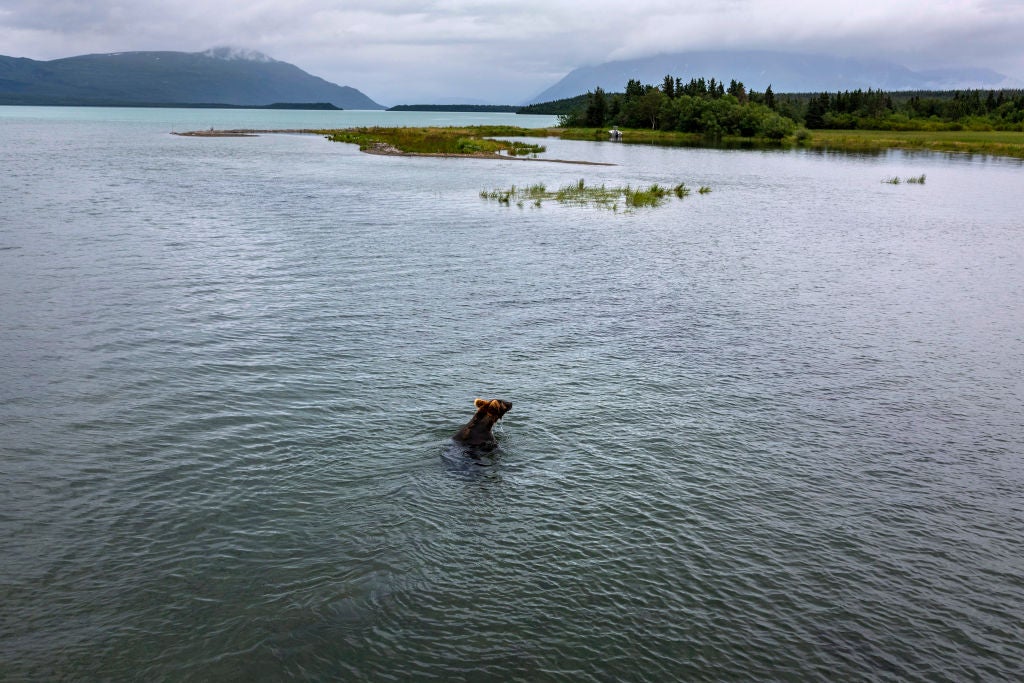
- Brown Bear Habitat: The wider region sustains dense populations of coastal brown bears. Industrial activity, increased human-wildlife encounters, and habitat fragmentation threaten the seamless movement and foraging patterns of these animals across the Alaska Range.
Official Responses and Perspectives
The debate over the Johnson Tract exposes deep philosophical divides regarding private property rights, federal oversight, and the true definition of a "national park."
The Developers and Federal Defense
Proponents of the project emphasize that CIRI’s mineral rights are legally secured and that federal agencies operated entirely within their legal boundaries when granting permits.
"This decision protects responsible mineral exploration on private land," stated Principal Deputy Assistant Attorney General Adam Gustafson of the Justice Department’s Energy and Natural Resources Division (ENRD), following the court’s dismissal of the conservationist lawsuit. "The court’s decision reaffirms that federal agencies are entitled to deference when they make scientific and predictive judgments, and it keeps an important Alaska project moving forward."
Contango Ore CEO Rick Van Nieuwenhuyse has similarly defended the company’s approach, noting that his team has actively worked to fill data gaps regarding local beluga whale populations by utilizing National Park Service data, while acknowledging that full permitting remains a meticulous, multi-year process.
Conservationists and Local Stakeholders
Conversely, environmental watchdogs and local residents argue that legal technicalities should not override common-sense environmental protection.
"This would set a terrible precedent for our beloved national parks," said Jen Woolworth, the National Parks Conservation Association (NPCA) Regional Program Manager for Alaska. "Everything in this landscape is at risk. Our national parks were created to protect natural wonders just like this. If we can’t protect Lake Clark, how can we protect its sister park, Katmai?"
The anxiety extends directly to local commercial operators whose livelihoods depend on the absolute wilderness character of the region. Dorien Coray’s family owns a bear photography and fishing business situated at the mouth of the Johnson River, just 12 miles downstream from the proposed mine site.
"I think there’s worry about water quality for the Johnson River itself, obviously. I mean, we’ve got acid rain, acid mine drainage, but also just turbidity," Coray shared in interviews with Alaska Public Media. "There’s going to be trucks, there’s going to be industrial activity… It’s going to affect the water quality and also the wildlife."
Implications: A Dangerous Precedent for America’s Parks?
As the legal roadblocks clear for Contango Ore and CIRI, the broader implications of the Johnson Tract project loom large over the National Park System.
National parks are traditionally viewed as inviolable sanctuaries—ecosystems shielded from the extraction pressures that affect other public lands like Bureau of Land Management (BLM) tracts or U.S. Forest Service holdings. However, the checkerboard land ownership patterns established by historical settlements like ANCSA and ANILCA mean that millions of acres of private inholdings still exist within park boundaries nationwide.
If the Johnson Tract successfully navigates its remaining permitting phases, establishes heavy industrial access corridors through public parklands, and implements heavy trucking operations in a delicate watershed, it could establish a blueprint for other private inholders seeking to exploit hidden mineral wealth within America’s most treasured protected spaces.
While the internet cheers for the plump, carefree apex predators of Katmai during Fat Bear Week, the reality unfolding just over the horizon serves as a sobering reminder: the wild, untamed spaces of Alaska are constantly being renegotiated at the intersection of law, commerce, and conservation. Whether Lake Clark can withstand the pressures of industrial progress without sacrificing its ecological soul remains the defining question of the decade.
