

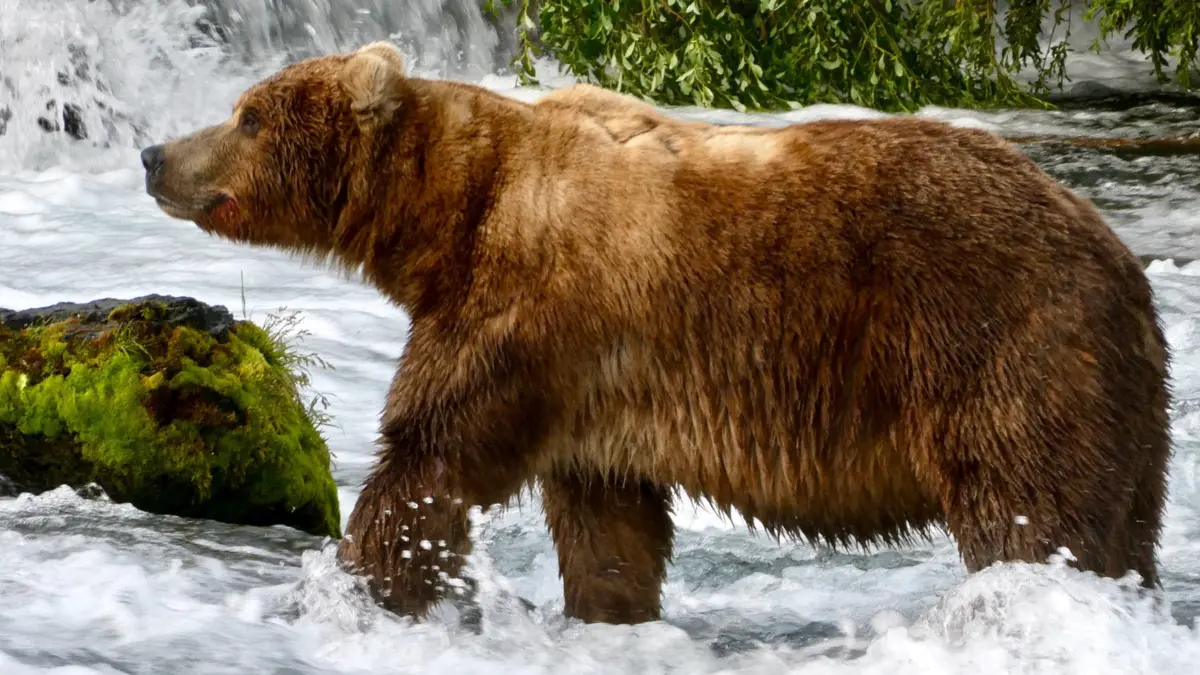
ANCHORAGE, Alaska — In an era dominated by hyper-aggressive posturing, constant digital connectivity, and an unrelenting cultural obsession with optimization, millions of internet users have found an unlikely North Star. His name is Bear 89, better known to the global community as Backpack.
Weighing in at a colossal 1,000 pounds, this mature male grizzly recently claimed the crown in Katmai National Park and Preserve’s annual Fat Bear Week. But Backpack’s victory represents much more than a simple celebration of seasonal ursine gluttony. In a tournament historically defined by territorial dominance and cinematic brawls, Backpack’s triumph as a conflict-averse, rock-lounging philosopher has struck a profound chord with a public weary of friction.
As society navigates the complexities of 2026, the crowning of a 20-year-old bear who prefers quiet persistence over bloody warfare offers a collective exhale—and perhaps a lesson in how to navigate our own turbulent waters.
Main Facts: The Anatomy of a Gentle Apex Predator
To understand Backpack’s monumental appeal, one must first understand the high-stakes reality of Fat Bear Week. Hosted annually by Katmai National Park and Explore.org, the March Madness-style bracket pits the park’s most successful brown bears against each other in a public vote. The core metric is simple: visual girth.
For the bears of the Brooks River, packing on maximum fat ahead of their winter hibernation is an evolutionary necessity. Bears that fail to accumulate sufficient adipose tissue risk starvation or dangerous early emergence from their dens during the harshest months of the Alaskan winter, when caloric resources are virtually nonexistent.
Yet, Backpack approaches this rigorous biological imperative with an aura of zen mastery. Standing as one of the heaviest bears in the park at approximately 1,000 pounds, Backpack is undeniably an apex predator. However, unlike his fiercely combative contemporaries, he achieves his massive proportions not through constant aggression, but through what park experts describe as "quiet strength."
While younger or more insecure males expend precious energy patrolling, posturing, and engaging in brutal turf wars, Backpack utilizes strategic positioning and unwavering patience. He is frequently observed claiming his preferred fishing spots not by chasing rivals away, but by simply out-waiting them, spending hours anchored to his favorite rock in the rushing waters of the Brooks River, calmly waiting for migrating salmon to swim into his path.
Chronology: From Vulnerable Cub to Crowned Champion
Backpack’s journey to the pinnacle of ursine royalty spans two decades of survival, resilience, and quiet adaptation within the complex social hierarchy of the Brooks River.
- The Early Years (Mid-2000s): Born to legendary mother Bear 435 (Holly)—who herself secured the Fat Bear Week crown in 2019—Backpack earned his moniker as a tiny cub by literally riding on his mother’s back. Like royal bloodlines in human history, his lineage is notable, though it hardly guaranteed his survival in the unforgiving wilderness.
- The 2007 Crisis: As an adolescent, Backpack’s future was cast into severe doubt. He arrived at the Brooks River bearing a devastating leg injury. Park rangers and early webcam viewers watched anxiously, openly questioning whether the young bear would succumb to his wounds. Through sheer resilience, he healed, developing a cautious approach to physical altercations that would define his adult life.
- The Dark Years of Fat Bear Week (2024–2025): The annual contest faced unprecedented turmoil in recent years. During the 2024 event, viewers watched in horror on livestreams as a dominant bear named Chunk fatally injured a cub belonging to another famous bear, Grazer, before another fatal, on-camera territorial killing took place. The ensuing drama forced organizers to temporarily pause the event. By 2025, a battered Chunk returned to win the crown despite carrying a broken jaw—the apparent casualty of a vicious brawl.
- The 2026 Resurgence of Peace: Emerging from the shadow of these violent seasons, Backpack captivated the electorate. Rejecting the trauma and turbulence of previous years, voters rallied behind the veteran bear’s peaceful demeanor, propelling him through the brackets to secure the 2026 Fat Bear Week championship.
Supporting Data: The Ecosystem of the Brooks River
Katmai National Park’s Brooks River is one of the most densely populated brown bear habitats on Earth, serving as a natural laboratory for studying ursine behavior during the summer and fall salmon runs. Data collected by biologists and park naturalists provide vital context to Backpack’s unique strategy:
- The Caloric Demand: To successfully hibernate, a large adult male grizzly like Backpack must consume tens of thousands of calories daily during the peak hyperphagia phase, primarily feeding on high-fat sockeye salmon.
- The Cost of Conflict: Biometric tracking and observational studies indicate that aggressive territorial defense burns massive amounts of energy. Bears that engage in frequent fights risk debilitating bone fractures, dental damage, and lacerations that can severely impair their ability to hunt before winter.
- Demographic Dominance: While dominant brawlers like Chunk and Grazer capture headlines through overt displays of power, demographic data from Explore.org suggests that "niche-dwellers" like Backpack—bears that avoid direct confrontation—achieve comparable or superior longevity and body mass index scores by conserving energy.
- Global Engagement: Fat Bear Week has evolved from a localized park management outreach program into a global phenomenon, drawing millions of votes from over 100 countries, turning remote Alaskan wildlife ecology into an international spectator sport.
Official Responses: Park Rangers and Conservationists Weigh In
The intersection of wild animal behavior and human internet culture creates a unique communications challenge for National Park Service personnel and conservation groups.
Experts are quick to remind the public of a fundamental truth: wild grizzly bears are not human beings, and they do not operate under human ethical or moral frameworks.
"While some bears are brawlers who thrive in the face of competition, others find a way to live within calmer niches," notes the official Explore.org profile for Bear 89. "These bears, like Backpack, express their own versions of toughness, yet are no less successful than their more aggressive counterparts. Backpack’s quiet toughness has allowed him to find his niche alongside the biggest bears at Brooks River."
Park naturalists have also addressed the psychological impact of the 2024 livestream incidents, emphasizing that nature is inherently unscripted and often brutal. When violent encounters stunned online audiences, forcing emergency panel discussions between Explore.org and NPS rangers, it served as a stark reminder of the raw reality of wildlife conservation.
However, rangers have embraced the public’s affection for Backpack as a valuable educational tool. By drawing eyes to a bear who succeeds through patience and composure rather than violence, millions of viewers gain a deeper, more nuanced appreciation for complex animal behavior, habitat preservation, and the delicate social structures that govern healthy ecosystems.
Implications: What Backpack Tells Us About 2026 Culture
Every cultural phenomenon acts as a mirror, reflecting the collective subconscious and desires of the society consuming it. As millions of internet users logged on to cast their votes in the autumn of 2026, the landslide support for Bear 89 carried a heavy sociological subtext.
Consider the prevailing cultural currents of the mid-2020s:
- The Fatigue of Toxic Posturing: For years, digital media has been saturated with hyper-masculine "alpha male" discourse, relentless self-optimization culture, and aggressive personal branding. In stark contrast, voters bypassed the brawling alpha bears of Katmai and crowned a gentle giant who spends hours sitting quietly on a river rock.
- The Antidote to Artificial Intelligence: At a time when generative AI chatbots promise to micro-manage, optimize, and streamline every waking second of human existence, Backpack represents the radical power of doing nothing. He is a creature of pure presence—eating, resting, and vibing in the physical world without an algorithm in sight.
- The Yearning for De-escalation: In a geopolitical and social landscape where conflict feels perpetually endemic, the global electorate projected its exhaustion onto the Brooks River. By cheering for an animal that actively de-escalates tension and finds success through calm persistence, humanity found a vicarious outlet for peace.
Ultimately, Backpack will return to his den this winter, entirely unaware of his internet fame, his royal lineage, or the profound philosophical weight placed upon his massive, furry shoulders. Yet, as he slumbers through the Alaskan freeze, he leaves behind a lingering reminder for the rest of us: true strength doesn’t always roar. Sometimes, it just finds a good rock, settles in, and lets the world flow by.
