

Published August 21, 2026
For decades, canister-based camping stoves have reigned supreme in the backcountry. Lighter, cleaner, and significantly more convenient than the traditional liquid-fuel stoves of the past—which required priming, pumping, and regular maintenance—modern butane-propane canisters have revolutionized how hikers cook on the trail. With proper management, these compact power sources can even perform reliably during winter excursions.
However, beneath their ubiquitous convenience lies a potentially volatile hazard. While rare, camping fuel canisters contain pressurized, highly flammable gas. Subjected to the wrong combination of heat, pressure, or user error, they can combust with catastrophic results.
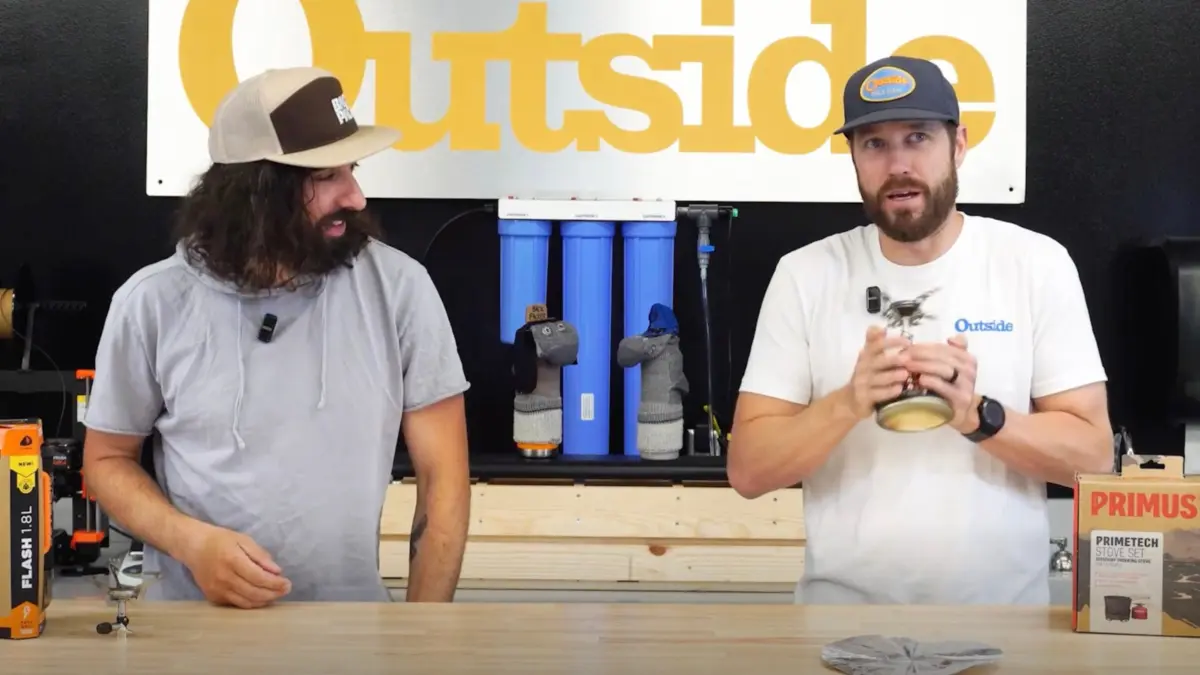
To uncover the most common ways fuel canisters fail both on and off the trail, Backpacker Editor-in-Chief Adam Roy and Lab Test Editor Adam Trenkamp visited the Outside Lab at CU Denver. Their mission: to dissect the physics of canister failures, explore the aftermath of a pressurized container blowing up inside a vehicle, and provide backpackers with essential safety protocols for handling their gear.
Main Facts: The Physics of Canister Failures
At their core, modern backpacking fuel canisters are pressurized metal vessels containing liquid and gaseous hydrocarbons, typically a blend of butane and propane. According to fundamental thermodynamics, as temperature rises, matter expands.
When a sealed metal canister is exposed to external heat, the fuel inside expands, generating immense internal pressure against rigid walls. Every manufacturer stamps clear safety warnings on these containers, usually advising users to keep temperatures below 120 degrees Fahrenheit. Empirical research from the lab shows that structural failure and subsequent explosions often occur once internal conditions cross the 122-degree threshold.
"We basically have a pressurized can of gas… and as most things in the world due to physics, we know that as they get hot, things expand," explains Lab Test Editor Adam Trenkamp. "With that being inside a metal container that has limited flexibility, that means it’s going to hit a breaking point."
With a safety margin of only a few degrees between standard hot ambient temperatures and catastrophic structural failure, the margin for user error is uncomfortably slim.
Chronology of Common Missteps: How Canisters Explode
While backpackers often worry about the dangers of open flames on the trail, the vast majority of canister failures actually occur off the trail due to human oversight. Industry experts have identified three primary scenarios where these everyday items turn dangerous.
1. The Hot Car Trap (Off-Trail)
The most frequent man-made disaster involving fuel canisters happens long after hikers have packed away their gear. Consider a common post-trip routine: a group finishes a rigorous three-day trek, packs their gear into the car, and heads into town for a celebratory hot meal.
It might be 90 degrees outside, but parked under direct midday sun, a vehicle’s internal temperature skyrockets exponentially. Within 30 minutes, the cabin air can climb to 110 degrees Fahrenheit. Within an hour, it breaches the critical 120-to-130-degree mark. A fuel canister left rolling around on a backseat or trunk floor will quickly absorb this ambient heat, driving internal pressure past the metal’s threshold and triggering a violent explosion.
2. Overzealous Refueling (Off-Trail)
A secondary wave of incidents has emerged alongside the rising popularity of fuel transfer devices, such as the FlipFuel. These aftermarket gadgets allow users to consolidate partial canisters into a single full one to minimize pack weight.
To achieve an efficient fuel transfer, users must create a pressure differential between the two cans—meaning one must be warmer than the other to force the liquid fuel to flow upward. Seeking a rapid transfer, some campers resort to boiling water, pouring it into a basin, and submerging the fuel canister directly into the scalding liquid. This massive, uncontrolled spike in thermal energy frequently causes the container to rupture.
3. Reflective Windscreens (On-Trail)
While off-trail storage errors account for most explosions, trail-side mistakes do happen. A lesser-known hazard involves the use of reflective windscreens.
Many backpacking stove kits—particularly remote-canister setups or specialized multi-fuel systems—come packaged with metal windscreens designed to shield the flame. However, if a reflective barrier is placed incorrectly around an upright canister stove, it acts like a satellite dish for thermal radiation.
"If you use this to block the wind and you have a good heat flame going from your stove, you’re now reflecting all of that heat back onto the canister itself," Trenkamp warns. Even if the outer air feels manageable, radiant heat builds up quietly against the metal wall, steadily pushing internal pressures to a dangerous limit.
Supporting Data: Understanding the Thresholds
To put the physical risks into perspective, the following data points outline the environmental and thermodynamic boundaries governing small camping fuel containers:
- Critical Temperature Limit: 120°F – 122°F (Manufacturer warnings and lab-tested structural failure points).
- Vehicle Heat Accumulation Rate: On a 90°F day, a closed car parked in direct sunlight reaches 100°F–110°F within 30 minutes, and hits or exceeds 120°F within 60 minutes.
- Safe Transfer Thermal Delta: A temperature difference of just 20°F to 30°F (achieved by placing one can in a freezer and letting the other warm slightly to room temperature) is sufficient for fuel transfer, eliminating the need for boiling water immersion.
- Reflective Energy Transfer: Unmodified aluminum windscreens can focus radiant heat onto a localized spot on a canister wall, bypassing ambient air temperature readings and rapidly accelerating internal pressure.
Official Responses and Industry Guidance
As gear technology evolves, outdoor journalism outlets and safety labs are pushing for clearer consumer education regarding auxiliary gear. Traditional manufacturing labels warn against high heat, but the rise of third-party transfer devices and universal wind-blocking accessories has created new blind spots for modern backpackers.
Experts emphasize that manufacturers are not failing to provide warnings; rather, consumers frequently underestimate how quickly ambient environments—like a parked sedan—can simulate industrial oven conditions. The Outside Lab’s collaborative testing aims to bridge this gap, translating complex thermodynamic principles into actionable, plain-language advice for weekend warriors and thru-hikers alike.
Implications and Practical Solutions
An explosion in a residential kitchen, a residential garage, or worse, the footwell of a moving automobile is not the kind of adrenaline rush most outdoor enthusiasts sign up for. Fortunately, avoiding these disasters requires only minor adjustments to standard packing and cooking habits.
What to Do Off-Trail
- Never leave fuel canisters in a parked car. If you must stop for food or supplies after a trip, take your fuel canisters with you.
- Find shade if necessary. If carrying the fuel into a restaurant or store is entirely impossible, place the canister in a secure, deeply shaded spot well away from the vehicle. However, exercise extreme caution: leaving glass or metal containers in erratic patches of sunlight can act as a magnifying hazard, triggering local wildfires.
Safely Using Fuel Transfer Devices
- Abandon the boiling water method. Never submerge a fuel canister in boiling water to speed up transfers.
- Leverage the freezer instead. To create a safe, efficient pressure differential, place one canister in your home freezer for a short period, and leave the second canister at normal room temperature (or let it warm gently in indoor sunlight to roughly 85°F). The resulting temperature gap will facilitate a smooth, controlled fuel flow without risking an over-pressurization explosion.
Mitigating Wind Safely on the Trail
- Ditch reflective materials. When cooking in windy backcountry conditions, ensure your windscreen is non-reflective. If you must use a metal shield that exhibits reflective properties, apply gaffer’s tape across the surface to dull it.
- Allow heat to dissipate. Ensure any custom or makeshift windscreen includes small ventilation ports to prevent hot air from trapping directly against the fuel source. Alternatively, utilize natural windbreaks like large boulders, or position your body or a non-flammable fabric shell at a safe distance to disrupt gusting air.
Modern canister stoves remain exceptionally safe tools when treated with respect. By understanding the thermodynamic limits of pressurized gas and eliminating reckless habits—like leaving gear to bake in hot vehicles—hikers can ensure their adventures remain memorable for the scenery, not the explosions.
For more safety guides, gear testing insights, and backcountry tutorials, visit backpacker.com.
