

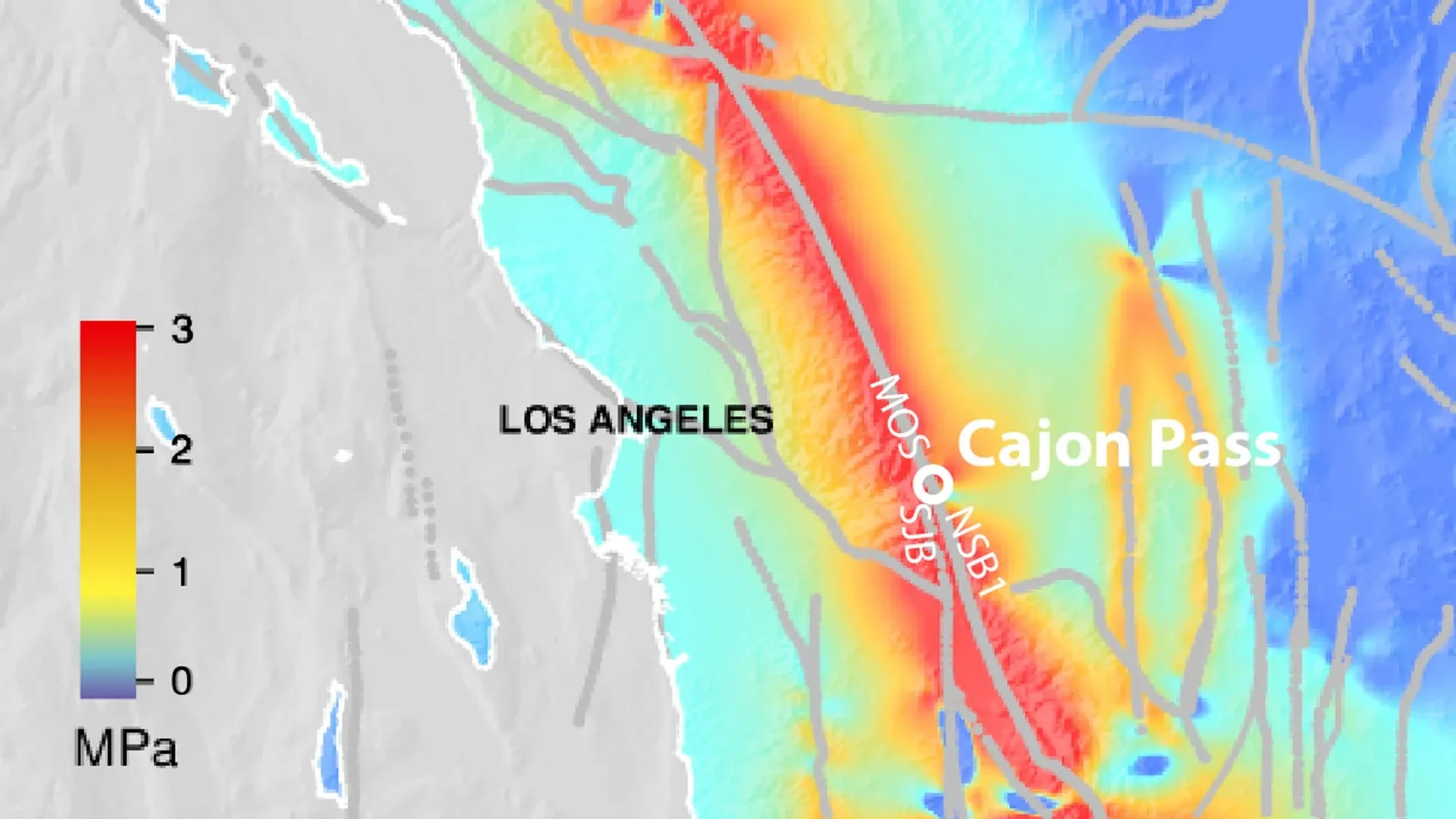
LOS ANGELES — Beneath the sun-drenched landscape and sprawling urban expanse of Southern California lies a subterranean network of immense tectonic volatility. For more than a century and a half, the greater Los Angeles metropolitan area has enjoyed a relatively quiet seismic period, largely undisturbed by a catastrophic, region-shaping earthquake. However, beneath this surface calm, an unprecedented amount of geological pressure has been quietly accumulating.
According to a groundbreaking international study recently published in the Journal of Geophysical Research: Solid Earth, tectonic stress across two of California’s most formidable fault systems has reached extreme levels, surpassing anything recorded in a millennium-long simulation. Led by Dr. Liliane Burkhard of the Division of Space Research and Planetary Sciences (WP) at the Physics Institute of the University of Bern, the research highlights a critical geological junction northeast of Los Angeles known as the Cajon Pass.
This complex nexus acts as an "earthquake gate," a structural valve that could dictate whether a future rupture remains contained to a single fault or cascades into a multi-fault mega-earthquake with catastrophic implications for millions of residents.
Main Facts
At the heart of Southern California’s tectonic architecture are the San Andreas and San Jacinto fault systems. Together, they absorb and accommodate the vast majority of the relentless tectonic motion generated as the Pacific and North American plates grind past one another. Where these two massive systems converge northeast of Los Angeles lies the Cajon Pass—a heavily fractured geological knot.
The new study reveals several critical realities regarding the region’s current seismic hazard profile:
- Historic Highs in Stress: By modeling 1,000 years of historical earthquake data, researchers discovered that tectonic stress in parts of the San Andreas and San Jacinto systems has reached, and in some areas exceeded, the maximum values observed anywhere in the millennium-long simulation.
- The "Earthquake Gate" Dynamic: The Cajon Pass does not act as a simple physical barrier to seismic activity. Depending on the precise state of localized stress, it can either arrest a fault rupture or allow it to jump seamlessly from one fault system to the other.
- Synchronized Loading: The study found that the San Jacinto-Bernardino section is currently subjected to 3.6 megapascals (MPa) of modeled stress—higher than any value reached during the 1,000-year simulation. Meanwhile, the adjacent Mojave South section of the San Andreas fault sits at 2.8 MPa. This synchronized elevation of stress mirrors conditions observed in models prior to past multi-fault ruptures.
- The 1857 Precedent: The broader Southern California region has not experienced a comparable major earthquake since the magnitude 7.9 Fort Tejon earthquake in 1857. That long inter-event quiet period has allowed stress to build continuously across the subsurface.
- No Imminent Forecast: The researchers explicitly stress that high mechanical stress does not equate to a short-term prediction. While the system is critically loaded, science cannot yet forecast the exact date or time of a future rupture.
Chronology of Seismic Behavior and Scientific Discovery
Understanding the current state of stress requires looking backward through both historical accounts and centuries of geological history. Earthquakes occur along fault lines when sections of the Earth’s crust become mechanically locked against one another. As tectonic plates continue their inexorable crawl, friction prevents immediate movement, causing stress to accumulate slowly over decades, centuries, or even millennia. When the friction threshold is finally overcome, the stored energy releases violently in the form of seismic waves.
The Historical Record
Southern California’s written and geological history is punctuated by massive ruptures that reveal the dynamic, unpredictable nature of the Cajon Pass junction:
- 1812 (The Wrightwood Earthquake): Historical accounts and geological proxies indicate that a major earthquake successfully breached the Cajon Pass, propagating across both the San Andreas and San Jacinto fault systems in a single, continuous, destructive event.
- 1857 (The Fort Tejon Earthquake): A colossal magnitude 7.9 earthquake ruptured a massive stretch of the San Andreas Fault. However, when the rupture propagated toward the southeast, it hit the Cajon Pass and stopped, failing to jump onto the San Jacinto Fault.
The Modeling Breakthrough
To untangle how stress has evolved since these historical events, Dr. Burkhard and an international team of researchers—including scientists from the University of Hawaiʻi at Mānoa, the U.S. Geological Survey Earthquake Science Center in Pasadena, and the Scripps Institution of Oceanography at UC San Diego—utilized advanced computational techniques.
The team constructed a physics-based, four-dimensional earthquake cycle model. This simulation tracked three spatial dimensions while dynamically following how the fault system evolved over a 1,000-year timeline. To ground the model in empirical reality, they fed it a comprehensive historical record compiled from radiocarbon dating, anomalous growth patterns preserved in tree rings, and historical documentation of ground-surface ruptures.
"The model tracks how each earthquake changes stress on neighboring fault segments, how stress accumulates during the quiet intervals between events, and how the deeper layers of the crust slowly relax following large ruptures," Dr. Burkhard explained. By running a millennial simulation of Southern California’s seismic past, the team was able to map out precisely how heavily loaded the fault networks are today.
Supporting Data and Technical Findings
The quantitative metrics produced by the Bern-led study offer a stark numerical representation of the region’s precarious geological balance.
Geoscientists measure mechanical stress and pressure using megapascals (MPa). In the newly published model, the values calculated for the primary Southern California fault segments have broken historical ceilings:
- San Jacinto-Bernardino Section: Modeled at 3.6 MPa—a value entirely unprecedented within the 1,000-year span of the simulation.
- Mojave South Section (San Andreas Fault): Modeled at 2.8 MPa, representing exceptionally high accumulated strain.
The Significance of Relative Stress
Dr. Burkhard points out that evaluating an individual fault in isolation provides an incomplete picture. The critical variable lies in the relationship between stress levels on adjacent fault systems.
When both the San Andreas and San Jacinto systems experience elevated, closely matched stress levels simultaneously, the mechanical resistance at their intersection drops. This creates a high-probability pathway for a rupture to bypass the Cajon Pass gate and propagate continuously through both systems. Conversely, when stress accumulation falls out of phase between the two faults, a rupture is far more likely to stall out at the junction.
"So not only is it concerning that the stresses are reaching historic highs," Dr. Burkhard noted, "but also that the relative stress conditions between the two fault systems are approaching the range we associate with major ruptures crossing both faults simultaneously—and that is a scenario with much larger consequences for the region."
Official Responses and Expert Assessments
The geoscience and emergency management communities have received the study not as an alarmist warning, but as an essential tool for long-term hazard assessment and infrastructure hardening.
Because earthquake forecasting remains an imperfect science, officials emphasize that the research shifts the focus from when an earthquake will happen to what kind of scenario communities must prepare for.
"The question of when and how the next major earthquake will occur in this region is one of the most pressing problems in applied geoscience," said Dr. Burkhard. She highlighted that the physics-based framework developed for Southern California is not geographically isolated; it offers a transferable model that can be applied to other complex, multi-fault junctions around the globe.
State and federal agencies, including the U.S. Geological Survey (USGS)—which contributed to the study—have long advocated for proactive risk mitigation. While public safety officials cannot point to a calendar date, data-driven simulations like this provide vital parameters for engineering standards, building codes, and municipal disaster response strategies.
Dr. Burkhard reiterated the study’s core boundary: "The study is not a prediction of when an earthquake will occur. What we can say is that the system is critically stressed and that physics-based models like ours give a clearer picture of the range of scenarios we should be prepared for. This information is important for hazard assessment, infrastructure planning and emergency preparedness."
Implications for Southern California
The potential realization of a multi-fault rupture spanning both the San Andreas and San Jacinto systems carries immense socioeconomic and infrastructural consequences.
An earthquake restricted to a single fault segment is capable of causing widespread destruction; however, a through-going rupture that crosses the Cajon Pass would dramatically expand the geographical footprint of the disaster.
Populated Centers at Risk
A combined-fault event would directly impact some of the most densely populated, economically vital, and infrastructure-dependent regions in the United States. Areas potentially subjected to severe shaking include:
- The Greater Los Angeles Metropolitan Area
- San Bernardino
- Riverside
- The Coachella Valley
The Cajon Pass Vulnerability
Beyond regional population centers, the Cajon Pass itself is a vital lifeline for commerce, transportation, and utilities. It serves as a heavily utilized geographic funnel carrying interstate highways, major freight and passenger rail lines, and critical energy infrastructure—including high-voltage power transmission lines and major petroleum pipelines.
A major seismic event centered directly on this corridor could temporarily sever Southern California’s connection to the rest of the country, crippling supply chains, isolating communities, and paralyzing emergency response efforts.
Preparing for the Plausible
Ultimately, the University of Bern study reframes the ongoing seismic risk in Southern California. The quiet period following the 1857 Fort Tejon earthquake has allowed tectonic energy to accumulate to extreme, historically unmatched levels. By illuminating how the Cajon Pass functions as an unstable switchboard governed by relative stress, the research arms planners, engineers, and policymakers with the physics-based insights necessary to fortify the region against its inevitable seismic future.
