

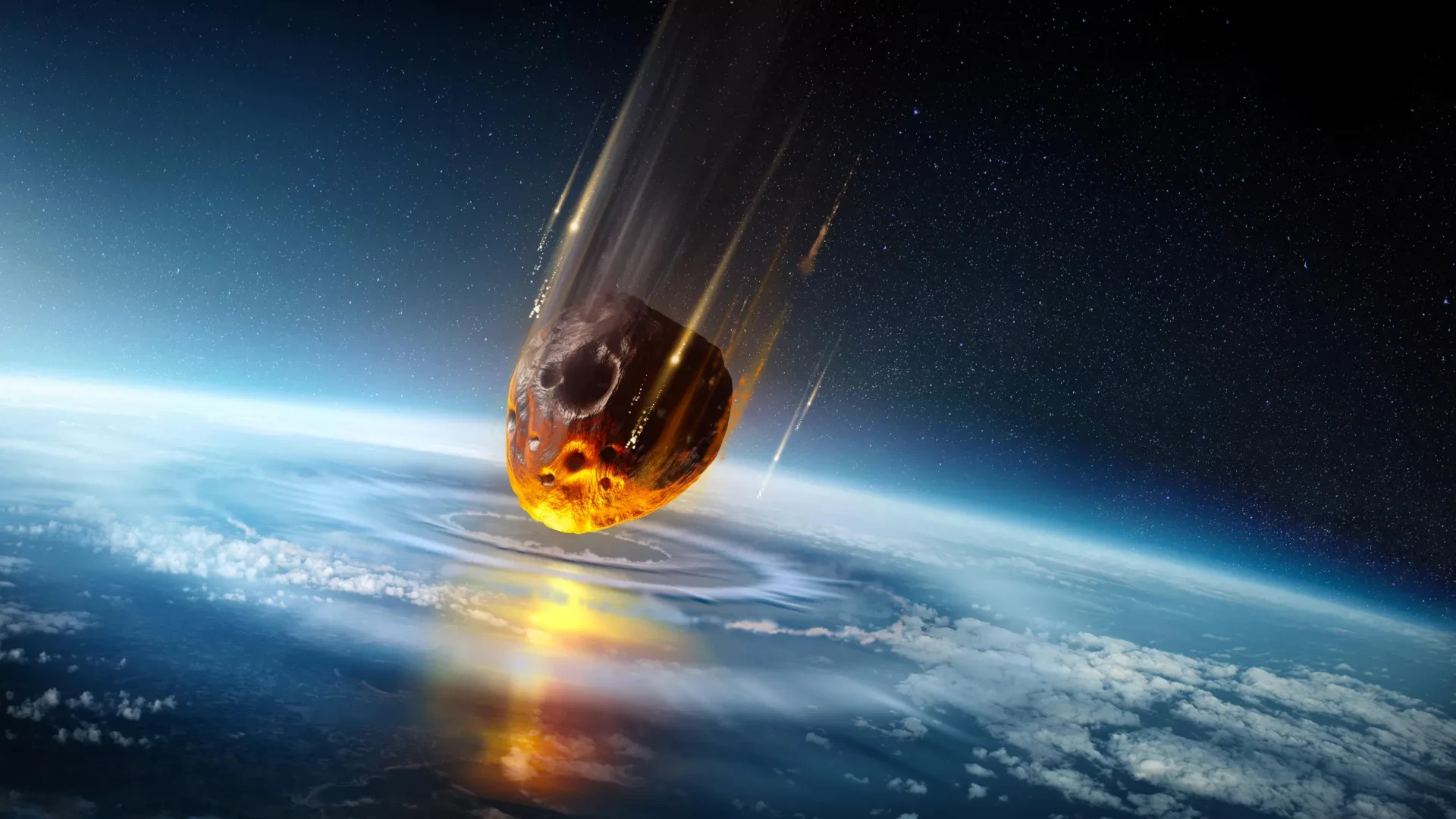
AUSTIN, Texas — Beneath the serene surface of agricultural land and rural communities in Major County, Oklahoma, lies a subterranean geological scar of staggering proportions. Known as the Ames impact structure, this buried meteor crater spans miles across, hidden beneath hundreds of feet of sediment. While it has long been celebrated by the energy industry as a prolific producer of oil and natural gas, the crater has occupied an equally significant, albeit heavily debated, position in the annals of academic geology. For decades, the prevailing scientific consensus slotted the Ames crater into a specific, dramatic chapter of Earth’s history: the Ordovician Meteor Event, an epoch roughly 467.5 million years ago when North America—and the planet at large—was thought to have been peppered by a barrage of space rocks.
However, a meticulous and multidisciplinary team of researchers at The University of Texas at Austin (UT Austin) has upended this long-standing narrative. In a study published in the journal Meteoritics & Planetary Science, the UT researchers present definitive geochronological evidence proving that the Ames impact structure is, in fact, nearly 100 million years younger than previously believed. Rather than dating back to the Middle Ordovician, the meteorite struck the region approximately 370 million years ago, during the Late Devonian period.
This dramatic revision does more than simply correct a date on a geological map. By severing the Ames crater from the Ordovician timeline and repositioning it squarely within the Late Devonian, the findings force scientists to re-evaluate the clustering of ancient impacts, challenge the hypothesis of an ancient Saturn-like ring system of asteroid debris around Earth, and introduce a provocative new piece to the puzzle surrounding one of the planet’s most devastating mass extinctions.
Main Facts: Upending a Geological Cornerstone
The core finding of the UT Austin study is as straightforward as it is disruptive: the Ames meteor impact structure formed approximately 370 million years ago, not 467.5 million years ago.
To arrive at this conclusion, the research team bypassed the biological proxies that had previously anchored the crater’s timeline and instead turned to high-precision radiometric dating of microscopic mineral crystals. Specifically, they analyzed uranium-lead (U-Pb) isotopes within zircon crystals extracted from granite that had been intensely altered by the thermal and mechanical shock of the impact.
- Location: Beneath the town of Ames, Oklahoma (Major County).
- Economic & Scientific Value: Beyond its geological intrigue, the Ames structure is a celebrated petroleum reservoir, holding significant quantities of oil and gas trapped within the fractured granite and overlying sedimentary rocks.
- Previous Dating Method: Biological dating via conodont fossils (microscopic teeth of an ancient eel-like vertebrate) found in sediment layers associated with the impact.
- New Dating Method: High-precision zircon U-Pb geochronology combined with advanced micro-imaging techniques (cathodoluminescence and electron backscatter diffraction).
- The Revised Age: Approximately 370 million years old (Late Devonian), representing a reduction in age of nearly 100 million years.
- Broader Context: The revised timeline places the impact perilously close to the Frasnian-Famennian mass extinction event, which unfolded roughly 372 million years ago and devastated global marine ecosystems.
Chronology: How the Discovery Unfolded
The path to rewriting the history of the Ames structure began years ago, sparked by curiosity over the clustering of North American impact structures.
The Ordovician Paradigm
For decades, geologists noted an intriguing statistical anomaly: a high concentration of meteorite impact craters across North America and Europe appeared to share a remarkably similar age of roughly 467 million years. This clustering led some prominent researchers to formulate a bold hypothesis: during the Middle Ordovician period, Earth may have captured a large asteroid that subsequently broke apart, leaving the planet temporarily encircled by a ring of debris akin to the rings of Saturn. Over time, pieces of this ring would have continuously rained down upon the Earth’s surface, creating a synchronized cluster of impact craters.
The Ames structure in Oklahoma was frequently cited as a prime pawn in this Ordovician hypothesis. Because of its circular geometry, scale, and structural characteristics, it fit neatly into the roster of craters thought to have been born out of this hypothetical cosmic bombardment.
The Conodont Misdirection
So, why did generations of geologists believe the Ames crater was 467.5 million years old? The answer lies in the limitations of the dating techniques available during the crater’s initial exploration and industrial boom.
Before the recent UT Austin study, the age of the Ames impact had been inferred primarily through biostratigraphy—the study of fossil remains. Researchers had recovered microfossils known as conodonts from rocks associated with the impact event. Conodonts are the tooth-like remains of an extinct, eel-like chordate. Because different conodont species evolved rapidly and are well-documented in the geologic record, they serve as excellent "index fossils" for dating sedimentary layers.
The conodonts found in the Ames rocks belonged to species that thrived during the Ordovician period. Consequently, scientists concluded that the impact must have occurred during that same timeframe.
However, lead author Elizabeth Catlos and her team realized that biological proxies can easily be misinterpreted in catastrophic geological settings. An asteroid impact is, by its very nature, a scene of total chaos. When a celestial body miles wide slams into the Earth at hypervelocity, it vaporizes rock, melts crust, and violently excavates and churns up subterranean layers.
Catlos and her colleagues deduced that the conodont teeth preserved in the Ames rock core were likely millions of years old before the asteroid ever struck. The impact event simply scooped up older, pre-existing Ordovician strata, churning them into the debris field and preserving the ancient fossils within the younger mixed deposits. The fossils were authentic, but their presence was a geological red herring.
The Zircon Revelation
Recognizing the potential flaws in relying solely on biostratigraphy, the research team sought a more definitive, physics-based method to determine the crater’s age. They turned to zircon ($textZrSiO_4$), a remarkably durable mineral that frequently incorporates trace amounts of uranium into its crystal lattice as it forms. Because uranium decays into lead at a known, constant rate, scientists can measure the ratio of uranium to lead within a zircon crystal to determine its age with astonishing precision.
The project was originally initiated by Andrew Parisi, a graduate student at UT Austin’s Jackson School of Geosciences. Parisi traveled to the Oklahoma Geological Survey to acquire precious rock cores drilled from deep within the Ames structure. He extracted the microscopic zircon crystals from altered granite samples and began the painstaking work of dating them.
No matter what analytical technique the team applied, the radiometric data stubbornly pointed to a much younger timeline.
"No matter what technique we used, it was coming back to this younger signal," recalled Elizabeth Catlos, associate professor in UT’s Department of Earth and Planetary Sciences.
The data indicated that the granitic basement rock had been thermally reset or structurally modified by an impact event roughly 370 million years ago, during the Late Devonian epoch. The findings were ultimately compiled and published in July in the peer-reviewed journal Meteoritics & Planetary Science.
Supporting Data: The Science of Shocked Crystals
To ensure that the radiometric ages derived from the zircon crystals genuinely reflected a meteor impact and not some other thermal overprinting event—such as regional metamorphism or ancient hydrothermal activity—the UT Austin team subjected the crystals to rigorous microscopic scrutiny.
Working in collaboration with researchers at NASA, the team utilized advanced imaging technologies, specifically cathodoluminescence (CL) and electron backscatter diffraction (EBSD).
When a zircon crystal is subjected to the unimaginable temperatures and pressures generated by a hypervelocity meteorite impact, its internal structure undergoes catastrophic shock. The mineral can partially or completely recrystallize, developing distinct internal microstructures, planar deformation features, or amorphous zones that are entirely unique to impact events.
Using NASA’s high-resolution imaging capabilities, the team was able to peer inside the microscopic crystals and verify that the zircons bore the distinct physical scars of a cosmic collision. The U-Pb isotopic clocks within these shocked crystals had been effectively reset by the heat and pressure of the impact, locking in the precise moment the asteroid struck Oklahoma 370 million years ago.
Danny Stockli, dean of the Jackson School of Geosciences and a co-author of the study, emphasized the power of this analytical approach.
"These small crystals allow us to go back in time and learn about the major changes to Earth’s ancient landscapes," Stockli said. "It would be great to do this for more of the meteor impact sites across the continent so we could get a more accurate timeline for these major events."
Official Responses and Collaborative Effort
The publication of this study marks the culmination of years of rigorous, collaborative scientific inquiry, though it is also tempered by the bittersweet loss of key contributors.
Andrew Parisi, the former Jackson School graduate student who laid the foundational groundwork for the project by procuring the core samples and performing initial mineral separations, graduated in 2018 and has since passed away. Similarly, co-author Michael Brookfield, an affiliated researcher at the school, passed away prior to the paper’s publication. Their pioneering efforts live on through this landmark study.
The research team also included contributions from prominent figures within the Jackson School of Geosciences, including Research Professor Sean Gulick and Professor Emeritus Mark Cloos, both of whom helped contextualize the structural and geophysical implications of a Late Devonian impact in North America.
Reflecting on the collaborative nature of the work and the dramatic shift the study represents, lead author Elizabeth Catlos used a vivid chess analogy to describe the team’s intervention in the scientific literature:
"With this research, we’re basically taking a major pawn out of the Ordovician Meteor Event and dumping it into the Frasnian-Famennian event, and saying, ‘This is where this impact belongs.’"
Implications: Rewriting Earth’s History and Mass Extinction Dynamics
The ramifications of the UT Austin study extend far beyond the borders of Oklahoma, touching upon fundamental debates in evolutionary biology, climatology, and planetary science.
1. Reassessing the Ordovician "Ring of Debris" Hypothesis
For years, the existence of a cluster of Ordovician craters—including Ames—served as the cornerstone for theories suggesting Earth was once ringed by asteroid debris. By removing the Ames structure from this cluster, the study weakens the empirical foundation of the Ordovician ring hypothesis. If prominent craters once thought to belong to this cosmic shower are systematically re-dated and found to belong to entirely different geological epochs, scientists may need to reconsider whether Earth ever hosted a Saturn-like ring system, or at least acknowledge that the purported cluster is far more temporally dispersed than previously assumed.
2. A New Clue in the Frasnian-Famennian Mass Extinction
Perhaps the most profound implication of the new dating is its chronological proximity to the Frasnian-Famennian extinction event. Occurring approximately 372 million years ago, this was one of the "Big Five" mass extinction events in Earth’s history. It profoundly altered global marine ecosystems, wiping out an estimated 70% to 80% of all species on Earth—particularly devastating shallow-water reef builders such as stromatoporoids and primitive corals.
For generations, paleontologists and geologists have debated the primary driver of the Frasnian-Famennian crisis. Was it triggered by terrestrial forces, such as massive volcanic outpourings (large igneous provinces) that induced severe global warming, ocean anoxia (oxygen depletion), and sea-level fluctuations? Or was it precipitated by an extraterrestrial trigger, such as a major asteroid impact that disrupted global climate systems through dust loading and impact winter?
While the 370-million-year age of the Ames crater does not definitively prove that the Oklahoma impact caused the Frasnian-Famennian extinction—the crater is simply too small (roughly 9 to 10 miles in diameter) to have caused a global-scale apocalypse on its own—it places a significant cosmic event remarkably close to the biological crisis.
Catlos and her colleagues argue that establishing precise, unassailable dates for mass extinctions and coeval geological events is the only way to untangle the complex feedback loops that have shaped our planet’s biosphere.
3. The Imperative for Modern Geochronology
The study serves as a cautionary tale for the broader geoscience community. For decades, researchers accepted a tidy narrative about North American impact structures because the biological data seemed to support it. By demonstrating that reworked fossils can easily mask the true age of a catastrophic geological event, the UT Austin study highlights the necessity of applying modern, high-resolution radiometric dating techniques—such as zircon U-Pb geochronology backed by advanced electron imaging—to legacy impact structures around the globe.
As Danny Stockli noted, applying this rigorous toolkit to other continental impact sites could yield a drastically revised and more accurate timeline of Earth’s violent cosmic history.
Ultimately, the humble oil-producing crater buried beneath Ames, Oklahoma, has transformed from a comfortable textbook example of an Ordovician impact into a dynamic catalyst for scientific revision. As researchers continue to probe the deep time records preserved in microscopic mineral grains, our understanding of Earth’s ancient past—and the cosmic forces that helped shape it—will never be the same.
