

EDMONTON, Alberta — To the average human observer, time is measured by the unyielding, metronomic sweep of a clock. Twenty-four hours compose a day, an exact rotation of our pale blue dot against the backdrop of the cosmos. For centuries, this temporal constant has structured human civilization, agriculture, commerce, and technology.
Yet, this cosmic clockwork is an illusion. Earth’s rotation is not a static, frictionless constant. It is dynamic, erratic, and subject to minute, perpetual fluctuations.
While the variance is measured in mere milliseconds, physicists possess the tools to detect it, and the implications ripple far beyond the realm of theoretical geophysics. Over time, days lengthen and shorten by fractions of a second due to subtle, colossal movements deep within the planet’s interior.
For roughly three decades, scientists have understood that Earth’s liquid outer core does not always rotate synchronously with the rocky outer layers. However, the precise mechanisms driving these variations—and how they translate to our daily perception of time—have remained elusive.
Now, a groundbreaking study published September 23 in the prestigious journal Nature has finally decoded this subterranean puzzle. Authored by University of Alberta physics PhD student Huifeng Zhang and professor Mathieu Dumberry, the research reveals that a hidden gravitational tug-of-war between Earth’s solid inner core and its rocky mantle dictates the subtle stretching and shrinking of our days.
Main Facts: Decoding the Planetary Shift
At the heart of the discovery lies the principle of conservation of angular momentum—the fundamental law of physics stating that a spinning system’s total momentum must remain constant unless acted upon by an external torque.
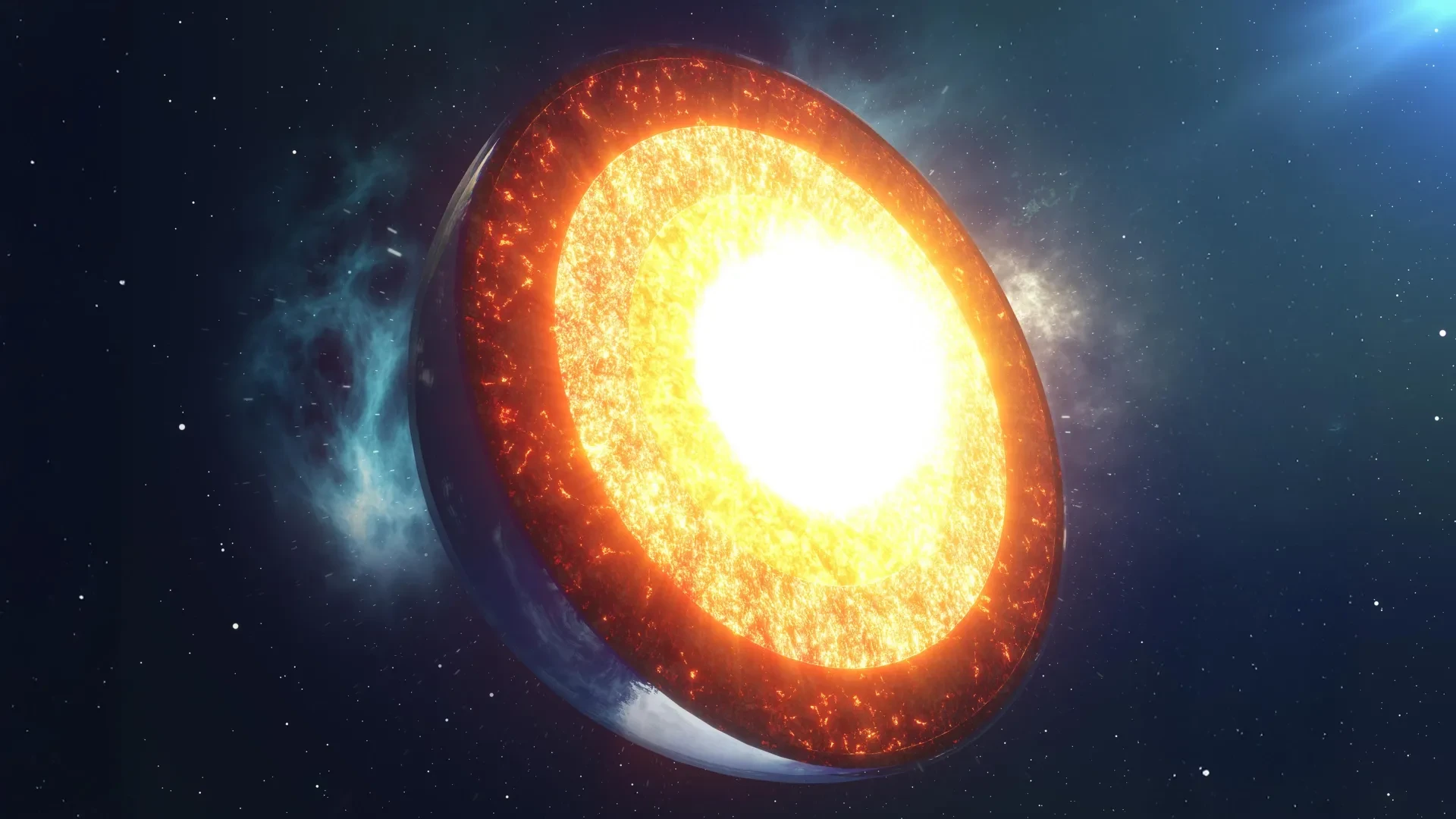
Earth operates as a massive, multi-layered gyroscope. Its interior is sharply divided:
- The Inner Core: A blazing-hot, solid iron-nickel sphere roughly the size of Pluto.
- The Outer Core: A vast ocean of turbulent, churning liquid iron and nickel roughly 2,000 kilometers thick.
- The Mantle: A 3,000-kilometer-thick, viscous rocky layer that extends upward to the planet’s crust.
For decades, geophysicists have known that changes in Earth’s magnetic field point to a staggering reality: the liquid outer core can gradually accelerate over several decades, only to decelerate during the subsequent decades.
To maintain the conservation of angular momentum, the mantle and crust must respond in the exact opposite direction. When the core speeds up, the mantle drags slightly, slowing its rotation. When the core decelerates, the mantle speeds up in compensation.
Because we live on the crust, any variation in the mantle’s rotation speed directly alters the duration of a rotation relative to the sun—effectively changing the length of our day by a few milliseconds.
Until now, however, science lacked a definitive explanation for how the deep core and the distant mantle could exchange rotational momentum across thousands of kilometers of intervening liquid.
Zhang and Dumberry’s research bridges this gap. By utilizing advanced mathematical modeling, they demonstrated that small changes in the rotational speed of the solid inner core generate a phenomenon known as "gravitational torque."
Because Earth’s inner core is not a mathematically perfect sphere, its shifting position creates gravitational interactions with uneven distributions of mass within the lower mantle. This invisible gravitational leash pulls on the mantle, altering its rotational speed and, by extension, the length of our days.
However, this gravitational pull does not operate in a vacuum. It is kept in check by a competing force known as the core-mantle boundary (CMB) torque. This frictional and electromagnetic drag acts at the physical interface where the liquid outer core meets the solid mantle. The subtle, ongoing shifts in the balance between this electromagnetic friction and the inner core’s gravitational pull account for the millisecond variations we observe on the surface.
Chronology: The Journey to Solving Earth’s Rotational Mystery
The realization that Earth’s rotation is irregular is not entirely new; rather, solving it has been an incremental scientific odyssey spanning centuries and accelerating over the last fifty years.
The Historical Context: Discovering the Wobble
- 17th to 19th Centuries: Early astronomers, notably Edmond Halley and later Simon Newcomb, noticed minor discrepancies in astronomical observations regarding the positions of the moon and planets. They suspected that Earth’s rotation rate was not perfectly uniform, though they lacked the precision instruments to prove it.
- 1950s–1970s: The advent of atomic clocks provided humanity with an ultra-precise timekeeping standard. For the first time, scientists could measure the Earth’s rotation against an absolute standard, confirming that days fluctuate seasonally and decadal-scale variations occur unpredictably.
The Core-Mantle Coupling Era
- 1990s: Geophysicists established that decadal changes in length-of-day (LOD) could not be explained by surface phenomena alone, such as atmospheric winds or ocean currents. Attention turned inward. Scientists proposed that electromagnetic coupling at the core-mantle boundary was transferring momentum between the deep interior and the surface.
- 2000s–2010s: Satellite missions, such as the European Space Agency’s Swarm constellation, began mapping Earth’s magnetic field with unprecedented accuracy. These measurements confirmed that the liquid outer core undergoes decadal surges and slowdowns. Yet, models relying solely on electromagnetic drag struggled to fully account for the observed magnitude of mantle momentum changes. A missing puzzle piece remained.
The Breakthrough: The September 23 Nature Study
- 2023–2024: Huifeng Zhang and Mathieu Dumberry at the University of Alberta turned their focus to the deepest layer of the planet—the solid inner core. While previous models treated the inner core as a passive passenger, Zhang and Dumberry investigated its dynamic interactions.
- September 23, 2024: The researchers published their landmark study in Nature, proving that gravitational torque between the inner core and the mantle provides the missing momentum transfer mechanism. Crucially, their work also revealed that the inner core deforms viscously on a decadal timescale, upending traditional assumptions about the rigidity of Earth’s deepest layers.
Supporting Data: Measuring the Unseen
To appreciate the gravity of Zhang and Dumberry’s findings, one must examine the extreme scales of energy, time, and mass involved in the mechanics of Earth’s interior.
| Parameter | Scientific Value / Description |
|---|---|
| Thickness of the Mantle | Approximately 3,000 kilometers (rocky, viscous layer) |
| Inner Core Composition | Solid iron-nickel sphere, roughly the size of Pluto |
| Scale of Time Variance | Milliseconds per day; decadal shifts spanning 10 to 30 years |
| Inner Core Deformation Rate | Viscous deformation occurring on a timescale of roughly 10 years |
| Primary Competing Forces | Gravitational Torque vs. Core-Mantle Boundary (CMB) Torque |
The data underscores a counterintuitive reality: despite being buried beneath thousands of kilometers of solid rock and churning liquid metal, the inner core exerts a profound, measurable gravitational influence on the surface of the planet.
Furthermore, the discovery that the inner core "deforms viscously" over a 10-year cycle provides quantitative constraints on the temperature, pressure, and material properties of Earth’s center—regions that humans can never directly sample, as temperatures there rival the surface of the sun.
Official Responses and Scientific Reception
The publication of the Nature study has sent ripples through the global ge geophysics community, drawing praise for its elegance and resolving power.
Dr. Elena Rostova, a theoretical seismologist at the International Institute of Earth Physics, noted the significance of the shift in perspective. "For a long time, we viewed the solid inner core as a rigid anchor," Rostova remarked. "Zhang and Dumberry’s work forces us to look at the center of the Earth as a living, breathing, deforming engine. The fact that gravity—not just electromagnetism—is driving changes at the surface from a depth of 5,000 kilometers is nothing short of breathtaking."
Co-author Mathieu Dumberry emphasized the collaborative nature of piecing together these planetary dynamics. "We have spent decades looking at the outer core for answers," Dumberry said in a statement accompanying the release. "By turning our attention to the inner core’s shape, its mass distribution, and its gravitational interplay with the mantle, we’ve solved a fundamental piece of the puzzle regarding how our planet conserves momentum."
Huifeng Zhang, the lead author and PhD candidate whose doctoral research culminated in the paper, highlighted the interdisciplinary nature of the discovery. "It requires combining geodesy, fluid dynamics, and solid-earth physics," Zhang explained. "We are using variations in surface timekeeping—milliseconds on a clock—to peer deeper into the Earth than any drill can ever hope to go."
Independent researchers have also pointed out that these findings will help refine global geodetic models. Space agencies, satellite operators, and global positioning system (GPS) networks rely on precise calculations of Earth’s orientation and rotation rate to maintain navigational accuracy. Understanding the deep-earth drivers of rotational irregularities allows scientists to build more accurate predictive models for future length-of-day variations.
Implications: What a Deforming Core Means for Earth Science
While a fluctuation of a few milliseconds may sound inconsequential to daily life—not requiring anyone to reset their wristwatches just yet—the implications of this research are profound across multiple scientific disciplines.
1. Rewriting Textbooks on Deep Earth Dynamics
For generations, material science assumed that solid metals under the crushing pressures of the inner core would behave with absolute rigidity over short geological timescales. The finding that the inner core undergoes viscous deformation on a 10-year cycle shatters this assumption. It proves that the deep interior is far more dynamic, responsive, and malleable than previously imagined.
2. Enhancing Navigation and Satellite Technology
In the modern era, precision is everything. Global Navigation Satellite Systems (GNSS), interplanetary spacecraft communication, and orbital tracking require exact knowledge of Earth’s rotation angle relative to the stars (Universal Time). Unaccounted-for shifts in Earth’s rotation can introduce errors into navigational calculations. By isolating the gravitational and electromagnetic forces controlling length-of-day variations, geophysicists can better predict future rotational trends.
3. A New Window Into Planetary Evolution
Earth’s magnetic field is generated by the convective churning of the liquid outer core—a protective shield that makes life on Earth possible by deflecting harmful solar radiation. Because the inner core, outer core, and mantle are thermally and mechanically coupled, understanding how momentum is traded between them sheds light on the thermal history of the planet’s interior. It offers clues about how the core is cooling, how the geodynamo is sustained, and how Earth might evolve over the next billion years.
Conclusion
We live on the precipice of a churning, violent, and deeply complex machine. While we look up at the stars to measure our days, the true timekeepers are buried thousands of kilometers beneath our feet in a realm of crushing pressure and extreme heat.
The research by Huifeng Zhang and Mathieu Dumberry reminds us that nothing on Earth exists in isolation. A gravitational tug between a solid iron sphere the size of Pluto and a rocky mantle can stretch our days, binding the microscopic fluctuations of an atomic clock to the grand, sweeping physics of planetary interiors. As science continues to peer deeper into the abyss of our planet’s core, we find that time itself is written in the restless, eternal dance of Earth’s hidden layers.
