

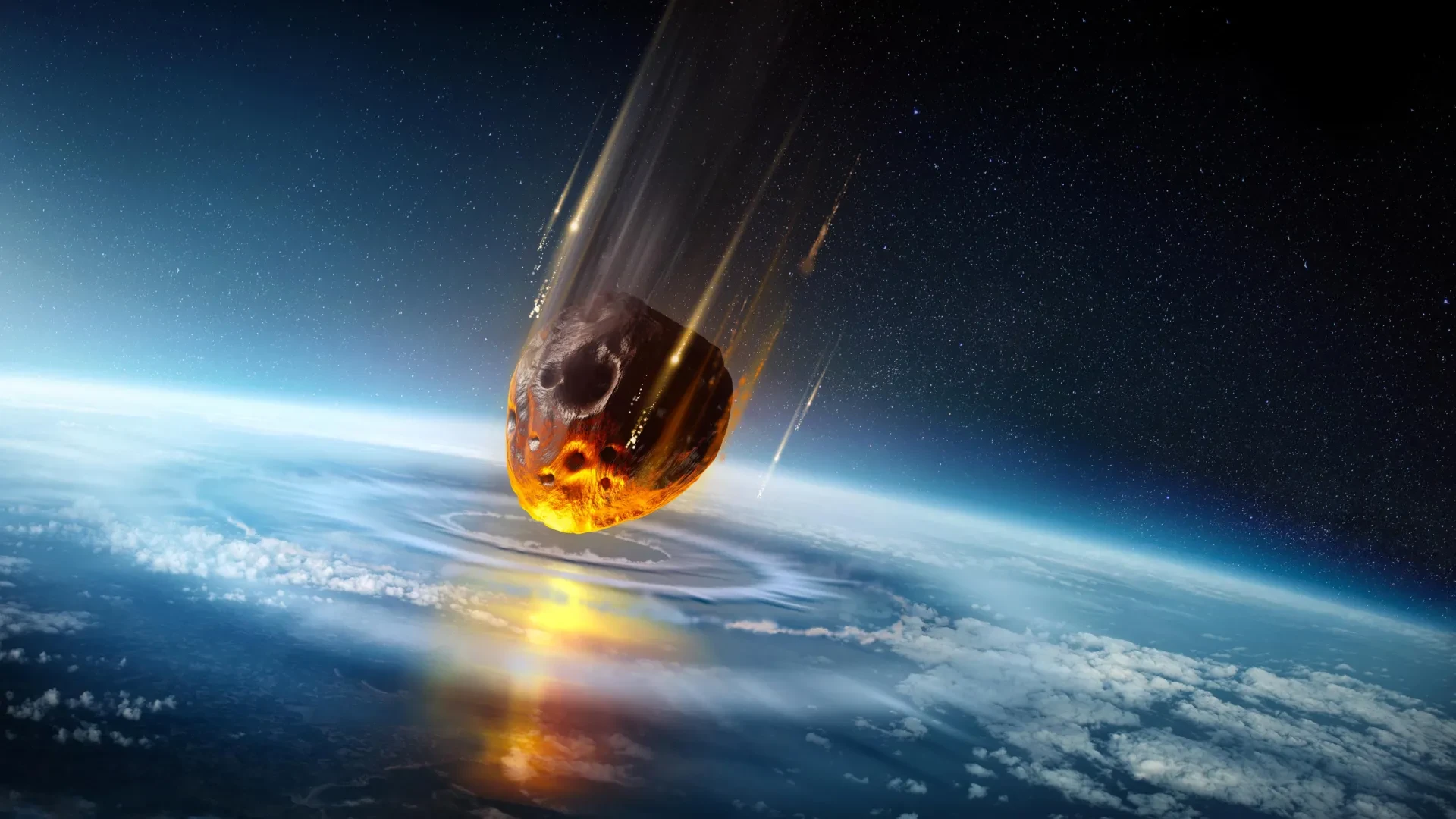
AUSTIN, Texas — In a discovery that sends ripples across the disciplines of planetary science and evolutionary history, researchers at The University of Texas at Austin have fundamentally rewritten a pivotal chapter of Oklahoma’s ancient geologic past. For decades, the buried Ames impact structure—a massive, miles-wide ring of scarred earth hidden deep beneath the surface of Major County, Oklahoma—was heralded as a cornerstone piece in a grand cosmic puzzle. Believed to be roughly 467 million years old, the crater was long categorized as a prominent casualty of the Ordovician Meteor Event, a hypothesized epoch when Earth may have briefly sported a Saturn-like ring of celestial debris.
However, a meticulous new geochronological study led by UT Austin scientists has shattered this timeline. By extracting and analyzing microscopic mineral crystals from rock cores retrieved deep beneath the Oklahoma topsoil, the research team has determined that the cataclysmic impact actually occurred approximately 370 million years ago, during the Late Devonian period.
This drastic correction lops nearly 100 million years off the crater’s previously assumed age. In doing so, it forces geologists, paleontologists, and astrobiologists to completely re-evaluate the sequence of major terrestrial and cosmic events. The revised date abruptly removes the Ames crater from the Ordovician period and plants it squarely in the timeline of the Frasnian-Famennian mass extinction—a devastating, complex biological crisis that wiped out a massive proportion of marine life on Earth.
Published in the journal Meteoritics & Planetary Science, the breakthrough serves as a cautionary tale about the pitfalls of relying solely on biological proxies in historical geology. It also demonstrates the unparalleled power of modern radiometric dating techniques when paired with cutting-edge nanoscale imaging.
Main Facts: Unveiling the Ames Anomaly
Buried under hundreds of feet of sedimentary rock, the Ames impact structure is invisible to the casual observer traversing the rolling Oklahoma landscape. Yet, beneath the town of Ames, the subsurface tells a tale of unimaginable violence. Stretching for miles underground, the circular depression is not only a scientific curiosity but also an economic powerhouse; the highly fractured, brecciated rock formations of the crater serve as a major reservoir for petroleum production, yielding rich deposits of oil and gas that have drawn commercial interest for decades.
Structurally, the site is a classic complex impact crater featuring a central uplift surrounded by a deep annular trough. For generations, geologists understood that an extraterrestrial body—likely an asteroid measuring several hundred meters across—had slammed into a shallow, ancient sea that once covered North America.
The core findings of the new UT Austin study fundamentally alter our understanding of when that cataclysm took place:
- The Revised Age: The impact occurred approximately 370 million years ago, during the Late Devonian epoch, rather than the Middle Ordovician.
- The Methodology: Researchers utilized uranium-lead (U-Pb) dating of zircon crystals extracted from granite altered by the shock of the impact.
- The Implications: The crater is now temporally linked to the Frasnian-Famennian extinction event, shifting its significance from the origins of Ordovician biodiversity to the catastrophic biotic bottlenecks of the Late Devonian.
- The Correction: The previous age estimate was based on fossilized micro-teeth from conodonts (ancient eel-like chordates), which researchers now realize were residual, pre-existing biological materials churned up and redeposited during the later impact event.
Chronology: From the Ancient Impact to Modern Discovery
To understand the magnitude of the UT Austin revision, scientists must look at the timeline of both the geological event itself and the scientific journey that led to its recent misinterpretation and subsequent correction.
Phase 1: The Devonian Cataclysm (C. 370 Million Years Ago)
Long before vertebrate life had successfully colonized the terrestrial landscape in earnest, a massive asteroid or comet plunged through Earth’s atmosphere and struck the shallow epicontinental seas covering what is now the North American craton. The kinetic energy released upon impact vaporized rock, triggered global shockwaves, and excavated a colossal basin into the ancient granitic basement rock. Over subsequent millions of years, the crater filled with sediment, masking its violent origins beneath layer upon layer of later geological epochs.
Phase 2: The Discovery and the Ordovician Misassignment
Fast-forward to the late 20th century, when the subsurface structure was discovered and heavily exploited for its hydrocarbons. As geologists scrambled to understand the origin of the Ames structure, they turned to biostratigraphy to date it. Trapped within the impact-affected sediments were microscopic fossils of conodonts—extinct, tooth-like microfossils commonly used as index fossils.
Because the conodont species recovered from the impact-associated rocks belonged exclusively to the Middle Ordovician period (roughly 467.5 million years ago), researchers naturally concluded that the impact must have occurred during that same window. This chronological placement made Ames a crucial data point in support of the "Ordovician Meteor Event" hypothesis, which argued for a massive, solar-system-wide spike in meteorite bombardment across North America and Baltoscandia.
Phase 3: The Spark of New Research (2018–Present)
The seeds of the recent revision were planted by Andrew Parisi, a graduate student at UT Austin’s Jackson School of Geosciences. Recognizing anomalies in how the crater’s history fit into broader regional geology, Parisi traveled to the Oklahoma Geological Survey to obtain precious rock core samples recovered directly from the Ames structure.
Working alongside faculty mentors, Parisi successfully extracted zircon crystals from the granitic basement rocks altered by the impact. Although Parisi tragically passed away in 2018 before the research could be fully realized, his foundational extraction and analysis work set the stage for the team to complete the study. Following additional collaborative efforts—including input from co-author Michael Brookfield, who also passed away prior to publication—the team utilized advanced analytical facilities at UT Austin and NASA to unlock the true history locked inside the crystals.
Supporting Data: Inside the Zircon Laboratory
How do geologists successfully reverse a decades-old historical consensus built on peer-reviewed assumptions? The answer lies in the microscopic durability of zircon ($textZrSiO_4$) and the precision of modern geochronological tools.
Zircon is something of a geological time capsule. As it crystallizes from magma, it naturally incorporates trace amounts of uranium while systematically rejecting lead. Over eons, the unstable isotopes of uranium radioactive-decay into stable isotopes of lead at a known, immutable half-life. By measuring the ratio of uranium to lead (U-Pb dating), scientists can pinpoint the exact moment a zircon crystal formed or was fundamentally reset by thermal or shock events.
Lead author Elizabeth Catlos, an associate professor in UT’s Department of Earth and Planetary Sciences, noted the relentless consistency of the new data. "No matter what technique we used, it was coming back to this younger signal," she explained. Every analytical run on the Ames core samples pointed unequivocally to the Late Devonian, obstinately ignoring the Middle Ordovician timeline.
To confirm that the zircons were genuinely responding to a hyper-velocity meteorite impact rather than a secondary thermal event like regional metamorphism, the research team partnered with NASA. They utilized advanced imaging techniques, including:
- Cathodoluminescence (CL): A microscopy method that reveals internal growth zoning, structural damage, and recrystallization textures within mineral grains.
- Electron Backscatter Diffraction (EBSD): A technique used to analyze crystal lattice orientations at the microscale.
When subjected to the incomprehensible pressures and temperatures of a meteor impact, zircon crystals undergo distinct structural deformation and recrystallization. The NASA-backed imaging confirmed that the Ames zircons bore the unmistakable microstructural scars of a hyper-velocity shock event, proving that the U-Pb clocks had been reset precisely at the moment of collision 370 million years ago.
Official Responses and Expert Perspectives
The academic community has received the study with a mix of shock and validation, as it highlights the inherent risks of relying on indirect dating methods without corroborating physical-mineralogical data.
Danny Stockli, dean of the Jackson School of Geosciences and a co-author of the study, emphasized the technological leap that made this correction possible.
"These small crystals allow us to go back in time and learn about the major changes to Earth’s ancient landscapes," Stockli remarked. He stressed the broader implications for North American geology, adding, "It would be great to do this for more of the meteor impact sites across the continent so we could get a more accurate timeline for these major events."
The transition of the Ames structure from the Ordovician to the Devonian effectively removes a heavy anchor from one hypothesis while weightily contributing to another. Catlos captured the tactical shift in geological accounting with a vivid metaphor:
"With this research, we’re basically taking a major pawn out of the Ordovician Meteor Event and dumping it into the Frasnian-Famennian event, and saying, ‘This is where this impact belongs.’"
The study also stands as a poignant posthumous tribute to its early contributors. The dedication of Andrew Parisi and Michael Brookfield underscores the collaborative, multi-generational nature of deep-earth science, where researchers often lay groundwork that takes years—and subsequent teams—to fully illuminate.
Implications: Re-evaluating Earth’s Evolutionary Crises
The consequences of this geographical reassessment extend far beyond the state borders of Oklahoma. They touch upon fundamental debates regarding what drives mass extinctions and how life on Earth responds to planetary-scale trauma.
1. The Frasnian-Famennian Extinction Puzzle
The Late Devonian period was a time of severe global stress for the biosphere. The Frasnian-Famennian boundary (approximately 372 million years ago) marked one of the "Big Five" mass extinction events in Earth’s history. While it did not match the sheer scale of the Permian-Triassic extinction, it decimated shallow-water marine ecosystems, particularly striking reef-building organisms such as stromatoporoids and corals, as well as various species of ammonoids and brachiopods.
For decades, paleoclimatologists and geologists have debated the primary driver of the Frasnian-Famennian extinction. Proposed culprits include:
- Massive global cooling or warming cycles.
- Ocean anoxia (widespread oxygen depletion in marine waters).
- Large-scale volcanic episodes (such as trap volcanism).
- Extraterrestrial impacts.
By demonstrating that a major hyper-velocity impact occurred right on the doorstep of the Frasnian-Famennian boundary, the UT Austin study revives the possibility that cosmic collisions played an underappreciated role in late Paleozoic biological crises. While scientists do not yet claim that the Ames impact alone triggered the global extinction, its close chronological alignment makes it an essential variable in the equation.
2. The Fading Mirage of the "Ordovician Ring"
Conversely, the removal of the Ames crater from the Ordovician period deals a significant blow to the hypothesis of a Saturn-like ring of asteroid debris during the Middle Ordovician. That provocative theory was formulated largely because a high concentration of impact structures across North America and Europe appeared to cluster temporally around 467 million years ago.
If major impacts like Ames are systematically re-dated using modern radiometric techniques—and found to belong to entirely different geological eras—the statistical foundation supporting the "asteroid ring" hypothesis begins to fracture. It suggests that apparent clusters of impacts in the geological record may sometimes be illusions born of dating errors, misidentified proxy fossils, or coincidence, rather than a single, sweeping cosmic event.
3. A Blueprint for Future Re-examinations
Ultimately, the study serves as a clarion call for the geological community to re-examine other classic impact structures whose ages have long been taken for granted. Many impact craters around the globe were dated decades ago using rudimentary techniques, weathered biological samples, or relative stratigraphic positioning.
As teams apply high-resolution U-Pb geochronology and nanoscale shock-quartz/zircon imaging to other buried or eroded craters, the timeline of Earth’s bombardment history may experience further calibrations. Each corrected date brings scientists one step closer to resolving the eternal chicken-and-egg debate of Earth history: whether the most catastrophic chapters in the story of life were written by the fiery fury of the cosmos from above, or the restless, tectonic breathing of the planet from within.
