

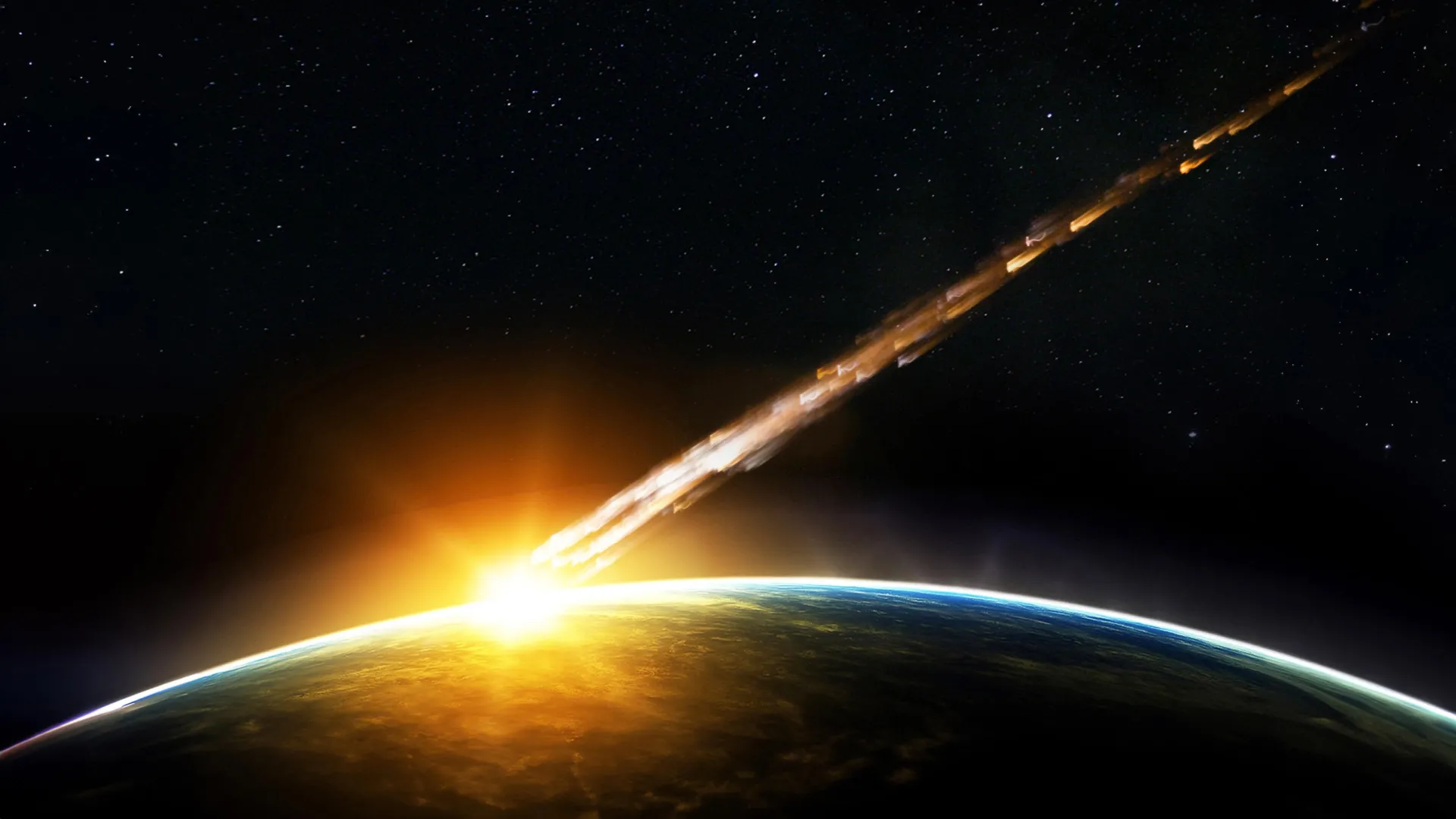
EDINBURGH — A scientific debate that has spanned more than two decades has finally reached a definitive conclusion. An international team of researchers has officially confirmed that the enigmatic Silverpit Crater, hidden hundreds of meters beneath the floor of the North Sea, is indeed the scar of an ancient asteroid impact.
The breakthrough—achieved by combining state-of-the-art seismic imaging, microscopic rock analysis, and advanced computer modeling—resolves one of marine geology’s most contentious mysteries. Published in the prestigious journal Nature Communications, the study identifies Silverpit as one of Earth’s exceptionally rare and well-preserved offshore impact structures, shedding new light on how extraterrestrial collisions have continually sculpted our dynamic planet over millions of years.
Led by Dr. Uisdean Nicholson of Heriot-Watt University in Edinburgh and supported by funding from the Natural Environment Research Council (NERC), the research team successfully hunted down the definitive "silver bullet" that had eluded geologists since the crater’s initial discovery in 2002.
Main Facts: Unveiling the North Sea’s Hidden Scar
The Silverpit Crater is located approximately 700 meters (2,300 feet) beneath the seabed of the southern North Sea, roughly 80 miles off the Yorkshire coast of England.
Measuring roughly three kilometers (1.9 miles) in diameter, the primary crater depression is encircled by an enormous, concentric ring of circular faults spanning an expansive 20 kilometers (12 miles). These fractures—or faults—occur when the Earth’s crust is subjected to massive, localized stress and displacement.
According to the new study, the crater was gouged out between 43 and 46 million years ago during the Eocene epoch by an asteroid measuring approximately 160 meters (525 feet) across. Approaching from the west at a shallow trajectory, the space rock struck the ancient marine environment with hypervelocity force, instantly excavating the seabed, blasting monumental volumes of debris into the upper atmosphere, and generating a catastrophic megatsunami that towered over 100 meters (330 feet) high.
The confirmation places Silverpit into an elite catalog of geological structures. While Earth has been bombarded by countless space rocks throughout its 4.5-billion-year history, only about 200 impact craters have been confirmed on land, with a mere 33 identified beneath the world’s oceans.
Chronology of a Two-Decade Scientific Controversy
To understand the magnitude of the recent breakthrough, one must retrace a contentious history of academic debate, shifting theories, and a controversial scientific vote.
2002: The Discovery
The Silverpit structure burst into the geological spotlight in 2002 when oil and gas industry geologists, analyzing commercial seismic survey data of the North Sea, stumbled upon the uncanny, bullseye-like concentric ring structure. Its circular morphology, central uplifted peak, and surrounding ring faults strongly mirrored the structural footprints of known hypervelocity impact craters elsewhere on Earth. At the time, proponents of the impact hypothesis argued that a cosmic collision was the most straightforward explanation for the anomalous shape.
The Skeptics’ Counter-Theories
However, the scientific community quickly fractured. Skeptics pointed out that unconventional terrestrial processes could sometimes mimic impact sites.
- Salt Tectonism: One prominent alternative theory suggested that thick underground layers of ancient Zechstein salt had shifted, dissolved, or migrated over time, causing the overlying sediment layers to collapse inward and form the circular depression.
- Volcanic Activity: Another group proposed that subterranean volcanic or hydrothermal activity had triggered localized structural collapse on the prehistoric seabed.
2009: The Formal Vote
The academic discord grew so profound that in 2009, geologists took the unusual step of holding a formal vote on the crater’s origin during a dedicated conference. As documented in the December 2009 issue of Geoscientist magazine, the majority of participating experts voted against the impact hypothesis, favoring terrestrial salt movement or collapse mechanisms instead. For over a decade, the conventional wisdom leaned toward a non-impact origin, leaving Silverpit stranded in scientific limbo.
The Modern Breakthrough
The stalemate persisted until a research team equipped with next-generation technology decided to take a fresh look at the archives. By applying modern, high-resolution seismic imaging tools and securing physical rock samples from nearby oil exploration wells, Dr. Nicholson and his colleagues managed to extract the microscopic clues needed to overturn the 2009 consensus once and for all.
Supporting Data and Methodology: The "Needle in a Haystack"
Proving an ancient impact beneath hundreds of meters of marine sediment requires extraordinary evidence. To build an airtight case, the research team synthesized three distinct lines of scientific inquiry:
- Next-Generation Seismic Imaging: Seismic data functions similarly to a medical ultrasound scan for the Earth. By bouncing acoustic waves off underground geological strata and measuring how they reflect back, researchers can construct high-definition three-dimensional images of subsurface rock layers. The newly available seismic data offered an unprecedented, razor-sharp view of Silverpit’s internal architecture, confirming that its deformation profile matched the physical dynamics of a high-speed projectile strike rather than gradual salt migration.
- Microscopic Mineral Analysis: The definitive turning point came from rock fragments recovered from an oil exploration well drilled near the crater site. Sedimentologists analyzed these fragments at a microscopic level and identified rare "shocked" quartz and feldspar crystals trapped at the exact geological depth of the crater floor.
- Computer Simulations: Dr. Gareth Collins of Imperial College London developed advanced numerical models to simulate hypervelocity impacts. These simulations allowed the team to virtually replicate the collision of a 160-meter asteroid and test whether the resulting shockwaves and material displacement matched the observed structure of Silverpit. The models aligned perfectly with the physical data.
The Significance of Shocked Minerals
"We were exceptionally lucky to find these—a real ‘needle-in-the-haystack’ effort," noted Dr. Nicholson. Shocked minerals are widely regarded by geologists as the gold standard of impact verification. When an asteroid strikes the Earth at speeds of several miles per second, the resulting shock pressures far exceed anything produced by standard terrestrial geology, volcanoes, or tectonic shifting. This immense force permanently alters the microscopic crystalline lattice of quartz and feldspar, leaving behind a distinct structural fabric that can only be forged by an extraterrestrial impact.
Official Responses and Expert Perspectives
The resolution of the Silverpit debate has brought immense satisfaction to the geologists who spent years defending the impact hypothesis against widespread skepticism.
Dr. Uisdean Nicholson, a sedimentologist at Heriot-Watt University’s School of Energy, Geoscience, Infrastructure and Society, emphasized the violence of the event unlocked by the new data:
"Our evidence shows that a 160-meter-wide asteroid hit the seabed at a low angle from the west. Within minutes, it created a 1.5-kilometer-high curtain of rock and water that then collapsed into the sea, creating a tsunami over 100 meters high."
A tsunami wave soaring 100 meters (more than 330 feet) high would dwarf many modern skyscrapers, sending catastrophic walls of water crashing across surrounding prehistoric coastlines and shallow marine shelves.
Professor Gareth Collins of Imperial College London, who attended the contentious 2009 debate where the impact hypothesis was initially voted down, expressed vindication over the new findings:
"I always thought that the impact hypothesis was the simplest explanation and most consistent with the observations. It is very rewarding to have finally found the silver bullet. We can now get on with the exciting job of using the amazing new data to learn more about how impacts shape planets below the surface, which is really hard to do on other planets."
Broader Implications: Earth, Oceans, and Planetary Science
The confirmation of the Silverpit Crater holds profound implications for several branches of earth and planetary science, ranging from the mechanics of planetary erosion to the assessment of future cosmic risks.
Why Earth Erases Its Scars
Despite bearing the brunt of countless asteroid and comet impacts throughout its 4.5-billion-year lifespan, Earth retains a surprisingly sparse record of impact craters. This is largely due to the planet’s extreme geological activity. Unlike the Moon or Mars—which preserve impact scars for billions of years due to a lack of atmosphere, plate tectonics, and active weather—Earth is an aggressively dynamic world.
Erosion from wind and rain, chemical weathering, volcanic eruptions, and the continuous churning of continental and oceanic tectonic plates act as a geological "reset button," systematically erasing the scars of ancient impacts. Offshore craters like Silverpit are particularly difficult to study because they are subsequently buried beneath thick blankets of marine sediment.
Joining Elite Company
With its origins firmly established, Silverpit joins a distinguished group of globally recognized impact structures:
- The Chicxulub Crater: Located off the coast of Mexico’s Yucatan Peninsula, this massive underwater and onshore crater is universally linked to the Cretaceous-Paleogene extinction event that wiped out the nonavian dinosaurs roughly 66 million years ago.
- The Nadir Crater: Another recently confirmed underwater impact structure discovered off the coast of West Africa, highlighting how much remains to be uncovered beneath the world’s oceans.
Looking to the Future
By treating Silverpit as a pristine natural laboratory, researchers can model how subsurface impact structures form, evolve, and become buried over tens of millions of years. This knowledge not only deepens our understanding of Earth’s ancient history and climate-altering catastrophes but also refines the predictive models scientists use to evaluate potential asteroid threats in the future.
As marine geologists turn their seismic instruments toward other anomalies hidden beneath the global ocean floor, the story of Silverpit proves that beneath layers of mud and time, Earth still holds breathtaking secrets waiting to be uncovered.
