

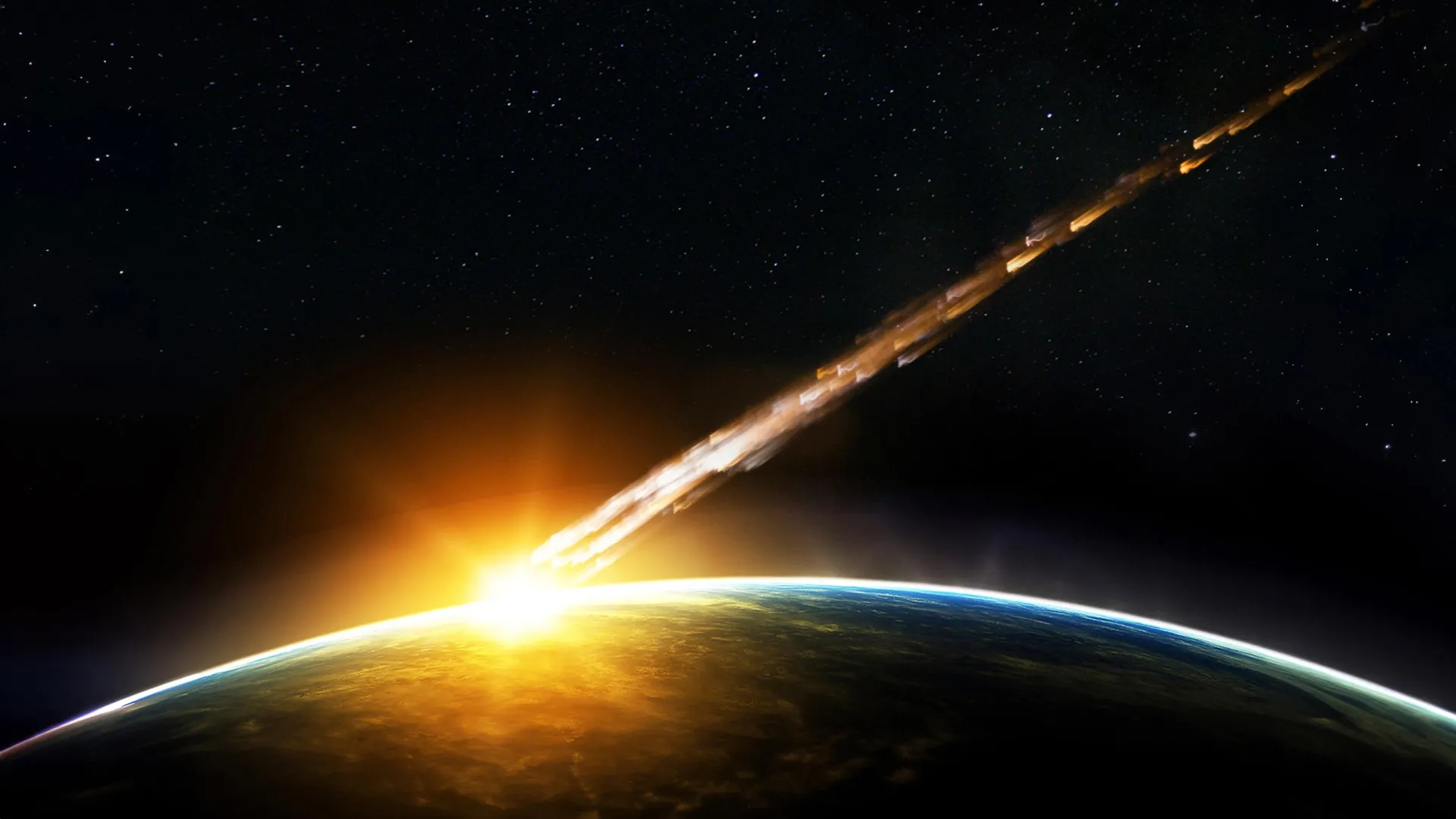
EDINBURGH — A scientific controversy that has quietly simmered in the geological community for more than twenty years has finally reached a definitive conclusion. Researchers have definitively confirmed that the enigmatic Silverpit Crater, hidden nearly half a mile beneath the floor of the North Sea, is indeed the scar of an ancient asteroid impact.
The breakthrough, spearheaded by a research team at Heriot-Watt University in Edinburgh and published in the prestigious journal Nature Communications, resolves a fierce debate that once divided generations of geoscientists. By combining state-of-the-art seismic imaging, microscopic analysis of rare mineral samples recovered from an offshore oil well, and advanced computer modeling, the scientists have unearthed the ultimate "silver bullet"—conclusive proof that a space rock slammed into the region between 43 and 46 million years ago.
The finding not only closes the book on a long-standing academic dispute, but it also elevates Silverpit to a position of immense global significance. It is now officially recognized as one of Earth’s exceptionally rare and well-preserved submarine impact craters, offering a pristine window into the catastrophic forces that have periodically reshaped our planet.
Main Facts: The Anatomy of an Offshore Anomaly
Located approximately 80 miles off the Yorkshire coast, the Silverpit Crater is buried beneath 700 meters (2,300 feet) of sediment on the southern North Sea seabed. The main crater depression spans roughly three kilometers (1.9 miles) in diameter, but it is encircled by a much larger, concentric ring of faults stretching outward to about 20 kilometers (12 miles).
These geological faults—fractures in rock layers caused by intense structural stress—have been the epicenter of a two-decade puzzle. While the structure’s circular geometry, central peak, and concentric ring faults strongly mirrored known impact sites around the globe, alternative theories persisted. For years, skeptics argued that the crater-like feature could have been forged by terrestrial processes, such as the subterranean migration of ancient salt deposits or volcanic collapses beneath the seabed.
The new study dismantles these terrestrial hypotheses. Armed with ultra-high-resolution seismic data, which operates much like a medical ultrasound for the Earth’s crust, the research team obtained an unprecedented look at the crater’s internal architecture. Crucially, the discovery of "shocked" quartz and feldspar crystals in rock fragments retrieved from a nearby oil exploration well provided the smoking gun. These microscopic minerals exhibit unique structural fabrics that can only be forged under the unimaginable temperatures and pressures of a hypervelocity impact.
Chronology: From 2002 Discovery to 2024 Breakthrough
To understand the magnitude of the latest discovery, one must trace the timeline of the Silverpit Crater from its initial discovery to the present day:
- 2002: Geologists analyzing commercial seismic data gathered during oil and gas exploration in the southern North Sea stumble upon the bizarre, multi-ringed circular depression. The structure is named the "Silverpit Crater," in honor of the Silver Pit, a nearby submarine valley. The discovery is heralded as a potential British impact crater.
- 2002–2009: A vigorous academic debate erupts. While impact modelers argue the structure bears all the hallmarks of an extraterrestrial collision, traditional geologists point to salt tectonics and subsurface fluid migration as more plausible, earthbound explanations for the circular faulting.
- 2009: The controversy reaches a formal climax. During a dedicated session and subsequent vote documented in the December 2009 issue of Geoscientist magazine, the majority of attending geologists formally reject the impact hypothesis, casting the crater into scientific limbo.
- 2010s: Advanced seismic technologies begin to emerge, but access to high-resolution data over the Silverpit site remains limited. The mystery languishes as a textbook case study in scientific uncertainty.
- Recent Years: Funded by the Natural Environment Research Council (NERC), a renewed investigation is launched. Led by Dr. Uisdean Nicholson of Heriot-Watt University, the team pairs next-generation 3D seismic imaging with archival well-core samples and numerical impact simulations.
- Present Day: The researchers publish their findings in Nature Communications, definitively proving the impact hypothesis and closing the 22-year debate.
Supporting Data: Unlocking the Physics of an Ancient Cataclysm
The multidisciplinary approach utilized by the Heriot-Watt team yielded a treasure trove of quantitative data that paints a vivid picture of the day the asteroid struck.
According to the computer simulations and geological analysis, the impactor was a celestial body roughly 160 meters (525 feet) in wide—roughly the height of a modern skyscraper. Traveling at hypervelocity speeds of several miles per second, the asteroid approached the region from the west at a remarkably shallow angle.
When it struck the ancient seabed 43 to 46 million years ago, the energy release was cataclysmic:
- The Initial Blast: The impact instantly excavated the three-kilometer-wide crater, pulverizing bedrock and vaporizing seawater.
- The Ejecta Curtain: Within minutes, the collision hurled a towering 1.5-kilometer-high curtain of rock, sediment, and water into the atmosphere.
- The Megatsunami: As the massive wall of displaced material collapsed back into the ocean, it generated an apocalyptic mega-tsunami surging more than 100 meters (330 feet) high—dwarf-sized waves compared to modern ocean swells, capable of devastating coastlines hundreds of miles away.
The definitive proof, however, lay hidden at the microscopic level. Dr. Uisdean Nicholson and his colleagues analyzed core samples from an old oil exploration well that happened to pierce the vicinity of the crater floor. Miraculously, they recovered grains of quartz and feldspar bearing the unmistakable microscopic signatures of shock metamorphism. These minerals require shock pressures tens of thousands of times greater than atmospheric pressure to form—pressures that cannot be replicated by volcanism, tectonics, or salt movement.
Official Responses and Expert Perspectives
The resolution of the Silverpit mystery has drawn enthusiastic praise from the international geoscience community, particularly those who spent years defending the impact model against a skeptical majority.
Dr. Uisdean Nicholson, a sedimentologist at Heriot-Watt University’s School of Energy, Geoscience, Infrastructure and Society and lead author of the study, emphasized the rarity and significance of the find.
"New seismic imaging has given us an unprecedented look at the crater," Dr. Nicholson stated. "Samples from an oil well in the area also revealed rare ‘shocked’ quartz and feldspar crystals at the same depth as the crater floor. We were exceptionally lucky to find these—a real ‘needle-in-a-haystack’ effort. These prove the impact crater hypothesis beyond doubt, because they have a fabric that can only be created by extreme shock pressures."
Reflecting on the scale of the event, Nicholson added: "Our evidence shows that a 160-meter-wide asteroid hit the seabed at a low angle from the west. Within minutes, it created a 1.5-kilometer-high curtain of rock and water that then collapsed into the sea, creating a tsunami over 100 meters high."
Professor Gareth Collins of Imperial College London, a co-author of the study who also attended the contentious 2009 debate where Silverpit’s impact origin was voted down, expressed profound satisfaction with the outcome. Professor Collins developed the numerical models used to simulate the impact physics and match them against the observed geological structures.
"I always thought that the impact hypothesis was the simplest explanation and most consistent with the observations," Professor Collins remarked. "It is very rewarding to have finally found the silver bullet. We can now get on with the exciting job of using the amazing new data to learn more about how impacts shape planets below the surface, which is really hard to do on other planets."
Implications: A Natural Laboratory for Planetary Science
The confirmation of the Silverpit Crater carries wide-ranging implications for both terrestrial geology and planetary science.
Despite the constant bombardment of asteroids and comets throughout Earth’s 4.5-billion-year history, the planet’s surface is remarkably adept at erasing these cosmic scars. Earth is a dynamic, living world governed by plate tectonics, extensive erosion, weathering, and volcanism. These geologic processes act as a planetary eraser, destroying or burying the vast majority of impact structures.
To date, scientists have confirmed only about 200 impact craters on land, and a mere 33 beneath the global oceans. The addition of a definitively proven, exceptionally well-preserved submarine structure like Silverpit expands this elite catalog.
By taking its place alongside other famous impact sites—such as Mexico’s Chicxulub Crater, which spelled doom for the dinosaurs 66 million years ago, and the recently discovered Nadir Crater off the coast of West Africa—Silverpit provides researchers with a pristine natural laboratory.
Geologists can now use the high-resolution seismic data from the North Sea to model subsurface impact mechanics in unprecedented detail. Because studying subterranean crater deformation on other rocky bodies in our solar system, like Mars or the Moon, is notoriously difficult, Earth-bound analogues like Silverpit offer vital insights.
Ultimately, resolving the Silverpit debate does more than settle a decades-old academic grudge. It enhances our understanding of how cosmic impacts have sculpted Earth’s history across deep time, while refining the predictive models scientists rely upon to assess and prepare for potential asteroid threats in the future.
