

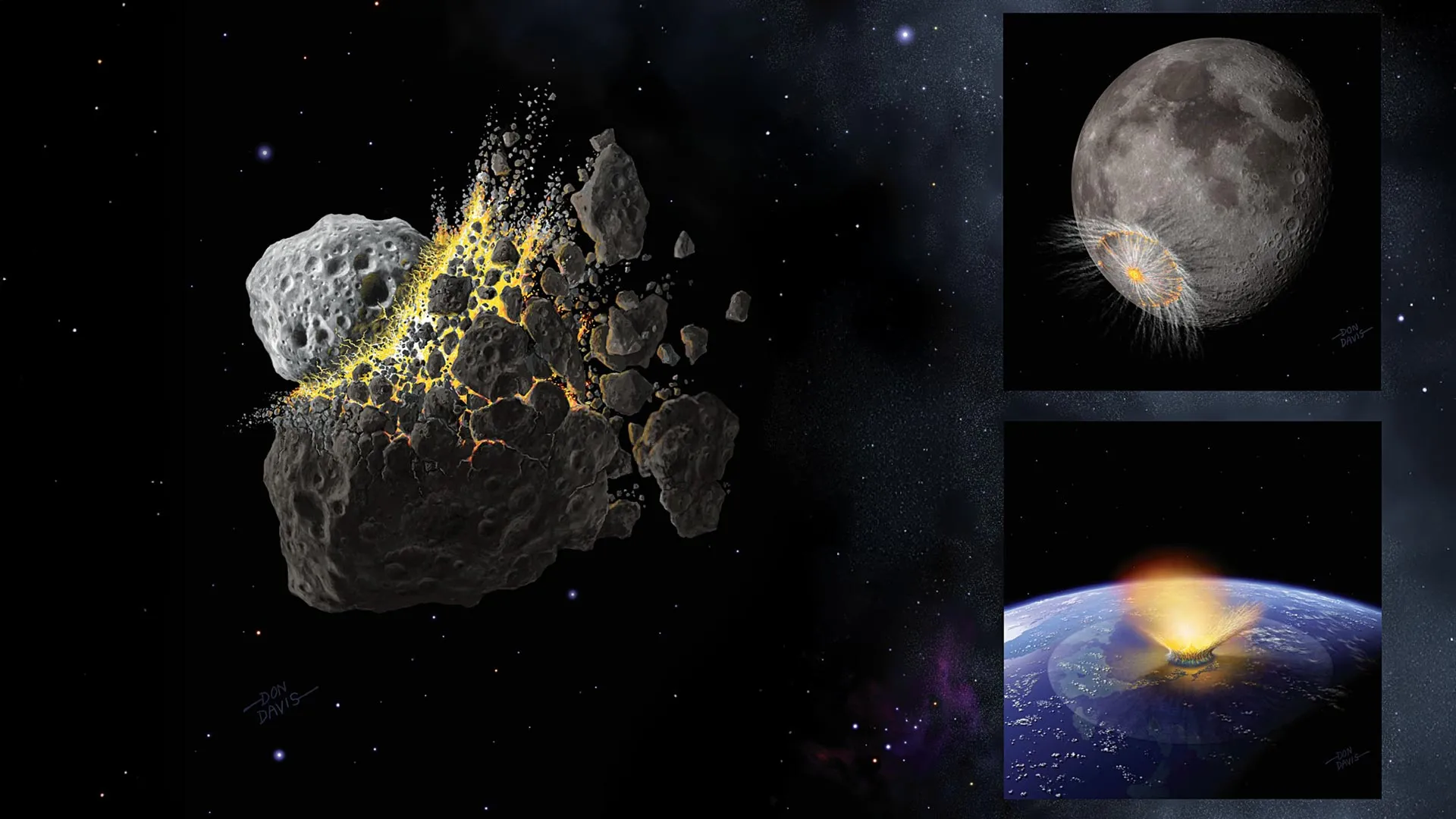
BOULDER, Colorado — Roughly 800 million years ago, a silent cataclysm unfolded in the vast expanse between Mars and Jupiter. In the main asteroid belt, a colossal carbon-rich parent body—measuring tens of kilometers across—suffered a catastrophic, violent collision.
The resulting explosion obliterated the ancient rock, scattering an unprecedented avalanche of planetary debris across the inner solar system. For more than 100 million years following the impact, Earth, the Moon, and Mars were subjected to an unrelenting cosmic bombardment.
According to a landmark study led by researchers at the Southwest Research Institute (SwRI), this ancient asteroid storm did far more than simply scar rocky surfaces. By pelting the inner planets with primordial debris, the event may have fundamentally altered planetary geology, catalyzed volcanic shifts, and potentially driven dramatic changes in Earth’s climate and early biosphere.
While scientists have long debated the cadence of impacts in the deep past, this new research offers a compelling, mechanically sound origin story for a mysterious spike in impacts that occurred during the Cryogenian period—an era on Earth defined by extreme global cooling and the dawn of complex life.
Main Facts: The Anatomy of a Belt-Wide Catastrophe
The core finding of the SwRI-led study centers on the Eulalia asteroid family, a known cluster of carbonaceous asteroids residing in the main belt. By employing advanced collisional and dynamical computer simulations, the research team traced the lineage of the Eulalia family backward in time to identify the precise moment of its birth.
The investigation yielded several critical facts:
- The Culprit: The breakup of a primitive, carbonaceous chondrite-like parent body roughly 800 million years ago.
- The Cosmic Escape Hatch: The parent asteroid happened to reside on the perilous edge of the 3:1 mean motion resonance with Jupiter (known as the J3:1 resonance), a powerful gravitational gateway.
- The Scale of the Barrage: The destruction sent millions of fragments spiraling out of the main belt. Earth, boasting a larger surface area and stronger gravitational pull than its neighbors, absorbed the brunt of the storm, receiving roughly twenty times more impacts than the Moon.
- A Prolonged Siege: The onslaught was not a single, instantaneous storm. While half of the debris escaped into Earth-crossing orbits almost immediately, another 25% of the fragments were funneled into the resonance over the next 100 to 150 million years via the Yarkovsky effect.
- Planetary Consequences: The impact surge correlates temporally with a mysterious spike in lunar crater ages, seismic and volcanic shifts on Mars, and severe global climate shifts on Earth.
Chronology: The Timeline of a 150-Million-Year Bombardment
To understand how a single collision millions of miles away could trigger a geological and biological ripple effect across multiple worlds, scientists must look at the step-by-step chronology of orbital mechanics and planetary physics.
T-Minus Zero: The Shattering (approx. 800 Million Years Ago)
Two primitive asteroids collided in the main belt with unimaginable kinetic energy. The impact pulverized the parent body that would eventually give rise to the Eulalia family. Because this destruction occurred right on the precipice of Jupiter’s gravitational influence—where an asteroid completes three orbits for every one orbit of the gas giant—the system was primed for disaster.
Phase One: The Immediate Exodus (0 to 10 Million Years Post-Impact)
Due to the catastrophic nature of the breakup, nearly half of the newly liberated debris was instantly flung into unstable, elongated trajectories. Jupiter’s gravitational nudges cleared out the J3:1 resonance zone, acting as a cosmic firehose that sprayed high-velocity carbonaceous fragments directly into the inner solar system. Earth, Venus, the Moon, and Mars were suddenly exposed to a massive, sudden spike in impactors.
Phase Two: The Yarkovsky Drift (10 to 150+ Million Years Post-Impact)
Unlike a single-day meteor storm, this cosmic siege endured for epochs. As leftover fragments orbited the Sun, they absorbed sunlight and re-emitted it as infrared radiation. Because dark, carbonaceous asteroids absorb heat unevenly, this thermal radiation created a microscopic thrust known as the Yarkovsky effect. Over millions of years, this subtle pressure slowly nudged another quarter of the remaining Eulalia debris fields into the J3:1 resonance, extending the planetary bombardment for upwards of 150 million years.
Supporting Data: Reading the Cosmic Archive
Reconstructing an event that transpired nearly a billion years ago presents a formidable challenge, particularly for Earth.
Earth’s Erasure Machine
On Earth, geological evidence of ancient impacts is notoriously difficult to find. Plate tectonics constantly recycle the planet’s crust, subducting ancient seabeds deep into the mantle. Volcanism buries old surfaces beneath fresh layers of basalt and lava, while weathering, wind, and rain slowly erode exposed impact craters.
To date, scientists have linked only one major impact directly to a mass extinction on Earth: the Chicxulub impact of 66 million years ago, an enormous impact crater buried beneath Mexico’s Yucatán Peninsula that wiped out the nonavian dinosaurs. Anything older than 650 million years has been largely scrubbed from the terrestrial record.
The Moon as a Planetary Proxy
Because Earth destroys its own history, scientists turn to the Moon. Lacking plate tectonics, running water, or a substantial atmosphere, the lunar surface acts as a pristine, static archive of inner solar system history.
Previous studies examining lunar crater distributions and impact glass—glass beads formed when hypervelocity impacts melt surface rock and cool rapidly—revealed a distinct surge in lunar impacts roughly 800 million years ago. By matching the dynamical models of the Eulalia breakup with this lunar impact peak, researchers finally found a physical, mathematical bridge explaining how the inner solar system was peppered simultaneously.
Official Responses and Expert Perspectives
Dr. William Bottke, an executive director in the Solar System Science and Exploration Division at the Southwest Research Institute (SwRI) in Boulder, Colorado, and lead author of the study, emphasized the profound gap in our understanding of planetary evolution.
"The role impacts have played in shaping the origin and evolution of life in our solar system is poorly understood," Dr. Bottke noted. "The heavily cratered surface of the Moon serves as a reminder of the large impacts in Earth’s past, but so far, only the Chicxulub impact event 66 million years ago has been strongly linked to a specific effect on life, namely the mass extinction of the dinosaurs."
Explaining how scientists bypassed Earth’s active geology to solve the mystery, Bottke elaborated on the utility of the lunar record:
"These rare events, triggered by large, well-positioned collisions in the main asteroid belt, bombard all inner solar system worlds. So, evidence preserved on the Moon’s static surface can be used to infer what happened on Earth and Mars in ancient times."
Discussing the detective work behind the discovery, Bottke highlighted the role of advanced computational techniques:
"Our cosmic forensics team used collisional and dynamical models to link these to the formation of the Eulalia asteroid family, when a primitive carbonaceous chondrite-like object collided with another object. The location of the parent asteroid was key—it broke up on the brink of the gravitational 3:1 mean motion resonance with Jupiter."
Implications: Climate, Catastrophe, and the Cradle of Life
While the SwRI study stops short of definitively proving that the Eulalia asteroid storm caused Earth’s subsequent environmental transformations, the chronological alignment is too striking to ignore.
The peak of this prolonged 150-million-year bombardment coincided precisely with the Cryogenian period, an era marked by severe global cooling—often referred to as "Snowball Earth"—and radical shifts in marine chemistry and early biological evolution.
When massive carbonaceous asteroids slam into a planet, they deliver vast quantities of volatile materials, including water, carbon compounds, and dust. Furthermore, the sheer kinetic energy of impacts of this magnitude would have injected massive amounts of aerosols into the upper atmosphere, potentially blocking sunlight, suppressing global temperatures, and altering weathering rates across continental landmasses.
Beyond Earth, the implications extend to the Red Planet. Researchers point out that on Mars, a barrage of this scale would have triggered intense, widespread seismic shaking capable of fracturing planetary crusts. Intriguingly, this timeline matches a known historical surge in Martian volcanic activity, suggesting that high-energy impacts may have acted as geological kickstarters for internal planetary processes.
A New Paradigm for Planetary Science
Ultimately, this research bridges a vital missing chapter in the history of the inner solar system. It demonstrates that the asteroid belt is not merely a static ring of space debris, but a loaded gun.
When the right asteroid shatters in the right orbital neighborhood, the resulting shrapnel can reverberate across millions of miles, reshaping the destinies of entire worlds. As scientists continue to comb through lunar samples and refine impact models, the 800-million-year-old cataclysm serves as a humbling reminder: the story of Earth is inextricably bound to the violent, dynamic rhythms of deep space.
