

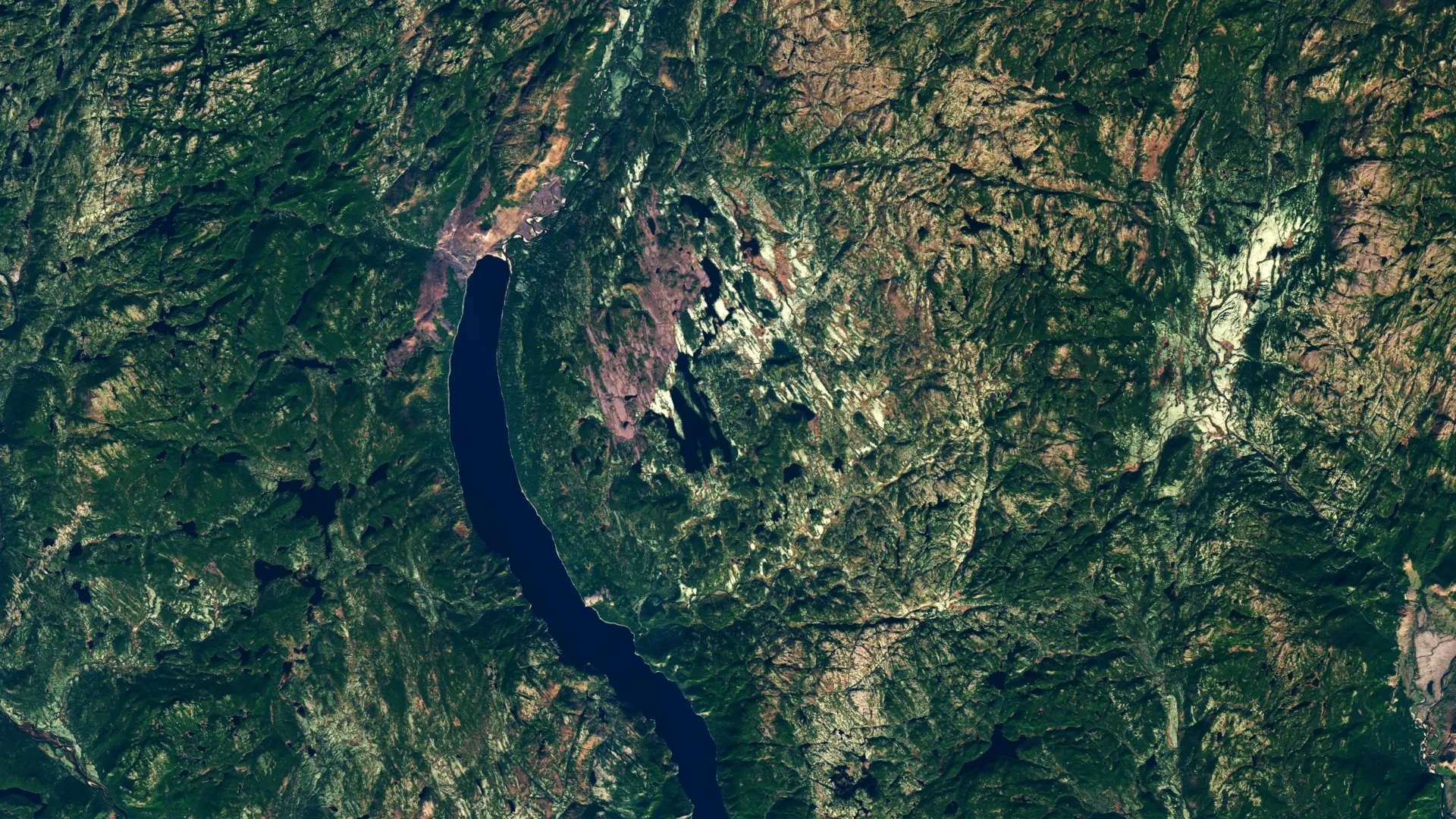
QUEBEC — What began as a quiet evening of leisure spent planning a wilderness getaway has culminated in a monumental geological discovery. While scanning online satellite maps for potential camping locations in the rugged terrain of Quebec, an amateur astronomer stumbled upon a peculiar geological anomaly. That casual observation has now been confirmed by leading planetary scientists as a massive, previously unrecognized meteorite impact crater measuring roughly 25 kilometers (16 miles) across.
Named Uhackatik—following respectful consultations with the local Innu Council of Ekuanitshit—this colossal structure represents the largest impact crater discovered anywhere on Earth since the identification of the 31-kilometer Hiawatha structure in Greenland in 2018. More than just a win for citizen science, the discovery offers a rare window into the ancient, violent history of our planet, reminding humanity of the invisible scars left by cosmic collisions deep within remote wilderness.
Main Facts: The Uhackatik Impact Structure
Earth’s dynamic geology is remarkably efficient at erasing its own history. Plate tectonics, erosion, and weathering constantly reshape the surface, hiding or destroying the evidence of ancient cosmic bombardments. Consequently, while geologists estimate that hundreds, if not thousands, of impact structures should scar our planet, only about 200 impact sites are officially confirmed today.
The newly authenticated Uhackatik crater expands this elite roster. Key details of the site include:
- Location: The remote Côte-Nord region of Quebec, centered around a lake area near Lake Marsal.
- Size: A complex impact structure spanning approximately 25 kilometers (16 miles) in diameter, featuring a distinct central uplift and high cliffs displaying columnar jointing.
- Age: Approximately 390 million years old, placing its formation deep within the Devonian period.
- Significance: It is the 11th known impact structure in the province of Quebec and the largest worldwide crater discovery in nearly a decade.
- Origin Evidence: Field discovery of rare "shatter cones"—unmistakable geological formations created exclusively by the unimaginable shockwaves of hypervelocity asteroid or comet impacts.
Had an impact of this scale occurred in modern times, the consequences would be apocalyptic. According to planetary geologists, the collision would unleash regional devastation capable of obliterating major metropolitan areas and triggering severe, global-scale climatic disruptions.
Chronology of a Discovery: From Satellite Screen to Remote Wilderness
The path from a pixelated anomaly on a computer screen to a globally recognized geological site unfolded over two years of persistence, international scientific collaboration, and grueling fieldwork.
2024: The Accidental Discovery
In 2024, amateur astronomer Joël Lapointe was preparing for a camping expedition into the isolated Côte-Nord region of Quebec. While utilizing online satellite imagery to scout terrain, map routes, and locate potential campsites, a perfectly circular topographical depression near Lake Marsal caught his eye.
Sensing that the formation looked too regular to be natural, Lapointe wondered if the depression could be the vestige of an ancient meteorite impact. Driven by curiosity, he reached out to geological specialists in both North America and Europe, sharing his coordinates and satellite captures.
Mid-to-Late 2024: Scientific Intrigue
Lapointe’s inquiry did not fall on deaf ears. The data caught the attention of a group of French researchers who formally presented the lake area as the center of a potential 11th impact structure in Quebec during a 2024 meeting of the Meteoritical Society.
The buzz eventually reached Dr. Gordon Osinski, a prominent planetary geologist at Western University in Canada who also serves as the director of the Impact Earth database. Initially, Osinski was profoundly skeptical. Anomaly reports from amateur enthusiasts are common, and terrestrial features like ancient volcanoes, glacial retreats, and erosion patterns can easily mimic circular impact basins from a satellite’s point of view. However, the sheer size and symmetry of the Quebec feature were too intriguing to ignore. Osinski resolved to see the site for himself, organizing a scientific expedition into the untamed Canadian wilderness for October 2025.
October 2025: The Expedition Into the Deep Wilds
Reaching the suspected impact site proved to be an immediate logistical nightmare. Osinski and his research team traveled to the remote sector via floatplane, but the aircraft was unable to approach the shoreline safely due to shallow, unpredictable waters. Carrying heavy geological equipment, scientific instruments, and survival gear, the team was forced to wade through 50 meters (165 feet) of freezing, murky water just to reach dry land.
Once ashore, the conditions deteriorated further. The landscape was swampy, rugged, and choked with aggressive insects and dense vegetation. Osinski, a seasoned field researcher whose career has spanned fieldwork across six different continents, later remarked that the location ranked as one of the single most punishing and difficult environments he had ever operated in.
Previous geological surveys of the area had cataloged local breccia rocks, but historical interpretations had misidentified them as a diatreme—a funnel-shaped volcanic structure created when explosive magma eruptions push a pipe of shattered rock upward.
However, by the second day of the expedition, the narrative shifted dramatically. As researchers combed through local rock outcrops, they made a definitive discovery: shatter cones. The presence of these fractured, cone-shaped rock patterns, formed only under the staggering pressures of hypervelocity impacts, definitively ruled out a volcanic origin. The anomaly was, without a doubt, an ancient impact crater.
Supporting Data and Geological Analysis
The confirmation of Uhackatik bridges a fascinating gap in Earth’s impact record. Laboratory analysis of the rock samples retrieved during the 2025 expedition indicates that the crater formed approximately 390 million years ago.
This chronology places the impact roughly 100 million years prior to a well-documented surge in Earth’s cratering rate. Scientists studying lunar data and terrestrial impact records have previously suggested that a massive uptick in asteroid collisions occurred later in Earth’s history, potentially driven by catastrophic collisions and disruptions within the main asteroid belt. The age of Uhackatik provides a valuable baseline data point for researchers attempting to map the frequency and rhythm of cosmic bombardment during the Paleozoic era.
Furthermore, the physical characteristics of the crater are textbook examples of complex impact structures. Unlike simple, bowl-shaped craters formed by smaller impacts, a 25-kilometer-wide impact generates enough energy to cause the floor of the crater to rebound, forming a central uplift. Combined with the high cliffs displaying columnar jointing found at the site, Uhackatik provides geologists with a rich, natural laboratory to study how Earth’s crust reacts to multi-gigaton cosmic impacts.
Official Responses and Cultural Context
The naming of the crater reflects a growing, welcome trend in modern science: honoring the Indigenous heritage and traditional stewards of the land where discoveries are made. Following respectful discussions and collaborations with the Innu Council of Ekuanitshit, researchers adopted the name Uhackatik for the structure.
While the scientific community views the impact origin as effectively confirmed, institutional bureaucracy requires a final procedural step. A dedicated committee of the Meteoritical Society is scheduled to review the data and grant formal, official recognition during its next assembly.
Despite his prominent role in planetary science—including serving on NASA’s first Artemis Geology Team to train astronauts for lunar exploration—Dr. Osinski noted that Uhackatik will likely remain strictly a site for remote study rather than astronaut training.
"We already have Kameshtashtan—also known as Mistastin Lake—a younger and much more accessible impact crater in Labrador that has historically hosted astronaut geology training," Osinski explained. The extreme isolation, lack of infrastructure, and brutal terrain of the Uhackatik region make regular expeditions entirely impractical for training programs.
For Joël Lapointe, the amateur astronomer whose curiosity sparked the multi-year scientific endeavor, the confirmation has been a life-changing triumph. In interviews with outlets like CityNews and Radio-Canada, Lapointe admitted he was "over the Moon" when researchers validated his satellite hunch.
"I encourage everyone to not ignore intuition or an observation, even if it isn’t part of your field of expertise," Lapointe said, embodying the quintessential spirit of citizen science.
Implications: The Power of Citizen Science
The discovery of the Uhackatik crater stands as a powerful testament to the democratization of science. In the digital age, high-resolution satellite mapping tools, open-source geographic information systems (GIS), and global data-sharing networks have transformed anyone with an internet connection and an inquisitive mind into a potential pioneer.
Space agencies like NASA actively foster this partnership through structured citizen science initiatives, inviting the public to help parse through astronomical and geological data that algorithms might otherwise overlook. Key programs include:
- The Daily Minor Planet Project: Allows volunteers to help astronomers sift through telescope imagery to identify and track asteroids and comets that could pose potential orbital threats to Earth.
- Impact Flash: Invites participants to examine dark, unilluminated regions of the Moon’s surface for brief, sudden flashes of light—direct evidence of meteoroid impacts occurring in real-time.
- Exoasteroids: Empowers citizen scientists to hunt for circumstellar debris disks and examine light curves for signatures of asteroids orbiting distant stars beyond our Solar System.
The story of Uhackatik proves that monumental scientific discoveries are not solely the domain of heavily funded institutions operating out of sterile laboratories. Sometimes, all it takes is a curious mind planning a simple camping trip, a willingness to look closer at the world around us, and the courage to share an observation with the experts. As researchers continue to analyze the ancient rocks of Quebec, Uhackatik will stand as a monument to human curiosity and a vivid reminder of our place in a dynamic, cosmic neighborhood.
