

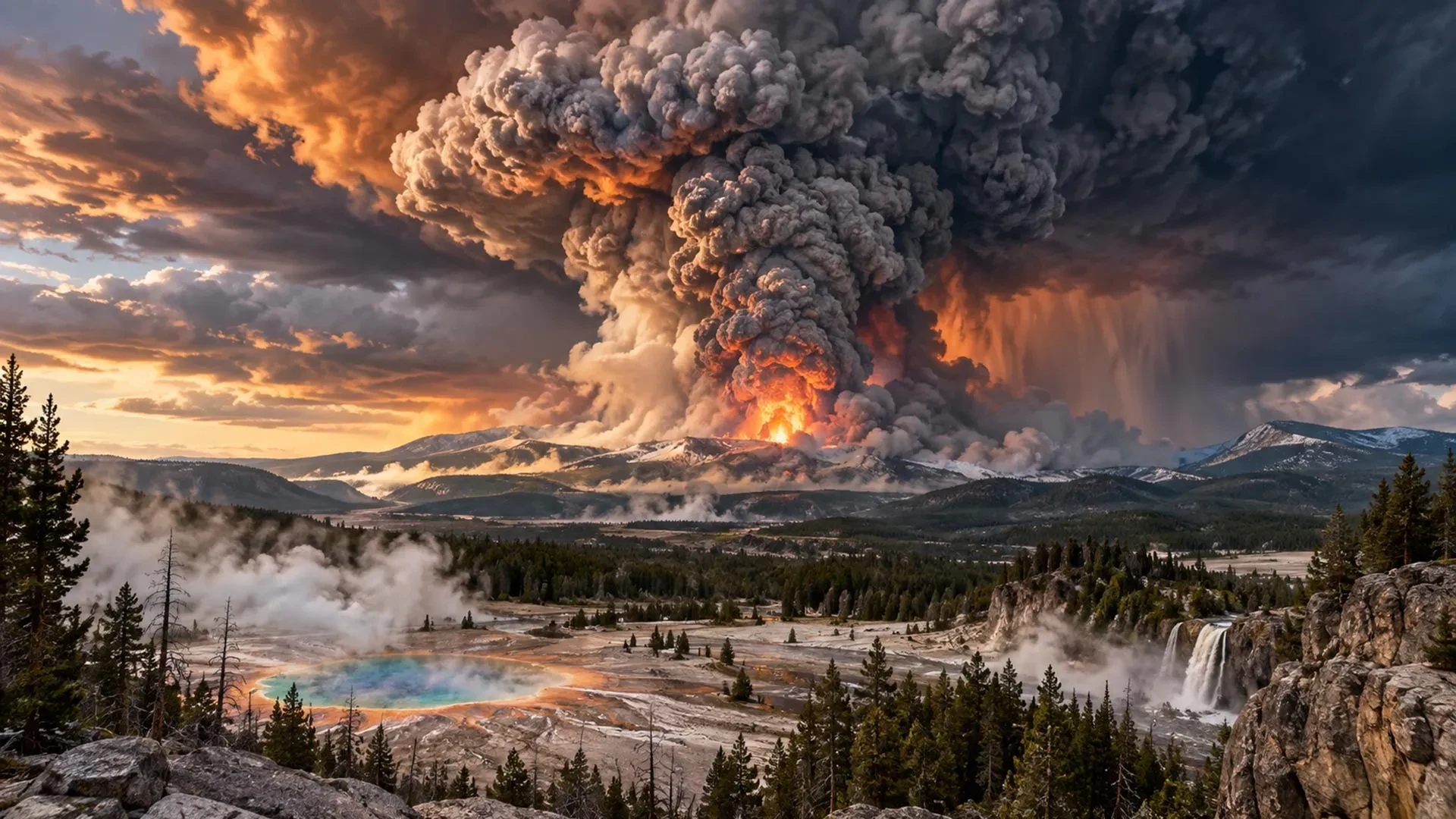
Six hundred and thirty-one thousand years ago—a mere blink of an eye in geological terms—catastrophe struck what is now north-western Wyoming. A series of unimaginable volcanic blasts shattered ecosystems for hundreds of kilometers, blanketing much of North America in thick ash and altering global climate patterns. This was a VEI-8 super-eruption of the massive volcanic system resting beneath Yellowstone National Park.
Back then, no human witnessed the cataclysm firsthand, as our ancestors had yet to reach the continent. Across the oceans, early humans likely wondered at hazier skies and unusually vivid sunsets as volcanic particles cooled their climate. Today, however, the consequences would be radically different. Modern civilization sits directly in the crosshairs of planetary vulnerability.
Based on current volcanological research, historical disaster modeling, and the collective insights of geohazard experts, what follows is a rigorous chronological examination of a worst-case scenario: a modern-day Yellowstone super-eruption.
Chronology of a Cataclysm: From First Tremors to Global Aftermath
T-2 Months: The First Spikes
Shortly after 6:00 AM, an analyst at the University of Utah Seismograph Stations notices a series of sharp, unusual anomalies slicing through the quiet, wavy lines of Yellowstone’s earthquake monitors. The tremors, detected beneath the park overnight, defy normal behavior.
Yellowstone is often mischaracterized as a "sleeping supervolcano." In reality, its geological plumbing never rests. A sophisticated, continuous monitoring network keeps watch around the clock: dense arrays of seismometers record localized earthquakes, while GPS stations, strainmeters, gas-sampling sensors, and satellite radar track minute deformations in the Earth’s crust.
Earthquake swarms are common in Yellowstone, which experiences thousands of tremors annually. However, this swarm is different. It is concentrated, tight, and—most concerningly—migrating upward. The analyst contacts colleagues across the Yellowstone Volcano Observatory (YVO). While individual indicators like ground deformation or minor gas emissions do not guarantee an eruption, the convergence of multiple anomalies prompts scientists to maintain a vigilant watch.
T-1 Month: Escalation and Advisory
Four weeks later, the warning signs multiply. The earthquake swarm continues its ascent, carving a narrow path directly beneath the 55-to-70-kilometer-wide caldera. GPS stations register opposing trajectories as the ground expands, and satellite radar confirms a broad area of accelerating surface uplift.
While Yellowstone has experienced false alarms before—such as an uplift episode between 2013 and 2014 driven by hydrothermal fluids rather than magma—the current data increasingly points toward fresh magma forcing its way into the crust.
To err on the side of caution, the YVO raises Yellowstone’s Volcano Alert Level from "normal" to "advisory." The U.S. Federal Emergency Management Agency (FEMA) quietly begins drafting large-scale evacuation frameworks. Concurrently, long-period seismicity and volcanic tremors intensify, signaling that pressurized fluids and magma are actively fracturing the rock.
T-2 Weeks: "It’s Gonna Blow"
With shallow earthquakes becoming incessant and ground deformation accelerating to centimeters per day, the YVO issues a severe public warning. The likelihood of a cataclysmic eruption within three weeks is now calculated at 85% to 92%. The alert level jumps to "watch," and the USGS issues an orange Aviation Color Code, rerouting commercial flights away from the region.
An evacuation zone is established, encompassing a 100-kilometer radius beyond the park boundaries and threatening to displace some 200,000 residents and countless tourists. World leaders face a profound dilemma: mount an unprecedented global humanitarian collaboration or retreat into fragmented, COVID-style national lockdowns. While the United States possesses the economic and logistical capability to coordinate massive resettlement, international hesitation regarding "volcano refugees" threatens global unity. Charities scramble, but the poorest and most marginalized are left with agonizing choices.
T=0: The Eruption Begins
Seismic monitoring instruments are instantaneously overwhelmed. Expanding clouds of steam burst from newly ruptured fissures as the warning levels hit maximum red.
The eruption commences not with a unified continental explosion, but through violent phreatomagmatic blasts. Rising magma intrudes into shallow hydrothermal systems, vaporizing immense quantities of trapped water. The resulting steam expansions fling mud, superheated vapor, and shattered rock kilometers into the sky.

Hours later, gas-rich magma heated to a searing 650°C–800°C breaches the fractured surface. Dissolved gases expand explosively, fragmenting the molten rock into pumice and ash while creating an eruption column towering 30 to 50 kilometers high—well above commercial flight paths.
As the colossal umbrella cloud spreads, collapsing eruption columns generate scorching pyroclastic density currents. These ultra-hot, fast-moving avalanches of gas, ash, and rock surge outward for tens of kilometers, annihilating everything in their path. Immediate human fatalities mount from the direct blast zone, vehicular accidents caused by blinding ash, and respiratory distress. Heavy ashfall soon plunges cities hundreds of kilometers away—from Denver to the Canadian border—into total darkness.
T+3 Days: Living in the Shadow
Three days into the cataclysm, North America buckles under relentless pulses of ash. Major regional hubs like Billings, Montana, disappear beneath meters of heavy volcanic debris. Salt Lake City and Boise receive tens of centimeters of accumulation.
Electrical grids fail as damp ash conducts electricity, short-circuiting power lines and substations. With the loss of electricity, water treatment facilities, sewage systems, fuel stations, and telecommunications collapse. Panic buying empties supermarket shelves nationwide.
T+2 Weeks to T+4 Months: Survival and Global Recession
Weeks blur into a prolonged humanitarian crisis. Dry ash clogs drainage systems, while rain transforms accumulated deposits into dense, suffocating slurries. Agriculture across at least eight vital states is decimated, choking national and global food supplies.
The economic fallout is catastrophic. Canada, Mexico, and Central American nations declare states of emergency due to trade disruptions and cross-border migration. Volcanic ash forces recurring airport closures globally, triggering a cascading banking, insurance, and recessionary crisis.
Simultaneously, stratospheric sulfur dioxide forms sulfate aerosols, reflecting solar radiation and instigating a multi-year global cooling episode. Central North America experiences dramatic temperature drops, challenging global agricultural yields.
T+10 Years: The Long Recovery
A decade after the initial blasts, humanity adapts. The global populace shifts toward localized, agrarian lifestyles—utilizing vertical farming, greenhouses, and small-scale root vegetable production to offset lost grain exports.
The human toll is staggering. Atmospheric silica from residual ash drives spikes in silicosis, lung cancer, and cardiovascular diseases, heavily straining compromised healthcare networks. Excess mortality analyses suggest that the eruption and its cascading impacts may account for 0.7 to 1.3 billion premature deaths globally.
Supporting Data and Volcanological Insights
- Scale and Frequency: VEI-8 eruptions are exceptionally rare. The last occurrence of this magnitude was the Toba super-eruption in Indonesia approximately 74,000 years ago.
- Atmospheric Impact: Climate modeling indicates that sulfur dioxide injections into the stratosphere would lower average global temperatures by roughly 1.5°C, with significantly harsher anomalies concentrated in the northern hemisphere.
- Demographic Strain: Pre-existing global vulnerabilities—such as the 4.4 billion people lacking safe freshwater access prior to the event—would likely expand, pushing populations toward increased disease vectors like cholera and malaria.
Official Responses and Strategic Preparedness
Managing a Yellowstone crisis requires unprecedented international cooperation. Agencies such as the USGS, YVO, and FEMA maintain continuous monitoring protocols to detect precursor anomalies months or years in advance. However, the sheer scale of a super-eruption exposes critical limitations in global disaster management:
- Evacuation Bottlenecks: Relocating hundreds of thousands of individuals from the immediate blast zone while managing secondary self-evacuations presents extreme logistical hurdles.
- Infrastructure Resilience: Modern electrical grids, transportation networks, and communication systems are highly vulnerable to fine, conductive volcanic ash. Hardening infrastructure remains an ongoing engineering challenge.
- Global Supply Chains: Because North American agriculture underpins global food security, international contingency planning must account for multi-year crop failures and severe economic contraction.
Implications for Human Civilization
A Yellowstone super-eruption would serve as the ultimate stress test for modern civilization. While the physical devastation within North America would be near-total and the global economic and demographic consequences would reverberate for generations, the resilience of the human species remains absolute.
As hypothesized by a distant, speculative future, life on Earth ultimately endures. The ash eventually settles, ecosystems regenerate, and the scars of cataclysm are subsumed by lush, persistent vegetation. A super-eruption can reshape the planet’s climate and society, but it cannot extinguish human tenacity.
