

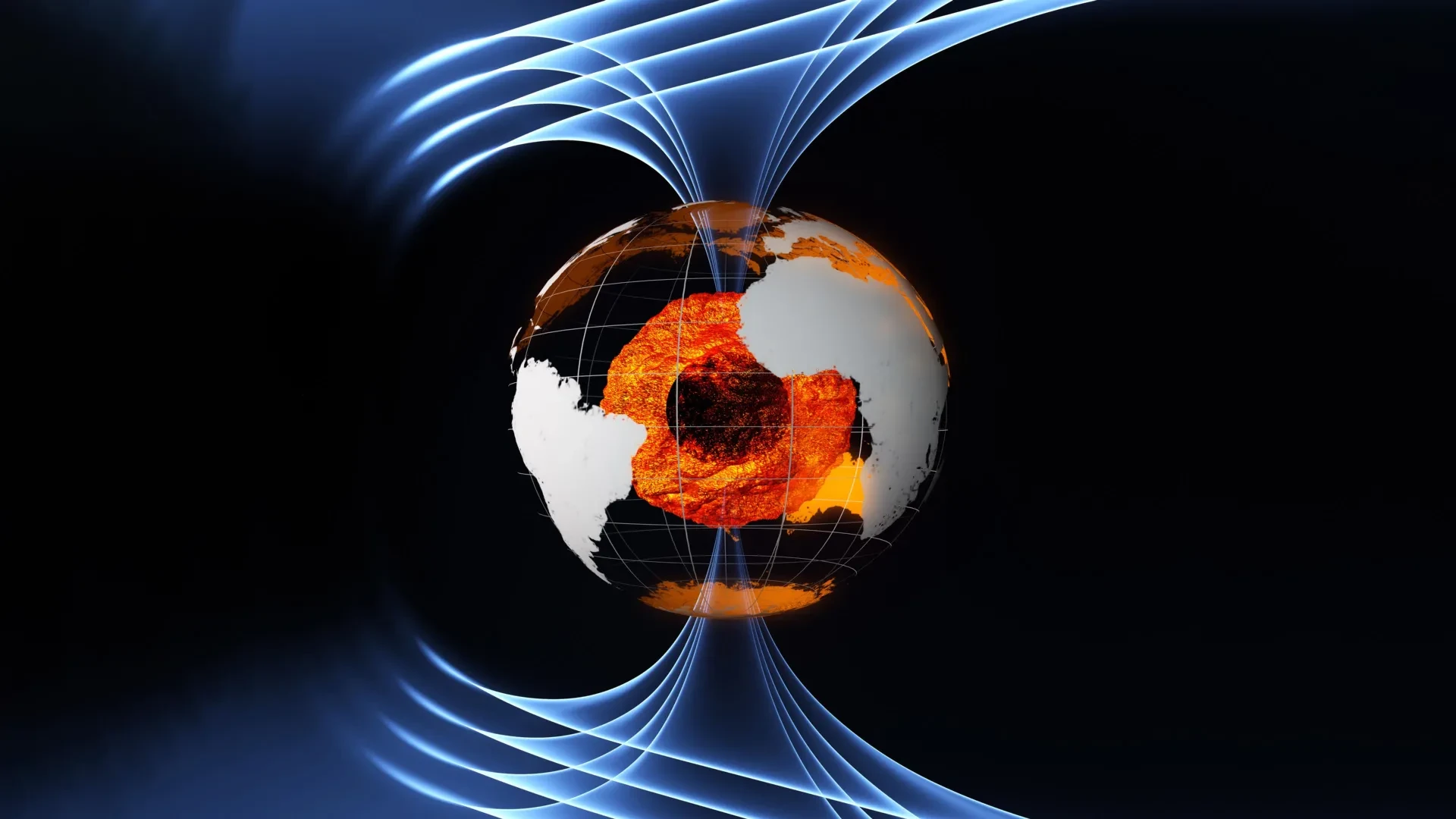
GLOBAL SCIENCE DESK — Deep beneath the crust of our planet, hidden roughly 2,200 kilometers below our feet, a vast and turbulent ocean of liquid iron is behaving in ways that continue to baffle the world’s leading geophysicists. For decades, the prevailing scientific consensus maintained that the swirling, electrically conductive fluid in Earth’s outer core flowed in a broadly predictable, predominantly westward pattern.
That long-held assumption was upended in 2010.
Through an unprecedented synthesis of ground-based observations and high-precision satellite data spanning nearly three decades, researchers have discovered that a massive volume of molten metal beneath the equatorial Pacific Ocean abruptly changed direction, reversing its trajectory to flow strongly eastward. The discovery not only challenges fundamental models of planetary geodynamics, but it also opens a new window into the violent, churning engine that generates Earth’s protective geomagnetic field.
Main Facts: A Paradigm Shift Beneath the Pacific
At the heart of this new research—published in the Journal of Studies of Earth’s Deep Interior—is the revelation that Earth’s deep interior is far more dynamic, volatile, and variable than previously believed.
The study, which integrates data collected between 1997 and 2025, tracked subtle variations in Earth’s magnetic field to map the movement of fluid iron near the core-mantle boundary. The findings center on a profound structural shift that occurred around 2010 beneath the central Pacific:
- The Reversal: A broad, regional expanse of iron-rich fluid transitioned rapidly from a weak westward circulation to a forceful eastward current.
- The Current Status: After peaking in intensity, this anomalous eastward flow has reportedly begun to weaken since 2020, introducing new questions regarding whether the event was a temporary fluctuation, part of a repeating multi-decadal oscillation, or an entirely new stable equilibrium for core circulation.
- The Inner Core Connection: Researchers have noted that the rise of the Pacific eastward flow coincided temporally with distinct behavioral shifts in Earth’s solid inner core, as inferred from modern seismology and geodesy, suggesting a previously under-appreciated mechanical coupling between the planet’s deepest layers.
Chronology of Discovery: Tracking the Core from Space (1997–2025)
Reconstructing the hidden mechanics of a region nearly impossible to physically sample requires a painstaking technological timeline. Because direct observation of the outer core is blocked by thousands of kilometers of dense mantle and crust, scientists must rely on "remote sensing" of Earth’s magnetic field—a field generated directly by the motion of the liquid core itself.
The Foundation Years (1997–2010)
For years, geophysicists studying magnetic data collected by ground observatories and early-generation satellites noted a relatively stable, large-scale westward drift of the outer core. During the late 1990s and 2000s, missions such as Germany’s CHAMP satellite and Denmark’s Ørsted mission provided increasingly granular data, establishing a baseline understanding of core dynamics that pointed toward steady, long-term circulation trends.
The 2010 Turning Point
Beneath the Pacific Ocean, the system broke its established pattern. In 2010, the localized flow dynamics underwent a rapid acceleration and reversal. Because this transition happened over the span of a single decade—a mere blink of an eye in geological terms—it disrupted the long-standing theory that core-scale fluid movements evolve only over centuries or millennia.
The Swarm Era and the 2017 Geomagnetic Jerk
In November 2013, the European Space Agency (ESA) launched its trio of Swarm satellites. Positioned in precise, coordinated polar orbits, the Swarm constellation was explicitly designed to untangle the complex web of magnetic signals originating from the core, crust, oceans, and upper atmosphere.
Data from the Swarm mission—supplemented by ESA’s CryoSat mission—allowed researchers to pinpoint the aftermath of the 2010 Pacific reversal and map subsequent phenomena, including the disruptive "geomagnetic jerk" of 2017. By continuously tracking the evolution of the field over more than a decade, the Swarm mission bridged the gap between historical ground observations and real-time spaceborne monitoring.
The Modern Baseline (2020–2025)
As the timeline of analysis extended toward 2025, researchers identified wave-like accelerations and rapidly shifting flow structures within the data. Most notably, the high-precision tracking revealed that the anomalous eastward flow beneath the Pacific has been decelerating since 2020, setting the stage for ongoing debates over whether the planet is witnessing the start of a recurring natural cycle.
Supporting Data and the Geodynamo Mechanism
To understand the significance of the 2010 reversal, one must examine the geodynamo—the physical process responsible for sustaining Earth’s magnetic field.
The outer core is a boiling, convective layer of liquid iron and nickel mixed with lighter elements. As heat escapes from the scorching inner core (which reaches temperatures comparable to the surface of the Sun) into the overlying rocky mantle, it drives thermal and compositional convection. Driven further by the Coriolis effect resulting from Earth’s rotation, these swirling columns of electrically conductive liquid act as a self-exciting dynamo, converting kinetic energy into magnetic energy.
Isolating Core Signals from Environmental Noise
Detecting changes in this subterranean engine from hundreds of kilometers above in space is a monumental data-processing challenge. The magnetic field measured by a satellite is a composite of several sources:
- The Core Field: Accounts for more than 95% of the total magnetic field measured at the surface, originating from deep-seated geodynamo processes.
- The Crustal Field: Permanent magnetization locked within the rocks of Earth’s solid outer shell.
- External Fields: Electric currents flowing in the ionosphere and magnetosphere, driven by interactions with solar wind.
ESA’s Swarm constellation overcame these hurdles through its three-satellite architecture (Alpha, Bravo, and Charlie flying in tandem). By comparing measurements taken at different altitudes and local times, scientists can mathematically subtract the "noise" generated by the sun and the crust. This leaves a pristine, high-resolution signal of the core-mantle boundary, exposing the abrupt fluid shifts that would otherwise remain invisible.
Official Responses and Expert Analysis
The publication of these findings has drawn widespread commentary from the international geophysics community, highlighting both the excitement and the mystery surrounding the deep Earth.
Frederik Dahl Madsen of the University of Edinburgh’s School of Geosciences, serving as the lead author of the study, emphasized the profound nature of the discovery:
"The large-scale flow reversal beneath the Pacific raises new questions about the behavior of Earth’s deep interior. Scientists now want to understand whether the reversal represents a short-lived fluctuation, part of a repeating oscillation, or a new stable equilibrium for core circulation. Continued monitoring will be essential to determine how the flow evolves over the coming years."
Addressing the deeper mechanical linkages within the planet, Madsen noted the striking synchronization between the outer core and the inner core:
"The rise of the strong eastward flow in the Pacific is contemporary with a change in behavior in the inner core, as inferred from geodesy and seismology, and we hypothesize that these changes in the deep interior are associated with the changes in flow beneath the Pacific."
From the mission operations perspective, ESA officials underscored the vital role that long-term space programs play in unravelling terrestrial mysteries. Anja Stromme, ESA’s Swarm Mission Manager, highlighted the unique capabilities of the constellation:
"Although Swarm was launched after the dramatic reversal event of 2010, it has provided high-precision data that tell us about Earth’s inner core in the period that followed. Importantly, Swarm provides continuous global coverage over many years, allowing scientists to track how core dynamics evolve over time rather than relying only on ground-based magnetic observatories. Long-duration satellite magnetic measurements allow researchers to follow changes in the geodynamo in near-real-time and improve models of Earth’s magnetic field evolution. Future observations from missions such as Swarm will play a crucial role."
Echoing these sentiments, Elisabetta Iorfida, ESA’s Swarm Mission Scientist, pointed out how the research shatters outdated paradigms of core stability:
"This study shows that regional changes can emerge rapidly within just a decade. The findings may also help scientists investigate possible interactions between Earth’s outer core, inner core, lower mantle and, therefore, give more insights into the core-mantle boundary, which is a critical region for deep Earth dynamics. This research raises intriguing questions about how Earth’s deepest layers are dynamically connected. As the magnetic field continues to evolve, satellite missions are providing an increasingly detailed view of the dynamic processes unfolding deep inside our planet, revealing that Earth’s core may be far more variable and complex than once believed."
Implications: Why Earth’s Core Matters to Life on the Surface
While the turbulent movements taking place thousands of kilometers beneath the Pacific Ocean pose no direct physical threat to human populations, climate systems, or infrastructure on the surface, they are of paramount importance to the long-term stability and technological functioning of modern society.
The Planetary Shield
The primary product of the outer core’s fluid dynamics is the geomagnetic field—an invisible, protective bubble that extends from Earth’s interior out into the vacuum of space. This magnetosphere acts as a planetary shield, deflecting the relentless stream of high-energy charged particles and solar radiation emitted by the Sun.
Without this shield, solar winds would gradually strip away Earth’s atmosphere, exposing the surface to sterilizing radiation and rendering complex life impossible. Furthermore, modern technological infrastructure—including global satellite networks, telecommunication systems, power grids, and high-altitude aviation—relies heavily on a stable magnetic environment. Disruptions or shifts in the geodynamo can directly impact space weather forecasting and operational safety for spacecraft.
Navigation and Geodesy
Changes in the core’s flow patterns inevitably trigger shifts in the morphology of the surface magnetic field. Compasses do not point to a static geographic north; the magnetic poles are in a state of constant, wandering motion. Understanding how fluid motions in the core drive these variations is essential for accurate navigation, geological mapping, and maintaining the accuracy of global positioning systems (GPS).
Unlocking Whole-Earth Dynamics
Perhaps most importantly, the discovery of the Pacific flow reversal provides a rare empirical bridge connecting distinct layers of the planet. For decades, disciplines such as seismology (studying earthquake waves passing through solid rock) and geomagnetism (studying fluid motions) operated largely in separate silos.
By demonstrating that fluid accelerations in the outer core correlate with structural behaviors in the solid inner core—and potentially interact with the lower mantle—this research paves the way for a unified "whole-Earth" model. It forces geophysicists to reconsider the core-mantle boundary not as a passive barrier, but as an active, communicative zone where thermal, chemical, and mechanical energy are continuously exchanged.
As scientists look ahead, the continued operation of missions like ESA’s Swarm, paired with next-generation geodetic and seismic surveys, will be critical. The mystery of why the Pacific iron flow reversed itself in 2010 remains unsolved, but humanity is now better equipped than ever to watch, listen, and decode the volatile heartbeat of the Earth’s deep interior.
