

By Environmental Science Correspondent
Published: Special Investigation
Main Facts: The Tickling Time Bomb on the Seabed
More than a century after the guns fell silent across the battlefields of Europe, the devastating legacy of the First World War continues to bleed into the natural world. Far beneath the churning, grey-green surface of the North Sea, an invisible and toxic environmental crisis is unfolding. Thousands of historical shipwrecks, long considered mere underwater monuments to the sailors who perished in them, are now recognized as corroding industrial hazards.
At the center of this emerging ecological anxiety are armed vessels packed with high explosives. Among them is the UC-30, a German Imperial Navy submarine that met its fiery end in April 1917. Laden with 18 deadly naval mines and six torpedoes, the vessel has spent the last century resting on the ocean floor near Rømø, Denmark. Today, modern marine science has confirmed what environmentalists have long feared: the ocean is eating away at these steel vaults, and the toxic materials inside are leaking directly into the marine ecosystem.
Recent findings from the landmark NorthSeaWrecks research project reveal that trinitrotoluene (TNT)—a synthetic, highly toxic explosive chemical compound—is seeping from the UC-30 and contaminating the surrounding water column, the seabed sediments, and local marine life, including starfish and mussels.
While the contamination is currently localized, experts warn that as structural corrosion accelerates, the exposure of these explosive caches will worsen. With more than 10,100 shipwrecks resting in Danish territorial waters alone—roughly 15 percent of which date from the turbulent eras of the First and Second World Wars—authorities face a monumental, costly, and technologically daunting challenge: how to clean up a century’s worth of hidden underwater munitions before they cause irreversible damage to marine biodiversity.
Chronology: From Wartime Disaster to Modern Discovery
To understand the scope of the current environmental hazard, marine scientists must trace the timeline of the North Sea’s turbulent history—from its role as a strategic killing zone to its status as a modern archaeological and ecological laboratory.
April 1917: The Final Voyage of the UC-30
In the spring of 1917, the UC-30 was operating under the harsh realities of naval warfare. Germany, outmatched by the surface dominance of the British Royal Navy, relied heavily on its Unterseeboote (U-boats) to choke off supply lines to the British Isles. The UC-30 had been dispatched on a mission near Ireland, but persistent engine failures forced the crew to abort the operation and turn the vessel back toward its home port in Germany.
The submarine never made it. On April 19, 1917, heavily laden with its payload of 18 mines and six torpedoes, the UC-30 tragically struck a British defensive mine. The resulting detonation was catastrophic, sending the submarine to the seabed and claiming the lives of all 27 crew members on board.
2016: Finding the Ghost Ship
For nearly a hundred years, the exact resting place of the UC-30 remained a mystery, swallowed by the shifting sands and deep currents of the North Sea. It was not until 2016 that Danish diver Gert Normann Andersen successfully located the wreck, bringing closure to a century-old naval mystery and opening a new chapter in marine environmental research.
2024: Mapping the Scope of the Threat
Fast-forward to 2024, when Katrine Juul Andresen, a professor at the Department of Geoscience at Aarhus University, published a comprehensive report commissioned by the Danish Environmental Protection Agency. The report mapped out the staggering density of historical wrecks in Danish waters—identifying a total of 10,127 sunken vessels. The study provided the foundational data necessary for environmental authorities to begin assessing the long-term ecological risks these underwater iron tombs pose to modern European water quality standards.
Supporting Data: The Chemical Footprint of War
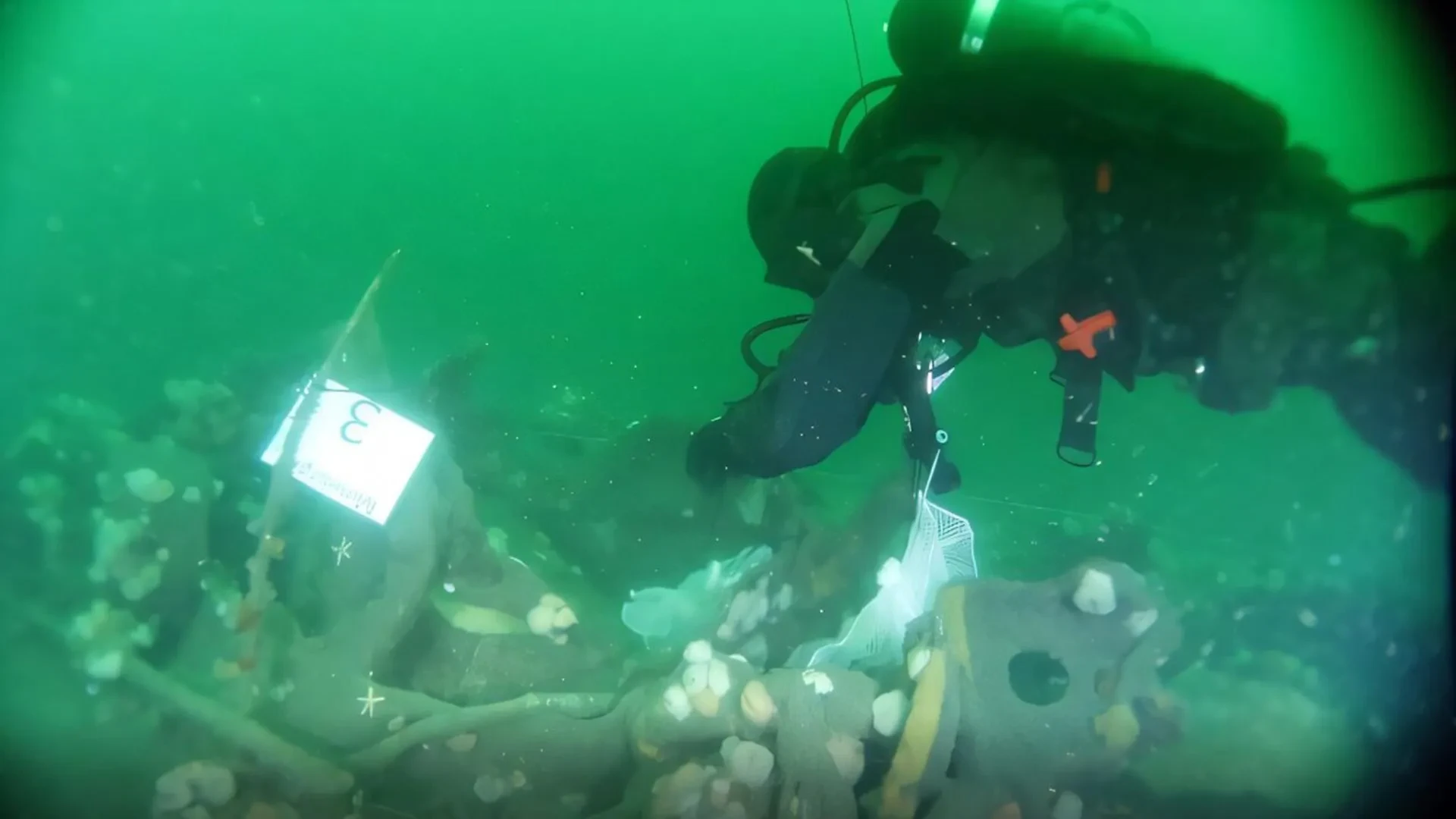
The NorthSeaWrecks initiative was established to look past the historical romance of sunken fleets and evaluate their hard chemical realities. When Professor Andresen and her interdisciplinary team set out to investigate the UC-30, they faced significant logistical hurdles. Because civilian diving on the historic war grave is strictly prohibited, the researchers forged a vital partnership with the Royal Danish Navy.
Utilizing specialized navy divers trained under strict academic protocols, the research team gathered vital samples from the site:
- Sediment Core Samples: Gathered from the seabed directly beneath and adjacent to the decaying hull.
- Water Column Samples: Extracted at varying distances from the wreck to map the diffusion of chemical pollutants.
- Biological Specimens: Mussels and starfish harvested from the wreck’s metal plating and the surrounding ocean floor to test for bioaccumulation.
The laboratory results confirmed that the threat is not merely theoretical. "We found traces of TNT in the wildlife, the seabed, and the water column," Andresen stated. "Pollution is definitely occurring. The question is how significant the effect is and how far from the wreck the pollution impacts the marine environment."
While the current geographic spread of the contamination appears relatively localized, the data indicates a trajectory of worsening conditions. As the steel hulls, torpedo casings, and mine housings continue to oxidize, collapse, and fracture, larger volumes of explosive compounds will be exposed to seawater, accelerating chemical leaching into the food web.
The Scale of the North Sea Battlefield
The UC-30 is far from an isolated case. During the First World War, the North Sea was arguably the most strategically vital and heavily contested body of water in the world.
- The Mine Warfare: An estimated 190,000 naval mines were sown across the North Sea by warring nations in attempts to deny passage to enemy warships and merchant vessels.
- The Battle of Jutland: Fought off the coast of Northern Jutland in 1916, this titanic clash remains the largest naval battle in history, resulting in the loss of more than 25 ships and the deaths of nearly 10,000 sailors.
These numbers explain why the North Sea seabed is quite literally paved with the iron, brass, and munitions of twentieth-century warfare.
Official Responses and Remediation Challenges
As marine scientists ring alarm bells, environmental regulators and government agencies are forced to confront a logistical nightmare. The European Union’s Water Framework Directive demands high standards for ecological health in regional seas, forcing countries like Denmark to account for the pollution leaking from historic wrecks. However, managing the problem is easier said than done.
The Financial and Technical Barriers
Neighboring Germany has already allocated substantial funding to locate, recover, and neutralize hazardous munitions and wrecks, particularly in the Baltic Sea where post-WWII ocean dumping added thousands of tons of conventional and chemical weapons to the deep. Yet, even for advanced economies, the process is prohibitively expensive.
"The Germans are further ahead with this than we are in Denmark," Andresen notes. "They sometimes retrieve explosives from the wrecks and neutralize them, but doing so is very costly."
Furthermore, physical removal is not always a straightforward or environmentally safe solution. A common public misconception is that blowing up or hoisting munitions out of the water instantly solves the problem. In reality, subaquatic detonations can release massive, concentrated plumes of toxic contaminants into the water column all at once, potentially causing greater immediate harm to marine life than the slow, continuous leakage of a deteriorating wreck.
"It depends on the area where the wreck and munitions lie," Andresen explains. "Currents and seabed morphology play a major role. In some cases, detonating them can do more harm than good."
Implications: The Future of Marine Conservation and Technology
Faced with the reality that cleaning up every single wreck is neither practical nor necessary, the scientific community is looking toward innovative, high-tech solutions.
Professor Andresen is currently collaborating with international researchers through the EU-funded REMARCO project. This initiative is dedicated to finding low-impact, sustainable methods for managing submerged munitions and hazardous historical shipwrecks without destabilizing the fragile marine environments surrounding them.
Seabed Robots: The New Guardians of the Deep
One of the most promising technological developments being tested involves autonomous or tethered benthic crawlers—seabed robots designed to creep along the ocean floor. These resilient machines can map the micro-topography of deep-sea wrecks, track the rate of structural deterioration with high-definition cameras, and pinpoint the exact locations of unexploded ordnance buried in the sediment.
Looking ahead, engineers hope these robotic systems will evolve to take physical action. "In some cases, the robots can also pick up items, retrieve them from the sea and neutralize them," Andresen says, pointing to a potential future where automated submersibles perform delicate underwater surgery on hazardous wrecks.
Prioritizing the Environmental Threat
Ultimately, conservationists must adopt a triage mindset. Not all wrecks pose an equal danger to the ecosystem. Research indicates that shipwrecks that are fully or partially buried under layers of marine sediment face a significantly lower risk of polluting the open water. The sand acts as a natural buffer, sealing off oxygen and slowing the corrosion process while trapping escaping chemical particles.
"Some wrecks are fully or partially buried in the seabed," Andresen concludes. "When covered by sand, the risk of polluting the surrounding sea is significantly lower. It is a matter of identifying where the environmental threat is greatest—and then deciding whether the munitions on the wrecks should be removed."
As researchers continue to map the sunken ghosts of the North Sea, the challenge ahead lies in balancing maritime heritage, financial realities, and ecological protection. The wars of the twentieth century may have ended over eighty years ago, but their chemical echoes will continue to ripple through the depths of Europe’s seas for generations to come.
