

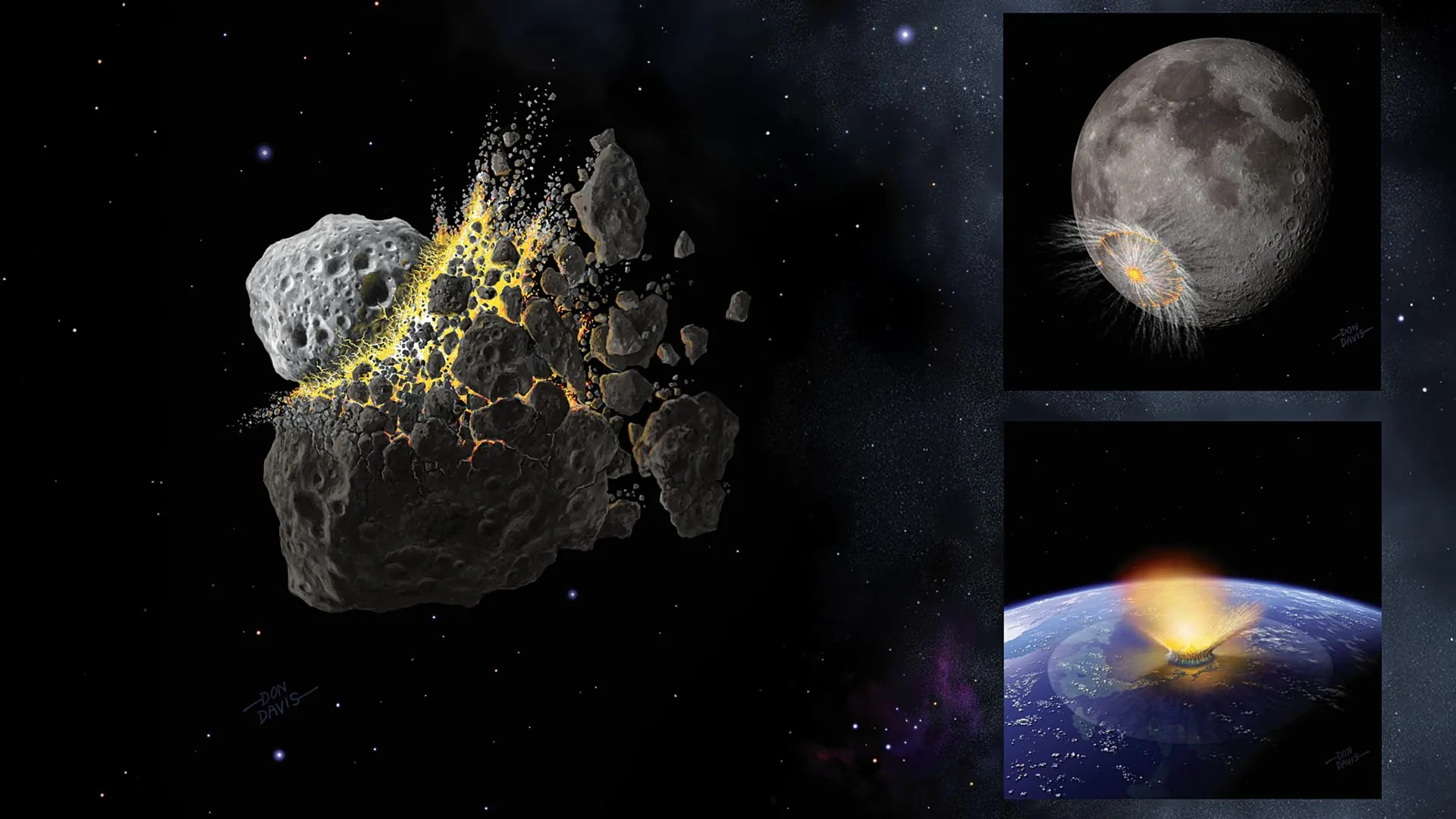
WASHINGTON — In the endless, silent theater of the solar system, violence is sometimes the catalyst for creation, evolution, and profound environmental transformation. Nearly 800 million years ago, deep within the dark expanse of the main asteroid belt located between Mars and Jupiter, two massive celestial bodies collided in a catastrophic event of unimaginable scale.
According to a groundbreaking study led by the Southwest Research Institute (SwRI), this ancient cataclysm did not merely shatter a rock; it triggered a prolonged, multi-million-year cosmic barrage that showered the inner solar system with debris. Earth, the Moon, and Mars were caught in the crosshairs of this asteroid storm, experiencing a wave of impacts that may have fundamentally altered their geologies, disrupted their climates, and inadvertently steered the course of planetary evolution.
Main Facts: The Eulalia Breakup and the Inner Solar System Bombardment
The new research centers on the destruction of the parent body of the Eulalia asteroid family, a primitive, carbon-rich collection of space rocks. When this original body was struck and pulverized, it unleashed a colossal torrent of fragments into the solar system.
Crucially, the location of the impact was a matter of astronomical misfortune. The parent body was positioned on the precipice of a powerful gravitational escape hatch known as the J3:1 mean motion resonance with Jupiter.
- The Scale of the Shower: The destruction of the Eulalia parent body sent millions of tons of debris hurtling toward the terrestrial planets. Because Earth possesses a significantly larger mass and stronger gravitational pull than the Moon, scientists calculate that for every impact the lunar surface endured, Earth was struck roughly twenty times by objects of similar or greater size.
- The Missing Terrestrial Record: While Earth took the brunt of the assault, finding physical proof on our home planet is nearly impossible. Earth’s active geology—plate tectonics, wind, rain, volcanic activity, and weathering—has relentlessly recycled and erased the ancient impact scars.
- The Lunar Archive: To reconstruct this hidden chapter of Earth’s history, planetary scientists turned to the Moon. Free from plate tectonics, liquid water, and a thick atmosphere, the lunar surface acts as a pristine, static archive preserving the impact history of the inner solar system.
- Broader Planetary Consequences: Beyond Earth and the Moon, Mars also felt the shockwaves. The prolonged bombardment would have induced massive seismic shaking and coincided with a documented surge in Martian volcanic activity.
Chronology of a Cosmic Catastrophe
To understand how a single event in the asteroid belt could torment planets hundreds of millions of miles away, researchers had to piece together a precise timeline utilizing dynamical modeling and geological data.
Phase 1: The Initial Cataclysm (Approx. 800 Million Years Ago)
A large, primitive carbonaceous chondrite-like body collided with another massive object in the main asteroid belt. The destruction was so violent and strategically located that approximately 50% of the newly liberated fragments were immediately swept into the J3:1 resonance with Jupiter. This gravitational funnel immediately launched the debris into eccentric, planet-crossing orbits.
Phase 2: The Immediate Barrage (0 to 50 Million Years Post-Impact)
The initial wave of fragments arrived in the inner solar system rapidly. Earth, the Moon, and Mars experienced an immediate surge in impact rates. Craters began piling up across the lunar highlands, while Earth endured a relentless rain of debris that dwarfed anything seen in modern human history.
Phase 3: The Yarkovsky Effect and the Long Tail (50 to 150+ Million Years Post-Impact)
The bombardment did not stop with the initial spray. Over the next 100 to 150 million years, another 25% of the remaining Eulalia fragments slowly migrated into the J3:1 resonance. This delayed migration was driven by the Yarkovsky effect—a subtle phenomenon where an asteroid absorbs sunlight and reradiates it as heat. Because the heat is emitted unevenly as the asteroid rotates, it acts as a tiny thermal thruster, subtly altering the object’s orbit over millions of years and feeding a continuous stream of impactors into the inner solar system.
Supporting Data: Decoding the Lunar and Asteroid Evidence
The hypothesis relies on a synthesis of modern computer simulations, cosmic forensics, and physical data gathered decades ago during NASA’s Apollo missions.
The Chemistry of Impact Glass
During the Apollo missions, astronauts and automated probes gathered samples of impact glass. These glassy beads form when a high-velocity asteroid impact generates extreme heat, instantly melting surface rock that subsequently cools into a vitreous material. By dating these glass samples, researchers established a chronological timeline of when the Moon was pelted most heavily. The data revealed a conspicuous spike in impact events clustered around 800 million years ago.
The J3:1 Resonance Mechanism
To link lunar craters to the asteroid belt, Dr. William Bottke and his colleagues utilized advanced collisional and dynamical models. They focused on the J3:1 orbital resonance—a region where an asteroid orbits the Sun precisely three times for every single orbit completed by Jupiter.
Repeated gravitational tugs from the gas giant act like a cosmic slingshot, destabilizing asteroids in this zone and hurling them out of the belt and into the inner solar system. The Eulalia family’s birth right at the edge of this resonance made it the prime suspect for the lunar impact spike.
Carbonaceous Chondrites
The fragments coming from the Eulalia breakup belonged to a class of meteorites known as carbonaceous chondrites. These are among the most primitive, carbon-rich objects in the solar system, holding water-bearing minerals and complex organic compounds—the very building blocks of prebiotic chemistry. When these objects struck the early Earth, they did not just bring destruction; they delivered a massive inventory of volatile compounds and organic materials to our planet’s surface.
Official Responses and Expert Perspectives
The study, spearheaded by leading figures in planetary science, has opened new avenues for understanding how external cosmic forces dictate internal planetary conditions.
"The role impacts have played in shaping the origin and evolution of life in our solar system is poorly understood," said Dr. William Bottke, executive director of SwRI’s Solar System Science and Exploration Division in Boulder, Colorado, and lead author of the study.
Dr. Bottke, who also directs the Center for Lunar Origin and Evolution (CLOE) under NASA’s Solar System Exploration Research Virtual Institute, emphasized the stark contrast in how humanity views impact hazards:
"The heavily cratered surface of the Moon serves as a reminder of the large impacts in Earth’s past, but so far, only the Chicxulub impact event 66 million years ago has been strongly linked to a specific effect on life, namely the mass extinction of the dinosaurs."
The Chicxulub impact—the massive asteroid strike buried beneath the Yucatán Peninsula in Mexico—is universally accepted as the executioner of the nonavian dinosaurs. However, Bottke and his team argue that studying much older, prolonged showers like the Eulalia breakup allows scientists to look beyond single extinction events and examine how continuous cosmic bombardment influences entire planetary epochs.
Other planetary geologists and astrobiologists have praised the study’s interdisciplinary approach, noting that it successfully bridges the gap between asteroid belt dynamics and terrestrial geological history. By utilizing the Moon as a proxy, researchers have bypassed the limitations of Earth’s destructive tectonic recycling machine.
Implications: Climate, Biosphere, and Planetary Evolution
The revelation that the inner solar system underwent a massive, prolonged asteroid shower 800 million years ago carries profound implications for multiple scientific disciplines.
1. Environmental and Climatic Shocks on Earth
The timing of the Eulalia impact surge intriguingly overlaps with a dramatic chapter in Earth’s history: a period of widespread global cooling and major shifts in the biosphere. While the SwRI study stops short of definitively claiming that the asteroid barrage caused these terrestrial changes, the temporal correlation is striking.
An influx of sulfur, dust, and debris from hundreds of large impacts could have periodically blocked out sunlight, disrupted marine ecosystems, and triggered severe climatic fluctuations. Conversely, the delivery of massive quantities of water and carbon-rich material via carbonaceous chondrites may have chemically fertilized the oceans, priming the biosphere for the complex biological leaps that followed.
2. Seismic Upheaval on Mars
On the Red Planet, the consequences would have been equally dramatic. The impact storm would have induced massive, planet-wide episodes of seismic shaking. Furthermore, the modeling aligns chronologically with a documented surge in Martian volcanic activity. Planetary scientists suggest that intense, localized impact fracturing of the Martian crust may have relieved subsurface pressure, acting as a trigger for widespread volcanism.
3. Rewriting the Astrobiological Paradigm
For decades, scientists viewed asteroid impacts almost exclusively as destructive hazards capable of wiping out life. This research reframes the narrative. While a sudden cataclysm like Chicxulub brings abrupt devastation, a prolonged asteroid shower introduces a complex cocktail of physical stress, climate modification, and chemical delivery.
As researchers continue to analyze samples from the Moon, Mars, and near-Earth asteroids, the legacy of the Eulalia family stands as a testament to the interconnected nature of the cosmos. It reminds us that Earth does not exist in isolation; our climate, our geology, and perhaps even our very existence were forged in the cosmic crossfire of an ancient asteroid storm.
