

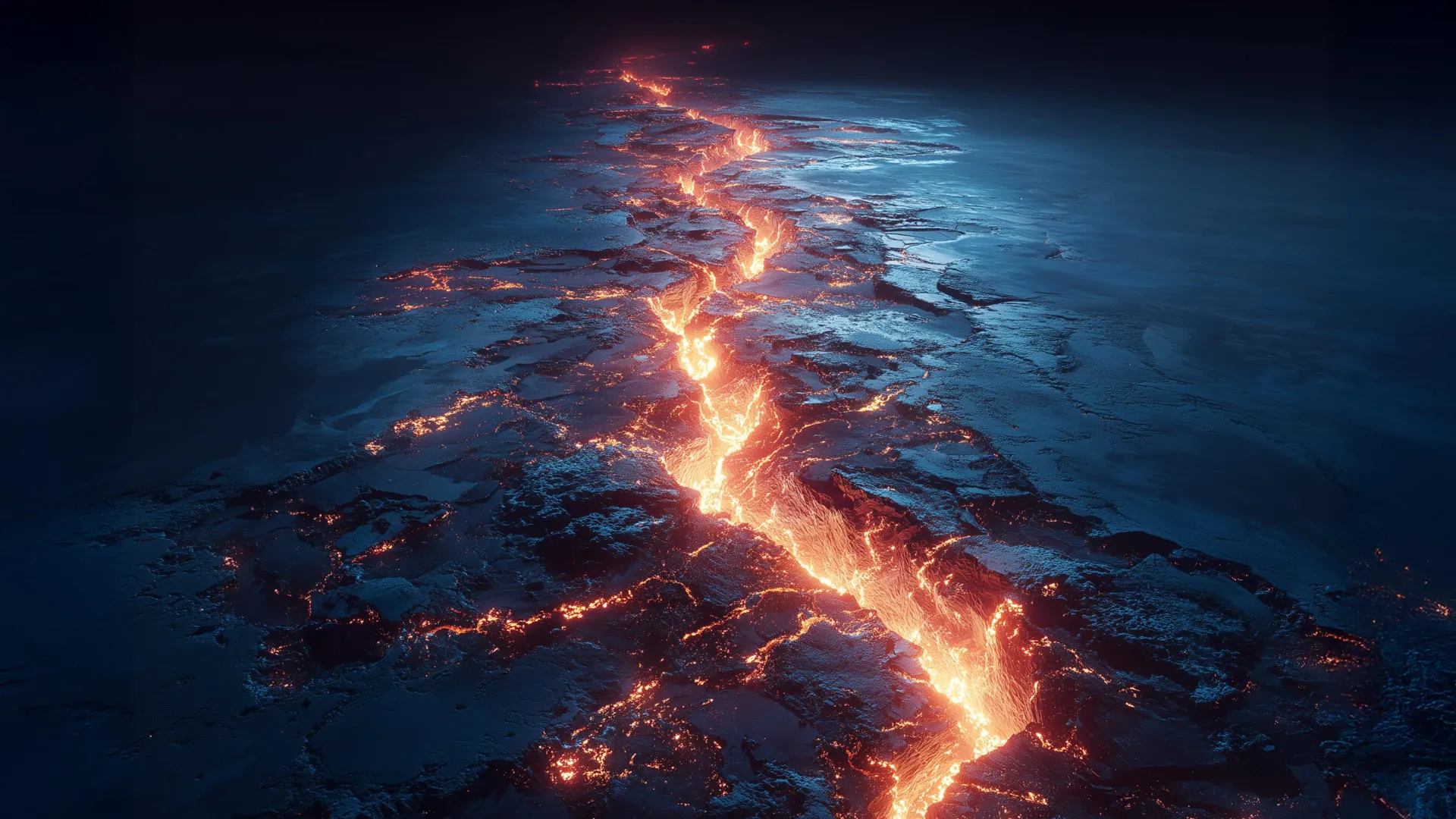
TOKYO — Deep beneath the rolling swells of the western Pacific Ocean lies the Ontong Java Plateau (OJP), a colossal undersea behemoth that holds the title of the largest oceanic plateau on Earth. For decades, geologists have known that this monumental geological feature was forged during a period of extraordinary submarine volcanism roughly 110 to 120 million years ago—a cataclysm widely considered the most massive volcanic outpouring in our planet’s history.
However, new scientific revelations indicate that the event did far more than merely coat the seafloor in staggering thicknesses of lava. According to a landmark study published in Geophysical Research Letters, this ancient volcanic super-event actively tore open, rewrote, and chemically transformed the very tectonic plate upon which it sits.
Led by Lecturer Azusa Shito of the Okayama University of Science, alongside Associate Professor Akira Ishikawa of the Institute of Science Tokyo and Professor Masako Yoshikawa of Hiroshima University, a multidisciplinary research team has utilized advanced seismic wave analysis to peer deep into the hidden plumbing of the OJP. Their findings paint a startling picture of a composite interior laced with ancient magma highways, proving that mantle plumes can fundamentally alter the structural and chemical DNA of Earth’s lithosphere.
Main Facts: Unlocking the Undersea Giant
The Ontong Java Plateau is an awe-inspiring geological anomaly. Covering an area roughly the size of Alaska, it rises thousands of feet above the surrounding abyssal plains. Scientists have long debated the exact mechanics of its birth, with leading theories pointing toward a colossal thermochemical mantle plume—a towering column of hyper-heated, chemically distinct material originating deep within Earth’s mantle, potentially carrying recycled fragments of ancient oceanic crust.
While previous studies focused primarily on the surface lavas and the environmental devastation triggered by the eruptions (which likely disrupted global ocean chemistry, severely depleted marine oxygen levels, and contributed to ancient mass extinctions), far less was known about what happened inside the oceanic plate beneath the plateau.
Using high-frequency seismic signals known as Po and So waves, the research team discovered that the plate beneath the OJP is radically different from typical, relatively uniform oceanic plates. Rather than possessing a simple, predictable internal layering, the plate features a complex "composite" architecture.
The core revelations of the study include:
- Vertical Magma Intrusions: The plate is heavily fractured and laced with massive swarms of vertical dikes—channels where molten rock once forced its way upward through massive cracks and solidified.
- Chemical Transformation (Refertilization): Seismic velocities beneath the plateau are unusually slow, a phenomenon researchers attribute not just to fracturing, but to deep chemical reactions between rising magma and the surrounding mantle peridotite.
- A Dual-Natured Interior: The plate exhibits a combination of horizontal layering (lamination) and vertical intrusions, creating a structural matrix that selectively scatters and filters seismic waves as they travel thousands of kilometers beneath the seafloor.
Chronology: Piecing Together a 120-Million-Year-Old Puzzle
To understand how the research team arrived at these conclusions, it is necessary to examine both the ancient timeline of the plateau’s creation and the modern timeline of the scientific breakthroughs that unlocked its secrets.
Phase 1: The Cretaceous Cataclysm (120–110 Million Years Ago)
During the mid-Cretaceous period, a massive thermal-chemical anomaly brewed deep within Earth’s mantle. As this buoyant plume ascended toward the surface, it encountered the overlying Pacific oceanic plate. The sheer volume of magma generated by the plume overwhelmed the tectonic plate, bursting through the crust in a colossal series of submarine eruptions. Over millions of years, successive sheets of basaltic lava accumulated to form the Ontong Java Plateau, while millions of cubic kilometers of magma forced their way directly through the existing plate, carving out extensive networks of underground conduits.
Phase 2: Modern Reconnaissance (Late 20th to Early 21st Century)
As marine geosciences advanced, scientists deployed ocean-bottom seismometers (OBS) and established land-based seismic stations on remote western Pacific islands. These instruments began capturing ambient and earthquake-generated seismic waves propagating through the oceanic lithosphere. Researchers quickly noticed anomalies in how these waves traversed the OJP region, setting the stage for targeted analytical modeling.
Phase 3: The Breakthrough Analysis (Recent Study)
Dr. Azusa Shito and her colleagues embarked on a detailed investigation of high-frequency Po and So waves—specialized seismic signals that travel horizontally inside oceanic plates rather than diving deep into the lower mantle. By applying rigorous seismic waveform modeling, the team managed to reconcile why Po waves traveled efficiently across the plateau while So waves experienced dramatic attenuation. Their computational models successfully matched the observed wave behaviors to a subsurface structure defined by horizontal lamination intersected by dense vertical dike swarms and chemically modified mantle rock.
Supporting Data: What the Seismic Waves Revealed
Seismic waves are Earth’s natural X-rays. As they travel through different rock types, temperatures, and structural formations, their speed, amplitude, and frequency are altered.
Under normal geological conditions, Po and So waves are generated when primary (P) and secondary (S) seismic waves undergo repeated scattering through the finely layered minerals of an intact oceanic plate. This continuous scattering allows the signals to maintain their strength over thousands of kilometers.
However, the waves recorded around the Ontong Java Plateau defied standard expectations:
- The Po/So Disconnect: Po waves propagated with relative ease through the region, whereas So waves weakened drastically. This anomaly served as the primary smoking gun, indicating that the plate’s interior had been physically disrupted by large-scale structural barriers—specifically, vertical dike swarms breaking up the horizontal continuity of the plate.
- Unusually Low Wave Speeds: Both Po and So waves traveled at a significantly reduced velocity beneath the plateau. Standard structural fracturing alone could not account for the magnitude of this slowdown. The researchers deduced that the physical composition of the rock must have changed.
- The Physics of Refertilization: The mantle beneath oceanic plates is primarily composed of a rock called peridotite. When partial melting occurs, vital chemical components are stripped away, leaving the peridotite "depleted." The seismic team concluded that the rising plume’s magma did not just pass through; it reacted chemically with the depleted peridotite, returning lost elements in a process known as refertilization. This influx of new mineral components fundamentally altered the density, rigidity, and seismic velocity of the plate’s interior.
Official Perspectives and Expert Insights
The study has sent ripples through the global geoscience community, offering a fresh framework for how geologists view large igneous provinces (LIPs) and mantle plume dynamics.
Dr. Azusa Shito emphasized the significance of moving beyond surface-level observations in marine geology. "For a long time, oceanic plateaus were studied primarily through their basaltic crust—the lavas we can sample on the seafloor," notes the research team’s framework. "Our work demonstrates that the hidden engine of these eruptions left a permanent, highly complex physical and chemical scar deep within the lithospheric plate itself."
Co-author Associate Professor Akira Ishikawa of the Institute of Science Tokyo highlighted the importance of integrating seismic wave physics with mantle geochemistry. The discovery that mantle peridotite can be extensively refertilized by transient magmatic networks provides a critical bridge between geophysical observations (seismic speeds) and petrological realities (mineral compositions).
Meanwhile, Professor Masako Yoshikawa of Hiroshima University pointed out that understanding the internal mechanics of the OJP helps clarify how Earth regulates heat and mass transfer from its deepest interiors. "When a super-plume breaches the crust, it is not a passive event," researchers suggest. "The plate fights back, becomes fractured, absorbs the invading magma, and is chemically reborn in the process."
Broader Implications: Rewriting Textbook Geology
The ramifications of this study extend far beyond the western Pacific. By proving that massive volcanic events can fundamentally modify the physical structure and chemical composition of existing oceanic plates, the findings challenge traditional models of plate tectonics and crustal evolution.
1. Re-evaluating Large Igneous Provinces (LIPs)
Other major oceanic plateaus and continental flood basalt provinces—such as the Kerguelen Plateau, the Siberian Traps, and the Deccan Traps—may share similar hidden architectures. If massive dike swarms and extensive refertilization are standard byproducts of plume activity, geologists may need to re-examine seismic data from other global LIPs to uncover similar subsurface networks.
2. Refining Mantle Dynamics and Lithospheric Evolution
The concept of "physicochemical modification" offers a more holistic view of how Earth’s interior operates. Traditionally, the lithosphere (the rigid outermost shell of the planet) and the asthenosphere (the ductile layer beneath it) are viewed through distinct mechanical boundaries. This study shows that extreme magmatic events can blur these lines, injecting deep mantle signatures directly into the overlying plate and altering its mechanical strength.
3. Implications for Ancient Mass Extinctions
While the primary focus of Shito and her colleagues’ paper is geophysical, the broader context of the OJP formation remains tied to Earth history’s most critical biological crises. The immense volume of magma required to create these vertical dikes and surface plateaus reinforces calculations regarding the sheer scale of greenhouse gases and volatiles released during the event. Understanding the internal pathways of the magma helps constrain models of how efficiently these gases were transported from the deep mantle to the atmosphere and oceans.
As researchers continue to analyze seismic data from Earth’s most remote ocean basins, the Ontong Java Plateau stands as a prime example of the deep connections linking our planet’s fiery core to its dynamic surface. The scars left by a 120-million-year-old cataclysm are still whispering secrets from the deep—revealing a planet that is constantly tearing itself apart, rebuilding, and transforming from the inside out.
