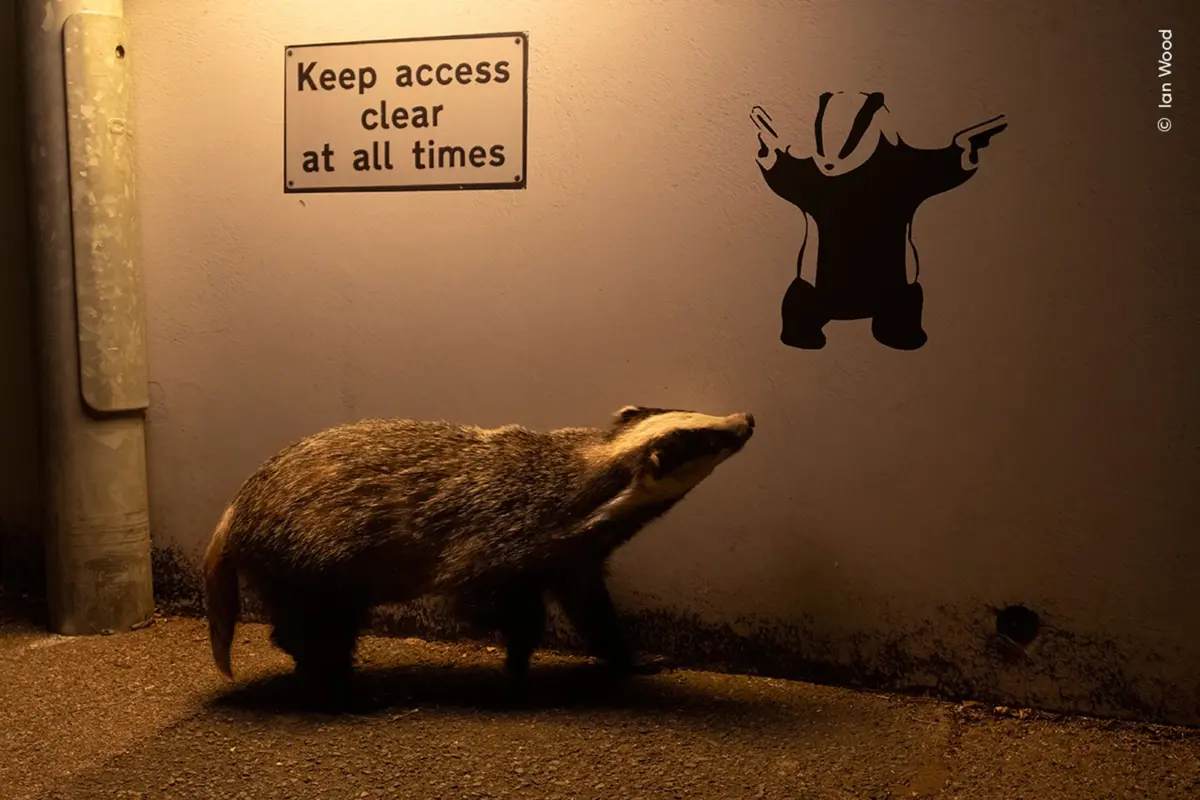
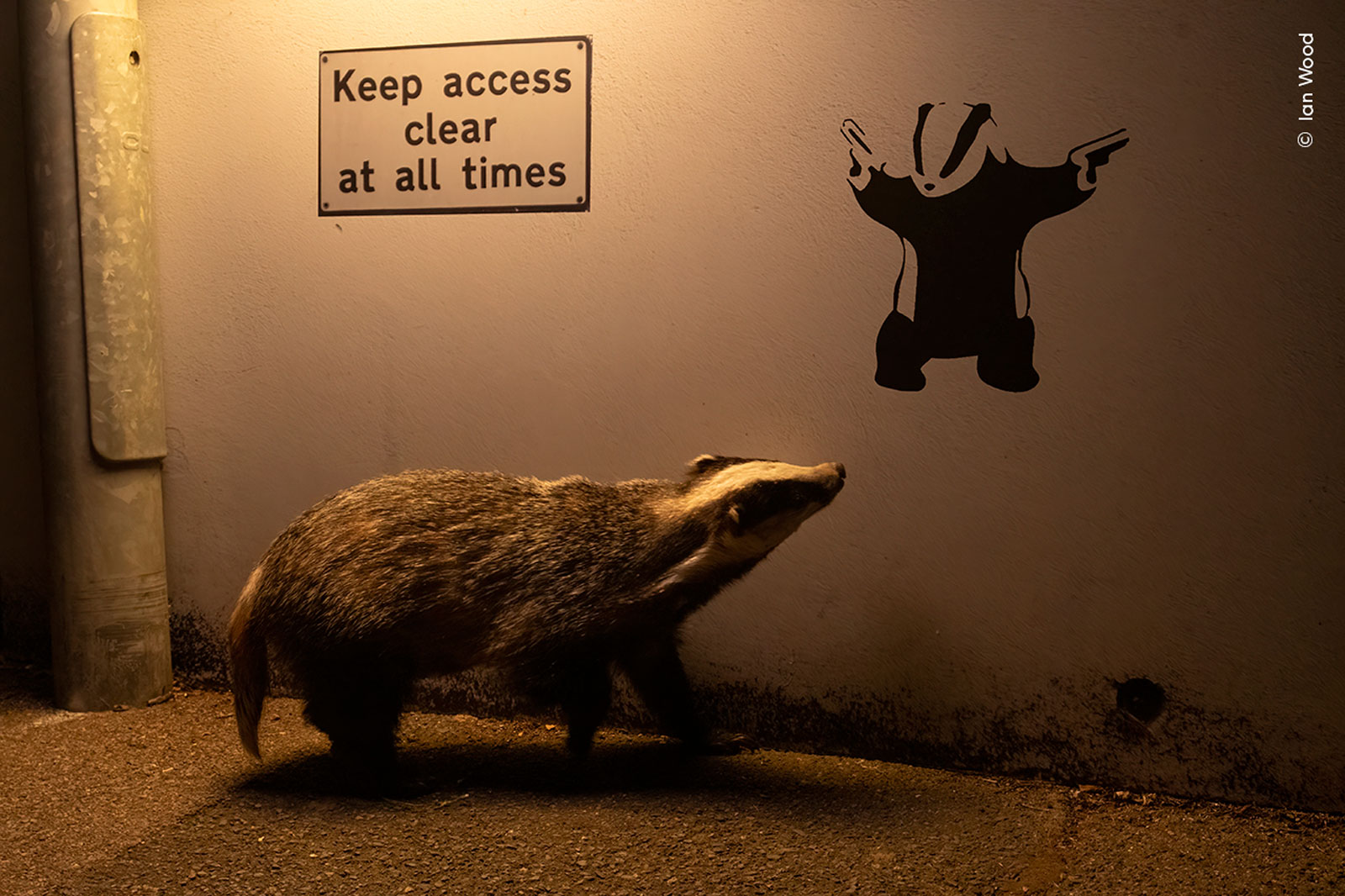
LONDON — In a stunning intersection of urban existence and wild beauty, British photographer Ian Wood has claimed the prestigious title of the 2024 Wildlife Photographer of the Year People’s Choice Award. His perfectly timed photograph, titled "No Access," depicts an ambling Eurasian badger pausing to glance up at a piece of striking graffiti on a street in St Leonards-on-Sea, England.
Beating out an elite shortlist of 25 extraordinary nature images, Wood’s photograph captured the imagination of a record-breaking global audience. Over 76,000 nature enthusiasts and wildlife photography fans from across the world cast their votes, making the tenth edition of the People’s Choice Award one of the most competitive and widely participated events in the history of the competition.
The winning image, alongside four other highly commended finalists, will remain on display in a flagship exhibition at the Natural History Museum in London until June 29, 2025. While the photograph has been celebrated for its artistic brilliance and whimsical charm, it has also reignited an urgent, contentious conversation regarding the plight of British wildlife and the controversial ongoing badger culls across the United Kingdom.
Main Facts: The Triumph of "No Access"
The announcement of the 2024 People’s Choice Award winner marks a milestone for the globally renowned Wildlife Photographer of the Year competition, developed and produced annually by the Natural History Museum, London.
Ian Wood’s winning capture, "No Access," features a solitary Eurasian badger navigating a modern urban landscape. Illuminated solely by the harsh amber glow of a street lamppost, the badger walks along a concrete pavement, momentarily lifting its snout to gaze at urban graffiti that mirrors its own presence. The image encapsulates the fragile, often startling ways in which wild animals are forced to adapt to expanding human footprints.
The runner-up and highly commended finalists that rounded out the top tier of public favorites include:
"Earth and Sky" by Francisco Negroni (Chile): A dramatic nighttime capture of a double lenticular cloud illuminated by the fiery glow of lava erupting from the Villarrica volcano.
"Edge of Night" by Jess Findlay (Canada/Global): An ethereal action shot showcasing a ghostly barn owl bursting through the hayloft window of a derelict barn to begin its nocturnal hunt.
"Whiteout" by Michel d’Oultremont (Belgium): A minimalist yet striking portrait of a stoat sitting upright to survey its snow-covered territory, perfectly camouflaged against a stark white Belgian winter backdrop.
"Spiked" by David Northall (United Kingdom/Global): An intense, gritty frame depicting a bloodied yet resolute honey badger returning to finish a confrontation with a Cape porcupine that had desperately tried to defend itself.
These five images were originally selected by an international expert panel from nearly 60,000 entries submitted by photographers from all over the world into the milestone sixtieth competition. They were then handed over to the public for the global vote.
Chronology: From Street-Side Observations to Global Acclaim
The journey of "No Access" from a quiet English seaside pavement to the halls of the Natural History Museum is a testament to patience, fieldcraft, and serendipity.
The Urban Foragers of St Leonards-on-Sea
The genesis of the photograph began in St Leonards-on-Sea, a town in East Sussex, England. Local residents had established a habit of leaving food scraps and leftovers on pavements to feed local urban foxes. However, Ian Wood noticed that foxes were not the only beneficiaries of this urban generosity. Badgers from a nearby woodland sett had begun venturing out of their natural habitats, traveling down into the residential streets to scavenge for food under the cover of darkness.
Setting the Trap
Having observed a badger routinely patrolling a specific route along a sidewalk flanked by a heavily graffitied wall, Wood realized he had the makings of a compelling visual narrative. Determined to capture the interaction without disturbing the animal, he set up a small, discreet photography hide on the edge of the road.
On a quiet night, utilizing only the ambient illumination cast by a nearby municipal lamppost, Wood waited. His patience was rewarded when the badger ambled past, paused, and briefly looked upward, creating a composition that felt almost cinematic in its perfection.
The Global Vote and Victory
The image was submitted to the sixtieth Wildlife Photographer of the Year competition and successfully navigated the preliminary rounds to be named among the 25 official nominees for the People’s Choice Award. When voting opened to the public, the image struck an immediate chord. By the time voting closed, more than 76,000 ballots had been cast—a new record for the popular vote category. On the announcement day, "No Access" was crowned the definitive public favorite.
Supporting Data: By the Numbers
To understand the magnitude of the Wildlife Photographer of the Year competition and the scale of Wood’s victory, one must look at the metrics defining the 2024 and 2025 cycles:
76,000+: The record-breaking number of public votes cast for the 2024 People’s Choice Award, demonstrating a growing global appetite for wildlife conservation imagery.
60,000: The approximate total number of entries submitted from global photographers for the landmark sixtieth competition from which the initial shortlist was drawn.
25: The number of exceptional images shortlisted by the Natural History Museum’s international judging panel for the public vote.
5: The elite group of winning and highly commended images featured prominently on interactive voting screens at the London museum.
June 29, 2025: The closing date of the flagship exhibition at the Natural History Museum, London, where visitors can view the winning imagery.
October 2025: The anticipated month for the upcoming awards ceremony, where winners of the sixty-first competition will be officially unveiled.
Official Responses: Perspectives from Leadership and the Artist
The triumph of "No Access" drew widespread praise from cultural and scientific leaders, while also prompting the photographer himself to use his platform to address a grim ecological reality.
Dr. Douglas Gurr, Director of the Natural History Museum
Dr. Douglas Gurr commended the winning photograph for its ability to bridge the gap between human infrastructure and the natural world. In an official statement, Dr. Gurr remarked:
"Ian’s flawlessly timed image offers a unique glimpse of nature’s interaction with the human world, underscoring the importance of understanding urban wildlife.
His exceptional photograph serves as a powerful reminder that local nature and wildlife, often just outside our homes, can inspire and captivate us."
Ian Wood on the Paradox of His Photograph
While deeply humbled by the public outpouring of affection for his subject, Ian Wood used his acceptance of the award to shine a light on a dark and contentious issue facing British wildlife: the badger cull.
Wood, who resides in rural Dorset where he actively engages in rewilding initiatives to restore natural habitats, emphasized that urban badgers are often symptoms of a much deeper environmental crisis. He stated:
"The outpouring of badger love since my photo was nominated for the People’s Choice Award has been beautifully overwhelming. Finding out that it has won is truly humbling. However, there is a darker side to this image.
I live in rural Dorset where I’m on a re-wilding mission to enhance habitats for a huge array of wildlife. The badger cull — which is still ongoing — has decimated their numbers and I fear that unless the cull is stopped, we’ll only see badgers in urban settings in several parts of England.
My hope is for this image to raise awareness of the damaging effect of the badger cull and help push for change."
Implications: Urban Adaptation Versus Rural Eradication
The resonance of "No Access" extends far beyond its aesthetic qualities, forcing conservationists, policymakers, and the public to confront uncomfortable truths about how humans manage shared ecosystems in the United Kingdom.
The Urbanization of Wildlife
As natural habitats continue to fragment due to real estate development, agricultural expansion, and infrastructure projects, many adaptable mammal species are finding themselves pushed to the fringes. Foxes, urban deer, hedgehogs, and badgers are increasingly forced to forage in towns and cities. While cities can offer abundant food sources—such as discarded human waste and intentional feeding by wildlife lovers—urban environments present immense hazards, including vehicular traffic, domestic pets, and anti-social human behavior.
Wood’s photograph captures this forced migration in a single frame: a creature of ancient woodlands walking on cold asphalt beneath human graffiti.
The Controversy of the Badger Cull
The core of Wood’s message touches upon one of the most polarizing environmental policies in modern British history. Initiated to curb the spread of bovine tuberculosis (bTB) in cattle, government-sanctioned badger culls have led to the systematic shooting of hundreds of thousands of badgers across England since their inception.
Conservation scientists, animal welfare organizations, and independent researchers have long debated the ecological efficacy of the cull, with many arguing that it disrupts badger social structures, drives surviving animals to disperse more widely—potentially spreading bTB further—and inflicts catastrophic damage on regional biodiversity.
By highlighting how badgers are increasingly driven toward urban safe havens simply to escape rural eradication programs, "No Access" transforms from a simple snapshot into a potent political and ecological critique. It poses a haunting question to British society: Will the majestic Eurasian badger soon vanish from the wild countryside entirely, surviving only as an urban refugee on the edges of our towns?
The Power of Conservation Photography
Ultimately, the Wildlife Photographer of the Year competition was founded on the premise that visual storytelling can alter human behavior and inspire environmental stewardship. Dr. Gurr and the Natural History Museum continue to champion images that do not merely celebrate the beauty of the Earth, but challenge viewers to protect it.
As the winning images remain on display in London through the summer of 2025, and as judging for the sixty-first competition gets underway, Ian Wood’s urban badger stands as a symbol of resilience—and a warning siren for the future of British wildlife. Through the lens of a camera, a quiet moment on a St Leonards-on-Sea pavement has become a catalyst for a national conversation.