

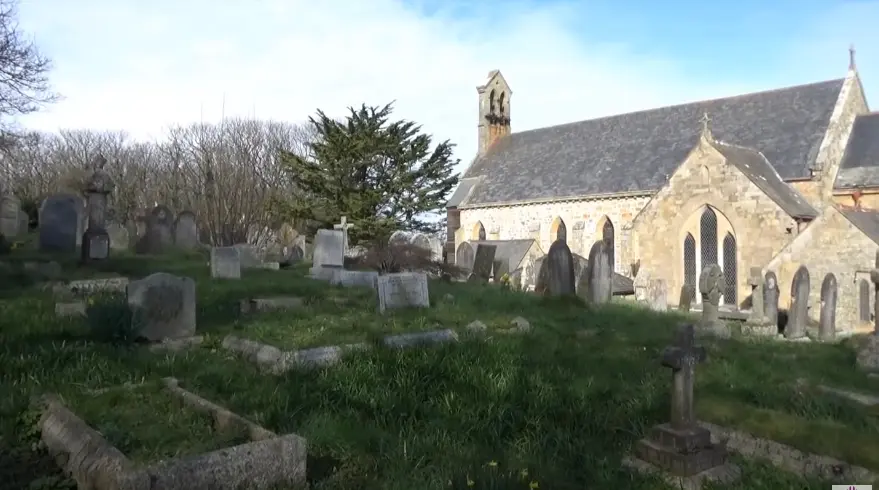
For over half a century, the final chapter in the earthly life of one of the most influential figures in modern esotericism remained shrouded in obscurity. Pamela Colman Smith—the brilliant artistic visionary behind the world’s most popular and ubiquitous tarot deck, the Rider-Waite-Smith—passed away in relative anonymity in 1951. For decades, the exact location of her grave was lost to time, overshadowed by the massive global footprint of her artistic legacy.
However, through meticulous detective work, cross-referencing of parish archives, and independent validation by local historians, researchers have successfully identified the probable location of her final resting place. Situated within the tranquil confines of St. Michael & All Angels Churchyard, her site of interment reflects a poignant intersection of historical tragedy, natural beauty, and enduring legacy.
Main Facts: Pinpointing the Lost Grave of "Pixie"
Pamela Colman Smith, affectionately known to her contemporaries as "Pixie," died on September 18, 1951. A week later, on September 25, 1951, she was laid to rest in the churchyard of St. Michael & All Angels by a well-regarded Roman Catholic priest, Father Joseph Henry du Moulin-Browne.
Despite the formal burial, locating her physical remains has proven to be an extraordinary challenge. Her original marker—which was likely constructed of wood, or perhaps left entirely unmarked due to her impoverished circumstances at the time of her death—has long since vanished. Compounding the issue, the church’s original plot register was destroyed in a tragic fire.
Despite these obstacles, a dedicated investigative effort has yielded compelling results. Researchers surveying the churchyard determined that the plots are arranged in strict chronological order. By cross-referencing surviving parish records with the dates and names inscribed on surrounding surviving markers, investigators narrowed down her likely resting place to a specific, secluded corner of the graveyard.
This targeted location contains approximately three marked graves dating from the pivotal window of 1950 to 1951, alongside at least three unmarked plots. Following a preliminary site assessment, local historians who first researched the churchyard three decades ago independently validated the findings, providing a robust consensus regarding where Pixie ultimately came to rest.
Chronology: From Obscurity to Rediscovery
To understand how the resting place of such a monumental figure could be lost to history, one must examine the timeline of her final days, the administrative misfortunes of the parish, and the recent efforts to reclaim her memory.
1878 – 1951: A Life of Art and Solitude
Born in Islington, London, to American parents, Pamela Colman Smith lived a vibrant, transatlantic life. She was an accomplished illustrator, set designer, and folklorist before joining the Hermetic Order of the Golden Dawn, where she met Arthur Edward Waite. Commissioned by Waite, Smith created the 78 distinctive illustrations for the tarot deck published by William Rider & Son in 1909. Despite the deck’s monumental success, Smith received a flat fee rather than ongoing royalties, leaving her in financial precarity in her later years. She converted to Roman Catholicism and spent her final years living in Cornwall, passing away in relative obscurity in 1951.
September 25, 1951: The Interment
Father Joseph Henry du Moulin-Browne officiated Smith’s burial at St. Michael & All Angels Churchyard. At the time, record-keeping was managed locally via standard parish logs, and a modest or temporary marker was placed at the head of her plot.
The Parish Fire: Loss of the Records
During a subsequent period of church renovation work, parish records were temporarily stored in a local builder’s hut. A destructive fire broke out in the hut, consuming invaluable historical documents, including the precise plot maps and registers detailing where individuals were buried during that era. Consequently, subsequent generations seeking to pay homage to the artist found themselves facing a bureaucratic and physical void.
Modern Investigation and Validation
Decades later, tarot researchers and historians turned their attention to solving the mystery of Pixie’s grave. By analyzing the chronological layout of the graveyard—where burials follow a sequential pattern—and aligning those patterns with the surviving parish death records from September 1951, researchers successfully mapped out the exact geographic sector of her burial. Independent validation by a veteran local historian cemented this hypothesis, offering closure to a decades-long historical oversight.
Supporting Data: Contextualizing the Discovery
The geographical and documentary data supporting the identification of Smith’s grave paint a vivid picture of her final environment:
- The Churchyard Layout: St. Michael & All Angels features a systematic burial structure. The chronological progression of graves allows researchers to reliably date sections down to specific years and months.
- The Critical Window: The target zone in the far corner of the churchyard holds markers explicitly dated to 1950 and 1951, matching the exact timeframe of Smith’s death and funeral.
- Surrounding Unmarked Graves: The presence of at least three unmarked plots in this specific cluster aligns with historical accounts of individuals who, like Smith, passed away with limited financial resources and could only afford modest or ephemeral markers.
- The Archival Void: Confirmation of the builder’s hut fire explains why institutional memory regarding the plot failed, shifting the burden of proof to forensic genealogy, spatial mapping, and comparative historical analysis.
The location itself offers a poetic resonance. Nestled close to the shoreline—a landscape that Pamela deeply cherished during her life—the site is embraced by native woodland and the soothing backdrop of birdsong. Observers noting the atmosphere during recent site documentations even reported church bells ringing spontaneously as video footage was captured, adding a symbolic layer of spiritual harmony to the rediscovery.
Official Responses and Expert Insights
The rediscovery of the likely site has generated significant buzz within esoteric and academic communities. Scholars dedicated to preserving the true history of tarot development have championed the finding as a major milestone in honoring the unsung contributors to occult history.
Prominent researchers Marcus Katz and Tali Goodwin, authors of the acclaimed book Secrets of the Waite-Smith Tarot (Llewellyn, 2015), have continuously pushed for greater recognition of Smith’s life and artistic contributions. Their work dives deep into the dynamic between Arthur Edward Waite and Pamela Colman Smith, shedding light on how their collaborative genius birthed the world’s most enduring divinatory system.
Furthermore, specialized platforms such as the Tarot Association have expanded their educational archives to include exclusive materials for members. Under the section titled "The Kiss of the Sun for Pardon: A Memory of Pamela Colman Smith," the association provides newly uncovered photographs, historical documents, and ongoing research updates. Experts emphasize that uncovering the biographical facts of creators like Smith is vital for grounding practical tarot innovation in historical truth, ensuring that modern practitioners understand the rich, human stories behind the cards they use every day.
Implications: Preserving the Legacy of Pamela Colman Smith
The identification of Pamela Colman Smith’s final resting place carries profound implications for cultural heritage, feminist art history, and the global tarot community.
1. Elevating the Artist’s Status
For decades, the deck was widely referred to simply as the "Rider-Waite" deck, systematically erasing Smith’s surname and, by extension, her immense artistic contribution. Discovering and honoring her final resting place serves as a powerful corrective gesture. It forces the esoteric community and art historians alike to properly contextualize her role as the visual architect of the modern tarot revival.
2. A Place of Pilgrimage and Remembrance
With a probable location now established, St. Michael & All Angels Churchyard transforms from an obscure Cornish graveyard into a meaningful site of pilgrimage. Tarot enthusiasts, artists, and historians worldwide now possess a geographical focal point where they can pay their respects, leave tokens of appreciation, and meditate on her enduring artistic legacy.
3. Fostering Rigorous Historical Research
The journey to find Smith’s grave highlights the importance of grassroots archival research, forensic geography, and oral history. It demonstrates that even when official municipal and parish records are destroyed by fire or negligence, persistent inquiry and respect for historical context can rescue forgotten pioneers from historical erasure.
As modern interest in the tarot continues to reach unprecedented heights, the rehabilitation of Pamela Colman Smith’s memory ensures that "Pixie" is no longer just a shadowy footnote in occult history, but a celebrated, visible pillar of artistic and spiritual heritage.
