

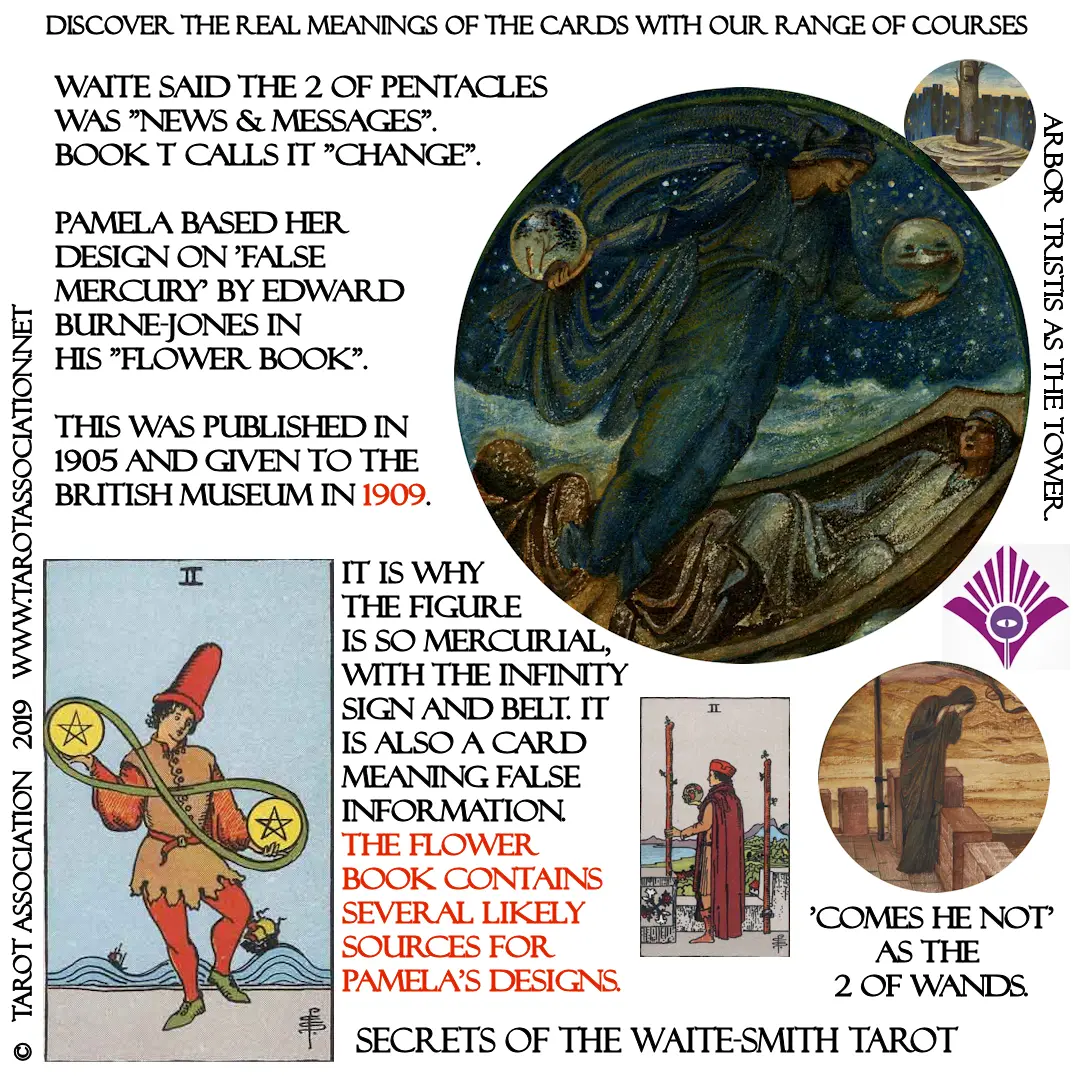
LONDON — For generations, modern tarot enthusiasts have understood the Two of Pentacles as a reassuring emblem of multitasking, financial budgeting, and the eternal tightrope walk of balancing time and money. However, a meticulous re-examination of historical archives, esoteric texts, and original artwork reveals that this ubiquitous card has drifted far from its intended meaning. Far from a benign reminder to juggle your schedule, historical research indicates that the Two of Pentacles is the original "gaslighting" card—steeped in themes of miscommunication, strategic deception, and deceptive illusions.
To understand how a symbol of financial balance became synonymous with psychological manipulation, we must journey back to the roots of the Western esoteric tradition, the secretive Hermetic Order of the Golden Dawn, and a chance discovery in the British Museum at the turn of the 20th century.
Main Facts: The Evolution of a Misunderstood Arcanum
The Two of Pentacles occupies a unique space in the Minor Arcana of the Rider-Waite-Smith tarot deck. While popular culture views it through a purely pragmatic lens—managing a checkbook or balancing a busy calendar—its foundational blueprints tell a starkly different story.
According to occult historians, the card’s traditional design and esoteric correspondences link it directly to the concepts of fluctuating realities, alternating fortunes, and, most importantly, false messaging. Ruled by Mercury—the mythological messenger god associated with both communication and trickery—the card carries a dual nature. It is an exploration of how information can be manipulated, distorted, and used to create imaginary obstacles.
- Esoteric The Lord of Harmonious Change.
- Kabbalistic Attribution: Chockmah of Assiah (Wisdom of Action).
- Astrological Correspondence: Jupiter in Capricorn (Expansion in Steadiness).
- Core Modern Misconception: Reduced exclusively to time management and financial budgeting, stripping away its warnings regarding deception and psychological manipulation.
Chronology: From Golden Dawn Roots to the British Museum
The distortion of the Two of Pentacles’ meaning can be traced through a specific historical timeline connecting 19th-century occultism to the creation of the world’s most famous tarot deck.
1. The Hermetic Foundation (Late 19th Century)
The intellectual architecture of the Rider-Waite-Smith deck was heavily drawn from the foundational teachings of the Hermetic Order of the Golden Dawn, specifically the unpublished instructional manuscripts known as Book T. In these secret papers, the Two of Pentacles was not described as a simple balancing act of finances, but rather as a complex study in instability: “The harmony of change, alternation of gain and loss; weakness and strength; everchanging occupation… industrious, yet unreliable; fortunate through prudence of management, yet sometimes unaccountably foolish; alternatively talkative and suspicious.”
2. The 1909 British Museum Revelation
In 1909, artist Pamela Colman Smith and esoteric scholar A. E. Waite visited the British Museum in London. Their mission was to seek inspiration for a revolutionary new tarot deck. During this visit, they gained access to materials including the Sola Busca Tarot and, crucially, a privately printed, illustrated notebook by artist Edward Burne-Jones.
3. The "False Mercury" Inspiration
In Burne-Jones’s botanical and poetic journal, the artist illustrated various flora by drawing upon the popular folklore names of plants. One such illustration depicted "False Mercury" (Mercurialis perennis), a notoriously poisonous woodland plant masquerading as a true mercury herb. Burne-Jones drew a mercurial figure balancing two spheres while standing near a boat tossed by treacherous ocean waves, offering delirious sailors illusory visions of safety and home.
Captivated by this imagery, Pamela Colman Smith adopted the motif for the Two of Pentacles. In doing so, she embedded the core archetype of the "false messenger"—an entity luring individuals toward peril through comforting illusions—directly into the tarot canon.
4. Publication of the Pictorial Key (1910)
A. E. Waite attempted to synthesize these esoteric currents in his 1910 work, Pictorial Key to the Tarot. Unable to fully disclose the secret doctrines of Book T, Waite leaned into the communicative aspect of the card, noting that it signifies "news and messages in writing, as obstacles, agitation, trouble, embroilment," while adding the crucial caveat: "Troubles are more imaginary than real."
Supporting Data: Kabbalistic and Astrological Frameworks
To fully grasp the depth of the Two of Pentacles, one must examine its position within the Tree of Life and astrological decans.
The card corresponds to Chockmah (Wisdom) located at the head of the pillar of force, manifested in Assiah, the material world. While the Golden Dawn optimistically labeled this intersection "pleasant change" or a "visit to friends," the mechanics of the energy are fundamentally unstable. Unlike the balanced pouring of liquids seen in Temperance, or the fixed axis of the Wheel of Fortune, the Two of Pentacles represents a rolling change—a constant shifting of currents that keeps individuals off-balance.
In practical terms, this places the card under the domain of Mercury, the ruler of communication, commerce, and intellect. When Mercury’s energy is distorted or adversarial, it manifests as duplicity, misinformation, and the rewriting of narratives—the exact operational definition of modern "gaslighting."
Official Perspectives: Expert Interpretations and Contemporary Readings
Modern esoteric scholars and tarot practitioners have increasingly called for a return to the card’s original, multi-dimensional warnings. Rather than viewing the figure in the card as a cheerful juggler effortlessly managing life’s demands, modern researchers interpret the wavy seas and precarious spheres as a depiction of a person caught in a manufactured reality.
When the Two of Pentacles appears in a contemporary reading, professional tarot readers advise looking past surface-level busyness to examine underlying communication dynamics.
Romance and Relationships
On the surface, the card suggests the typical compromises required to keep a partnership running smoothly. However, on a deeper level, it serves as a red flag against deliberate miscommunication, emotional manipulation, or gaslighting by a partner. It urges individuals to test the ground beneath them and verify whether their shared reality is built on truth or illusion.
Finance and Resources
While budgeting and managing multiple income streams are standard interpretations, the deeper warning points toward potential financial deceit. It cautions against misleading investment pitches, deceptive business partners, or projects whose true nature has been intentionally obscured.
Career and the Workplace
Professionally, the card highlights the strain of juggling multiple tasks. Yet, its cautionary undercurrent demands absolute clarity. Practitioners advise getting agreements, expectations, and project scopes strictly in writing to protect oneself from shifting goalposts and workplace gaslighting.
Home and Domestic Life
Balancing domestic chores with external obligations can create temporary chaos. However, the card warns against environments where gaslighting creates persistent, imaginary anxieties within the household.
Education and Learning
Students balancing academics with life commitments must maintain organization. Esoterically, the card reminds learners to critically evaluate their sources, ensuring that the "information" they consume is authentic rather than misleadingly presented.
Spiritual and Mystical Initiation
In magical and spiritual traditions, the Two of Pentacles represents Chockmah in Assiah: the initiate working in the physical workshop, accepting the world’s duality while striving for personal transformation. It is the art of grounding esoteric wisdom into daily reality without falling prey to spiritual delusions.
The "Yes/No" Verdict
In binary divinatory spreads, the Two of Pentacles delivers a qualified YES. The overarching trajectory remains positive and harmonious, but it requires navigating a series of tactical retreats, setbacks, and fluctuating conditions before reaching a stable resolution.
Implications: Re-evaluating the Minor Arcana for the Modern Era
The rediscovery of the Two of Pentacles’ true heritage carries profound implications for the tarot community and psychological practitioners alike. For over a century, the sanitization of esoteric symbols robbed individuals of vital psychological tools. By recognizing the card as the original "gaslighting" emblem, readers and seekers are equipped with a more sophisticated vocabulary for identifying manipulation in their professional, financial, and personal lives.
As modern society grapples with an unprecedented influx of digital misinformation, deepfakes, and psychological manipulation, the ancient warning of the "False Mercury" feels startlingly contemporary. The Two of Pentacles is no longer merely a reminder to pay your bills on time; it is a timeless sentinel guarding against the illusions we tell ourselves—and the deceptions others weave around us.
Further Reading
- Goodwin, T. & Katz, M. Secrets of the Waite-Smith Tarot. Llewellyn Worldwide Publishing, 2015.
- Bain, D., Goodwin, T. & Katz, M. A New Dawn for Tarot: The Original Tarot of the Golden Dawn. Forge Press, 2014.
