

By Investigative Cultural Desk
Published in collaboration with Tarot History and Research Archives
Main Facts: The Rediscovery of a Lost Legacy
Decades after her passing in near-obscurity, renewed historical investigation has shed light on the final resting place of Pamela Colman Smith—the brilliant, multifaceted artist whose visionary illustrations for the Rider-Waite-Smith tarot deck became a foundational pillar of modern esoteric culture. Smith, affectionately known to friends and contemporaries as "Pixie," died on September 18, 1951, at a hospital in Bude, Cornwall. A week later, on September 25, 1951, she was laid to rest in the churchyard of St. Michael & All Angels Church in the coastal town of Bude. The funeral service was officiated by Father Joseph Henry du Moulin-Browne, a well-regarded Roman Catholic priest of the era.
Despite the profound global influence of her artwork—which continues to be printed in millions of copies worldwide and serves as the standard template for contemporary cartomancy—Smith’s physical grave has long remained an elusive ghost in the historical record. Her original grave marker, likely a modest wooden cross or perhaps an unrecorded temporary stake, has long since vanished. Compounding this historical loss, the parish’s original burial ledgers and plot records were tragically destroyed in a catastrophic fire. The blaze reportedly consumed a builders’ hut where temporary parish documents and records were being stored during a period of extensive structural renovation at the church.
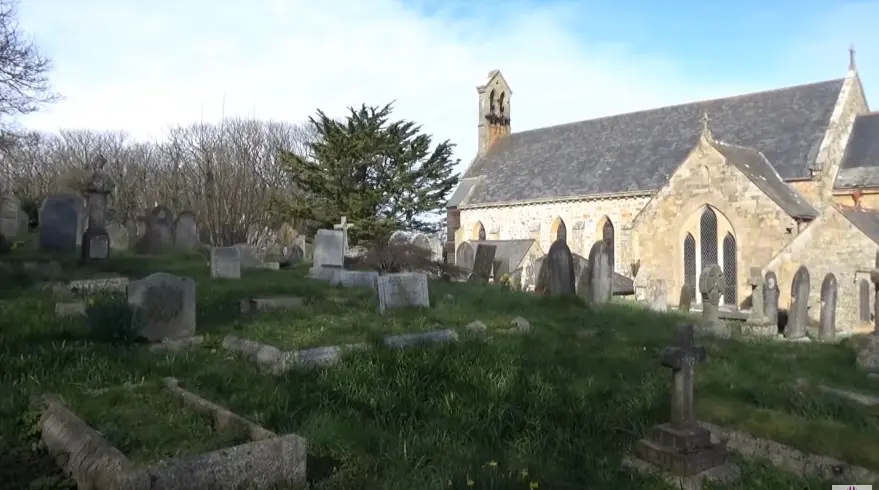
However, through painstaking cross-referencing, spatial analysis, and independent corroboration by seasoned local historians, researchers have now identified the precise zone within the St. Michael & All Angels churchyard where Smith’s remains most certainly lie. Situated in a tranquil, windswept corner of the church grounds overlooking the dramatic Cornish coastline, this specific area aligns chronologically with surviving parish registers from the autumn of 1951.
Chronology: Tracing the Life and Aftermath of "Pixie" Smith
To understand the quiet tragedy of Pamela Colman Smith’s final years and the subsequent obscurity of her burial site, one must trace the winding, unconventional trajectory of her life. Born in Islington, London, on June 16, 1878, to American parents, Smith spent an itinerant childhood moving between London, Jamaica, and New York. Gifted with a vivid imagination and a keen artistic sensibility, she trained at the Pratt Institute in Brooklyn under the renowned avant-garde artist Arthur Wesley Dow. Her distinctive style—characterized by fluid lines, evocative symbolism, and an impressionistic approach to color—quickly gained traction in theatrical and artistic circles.
The Artistic Rise and Financial Hardship
Upon returning to England, Smith established herself as a prolific book illustrator, set designer, and folklorist. She was fiercely independent, eccentric, and deeply immersed in bohemian circles. Her association with the Hermetic Order of the Golden Dawn—a pivotal 19th-century magical society—introduced her to Arthur Edward Waite, a prominent occultist and scholar.
In 1909, Waite commissioned Smith to produce a 78-card tarot deck that would break away from traditional medieval designs by incorporating intricate narrative scenes into the Minor Arcana. Published by Rider & Company, the deck—initially known simply as the Rider tarot—revolutionized cartomancy. Yet, despite the enduring monumental success of the project, Smith received a flat fee for her labor, retaining no ongoing royalties. As the decades progressed, shifting artistic tastes, the disruptions of two World Wars, and her conversion to Roman Catholicism in 1911 saw her step away from London’s bustling cultural hubs. She eventually retired to the rugged, inspiring coast of Cornwall, living in relative isolation and modest financial straits until her death at the age of 73.
The Posthumous Disappearance of Records
Following her death in September 1951, Smith’s worldly possessions were auctioned off to settle outstanding debts, and her burial at St. Michael & All Angels passed with little public fanfare. The loss of the parish plot records during the church renovations meant that for over half a century, scholars, tarot practitioners, and biographers visiting Bude could only gesture vaguely toward the churchyard, knowing she was somewhere on the grounds, but unable to pinpoint the exact patch of earth.
Supporting Data: Methodology and Field Investigation
The recent breakthrough in locating Smith’s grave is the result of rigorous investigative fieldwork conducted by researchers associated with leading tarot preservation societies, working in tandem with local historical experts in Cornwall.
Spatial and Chronological Mapping
Because formal register entries for September 1951 survive—even though the master plot grid was destroyed—researchers approached the problem through forensic archaeology and spatial mapping. A granular analysis of the graveyard revealed a distinct structural pattern: the overwhelming majority of plots within the St. Michael & All Angels churchyard are arranged in strict chronological order, moving progressively across the terrain according to the date of internment.
By identifying surviving, legible headstones dated precisely between August and October 1951, investigators were able to isolate a narrow, highly probable geographic corridor in the far corner of the churchyard. This specific sector contains:
- Three marked graves clearly dated to the 1950–1951 window.
- At least three unmarked or weathered plots that correspond directly to the gap in physical markers matching Smith’s burial date of September 25, 1951.
Independent Verification
During an initial site visit, researchers mapped this corner and formulated a hypothesis regarding the exact cluster of plots. In a display of rigorous academic peer review, the findings were presented to a local Cornish historian—an expert who had extensively researched the parish archives and local genealogies for over thirty years. Independent of the researchers’ initial assumptions, the local historian reviewed the surviving parish dates, the layout of the graveyard, and the chronology of burials, and independently arrived at the exact same conclusion regarding Smith’s resting place.
Official Responses and Field Observations
The rediscovery of the likely burial zone has elicited a profound emotional response from the international esoteric and artistic communities, who view the site not merely as a grave, but as a place of pilgrimage.
Researchers who documented the site visit have described a deeply atmospheric environment that feels entirely fitting for an artist who drew so much of her creative inspiration from nature, folklore, and the sea. The churchyard itself is situated mere moments from the rugged Cornish shoreline—a landscape defined by crashing Atlantic waves, dramatic cliffs, and an expansive horizon that Smith would have known intimately during her final years in Bude.
During the recording of video footage at the site, an unexpected moment occurred: the bells of St. Michael & All Angels began to ring out across the churchyard. Surrounded by ancient woodlands, the calls of local birds, and the resonant tolling of the bells, the moment felt remarkably poignant to the visiting researchers. Observers noted that the coincidence seemed to impart an unspoken message of peace, closure, and well-being for an artist whose contributions to culture were overshadowed for decades, yet ultimately immortalized through her work.
Scholarly literature has increasingly sought to restore Smith to her rightful place in art history. Landmark works such as Secrets of the Waite-Smith Tarot (Llewellyn, 2015), authored by researchers Marcus Katz and Tali Goodwin, have provided critical new photographs, biographical discoveries, and deep dives into the dynamic, sometimes fraught working relationship between Smith and Arthur Edward Waite. Furthermore, specialized organizations like the Tarot Association have dedicated secure, members-only archival modules—such as the comprehensive essay “The Kiss of the Sun for Pardon: A Memory of Pamela Colman Smith”—to ensure that members have access to the latest photographic documentation and historical findings regarding her life, her art, and her final days in Cornwall.
Implications: Preserving a Cultural Icon’s Legacy
The identification of Pamela Colman Smith’s probable resting place carries profound implications for cultural heritage preservation, art history, and the modern esoteric community. For generations, Smith was an invisible figure in her own masterwork—often referred to historically only as "Rider-Waite," with her surname systematically omitted from the deck’s title for decades. The global grassroots movement in recent years to formally rename the deck the "Rider-Waite-Smith" (or simply the Smith-Waite deck) represents a broader reckoning within the cultural sphere: a conscious effort to restore credit, dignity, and recognition to pioneering women artists whose contributions were marginalized by their contemporaries.
Redefining the Narrative of Early 20th-Century Art
The renewed focus on Smith’s final days in Bude challenges the historical narrative of the solitary, forgotten artist dying in penury. While her financial struggles toward the end of her life are a matter of painful historical record, the meticulous tracing of her grave transforms her legacy from one of tragic erasure to one of enduring remembrance. It anchors her mortal existence to a physical geography—the windswept cliffs and green churchyards of Cornwall—connecting the woman who visualized the Fool, the High Priestess, and the World to the tangible earth.
Future Preservation and Educational Outreach
Moving forward, researchers and local preservationists are discussing ways to honor the site respectfully without disrupting the peaceful sanctity of St. Michael & All Angels Churchyard. While the lack of a surviving headstone presents a challenge for traditional monument tourism, the establishment of a verified historical consensus opens the door for educational plaques, digital mapping projects, and guided historical retrospectives.
As interest in the historical roots of cartomancy continues to experience a massive global renaissance, the uncovering of these physical and archival details ensures that Pamela Colman Smith will no longer be treated as a nameless historical footnote. Instead, she stands firmly in the light—both through the vibrant, living imagery of her immortal tarot deck and through the quiet, beautiful Cornish earth where her journey finally found its rest.
