

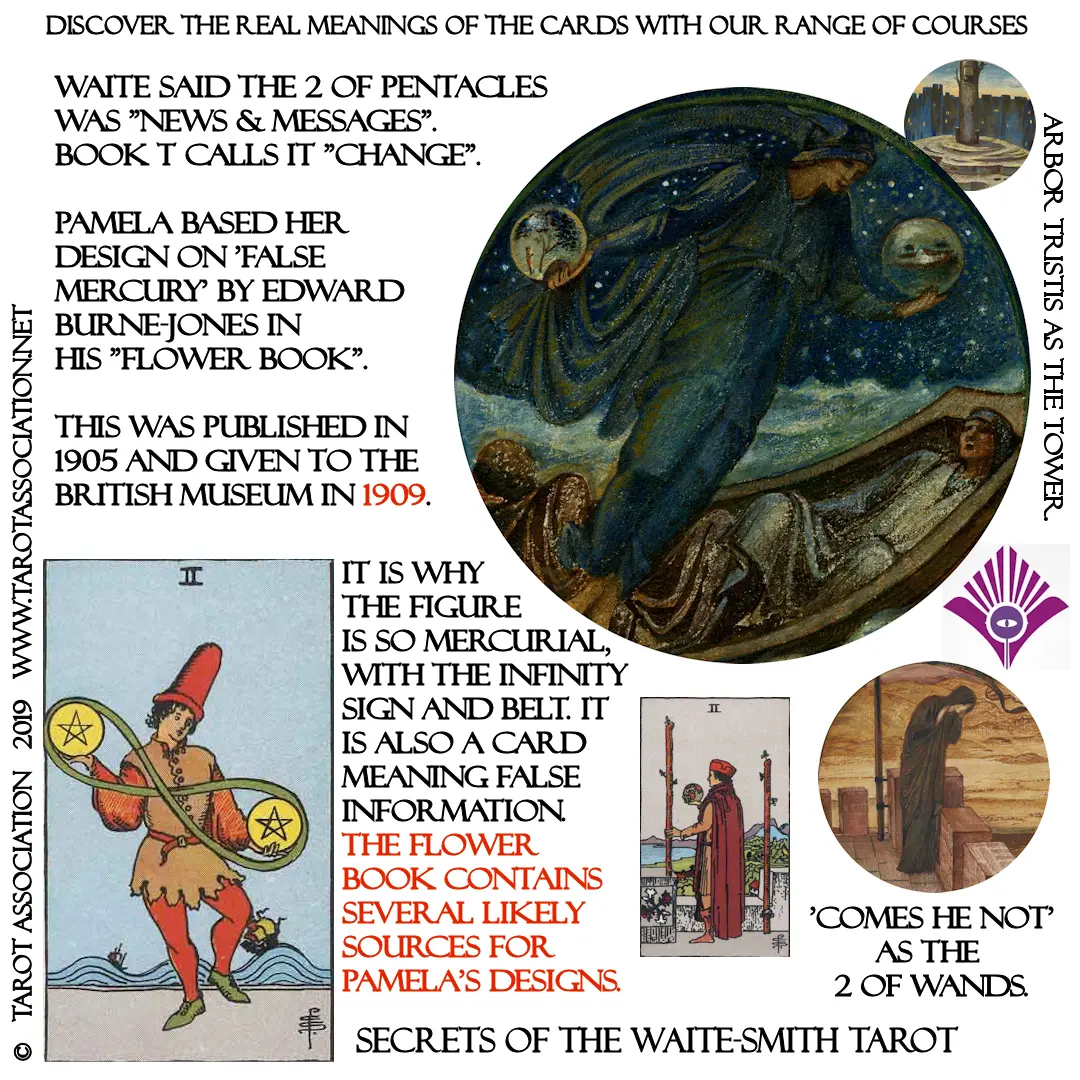
LONDON — For generations, modern tarot enthusiasts have interpreted the Two of Pentacles as a benign emblem of multitasking, financial juggling, and the eternal struggle to balance time and money. However, groundbreaking historical research reveals that this iconic card has been fundamentally misunderstood for over a century. Far from a simple blueprint for time management, the Two of Pentacles is, at its core, the original tarot card of miscommunication, psychological manipulation, and deception—truly, the historical precursor to "gaslighting."
A deep dive into the foundational texts of the Hermetic Order of the Golden Dawn, combined with the personal artistic inspirations of Pamela Colman Smith, exposes how the card’s true narrative was lost in translation, masking a far more cunning reality.
Main Facts: A Century of Misinterpretation
The standard contemporary reading of the Two of Pentacles relies on surface-level visual cues: a youthful figure nimbly keeping two coins aloft within an endless, undulating ribbon, standing against a backdrop of rolling, wave-tossed seas and bobbing ships. It has long been taught as a symbol of adaptability amidst changing tides.
Yet, historical scholarship proves that this imagery was never meant to convey innocent equilibrium. Instead, it was drawn from dark, esoteric origins signifying instability, conflicting communications, and unreliable forces.
- The Golden Dawn Root: Far from steady budgeting, original occult texts associate the card with fluctuating fortunes, alternating moods, inconsistency, and arguments.
- The Artistic Source: Illustrator Pamela Colman Smith based her design directly on a private notebook by pre-Raphaelite artist Edward Burne-Jones, specifically a drawing titled "False Mercury"—a visual pun representing a toxic, deceptive plant known as dog’s mercury.
- The Modern Revelation: Rather than offering a reassuring pat on the back about work-life balance, the card serves as a warning against calculated deceit, false promises, and psychological manipulation in romance, finance, and the workplace.
Chronology: How the Secret History of the Card Unfolded
To understand how the Two of Pentacles drifted so far from its original meaning, researchers trace a precise timeline linking 19th-century occultism to early 20th-century museum archives.
- Late 19th Century: The Hermetic Order of the Golden Dawn establishes its foundational instructional texts, notably Book T, defining the esoteric mechanics and divinatory meanings for the Lesser Arcana. The Two of Pentacles is designated as "The Lord of Harmonious Change," tied to Chockmah in Assiah (Wisdom of Action) and the astrological decan of Jupiter in Capricorn. Despite the harmonious title, its descriptive attributes include weakness, inconsistency, unreliability, and argumentativeness.
- 1909: Artist Pamela Colman Smith and occultist A. E. Waite visit the British Museum in London to draw inspiration for their revolutionary tarot deck, frequently studying historical cards on display like the Sola Busca Tarot. During this same era, a privately printed, illustrated botanical notebook by Edward Burne-Jones—containing the "False Mercury" drawing—enters the museum’s sphere of influence.
- 1909–1910: Smith designs the Rider-Waite-Smith tarot deck, utilizing the "False Mercury" concept for the Two of Pentacles. Meanwhile, Waite publishes The Pictorial Key to the Tarot, struggling to fully articulate the card’s secret Golden Dawn roots while noting its associations with "news and messages in writing, as obstacles, agitation, trouble, embroilment," alongside imaginary troubles and simulated enjoyment.
- Mid-to-Late 20th Century: As tarot popularity surges through successive cultural waves, the esoteric and deceptive underpinnings of the lesser arcana are largely smoothed over in favor of psychological, self-help frameworks, reducing the Two of Pentacles to an innocuous symbol of lifestyle balancing.
- Present Day: Modern historical research by tarot scholars bridges the gap between Burne-Jones’s botanical sketches and Smith’s artistic choices, resurrecting the card’s true identity as an emblem of misdirection and psychological manipulation.
Supporting Data: Esoteric Roots and Botanical Inspiration
The architecture of the Two of Pentacles relies heavily on kabbalistic correspondences and botanical symbolism, which shed light on why the card carries such a sharp, deceptive edge.
The Kabbalistic Blueprint
In the mystical framework of the Kabbalah, the card corresponds to Chockmah (Wisdom) located on the Pillar of Force within the lowest of the four worlds, Assiah (the Material World). While the Golden Dawn termed this "pleasant change" or "harmonious change," occultists note that this is not the fixed-axis spinning of the Wheel of Fortune, nor the measured pouring of Temperance. Instead, it is a rolling, volatile shift—an oscillation between opposing currents.
The Botanical Connection to "False Mercury"
The most smoking gun in the card’s historical reassessment lies in Pamela Colman Smith’s direct inspiration. Edward Burne-Jones’s illustrated notebook utilized folk names and Latin translations of herbs and flowers. For the Two of Pentacles, Smith adapted the concept of Mercurialis perennis—commonly known as "Dog’s Mercury" or "False Mercury."
Unlike true mercury plants, Mercurialis perennis is highly toxic. In Burne-Jones’s artistic interpretation, "False Mercury" was depicted as a mercurial figure luring sailors on a storm-tossed boat toward deceptive, hallucinatory visions of home and safety. Mercury, the ancient Roman messenger god, governs communication, intellect, and travel. A false messenger, therefore, represents deliberate misinformation, gaslighting, and betrayal masked as helpfulness.
Official Responses and Expert Perspectives
Tarot historians and modern esoteric researchers have increasingly advocated for a return to these original, unvarnished card meanings.
In their seminal reference work, Secrets of the Waite-Smith Tarot (2015), researchers Marcus Katz and Tali Goodwin highlight the intricate web of historical, artistic, and literary references utilized by Smith and Waite. According to Katz and Goodwin, the visual composition of the Rider-Waite-Smith deck cannot be fully understood without examining the Victorian art movements and museum collections accessible to its creators at the dawn of the 20th century.
Furthermore, collaborative works such as A New Dawn for Tarot: The Original Tarot of the Golden Dawn (Forge Press, 2014) emphasize that early esoteric orders viewed the Minor Arcana not merely as psychological mirrors, but as dynamic maps of spiritual and energetic forces—forces that frequently included disruption, trials of intellect, and the psychological friction of duplicitous human behavior.
Implications: Contemporary Readings and Practical Applications
Revisiting the Two of Pentacles as the original "gaslighting" card fundamentally transforms how readers should interpret it across various life domains. While the surface-level balancing act remains relevant, the deeper subtext demands heightened vigilance against manipulation.
Romance and Relationships
While a standard reading might suggest juggling dates or managing busy schedules together, a deeper exploration uncovers deliberate miscommunication. It serves as a stern warning against emotional manipulation, stonewalling, or gaslighting by a partner—or oneself. It demands testing the ground to ensure mutual honesty rather than accepting a simulated reality.
Finance and Resources
Beyond basic budgeting and managing multiple income streams, the card cautions against fraudulent investment opportunities or financial deceit. Someone may be misleading you regarding the true viability or risk of a financial project.
Career and Workplace Dynamics
In a professional context, while multitasking and shifting priorities are normal, the card mandates extreme clarity. Vague directives, shifting goalposts, and undocumented verbal agreements should be met with caution; workers are advised to get everything in writing to protect against workplace politics and deception.
Home, Education, and Spiritual Life
Even in domestic, academic, or spiritual settings, the Two of Pentacles calls for grounding. Whether balancing home duties with external demands or harmonizing mundane life with esoteric studies, the underlying message remains: do not let external illusions pull you off-center.
The "Yes/No" Verdict
When pulled in a binary query, the Two of Pentacles offers a qualified YES. The overarching trajectory remains positive, but it requires navigating a series of fluctuations, setbacks, and approaches before reaching true resolution.
Ultimately, the true message of the Two of Pentacles can be distilled into a single imperative: Balance your resources and keep it real during a period of positive change. By stripping away a century of sugar-coated interpretations, today’s seekers can finally heed the true warning whispered by the false messenger of the waves.
