

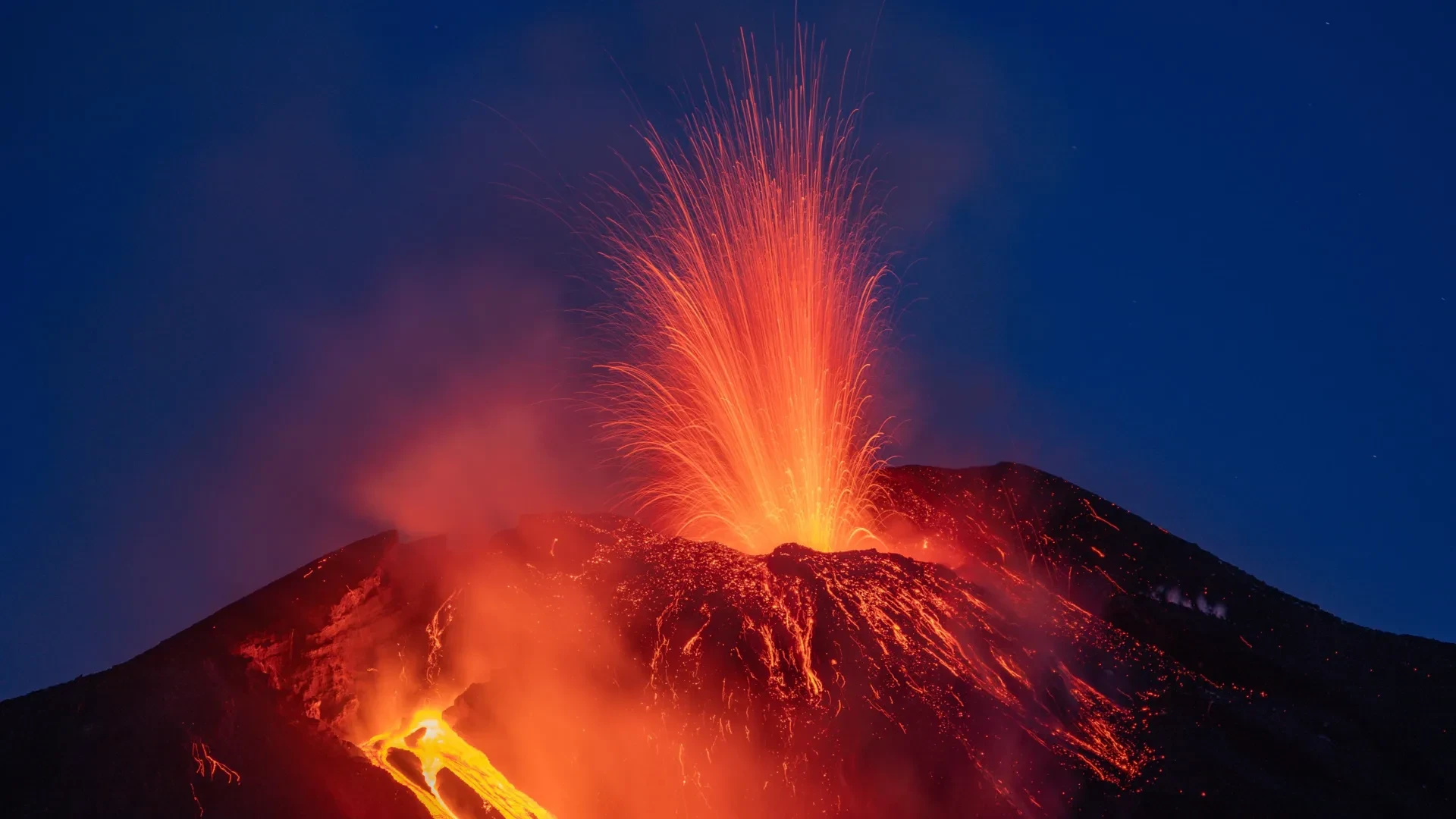
Main Facts: Decoding the Volcanic Anatomy of Mount Etna
Volcanoes are often conceptualized by the public as towering, monolithic mountains with simple, vertical conduits of molten rock. In reality, they are fed by vast, intricate underground networks of magma chambers, fractures, and gas conduits that behave with staggering unpredictability. Even a single volcano—fed by the same general mantle source—can produce vastly different types of eruptions through drastically contrasting physical and chemical processes.
A Cornell University-led research team has unveiled groundbreaking insights into this subterranean complexity, focusing on Mount Etna, Europe’s most active and iconic volcano. By reconstructing two major, historical eruptions from Italy’s premier giant, the scientists demonstrated that magma can follow radically different pathways and ascend toward the surface at wildly divergent speeds.
The findings, recently published in the prestigious journal Geochemistry, Geophysics, Geosystems, mark a significant leap forward in volcanology. The study was spearheaded by Esteban Gazel, the Charles N. Mellowes Professor in the Department of Earth and Atmospheric Sciences within the Cornell Duffield College of Engineering, alongside former postdoctoral researcher and first author Maxim Gavrilenko.
At the core of the discovery is a pioneering application of Raman spectroscopy. By examining microscopic crystals that formed deep within the magma, researchers can now measure minuscule gas bubbles—measuring only 1 to 10 percent the thickness of a human hair—trapped inside those mineral structures. This innovative analytical pipeline allows scientists to calculate the density of carbon dioxide ($textCO_2$) within the inclusions, translate that density into pressure metrics, and ultimately map the depth of the magma’s origin with unprecedented precision.
This unprecedented level of detail is transforming how scientists view volcanic plumbing systems. By understanding the specific triggers—such as the volatile competition between carbon dioxide and water—researchers hope to drastically improve the physical models used to assess and mitigate risks for future volcanic crises.
Chronology: A Tale of Two Eruptions Across Millennia
To understand how Mount Etna’s internal plumbing operates, the research team—which included collaborators Terry Plank of Columbia University and Bruce Houghton of the University of Hawaii, Manoa—reconstructed the life cycle of two distinct, highly violent eruptions separated by millennia. Their chronological reconstruction reveals a geological system capable of switching gears entirely depending on the volatile composition driving the melt.
The 122 B.C. Plinian Eruption: A Slow, Stalling Ascent
The first event examined was one of Etna’s largest and most historically significant known eruptions, which occurred in 122 B.C. This catastrophic event was both "mafic" (meaning the magma had relatively low viscosity and was rich in magnesium and iron) and "Plinian." Named after Pliny the Elder—who famously documented the catastrophic eruption of Mount Vesuvius in 79 A.D.—Plinian eruptions represent the most explosive and violently energetic class of volcanic activity on Earth.
Through systematic sample collection on the slopes of Etna and detailed sequencing and measurement of internal magma crystals, the research team mapped the journey of the 122 B.C. magma:
- Deep Origin: The magma began its journey from a deep mantle source situated approximately 22 kilometers (about 13.6 miles) beneath the surface.
- The Shallow Stall: Rather than shooting directly to the surface, the magma altered its trajectory. It moved upward slowly and stalled at a much shallower depth of 2 to 5 kilometers.
- Degassing and Eruption: The magma lingered in this upper-crustal reservoir for several weeks. During this period of stasis, it gradually released trapped gases before finally breaching the surface in a massive, explosive Plinian display.
The Fall Stratified Event: A Breakneck Sprint from the Depths
In sharp contrast, the research team analyzed data from an even older event: the "Fall Stratified" eruption, which occurred nearly 4,000 years ago. This eruption followed a radically different physical path and operated on a completely different timeline.
- Ultra-Deep Roots: The magma for the Fall Stratified event originated much deeper in the Earth’s mantle, originating roughly 24 to 30 kilometers below the surface.
- Rapid Ascent: Instead of pausing in a shallow crustal chamber to degas and gather strength, the magma experienced a breakneck ascent.
- Hours to the Surface: Fueled by massive internal pressures, the molten rock traveled upward and erupted at the surface within a matter of hours.
Comparing these two chronological snapshots revealed that Mount Etna is not governed by a single, static plumbing blueprint. Instead, its eruption style is dictated by a chemical tug-of-war deep underground.
Supporting Data: The Volatile Competition Between $textCO_2$ and Water
For decades, classical volcanology operated under a primary assumption: water ($textH_2textO$) is the primary volatile driver responsible for explosive volcanic eruptions. While carbon dioxide was known to exist in magmatic systems, its role as a primary trigger was largely overshadowed. However, in 2023, Gazel’s research group fundamentally shifted this paradigm by proving that carbon dioxide can single-handedly trigger explosive volcanic activity.
To conceptualize this, Gazel offers a familiar everyday analogy: "Imagine a bottle of soda. If you open that bottle without agitating it, you can drink it, but if you shake it up, all the bubbles get separated really fast, and you have an explosion," Gazel explained. "Volcanoes work in a similar way, and my lab is trying to quantify these processes."
The Mechanics of the Soda Bottle Effect
Magmatic volatiles like water and carbon dioxide dissolve into liquid rock under extreme subterranean pressure. As magma ascends, pressure drops, causing these dissolved gases to exsolve and form bubbles. If the gas separates rapidly and violently, it fragments the magma, resulting in an explosion.
However, the behavior of these gases varies greatly by geological setting:
- Oceanic Islands: Volcanic systems here are predominantly driven by high concentrations of carbon dioxide.
- Subduction Zones: Volcanoes in these regions are typically controlled by water.
- Mount Etna’s Unique Status: Etna stands out as one of the few places on Earth where carbon dioxide and water actively compete for dominance.
According to the team’s findings, the balance between these two volatiles dictates the entire plumbing route of an eruption:
- The $textCO_2$ Threshold: When a magma batch crosses a specific, high threshold of carbon dioxide, it acts as an intense propellant. This high-density $textCO_2$ drives magma rapidly and directly from deep within the mantle, leading to ultra-fast, short-notice eruptions (such as the Fall Stratified event).
- The Water Threshold: Conversely, when water is the more dominant or influential volatile species, the magma tends to stall at shallower depths. It lingers in crustal reservoirs for weeks or months, allowing complex degassing processes to dictate the eventual eruption style (such as the 122 B.C. Plinian event).
Official Responses and Scientific Perspectives
The implications of this research extend far beyond academic curiosity, offering new tools for geologists tasked with keeping populations safe near active tectonic zones.
Reflecting on the broad applicability of the Raman spectroscopy technique, Esteban Gazel emphasized the necessity of scaling these methods globally. "Ideally, this should be done in every volcano on the planet," Gazel stated. "This is data we need for physical models of eruptions that are the base of risk assessment."
Maxim Gavrilenko, the study’s first author, detailed the precision unlocked by the team’s analytical approach: "That technique gives us the density of $textCO_2$, and using a state equation we can transform that density into pressure, and pressure can be transformed into depth. Then we apply those techniques to these explosive eruptions, and we are able to reconstruct the plumbing system with an unprecedented precision."
The research has also inspired an appreciation for the cultural and historical resonance of Mount Etna. Long before modern volcanology mapped mantle plumes and crystal inclusions, ancient civilizations sought to explain the mountain’s fiery outbursts through myth. In Greek mythology, the rumblings and eruptions of Mount Etna were attributed to the imprisonment of the giant monsters Typhon and Enceladus beneath the earth after their defeat by the Olympian gods.
In a whimsical nod to his geological findings, Gazel pointed out an uncanny parallel between ancient myth and modern science: "There may be the two giant mythological monsters under Etna. And if you look at the plumbing system of the Plinian eruption, it’s like Typhon, because it’s elongated and serpentine, and the other one is Enceladus, because it’s kind of smaller. If you work in Etna, it’s hard not to be connected to history, classical work and great food."
The study was co-authored by Cornell postdoctoral researchers Kyle Dayton and Ellyn Huggins, alongside Anna Barth of the University of California, Berkeley. Financial support for the research was provided by the National Science Foundation (NSF).
Implications: Transforming Volcano Risk Assessment Worldwide
As global populations expand closer to active volcanic zones, the demand for accurate, predictive models has never been more urgent. Traditional methods of monitoring volcanoes—such as tracking ground deformation via GPS, measuring seismic tremors, and monitoring gas emissions at the surface—provide critical real-time alerts. However, they often struggle to answer fundamental questions: How fast is the magma moving? Where did it originate? What is driving its ascent?
The Cornell-led study bridges this critical gap by connecting the deep-Earth petrological record with surface hazards. By determining the exact depths of magma storage, the transit speeds, and the specific volatile thresholds ($textCO_2$ versus $textH_2textO$) governing an ascent, scientists can build far more realistic and sophisticated physical models of eruptions.
Building upon these successes, Gazel’s research group is already expanding their methodology to other volatile-rich volcanic systems around the globe, including targets in Chile, Hawaii, and beyond.
Ultimately, understanding the dual-plumbing nature of Mount Etna provides a vital blueprint for volcanic forecasting. By decoding the microscopic gas bubbles trapped inside ancient crystals, scientists are better equipped to read the subterranean warning signs of future eruptions—turning the unpredictable fury of the Earth into measurable, manageable data that can save lives.
