

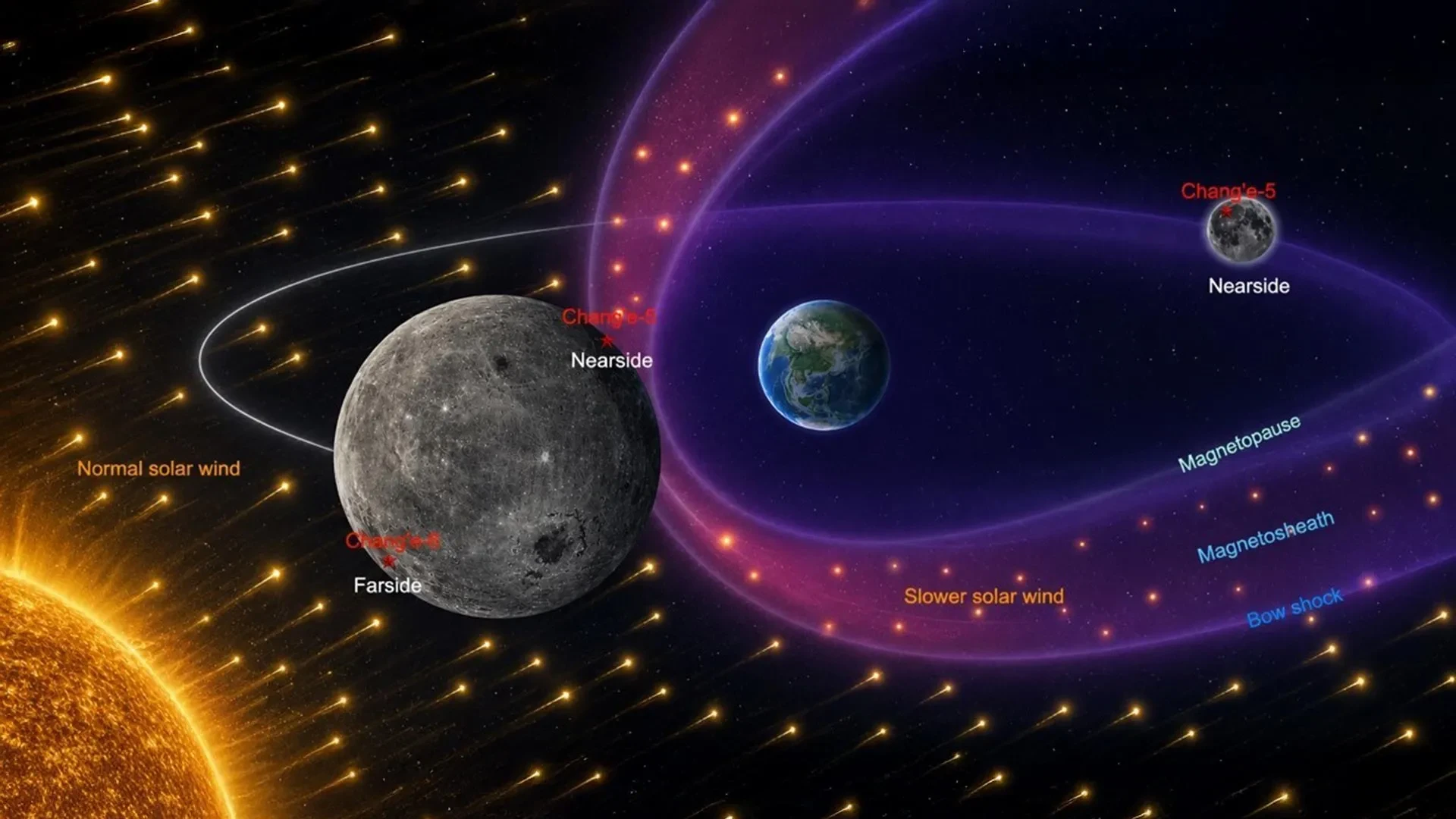
BEIJING — For billions of years, the Moon has stood as an exposed and silent witness to the relentless fury of the cosmos. Lacking a thick atmosphere to soften the blow or a global magnetic field to deflect incoming radiation, the lunar surface has absorbed a constant, unyielding bath of high-energy particles streaming from the Sun. For decades, scientists operated under the assumption that this cosmic sandblasting occurred uniformly, blanketing both hemispheres of Earth’s solitary satellite in an equal and indiscriminate storm of solar wind.
Groundbreaking new research, however, has shattered that long-held assumption.
An international team of scientists examining pristine soil samples retrieved from the Moon’s mysterious far side has discovered that the lunar hemispheres experience solar wind bombardment in starkly different ways. Particles striking the near side and the far side arrive at vastly different speeds, carry distinct energy signatures, and leave behind unique chemical footprints.
The primary architect of this celestial asymmetry is none other than Earth itself. According to findings published in the prestigious journal Nature Geoscience, our planet’s colossal magnetic field—the magnetosphere—acts as a dynamic speed-governing shield, casting a protective magnetic wake that fundamentally alters the solar wind before it can touch the lunar near side.
The discovery not only redefines our understanding of the complex, interconnected dance between the Sun, Earth, and the Moon, but it also turns the lunar regolith into an unprecedented "fossil archive" capable of unlocking the ancient history of Earth’s magnetic past.
Main Facts: A Tale of Two Hemispheres
The revelation stems from a rigorous geochemical analysis of material brought back to Earth by China’s historic Chang’e 6 mission. The samples provided the first-ever direct opportunity to compare solar wind implantation in soil from the lunar far side with decades of data collected from the near side.
At the heart of the discovery are noble gases—helium, neon, argon, krypton, and xenon—trapped deep within the grains of lunar dust, known as regolith. Because these elements are chemically inert and rarely react with other substances, they act as stable, reliable cosmic time capsules. They preserve the precise isotopic compositions and kinetic energies of the solar wind particles that drove them into the lunar soil eons ago.
Key takeaways from the newly published study include:
- Isotopic Divergence: Neon isotope analysis (
20Ne/22Ne) revealed that the far-side soil exhibits a significantly lower ratio (11.34 ± 0.22) than any previously studied near-side samples, pointing to intense isotopic fractionation driven by high-energy particle exposure. - Penetration Depth Disparity: Stepwise heating experiments involving xenon and krypton showed that solar wind particles penetrated much deeper into the far-side regolith, requiring significantly higher kinetic energy than particles striking the near side.
- The Earthly Shield: The variance is directly attributed to Earth’s magnetosphere. As the Moon orbits our planet, it passes through a transition zone called the magnetosheath, where the solar wind is dramatically decelerated—cutting speeds from roughly 400 kilometers per second down to 200 kilometers per second.
- A Permanent Record: Approximately 25% of the solar wind exposure recorded at the near-side Chang’e 5 landing site bears the signature of this slower, Earth-moderated flow, whereas the far-side Chang’e 6 site shows absolute zero evidence of this protective slowdown.
Chronology: From Near-Side Blind Spots to Far-Side Breakthroughs
To understand the magnitude of the Chang’e 6 discovery, one must look back at the historical limitations of lunar exploration and the step-by-step unraveling of the solar wind mystery.
The Near-Side Era (1969–2020)
For over half a century, humanity’s physical access to lunar material was strictly restricted to the near side. Samples returned by NASA’s Apollo and Soviet Luna missions, followed decades later by China’s Chang’e 5 mission in 2020, all originated from the hemisphere permanently locked in Earth’s gaze.
While these samples yielded invaluable insights into lunar geology and solar history, they created a profound scientific blind spot. Because researchers had zero physical material from the lunar far side, they could not definitively test whether solar wind implantation was truly symmetrical across the entire globe or if Earth’s magnetic environment played a localized filtering role. Theoretical models suggested Earth’s magnetosphere might affect the Moon, but without empirical ground truth from the opposite side of the world, those models remained unproven hypotheses.
The Chang’e 6 Triumph (June 2024)
The turning point arrived in June 2024, when China’s Chang’e 6 return capsule successfully parachuted down in Inner Mongolia. Tucked inside its cargo was 1,935 grams of precious regolith scooped from the South Pole-Aitken basin—one of the largest, deepest, and oldest impact craters in the solar system, located squarely on the lunar far side.
For planetary scientists, this was the holy grail. It provided the elusive counterpart needed to complete the comparative puzzle.
Laboratory Analysis and Publication (Late 2024 – Early 2025)
Following the curation of the Chang’e 6 samples, a dedicated research team led by the Institute of Geology and Geophysics (IGG) of the Chinese Academy of Sciences (CAS) set to work. Utilizing state-of-the-art mass spectrometry and stepwise thermal release techniques, the team meticulously measured the concentrations and isotopic structures of noble gases embedded within the far-side regolith grains. By comparing these metrics side-by-side with near-side samples (such as those from Chang’e 5), the researchers mapped out the distinct energetic and isotopic signatures that ultimately confirmed Earth’s dominant role as a solar wind governor.
Supporting Data: Decoding the Noble Gas Signatures
The scientific rigor behind the Nature Geoscience study rests on the meticulous reading of elemental and isotopic fingerprints trapped inside microscopic mineral grains.
Neon Isotope Fractionation
When solar wind ions strike an unprotected planetary body, lighter isotopes can behave differently than heavier ones depending on the energy of the collision and subsequent space-weathering processes. In the Chang’e 6 far-side regolith, the average 20Ne/22Ne ratio dropped to 11.34 ± 0.22.
This value is markedly lower than any measurement recorded in near-side lunar soils. According to the research team, this lower ratio aligns precisely with theoretical models predicting strong isotopic fractionation—a process where lighter neon-20 is preferentially scattered or lost, leaving a heavier neon-22 signature behind due to unmitigated, high-intensity particle bombardment.
The Xenon Thermal Release Curve
Perhaps the most striking physical evidence of differential particle energy came from the noble gas xenon. During laboratory thermal extraction—where samples are heated incrementally to release trapped gases—xenon from the Chang’e 6 far-side material emerged primarily in a single, high-temperature peak.
By contrast, near-side samples from the Chang’e 5 mission displayed a bimodal release pattern, with substantial quantities of xenon escaping at both low and high temperatures.
What does this mean physically? Gases released at lower temperatures in lunar regolith typically originate from shallower depths, where lower-energy particles managed to implant themselves. Gases that require high temperatures to break free are locked deep inside the crystalline structure of the mineral grains, deposited there by high-energy, fast-moving ions.
The absence of a low-temperature xenon release peak in the Chang’e 6 samples indicates that the far side was subjected to a continuous stream of high-energy, unhindered solar wind particles capable of driving deep into the soil matrix. Meanwhile, the near-side soil retained the shallower, low-energy footprints left behind by solar wind that had been slowed down by Earth’s magnetic buffer.
Official Responses and Expert Perspectives
The publication of these findings has drawn widespread praise and excitement from the global planetary science community, highlighting the importance of international sample sharing and collaborative investigation.
Xuhang Zhang, a postdoctoral researcher at IGG and lead author of the study, emphasized the profound shift in how scientists must view the Earth-Moon system.
"For decades, we treated the solar wind as a constant background noise across the lunar surface," Zhang noted. "Our findings prove that the Moon’s environment is far more dynamic. The far side is an unfiltered window into the raw, unadulterated solar wind, while the near side lives in a magnetically sheltered microclimate."
Professor HE Huaiyu of the Chinese Academy of Sciences, who supervised the research project, pointed out the technological and scientific triumph of the Chang’e program in making these discoveries possible.
"Without the successful retrieval of samples from the South Pole-Aitken basin by Chang’e 6, this comparative atmospheric-shielding research would have remained impossible," Professor He stated. "These tiny grains of dust are whispering secrets about the past interactions between worlds that we are only just beginning to decipher."
Independent space physicists not directly involved in the study have also lauded the work. Dr. Elena Rostova, a magnetospheric physicist based in Europe, remarked that the study opens up an entirely new diagnostic tool for planetary evolution.
"Using lunar noble gases to reconstruct the historical behavior of Earth’s magnetic shield is nothing short of brilliant," Rostova said. "It gives us a geological tape recorder that spans billions of years, far outlasting any ice core or sedimentary rock on Earth."
Implications: A New Window Into Earth’s Magnetic Past
Beyond rewriting lunar geology textbooks, the discovery that Earth’s magnetosphere governs solar wind speed on the near side carries profound implications for our understanding of Earth itself.
The Magnetospheric "Fossil Record"
Earth’s magnetic field is vital to life; it deflects lethal cosmic radiation and prevents our atmosphere from being stripped away by the solar wind. However, the exact history of Earth’s magnetosphere—how strong it was billions of years ago, how its protective bubble fluctuated, and when it first formed—remains one of the greatest unanswered questions in geophysics. Terrestrial rocks that preserve ancient magnetism (paleomagnetism) are often altered, weathered, or destroyed by plate tectonics over billions of years.
The Moon, by contrast, is geologically quiet and tectonically dead. Its regolith acts as a pristine, undisturbed filing cabinet.
The researchers behind the new study suggest that heavy noble gases trapped in lunar soil can serve as long-term "fossil records" of Earth’s ancient magnetosphere. By analyzing how solar wind implantation depths and isotopic ratios vary across different stratigraphic layers (representing different geological epochs) on both the near and far sides, scientists may soon be able to reconstruct a timeline of Earth’s magnetic evolution.
When cross-referenced with paleomagnetic data from terrestrial rocks, this lunar archive could reveal whether Earth’s magnetic shield pulsed, weakened, or strengthened during critical periods in planetary history—including epochs when complex life was first struggling to emerge on Earth’s surface.
Redefining Planetary Systems
Ultimately, the Chang’e 6 solar wind study serves as a humbling reminder that planetary bodies do not exist in isolation. The Sun, Earth, and Moon form an intricately coupled system where gravitational tethers, magnetic wakes, and particle streams continuously shape one another’s environments.
As future lunar missions—such as upcoming crewed landings and robotic return ventures—target increasingly diverse regions of the Moon, scientists expect to uncover even more hidden chapters of our cosmic neighborhood’s history. The dust of the lunar far side has spoken for the first time, and in its microscopic noble gas atoms, humanity has found a mirror reflecting not just the fury of the Sun, but the invisible, protective embrace of our home planet.
