

By Global Environmental & Maritime Correspondent
Published: April 2026
Main Facts
Deep beneath the grey, rolling waves of the North Sea, a century-old silent crisis is unfolding. More than a hundred years after the conclusion of the First World War, the ocean floor remains littered with thousands of historical steel hulls, sunken warships, and forgotten submarines. Among them are sunken vessels heavily laden with ordnance, unexploded torpedoes, and thousands of pounds of high explosives.
Recent scientific investigations, spearheaded by the landmark NorthSeaWrecks research initiative, have revealed a deeply concerning reality: these deteriorating marine graves are no longer merely historical relics. They are leaking toxic chemicals directly into the marine ecosystem.
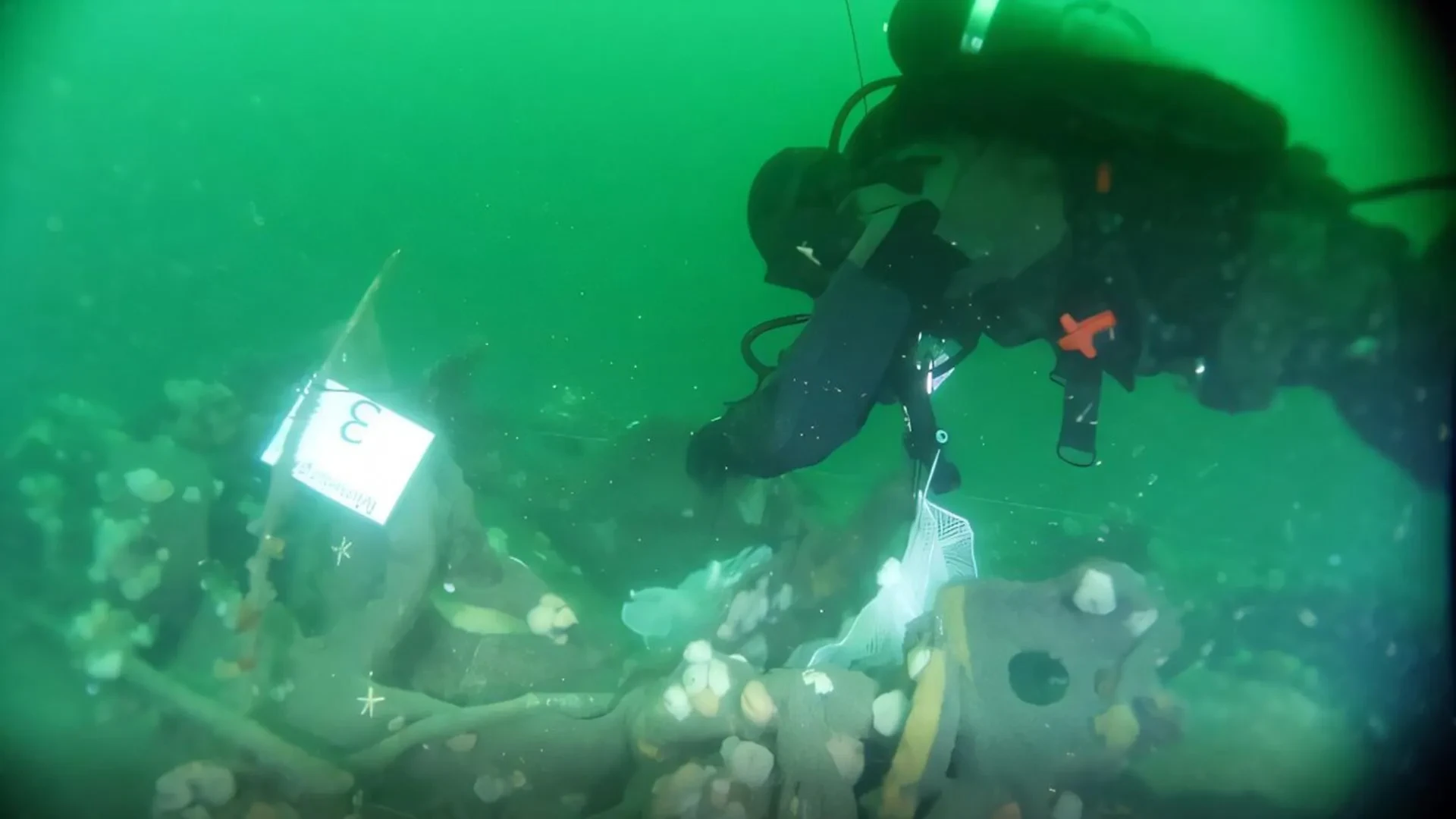
At the center of this environmental alarm is the UC-30, a German Imperial Navy submarine that sank off the coast of Rømø, Denmark, in April 1917. Packed to capacity with 18 naval mines and six torpedoes, the vessel has become a focal point for researchers assessing the long-term ecological damage of World War I munitions. According to recent findings published by marine geoscientists, trinitrotoluene (TNT)—a synthetic, highly toxic explosive compound—is actively bleeding out of the wreck. Traces of TNT have been successfully isolated from local seawater columns, surrounding seabed sediments, and indigenous marine life, including starfish and mussels clinging to the corroded hull.
While the pollution linked to individual wrecks like the UC-30 is currently believed to be relatively localized, the broader implications are staggering. A comprehensive 2024 report prepared for the Danish Environmental Protection Agency revealed that Danish territorial waters alone harbor over 10,100 historical shipwrecks, with roughly 15 percent dating back to the major global conflict periods of the 20th century.
As these metal behemoths steadily rust, collapse, and expose their lethal internal payloads to the corrosive embrace of seawater, environmental authorities across Europe face a daunting dilemma. Cleaning up the seabed is exorbitantly expensive, technically perilous, and fraught with the risk of causing secondary ecological disasters. Nevertheless, emerging technologies—including specialized crawling seabed robots developed through international research programs like REMARCO—offer a glimmer of hope in the race to map, monitor, and ultimately neutralize these submerged time bombs before the damage becomes irreversible.
Chronology
To understand how deadly wartime munitions ended up silently poisoning modern marine ecosystems, marine historians and scientists must look back more than a century to the geopolitical tensions that turned the North Sea into a watery killing zone.
1914–1918: The Wartime Crucible of the North Sea
During the First World War, control of the North Sea was of paramount strategic value to both the British Empire and the German Empire. Geographically, whoever commanded these waters controlled the maritime supply lines feeding into Northern Europe, granting them the power to impose devastating economic and military blockades.
Because the German High Seas Fleet was significantly smaller than the British Royal Navy, Berlin heavily relied on unconventional naval warfare. Unterseeboots (U-boats) were deployed en masse to stalk enemy merchant vessels and warships unseen, torpedoing them without warning. Simultaneously, both belligerent nations waged a devastating subterranean war using naval mines. Historical estimates indicate that approximately 190,000 naval mines were aggressively deployed across the North Sea throughout the war.
This naval attrition culminated in landmark engagements such as the Battle of Jutland off the coast of Northern Jutland in 1916—the largest naval clash in human history. More than 25 major warships were sent to the bottom, and nearly 10,000 sailors lost their lives in a single day, cementing the North Sea’s status as a vast, watery graveyard.
April 1917: The Final Voyage of the UC-30
Among the thousands of vessels lost during the conflict was the UC-30, a specialized German minelaying submarine. In April 1917, the submarine was navigating the treacherous waters near Rømø after abandoning a scheduled patrol near Ireland due to persistent engine failures. Turning back toward home and safety, the vessel was tantalizingly close to reaching German ports.
It never arrived. Packed to its structural limits with 18 explosive marine mines and six torpedoes, the UC-30 struck a British naval mine on April 19, 1917. The resulting detonation was catastrophic. The submarine was instantly torn apart, and all 27 crew members perished, sealing their fate beneath the surface.
2016: Rediscovery After a Century
For nearly a hundred years, the exact resting place of the UC-30 remained an unsolved mystery. The seabed guarded its secret until 2016, when Danish diver Gert Normann Andersen successfully located the decaying hull resting on the ocean floor. The discovery offered marine scientists an unprecedented opportunity to examine how a heavily armed WWI wreck interacts with the modern marine environment over the course of a century.
2024–Present: Scientific Awakening and Environmental Reports
The rediscovery of the UC-30 catalyzed modern environmental scrutiny. Katrine Juul Andresen, a professor at the Department of Geoscience at Aarhus University, stepped forward to co-lead investigations into the wreck site as part of the NorthSeaWrecks project. By 2024, Andresen had compiled a definitive report for the Danish Environmental Protection Agency, quantifying the staggering scale of the historical shipwreck problem in Danish waters and establishing a scientific baseline for ongoing contamination tracking.
Supporting Data
The scale of the threat posed by sunken military hardware is underscored by rigorous field data, marine surveys, and governmental assessments. The numbers paint a sobering picture of an ocean floor groaning under the weight of industrial-era detritus.
- 10,127: The total number of historical shipwrecks documented in Danish waters alone, according to Professor Andresen’s 2024 registry compiled for the Danish Environmental Protection Agency.
- 15 Percent: The approximate share of those Danish wrecks that date directly back to the two World War eras (1910–1920 and 1940–1945), representing vessels carrying high concentrations of military ordnance, fuel oil, and heavy metals.
- 190,000: The estimated number of naval mines deployed across the North Sea during World War I, many of which remain unexploded and buried in coastal sediment.
- 27 Lives: The total number of German submariners lost when the UC-30 detonated a British mine in April 1917.
- 18 Mines & 6 Torpedoes: The heavy offensive payload carried by the UC-30 at the time of its sinking, which now serves as a localized source of persistent TNT pollution.
Field data collected by navy divers working alongside Aarhus University researchers confirmed that toxic explosive compounds are actively leaking from the UC-30 hull. By extracting water samples, seabed sediments, and biological tissue samples from local starfish (Asterias rubens) and blue mussels (Mytilus edulis), scientists verified that TNT molecules have successfully bioaccumulated within the local food web. While dilution currents mitigate the concentration levels in the surrounding open water, the continuous structural decay of the vessel guarantees that the release of pollutants will intensify as time progresses and the protective metal casings of the munitions finally breach.
Official Responses
Governments and environmental protection agencies across Northern Europe are increasingly forced to grapple with the long-term liabilities inherited from 20th-century conflicts. However, the policy response has been fragmented, slow-moving, and constrained by immense economic and technical hurdles.
In Denmark, the Environmental Protection Agency commissioned the 2024 shipwreck inventory specifically to determine how the nation can align its environmental policies with the strict mandates of the European Union Water Framework Directive. The directive requires member states to achieve "good environmental status" across all regional marine waters, a standard that is severely threatened by the continuous leaching of carcinogenic explosives, heavy metals, and petrochemicals from wartime relics.
While the report provided a vital statistical foundation, local environmental authorities have yet to roll out a comprehensive, nation-wide remediation strategy. Professor Andresen notes that while the research is clear, the political and administrative follow-through remains in its infancy:
"I am not aware of whether the agency has taken the work further since the report was published in 2024. However, research shows that the wrecks represent a persistent source of pollution for the local marine environment."
By contrast, neighboring Germany has adopted a more aggressive financial and operational stance, particularly regarding munitions dumped in the Baltic Sea after the Second World War. When the Allies flooded the post-war ocean with surplus military hardware to prevent it from falling into hostile hands, they unwittingly created a legacy contamination crisis. Today, German federal agencies have committed substantial funding to locate, recover, and neutralize submerged ordnance.
Yet, even where funding is available, official caution is paramount. Experts emphasize that blindly attempting to dredge or detonate every discovered wreck can easily backfire. When heavy munitions are detonated in situ underwater, the shockwave can instantly pulverize aging metal casings, sending massive, concentrated plumes of toxic chemical contaminants cascading across miles of open ocean. Consequently, official policy is increasingly shifting away from brute-force removal toward targeted risk mitigation and advanced technological monitoring.
Implications
The discovery that WWI and WWII shipwrecks are actively poisoning European waters carries profound ecological, economic, and technological implications for the future of maritime management.
Ecological and Ecotoxicological Risks
The presence of TNT and its chemical degradation products—such as DNT (dinitrotoluene)—in marine wildlife poses insidious biological threats. TNT is known to be toxic, mutagenic, and carcinogenic to various aquatic organisms. While starfish and mussels living near the UC-30 have demonstrated an ability to absorb these compounds, the long-term impacts on commercial fisheries, marine mammal populations, and delicate benthic ecosystems remain poorly understood. As corrosion eats deeper into torpedo warheads and mine casings, the rate of toxic discharge will inevitably accelerate, turning localized hot spots into wider ecological dead zones.
The Complexity of Remediation
The old adage "let sleeping dogs lie" often applies to underwater wrecks, but marine scientists warn that ignoring them is no longer an option. However, cleaning up the seabed is an engineering nightmare. Civilian diving on historical war graves is strictly prohibited by international maritime law and safety regulations, meaning all investigative and remedial work must be executed by specialized military divers or robotic systems.
Furthermore, geography dictates strategy. As Professor Andresen points out, the physical state of a wreck matters immensely:
"Some wrecks are fully or partially buried in the seabed. When covered by sand, the risk of polluting the surrounding sea is significantly lower. It is a matter of identifying where the environmental threat is greatest—and then deciding whether the munitions on the wrecks should be removed."
Technological Horizons: Seabed Robots and REMARCO
Recognizing that manual deep-sea cleanups are too dangerous and expensive to apply to thousands of sites, the international scientific community is turning to cutting-edge automation. Through the EU-funded REMARCO project, researchers are collaborating to pioneer gentler, smarter approaches to dealing with submerged historical munitions.
The crown jewel of this technological push is the development of autonomous seabed-crawling robots. Designed to traverse rugged, uneven ocean floors, these robotic systems can map the precise coordinates of eroding munitions, capture high-definition visual data of hull degradation, and monitor environmental leakage parameters in real time. Crucially, next-generation prototypes are being engineered not only to observe but to act: future iterations may be equipped with robotic manipulators capable of delicately lifting dangerous items off the seabed, surfacing them, and transferring them to specialized land-based facilities for safe neutralization.
Conclusion
The ghosts of the North Sea are waking up. What began a century ago as iron monuments to human conflict have transformed into ticking environmental time bombs. While researchers have finally mapped the scope of the crisis—revealing thousands of vulnerable wrecks and documenting active TNT pollution around vessels like the UC-30—the path forward requires a delicate balance of science, state funding, and robotic innovation. Only through careful, prioritized intervention can Europe hope to cleanse its seabed without inadvertently unleashing an even greater ecological catastrophe upon the waves.
