

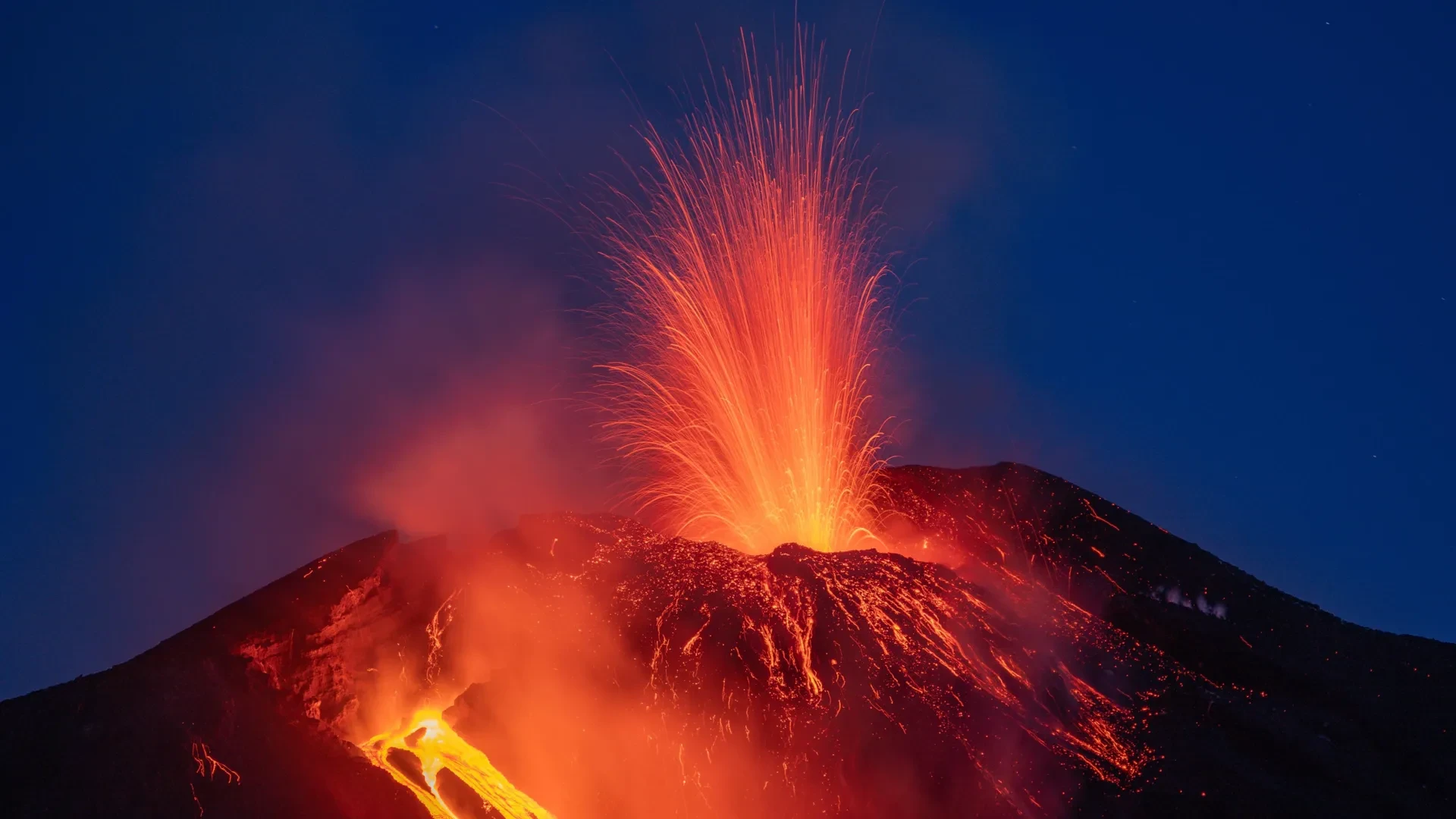
ITHACA, N.Y. — Volcanoes are among the most powerful and enigmatic natural phenomena on Earth, driven by colossal underground networks of molten rock, pressurized gases, and complex mineral structures. Yet, despite decades of intensive geological study, the exact mechanisms that transform a relatively gentle volcanic system into an explosive, catastrophic hazard remain deeply misunderstood.
Even a single volcano does not always behave the same way over time. In fact, a single geological edifice can produce vastly different types of eruptions through entirely unique subterranean processes.
A Cornell University-led research team has now cast unprecedented light on this volatile variability by mapping the complex subterranean pathways of Mount Etna in Italy. By meticulously reconstructing two major historical eruptions from the volcano’s past, the scientists discovered that magma followed drastically different routes and surged toward the surface at vastly disparate speeds.
The findings, recently published in the scientific journal Geochemistry, Geophysics, Geosystems, offer a transformative look at volcanic mechanics. By combining cutting-edge spectroscopic techniques with rigorous geochemical analysis, the researchers have provided a new framework that could radically improve the mathematical and physical models used to assess volcanic risks worldwide.
The study was spearheaded by Maxim Gavrilenko, a former postdoctoral researcher at Cornell and the paper’s first author, working alongside an interdisciplinary team of volcanologists and geochemists. The project was directed by Esteban Gazel, the Charles N. Mellowes Professor in the Department of Earth and Atmospheric Sciences within the Cornell Duffield College of Engineering. Gazel’s research program is dedicated to decoding the inner workings of volcanoes, with a particular focus on the triggers of explosive behavior and the subterranean variables that dictate whether an eruption flows gently or shatters the landscape.
Main Facts: Decoding the Subterranean Architecture of Volcanoes
At its core, a volcano’s explosiveness is governed by a delicate interplay of physical and chemical properties: how easily its magma flows (viscosity) and the volume of volatile materials trapped within the molten matrix. Volatiles are gases dissolved under intense pressure within the magma that can rapidly separate and expand as pressure drops during ascent.
To visualize this process, Esteban Gazel offers a familiar everyday analogy.
"Imagine a bottle of soda," Gazel explains. "If you open that bottle without agitating it, you can drink it, but if you shake it up, all the bubbles get separated really fast, and you have an explosion. Volcanoes work in a similar way, and my lab is trying to quantify these processes."
Historically, the volcanological community considered water to be the primary volatile responsible for driving explosive eruptions. However, a major paradigm shift occurred in 2023, when Gazel’s research group demonstrated that carbon dioxide ($CO_2$) can also independently trigger explosive volcanic activity.
To arrive at these insights, the Cornell team utilized a pioneering analytical technique involving Raman spectroscopy. This high-precision method allows scientists to examine microscopic crystals formed deep within the magma during its ascent. Trapped inside these crystals are minuscule gas bubbles—infinitesimal fluid inclusions measuring only about 1 to 10 percent the thickness of a human hair.
"That technique gives us the density of $CO_2$, and using a state equation we can transform that density into pressure, and pressure can be transformed into depth," Gavrilenko notes. "Then we apply those techniques to these explosive eruptions, and we are able to reconstruct the plumbing system with an unprecedented precision."
By applying this technique to Mount Etna—a geological complex selected because its system is relatively simple and dominated by volcanic gases—the researchers were able to trace the historical journeys of magma with a level of clarity previously thought impossible.
Chronology: Reconstructing Two Historic Eruptions at Mount Etna
Mount Etna, situated on the east coast of Sicily, Italy, is Europe’s most active stratovolcano. While it is frequently characterized by gentle, effusive lava flows, its long geological history is punctuated by infrequent, highly violent eruptions.
To understand the full spectrum of Etna’s behavior, the research team focused on two distinctly different eruptions separated by nearly four millennia. Collaborators and co-authors Terry Plank of Columbia University and Bruce Houghton of the University of Hawaii, Manoa, traveled to the field site to systematically collect comprehensive geological samples for the study.
The 122 B.C. Plinian Eruption: A Slow, Stalled Ascent
One of Mount Etna’s largest and most destructive historical events occurred in 122 B.C. This eruption was classified as both "mafic" and "Plinian." Mafic magma typically features low viscosity and is rich in magnesium and iron. Meanwhile, Plinian eruptions represent the most extreme and explosive class of volcanic activity—named in honor of the Roman author Pliny the Elder, who famously documented the catastrophic eruption of Mount Vesuvius in 79 A.D.
By sequencing and analyzing the chemical signatures of crystals formed within the magma of the 122 B.C. event, the researchers reconstructed its subterranean timeline:
- Deep Origin: Magma initial began its ascent from a profound depth of approximately 22 kilometers beneath the Earth’s surface.
- The Stalling Phase: Rather than racing directly to the surface, the magma’s upward migration slowed down dramatically. It pooled and stalled at a much shallower reservoir, roughly 2 to 5 kilometers underground.
- Degassing and Storage: The magma lingered in this shallow crustal holding zone for several weeks, steadily releasing gas and altering its chemical composition before finally breaching the surface in a massive Plinian explosion.
The Fall Stratified Event: A High-Speed Ascent From the Mantle
The researchers then cross-referenced their findings with data from an even older event in Etna’s history: the Fall Stratified eruption, which occurred nearly 4,000 years ago.
This ancient event followed a completely contrasting trajectory:
- Deep Mantle Generation: Magma originated much deeper in the Earth’s mantle, initiating its journey from depths of roughly 24 to 30 kilometers below the surface.
- Rapid Surge: Unlike the 122 B.C. eruption, the magma did not linger in shallow crustal chambers. Instead, it tore upward through the crust with blistering speed.
- Immediate Eruption: The entire ascent and subsequent eruption took place within a matter of hours, fueled by an intense concentration of deep-seated carbon dioxide.
Supporting Data and Geochemical Mechanics
The contrast between the 122 B.C. and Fall Stratified eruptions revealed a critical threshold governing volcanic behavior. The research showed that rapid, deep-seated ascents are directly correlated with exceptionally high concentrations of carbon dioxide, whereas slower, shallower processes are mediated by water and prolonged residence times in crustal pockets.
"Some volcanoes are only high $CO_2$, mostly in oceanic islands, and some volcanoes are mostly controlled by water, such as the ones in subduction zones," Gazel observes. "Etna is one of the few volcanoes in the world where you have the two volatile species competing."
This dual-volatile competition creates a chemical tipping point:
- The $CO_2$ Threshold: When carbon dioxide concentrations exceed a certain threshold, the magma is driven violently and rapidly upward from deep mantle sources, resulting in fast, highly explosive events.
- The Water Influence: When water becomes the dominant volatile or when magma spends extended periods lingering at shallow depths, the eruption dynamics shift, becoming controlled by shallow crustal degassing and pressure accumulation.
This discovery fundamentally alters how geologists view volatile interactions, proving that $CO_2$ is not merely a passive passenger in magma systems, but an active trigger capable of driving catastrophic geological events independently of water.
Official Responses and Broader Implications
The implications of this study extend far beyond the slopes of Mount Etna. Current volcanic risk assessment relies heavily on physical models that simulate how magma moves beneath the Earth’s surface. However, many existing models operate on generalized assumptions about magma ascent speeds and volatile drivers.
Gazel and his team are already expanding their methodology to test volcanoes in diverse tectonic settings worldwide, including Chile, Hawaii, and beyond.
"Ideally this should be done in every volcano on the planet," Gazel asserts. "This is data we need for physical models of eruptions that are the base of risk assessment."
By accurately determining the precise depth where magma initiates its ascent, quantifying the speed of its migration, and identifying which specific gases are driving the movement, volcanologists can construct far more realistic, predictive models. These advancements will ultimately provide civil protection authorities and vulnerable communities with earlier, more accurate warnings ahead of potential eruptions.
The research team behind these findings also includes postdoctoral researchers Kyle Dayton and Ellyn Huggins, alongside Anna Barth of the University of California, Berkeley. Financial support for the comprehensive study was provided by the National Science Foundation.
Cultural Echoes: Mythology Meets Modern Volcanology
Beyond its rigorous scientific contributions, Mount Etna occupies a unique space in human history and culture, having inspired myth and legend for millennia.
In ancient Greek mythology, the subterranean rumblings and fiery outbursts of Etna were attributed to the imprisonment of monstrous giants—Typhon and Enceladus—who were cast beneath the earth after being defeated by the Olympian gods. Interestingly, Esteban Gazel points out a striking, almost poetic parallel between these ancient myths and the complex plumbing structures revealed by his team’s modern geochemical research.
"There may be the two giant mythological monsters under Etna," Gazel reflects with a smile. "And if you look at the plumbing system of the Plinian eruption, it’s like Typhon, because it’s elongated and serpentine, and the other one is Enceladus, because it’s kind of smaller. If you work in Etna, it’s hard not to be connected to history, classical work and great food."
As science continues to decode the fiery depths of the Earth, the ancient stories told in the shadow of Mount Etna remind us of humanity’s long-standing fascination with the untamed forces of nature—forces that researchers are now finally beginning to understand with microscopic precision.
