

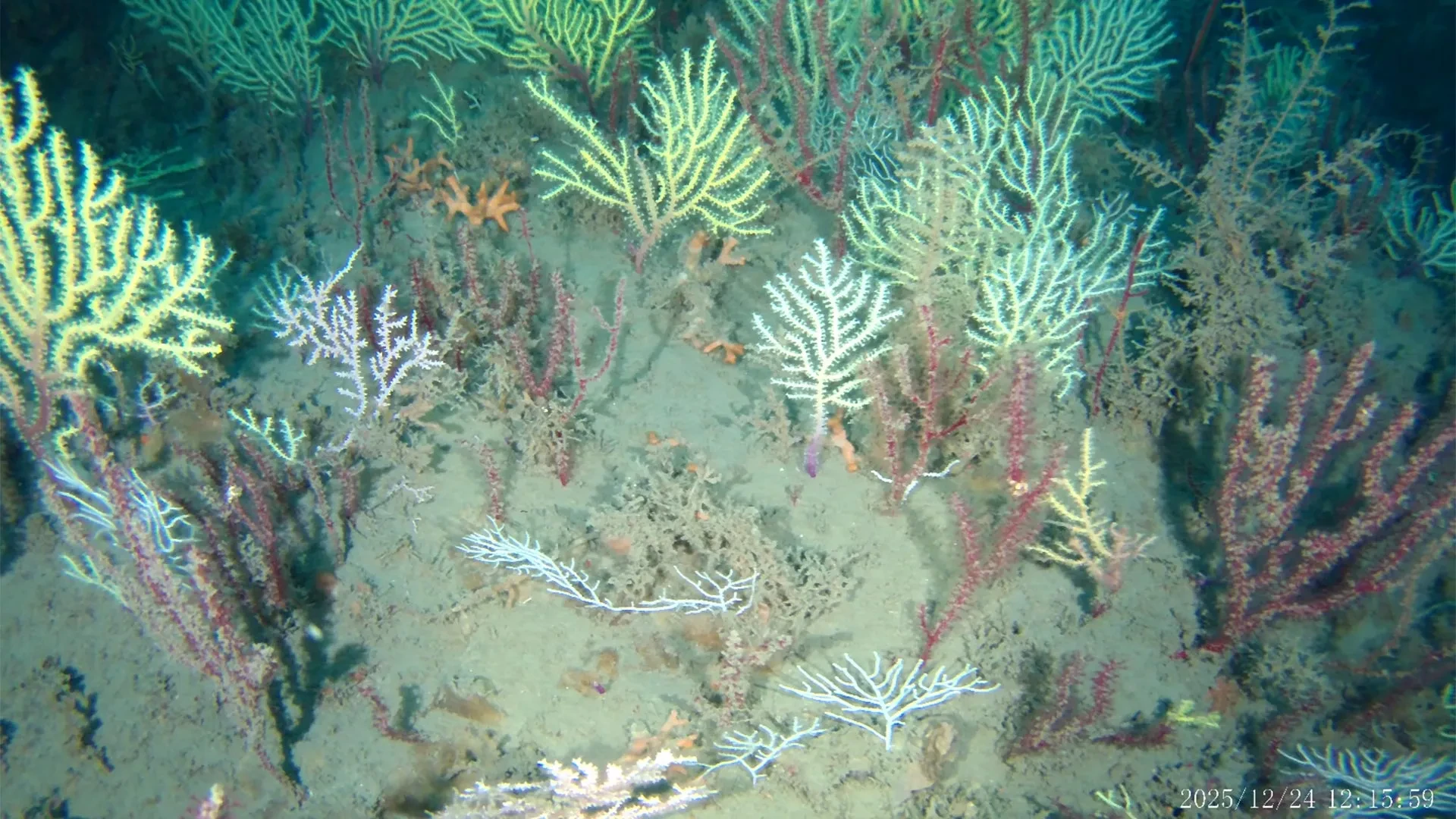
COASTAL BENIN — In the murky, nutrient-rich depths of the Gulf of Guinea, marine biologists have pulled off a modern underwater resurrection. A coral reef off the coast of Benin, written off by science as lifeless rubble for more than six decades, has been discovered not only surviving, but thriving.
The find, detailed in a recent study published in Frontiers in Marine Science, challenges historical assumptions about West Africa’s marine environments. Armed with modern high-resolution sonar and cutting-edge deep-sea camera systems, an international research team has confirmed the existence of a vibrant mesophotic coral ecosystem—a rare deep-water habitat that exists far below the sun-drenched shallows where most traditional reefs are found.
While the discovery has sparked widespread celebration within the global marine biology community, it also serves as a humbling reminder of how little humanity truly understands about the twilight zones of the world’s oceans.
Main Facts: A Hidden Ecosystem Brought to Light
The core of the discovery centers on an 11.5-kilometer stretch of seafloor lying more than 50 meters below the surface of the Atlantic Ocean off Benin. For decades, the site was marked in historical archives as a dead, unproductive geological curiosity—a relic of an ancient marine environment crushed by time, changing climates, and sediment.
Instead, the modern survey revealed a living sanctuary. Researchers documented eight distinct types of stony and soft corals alongside a bustling community of reef-dependent marine life. At least eight species of fish—including golden African snappers, blackbar soldierfish, Guinean angelfish, West African goatfish, Monrovia doctorfish, three-banded butterflyfish, and two species of damselfish—were observed utilizing the structural labyrinth of the reef for shelter, hunting, and breeding.
Rather than forming a single, continuous limestone wall like the Great Barrier Reef, this newly verified ecosystem manifests as a series of patchy, scattered coral communities. These colonies cling tenaciously to rocky outcrops on the continental shelf where environmental conditions—such as water temperature, current flows, and particulate levels—allow them to endure despite limited sunlight.
To the scientific community, this is a milestone. According to the research team, this marks the first officially confirmed record of a living mesophotic coral ecosystem anywhere on the Gulf of Guinea continental shelf.
Chronology: From 1960s Misconceptions to Modern Discovery
The story of the Benin reef is a tale told in two chapters separated by sixty years of technological evolution and shifting oceanographic paradigms.
Chapter 1: The 1960s Surveys
The historical narrative of the reef began in the 1960s. During this era, marine surveys along the West African coast were rarely designed with biodiversity conservation or deep-water ecology in mind. Instead, these campaigns were spearheaded primarily to locate and map productive commercial fishing grounds.
During these early expeditions, echo-sounding equipment registered unusual bottom topography more than 50 meters down. Analyzing the crude analog readouts and limited dredge samples of the era, the researchers of the 1960s concluded that the dense, jagged signatures belonged to a deep-water coral reef. However, because the gear brought to the surface yielded little evidence of living, polyp-bearing colonies, the team drew a discouraging conclusion: the reef was dead, likely choked or starved by shifting ocean conditions. For more than half a century, the data sat in archives, gathering dust as an ecological graveyard.
Chapter 2: The Return in the 2020s
The revival began when a team of modern scientists, led by Gérard Zinzindohoué of the Institut de Recherches Halieutiques et Océanologiques du Bénin (IRHOB), decided to take a fresh look at the historical records. Armed with contemporary tools—specifically modern multibeam sonar and the Deep Sea Camera System provided by the National Geographic Exploration Technology Lab—the team set out to re-examine the coordinates.
The field campaign was far from a luxury cruise. Zinzindohoué and his crew faced grueling conditions at sea, battling mechanical failures, technical glitches, and the psychological weight of profound uncertainty.
The breakthrough came when the shipboard sonar began registering distinct acoustic anomalies. The graphic signatures on the digital screens bore a striking resemblance to reef structures. Hope surged among the crew.
To confirm their suspicions, the team deployed an underwater drone and the Deep Sea Camera System, which functions essentially as a chain of automated wildlife trail cameras bolted to the dark, high-pressure ocean floor.
When the first high-definition images flickered onto the monitors aboard the research vessel, the reaction among the scientists was an emotional mixture of sheer disbelief and ecstatic vindication. After months of planning and decades of institutional neglect, a lost world had materialized on screen.
Supporting Data and Methodology
Unlocking the secrets of the Benin shelf required blending historical archive work with state-of-the-art oceanographic technology. The research methodology unfolded in distinct, rigorous phases:
- Archival Triangulation: Researchers digitized and georeferenced survey logs from the 1960s to pinpoint the suspected 40-kilometer barrier zone running parallel to the Beninese coast.
- Acoustic Mapping: Utilizing advanced sonar arrays, the team scanned 11.5 kilometers of the seabed, narrowing down the most anomalous, structurally complex zones.
- Visual Ground-Truthing: Deploying underwater drones and the National Geographic Deep Sea Camera System, the team captured hours of high-resolution video and thousands of still photographs across multiple transects.
Biological Composition Observed
While physical tissue samples have not yet been collected—meaning species identifications remain tentative pending laboratory genetic and morphological analysis—the visual data cataloged a remarkably diverse assemblage:
- Scleractinian and Octocorals: Eight distinct morphological types of coral were identified across the surveyed patches.
- Piscine Diversity: The fish census revealed an active trophic web, heavily reliant on the reef structure:
- Golden African snapper (Lutjanus fulgens)
- Blackbar soldierfish (Myripristis jacobus)
- Guinean angelfish (Holacanthus africanus)
- West African goatfish (Pseudupeneus prayensis)
- Monrovia doctorfish (Acanthurus monroviae)
- Three-banded butterflyfish (Chaetodon ellioti)
- Multiple unclassified damselfish species (Pomacentridae)
Despite these rich findings, the researchers maintain strict scientific humility. They caution that the initial phase represents only a tiny fraction of the total area. Furthermore, without physical samples, they cannot definitively state whether the corals observed today are the direct descendants of a resilient population that survived the 1960s, whether the original 1960s surveys simply misinterpreted living patchy formations as dead rubble, or whether the ecosystem underwent a natural, long-term cyclical recovery.
Official Responses and Perspectives
The publication of the findings in Frontiers in Marine Science has sent ripples through the international marine conservation community, eliciting powerful reflections from the scientists at the helm.
Lead author Gérard Zinzindohoué has been vocal about the psychological and scientific hurdles of the expedition.
"It was not an easy field campaign," Zinzindohoué recounted. "It was a mix of long days at sea, technical problems, and a lot of uncertainty. But then we saw structures on the sonar that looked like they could be reef signatures, which gave us hope that we were close."
Describing the pivotal moment the cameras reached the seafloor, Zinzindohoué noted the surreal nature of the discovery:
"That was a big moment for us, because suddenly we could actually see the seafloor. I still remember seeing those first images. It was a mix of excitement and disbelief, because after all this time thinking about this reef, suddenly there was something real in front of us."
Addressing the unique nature of the habitat, Zinzindohoué explained why the 1960s researchers likely mischaracterized the site:
"A mesophotic coral ecosystem lives deeper than the usual shallow coral reefs, in zones where light is much more limited. Unlike typical shallow reefs, it does not always form a single continuous reef structure. Instead, it can appear as patchy or scattered coral communities spread across the seafloor."
When asked about the broader implications for West African marine science, Zinzindohoué did not mince words:
"To our knowledge, this is the first confirmed record of a living mesophotic coral ecosystem on the Gulf of Guinea continental shelf. However, I think what we found is probably not an exception. It is more likely a reflection of how little we still know about coastal regions in West Africa and elsewhere."
Implications: A Vast, Uncharted Oceanic Archive
The rediscovery of the Benin reef opens up profound questions regarding marine conservation, ocean history, and global biodiversity mapping.
1. The "Out of Sight, Out of Mind" Problem of West African Waters
For decades, marine conservation funding and high-tech exploration have heavily favored regions like the Caribbean, the Indo-Pacific, and the Great Barrier Reef. West Africa’s coastal and deep-water ecosystems have remained notoriously under-studied.
Zinzindohoué points out the staggering implications of their find:
"If we were able to find this reef again after 60 years, how many others are still undocumented or simply forgotten? So yes, I do believe there are likely more coral systems out there that we have not documented yet. But we should not assume they are everywhere. Each discovery needs to be confirmed. Without going back into the field, we are really just guessing."
2. Unlocking Regional Climate and Ocean History
The historical records from the 1960s hinted that the reef might be part of a massive, continuous coral barrier stretching roughly 40 kilometers parallel to the Beninese coast. The research team has only scraped the surface of this vast geological footprint.
If future funding permits a comprehensive scientific diving and physical sampling campaign, the ecosystem could serve as a living climate archive. Corals grow by accreting calcium carbonate layers over time, trapping chemical signatures of the ocean’s temperature, salinity, pH, and pollution levels in their skeletons. Reading these layers could allow scientists to reconstruct centuries of environmental changes in the Gulf of Guinea—offering crucial insights into how regional marine life responds to warming seas and anthropogenic stress.
3. Conservation Urgency
While the discovery is a cause for celebration, it also introduces a race against time. Mesophotic reefs are often shielded from surface-level warming and bleaching events by their depth, but they are not immune to deep-water trawling, offshore oil and gas exploration, shifting ocean currents, and industrial pollution.
Knowing that these complex habitats exist along the continental shelf changes the legal and ecological calculus for maritime spatial planning in Benin and neighboring nations. Governments and international bodies will now face pressure to map, monitor, and protect these hidden biological strongholds before they suffer irreversible damage from human activity.
As Zinzindohoué concluded:
"For me, the most exciting part is about understanding the reef’s history, and what it can tell us about how the ocean in this region has changed over time. It feels like we have only just started to read an archive that has been there for a very long time."
With the deep sea continuing to surrender its secrets, the Lazarus reef of Benin proves that nature, given the chance—and the right technology to find it—has a remarkable capacity to defy our lowest expectations.
