

LONDON — In the ever-evolving landscape of esoteric practices and modern cartomancy, a novel framework is turning heads among practitioners of intuitive arts. Known as “Ancient Echoes,” this innovative methodology bridges the gap between historical introspection and contemporary self-awareness. Developed within the sophisticated tradition of Tarosophy—a philosophical and practical approach to reading tarot pioneered by modern esoteric scholars—Ancient Echoes utilizes a unique "split-deck" technique.
Rather than treating the 78 cards of a standard tarot deck as a singular, monolithic tool for divination, Ancient Echoes deconstructs the deck into its foundational components: the Major Arcana, the Minor Arcana, and the Court Cards. By dividing the deck into distinct functional categories, readers can isolate specific layers of human experience, traversing the boundaries of time, karma, and soul evolution.
As interest in alternative spiritualities, ancestral healing, and past-life regression continues to surge in the wellness mainstream, Ancient Echoes offers a structured, highly visual, and deeply narrative-driven alternative to traditional hypnotic regression. This report examines the mechanics of the spread, its chronological steps, the interpretive data it yields, the perspectives of esoteric authorities, and the broader psychological and spiritual implications of incorporating past-life narratives into modern mindfulness.
Main Facts: The Architecture of Ancient Echoes
At its core, Ancient Echoes is designed to answer a complex, multi-layered question: Who are we in the present moment, how is that identity informed by our current lifetime, and what echoes of past existences are reverberating through our spiritual DNA?
To execute the spread, a practitioner cannot simply shuffle and draw from a unified deck. The fundamental premise of Tarosophy’s split-deck method requires absolute separation. The deck must be sorted into three distinct piles before any inquiry begins:
- The Court Cards: Representing personalities, archetypal behaviors, soul essence, and relational styles.
- The Major Arcana: Representing grand karmic lessons, spiritual turning points, and universal archetypes.
- The Minor Arcana: Representing the daily environment, the texture of lived experience, emotional currents, and the circumstantial fabric of a lifetime.
By isolating these categories, the reader ensures that specific facets of human consciousness—archetypal destiny (Major), lived reality (Minor), and essential character (Court)—do not blur together. Instead, they interact in a calculated, geometric layout on the reading table.
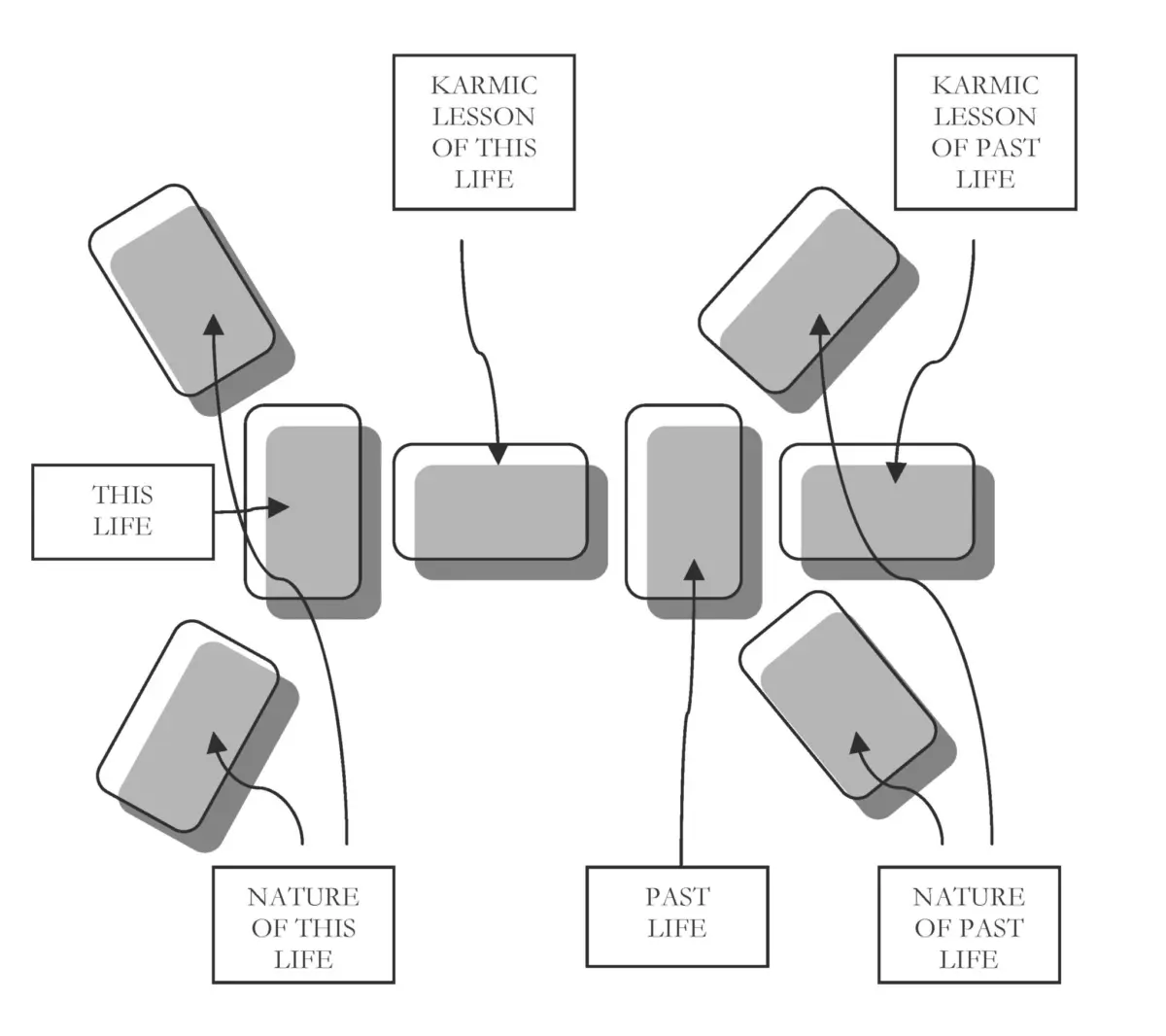
[Previous Life Court Card] <--- [Minor Arcana] [Minor Arcana] (Past Life Context)
             |
[Major Arcana: Karmic Lesson]
             |
[Present Soul Court Card] <--- [Minor Arcana] [Minor Arcana] (Current Life Context)
The process is inherently modular. It begins with the anchor of the present moment, moves outward to examine the current incarnation, dips backward into the mirror of a past life, identifies the karmic bridge connecting the two, and ultimately allows the practitioner to loop backward infinitely through a chain of ancestral echoes.
Chronology: Step-by-Step Execution of the Spread
For those seeking to replicate or study the methodology, the Ancient Echoes spread follows a precise chronological sequence. Each step introduces a new category of cards, accompanied by specific contemplative prompts.
Step 1: Establishing the Present Soul Anchor
The practitioner begins by taking the stack of Court Cards, shuffling them thoroughly while meditating on their current state of being. A single card is drawn and placed centrally on the table.
- The Action: Lay the card face up.
- The Prompt: "This is the nature of my Soul in present-time."
- The Significance: This card establishes the baseline personality, psychological mask, or foundational soul expression operating in the reader’s current incarnation.
Step 2: Mapping the Current Lifetime
Next, the practitioner gathers the Minor Arcana stack, shuffling them while keeping the Soul card in view. Two cards are drawn from this stack and placed in proximity to the central Soul card.
- The Action: Lay the two Minor cards down flanking or surrounding the Soul card.
- The Prompt: "This is the nature of my lifetime in this life."
- The Significance: These cards describe the environmental, emotional, and circumstantial conditions of the reader’s current existence. They outline the day-to-day theater in which the present soul is currently playing out its destiny.
Step 3: Evoking the Previous Lifetime Self
Returning to the Court Cards, the reader shuffles them once more. While observing the two Minor cards representing the current life, the practitioner selects a single Court Card and places it to one side (top, bottom, left, or right) of the current-life configuration.
- The Action: Place the chosen Court Card adjacent to the current-life spread.
- The Prompt: "This is an echo of my previous lifetime self."
- The Significance: This card introduces a distinct persona or psychological orientation belonging to an antecedent incarnation, setting up a dialogue between who we are now and who we were before.
Step 4: Identifying the Karmic Bridge
The process then shifts to the Major Arcana stack. After shuffling, the reader selects a single Major Arcana card and places it directly in the physical space between the present-life Court Card and the previous-life Court Card.
- The Action: Bridge the two Court cards with a single Major Arcana card.
- The Prompt: "This is the Karmic lesson I must learn in this lifetime."
- The Significance: This is the keystone of the entire operation. The Major Arcana card acts as the spiritual bridge, explaining why the past-life persona’s traits are echoing into the current life, and what spiritual curriculum links the two chapters of the soul’s journey.
Step 5: Unveiling the Past Life Context and Storytelling
To fully flesh out the historical incarnation, the practitioner takes the Minor Arcana stack once again. Meditating deeply on the Major Arcana Karmic Lesson card that bridges the past and the present, the reader draws two final Minor Arcana cards and places them directly against the previous-life Court Card.
- The Action: Anchor two Minor cards to the past-life Court Card.
- The Prompt: "This was the nature of that previous life."
- The Significance: Armed with a Court Card (the personality), a Major Card (the karmic lesson), and two Minor Cards (the life circumstances), the reader is instructed to weave a coherent historical or metaphorical narrative. This step transforms abstract symbols into a living, breathing story of a bygone existence.
Supporting Data and Advanced Exploration Techniques
Once the core spread is completed, the Ancient Echoes framework does not consider the inquiry finished. Instead, it invites deeper data analysis and infinite expansion. Advanced practitioners utilize several diagnostic layers to extract maximum insight from the layout.
1. Infinite Past-Life Regression
Because the method is modular, it is not limited to a single past life. Practitioners can repeat the sequence indefinitely. By taking the previous life Court Card and treating it as a new focal point, the reader can draw a subsequent Major Arcana Karmic Lesson card branching further backward, followed by a new set of Minor Arcana cards to flesh out that preceding era. By working continuously outwards, a reader can theoretically map an entire lineage of soul echoes across centuries or millennia.
2. Statistical and Pattern Analysis of Suits and Genders
When examining the Minor Arcana cards deployed across multiple past-life extensions, practitioners are encouraged to look for macroscopic data patterns:
- Gender Demographics: Are the Court Cards drawn for past lives predominantly male or female? A heavy imbalance may point toward unresolved archetypal biases or lessons specifically tied to traditional gender roles across historical incarnations.
- Elemental Dominance (Suits): Do the Minor Arcana cards lean heavily into Cups (emotion, relationships), Wands (passion, enterprise), Swords (intellect, conflict), or Pentacles (materialism, labor)? Particular suits often denote recurring vocational themes, such as trades, scholarship, military service, or agricultural labor, offering tangible clues to historical identities.
3. The Major Arcana Karmic Timeline
By extracting all the Major Arcana cards used as Karmic Lessons across multiple iterations of the spread and laying them out in a straight chronological row, the reader creates a visual timeline of spiritual evolution. Practitioners analyze this row for numerical progression, astrological sequences, or thematic patterns (e.g., moving from the heavy material bindings of The Devil to the liberation of The World), mapping the macro-trajectory of the soul’s education.
Official Responses and Esoteric Perspectives
The introduction of Ancient Echoes has sparked lively discourse within global tarot and esoteric communities. Traditional cartomancers, who often view the tarot strictly as a psychological mirror or a tool for immediate divinatory guidance, have debated the validity of incorporating explicit past-life mechanics into card reading.
Speaking on the conceptual framework of Tarosophy, modern esoteric researchers emphasize that whether a practitioner literally believes in reincarnation is secondary to the psychological utility of the method.
"The tarot speaks in the language of universal myth and archetype," notes one prominent Tarosophy instructor. "When we ask the cards to tell us a story about a ‘previous life,’ we are essentially bypassing the conscious ego’s defensive armor. We project our deepest, most unexamined present-day neuroses, ancestral traumas, and latent potentials onto a historical canvas. In doing so, we gain the objective distance required to heal them in the here and now."
Other esoteric circles have praised the method for its structural rigor. Unlike intuitive spreads that rely entirely on free-form interpretation, Ancient Echoes enforces a disciplined grammatical structure: Actor (Court) + Environment (Minor) + Bridge (Major). This prevents readers from drifting into vague generalizations, forcing them to construct a rigorous, verifiable narrative framework.
Implications: The Intersection of Tarot, Psychology, and Healing
The rise of methods like Ancient Echoes highlights a broader cultural shift in how people engage with spiritual divination. No longer satisfied with simple fortune-telling—such as asking whether a new job or romantic partner is on the horizon—modern seekers increasingly utilize esoteric tools as modalities for deep shadow work, psychological integration, and narrative therapy.
1. Narrative Reframing and Trauma Release
In psychological terms, human beings are meaning-making creatures who live by the stories they tell about themselves. If an individual struggles with chronic anxiety, feelings of inadequacy, or unexplainable phobias, standard talking therapies sometimes hit a wall when the root cause predates conscious memory. By framing these psychological blocks as "echoes of a previous lifetime," methods like Ancient Echoes allow individuals to externalize their internal struggles. Assigning the burden to a past-life persona creates a safe psychological distance, enabling the client to forgive themselves, process grief, and rewrite their internal narrative.
2. The Gamification of Ancestral Healing
By breaking the tarot deck down into functional stacks—sorting Courts, Majors, and Minors—the method introduces an interactive, almost tactile element to spiritual inquiry. This modular approach makes complex esoteric concepts accessible to beginners while offering seasoned readers an infinite sandbox for exploration. As interest in generational trauma ("epigenetics") and ancestral healing dominates wellness culture, Ancient Echoes provides a creative, structured ritual that turns abstract spiritual concepts into tangible, visual stories.
Conclusion
Ancient Echoes represents a sophisticated evolution in modern cartomancy. By merging the disciplined architecture of Tarosophy with the timeless human fascination of past lives, it transcends simple card reading, offering a profound methodology for self-discovery. Whether viewed as literal traffic across reincarnated lifetimes or as a brilliant psychological projection technique, the method invites individuals to look past the mirror of the present moment and listen closely to the profound, lingering whispers of their ancestral past.
