

SPECIAL FEATURE — When the late, renowned author and tarot grandmaster Rachel Pollack contemplated her own mortality ahead of World Tarot Day in May 2015, she didn’t look toward rigid dogmas or complex theological treatises for her epitaph. Instead, she distilled a lifetime of esoteric exploration, comic book writing, and avant-garde fiction into four simple, profound words: “Story. It’s all story.”
Pollack, who passed away in April 2023, left behind an indelible legacy that reshaped how modern practitioners view the seventy-eight cards of the tarot deck. Rather than treating the deck as a cold mechanical calculator for foretelling the future or a rigid repository of occult dogma, Pollack championed tarot as a dynamic, living narrative machine. Her reflections—originally penned for World Tarot Day on May 25, 2015—continue to serve as a cornerstone for contemporary esoteric philosophy, bridging the gap between imaginative storytelling, human psychology, and the fundamental mysteries of the universe.
Main Facts: The Narrative Architecture of the Tarot
At the heart of Rachel Pollack’s philosophical contribution to the esoteric community is the belief that tarot cards are fundamentally images waiting to be animated by human narrative. While many traditions approach the deck through the lens of strict divination or structured spiritual sciences like the Kabbalistic Tree of Life, Pollack argued that these systems themselves are simply elaborate, interlocking stories we construct to make sense of reality.
Drawing inspiration from Italian author Italo Calvino—who famously wrote that "the tarot is a machine for constructing stories"—Pollack viewed each card as a frozen moment in time. When a reader, a querent, and the deck itself come together, they do not merely extract data about the future; they engage in a collaborative act of world-building.
Key takeaways from Pollack’s enduring framework include:
- The Power of Imagery: Tarot originated as visual art, not doctrinal rules. This allows the cards to bypass intellectual barriers and evoke deep emotional and psychological truths.
- The Triad of Connection: A tarot reading requires three active participants—the subject, the reader, and the cards—working in tandem to allow a narrative to emerge.
- Co-Creating Truth: Truth is not a static object waiting to be discovered like a stone in the dirt; it is brought into being through human engagement, imagination, and shared storytelling.
Chronology: A Lifelong Romance with the Cards
To understand Pollack’s revolutionary approach to tarot, one must trace her journey from a curious newcomer to one of the most respected authorities in the field.
Spring 1970: The Awakening
Pollack’s lifelong fascination with the cards began in the early spring of 1970. A friend offered to read her fortune using a rare University Press edition of the Rider-Waite-Smith deck, consulting Eden Gray’s foundational instructional books for the meanings.
However, Pollack found herself entirely indifferent to the predictive elements of the reading. Instead, she was instantly captivated by the visual narrative of the cards themselves. Each piece of artwork felt like a cinematic still frame from an unfolding epic. The mysterious Six of Swords, in particular, left a permanent imprint on her imagination, anchoring itself as a lifelong symbol of that pivotal afternoon.
July 2009: The Tarosophy Conference
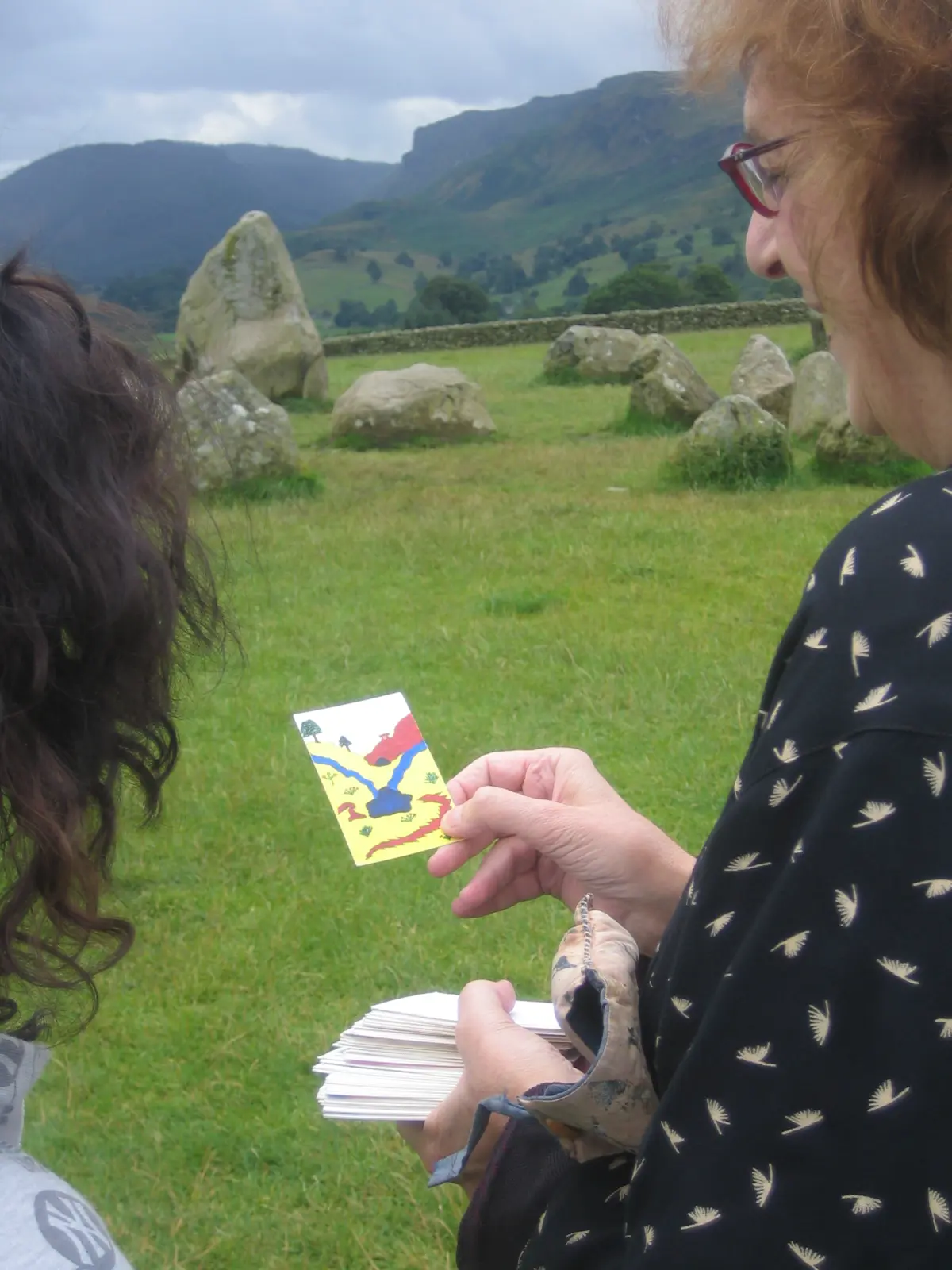
Decades later, Pollack’s intellectual and spiritual footprint in the tarot community was firmly established. In July 2009, she appeared as a keynote speaker and guest of honor at the Tarosophy Tarot Conference held near the ancient Castlerigg Stone Circle in England’s picturesque Lake District. Surrounded by megalithic history and fellow scholars, Pollack continually emphasized the literary and mythic dimensions of the cards, cementing her reputation as a bridge between traditional esoteric study and modern literary theory.
May 2015: World Tarot Day Reflections
Marking World Tarot Day on May 25, 2015, Pollack penned her definitive essay on the nature of reality and narrative. It was in this essay that she synthesized decades of metaphysical inquiry, proposing alternative epitaphs that challenged orthodox views of life, death, and divination. These reflections would eventually become a touchstone for her students and admirers worldwide following her passing in 2023.
Supporting Data and Esoteric Philosophy
Pollack’s perspective on tarot was deeply informed by a worldview that questioned the rigid boundaries between objective reality and human perception. She frequently leaned on cross-cultural traditions and modern science to validate the power of narrative.

In her 2015 essay, she recalled considering several potential epitaphs before settling on “Story. It’s all story.” Her earlier considerations included:
- A Gabon Pygmy Song: “All lives, all dances, and all is loud”—a celebration of raw consciousness and existence.
- Normandi Ellis’s Awakening Osiris (a poetic translation of the Egyptian Book of the Dead): “Give me not words of consolation. Give me magic.”
Furthermore, Pollack’s philosophical inquiries extended into the realms of quantum physics. She famously recounted a conversation with a physicist friend regarding whether subatomic particles actually existed prior to being predicted and observed by scientists. Her friend conceded that it was entirely possible. For Pollack, this scientific uncertainty mirrored the mechanics of tarot: reality bends toward the stories we tell, anticipate, and seek out.
Official Responses and Community Impact
Since her passing, the international tarot and esoteric communities have continually reflected on Pollack’s profound influence. Authors, historians, and practitioners alike have stepped forward to honor a woman who wrote definitive textbooks—such as Seventy-Eight Degrees of Wisdom, widely considered the "Bible" of modern tarot reading—while also carving out a celebrated career as a science fiction and comic book writer (including notable runs on DC Comics’ Doom Patrol).
Tarot scholars and organizations have highlighted how Pollack democratized the cards. By stripping away dogmatic gatekeeping and replacing it with an inclusive, narrative-driven exploration of the human psyche, she empowered generations of readers to trust their intuition.
"Rachel didn’t just teach us how to read the cards; she taught us how to read our own lives," noted one contemporary tarot educator. "She showed us that the future isn’t a fixed destination written in stone, but a fluid story that we have the power to co-author."
Implications: The World Is Not What We Think It Is
What does Pollack’s philosophy mean for the future of tarot and our broader understanding of human consciousness?
By reducing the metaphysical weight of the cards to the fundamental concept of "story," Pollack did not diminish their value; rather, she elevated it. Stories are the primary vehicles through which humans process trauma, find hope, make ethical decisions, and understand their place in the cosmos.
When a querent sits across from a tarot reader in moments of deep crisis, searching for a precise answer to unlock a life-altering decision, the magic that occurs is not necessarily supernatural—it is deeply, radically human. As Pollack observed, the deck frequently finds the exact right card when it matters most, bridging the gap between random imagery and profound psychological insight.
Ultimately, Rachel Pollack’s life and work leave us with her final, lingering takeaway—a sentiment that challenges our assumptions about truth, reality, and divination:
“The world is not what we think it is.” And through the lens of story, tarot remains one of our most powerful tools for exploring the vast, mysterious spaces beyond our conventional imagination.
