

By Investigative Cultural Desk
Published in Collaboration with Tarot Historical Research Archives
Main Facts: The Legacy and Mystery of "Pixie" Smith
Decades after her passing in relative obscurity, the woman whose artistic vision shaped the modern esoteric world continues to draw pilgrims, historians, and researchers. Pamela Colman Smith—affectionately known to her contemporaries as "Pixie"—died on September 18, 1951, and was laid to rest a week later on September 25. Her funeral rites were conducted by a well-regarded Roman Catholic priest, Father Joseph Henry du Moulin-Browne, at St. Michael & All Angels Churchyard. Yet, despite her monumental contribution to global culture as the illustrator of the world’s most popular tarot deck, her precise physical plot remained lost to history for over half a century.
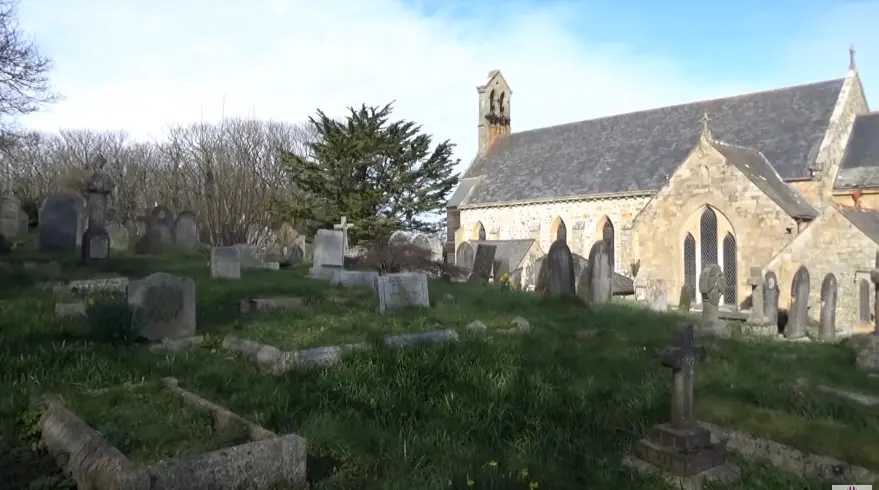
Today, rigorous historical detective work, combining parish burial records, chronological plot mapping, and independent local expertise, has finally narrowed down her likely final resting place. Situated in a serene corner of St. Michael & All Angels Churchyard—overlooking the coastline she adored so deeply—this tentative site offers closure of a sort to the admirers of an artist who died penniless and largely forgotten, only to achieve posthumous immortality.
To understand the weight of this rediscovery, one must examine the monumental scale of Smith’s artistic footprint. Born in 1878 to American parents in England, Smith was a prolific illustrator, set designer, and folklorist before she ever touched the Rider-Waite-Colman-Smith tarot deck. Commissioned by occultist Arthur Edward Waite and published by William Rider & Son in 1909, the deck revolutionized cartomancy. Unlike previous decks, which featured mostly abstract or simplistic pips in the minor arcana, Smith infused every single card with rich, narrative-driven allegorical imagery. Her distinctive style—blending Arts and Crafts aesthetics with Symbolism—breathed life into archetypes that continue to guide millions of practitioners, artists, and psychologists worldwide.
Yet, her earthly journey ended far removed from the acclaim she deserved. When researchers set out to map her final moments and physical memorial, they encountered the barriers of time, tragedy, and bureaucratic loss. The quest to identify her grave is not merely an exercise in historical bookkeeping; it is a profound journey of reclamation for an artist who spent her life giving form to the unseen.
Chronology: A Life of Art, Exile, and Obscurity
To trace the final resting place of Pamela Colman Smith, researchers must first retrace the timeline of her remarkable yet melancholic later years. Her trajectory moves from vibrant bohemian artistic circles in London to financial hardship, religious conversion, and eventual quiet withdrawal to the Cornish coast.
- 1878: Pamela Colman Smith is born in Middlesex, England, to American parents. Her early life involves considerable travel between London, Jamaica, and New York, exposing her to diverse cultural mythologies and vibrant visual motifs that would later saturate her art.
- 1890s–1900s: Smith establishes herself in London’s artistic community. She studies at the Pratt Institute in Brooklyn under Arthur Wesley Dow, becomes a member of the prestigious Society of Illustrators, and illustrates works for notable figures like William Butler Yeats and Bram Stoker. She earns the nickname "Pixie" for her whimsical imagination and theatrical flair.
- 1909: Partnering with Arthur Edward Waite under the auspices of the Hermetic Order of the Golden Dawn, Smith creates the 78 illustrations for the tarot deck that bears their names. Despite her foundational role in its creation, she receives a flat fee for her labor, retaining no ongoing royalties—a financial vulnerability that would plague her later life.
- 1911: Smith converts to Roman Catholicism, finding deep spiritual solace within the faith—a devotion underscored decades later by the choice of a Catholic priest to officiate her funeral.
- 1940s: Having relocated to Bude, Cornwall—a coastal landscape that captured her imagination—Smith lives in increasingly modest circumstances. The disruptions of World War II and dwindling artistic commissions leave her in strained financial straits.
- September 18, 1951: Pamela Colman Smith passes away at her home in Cornwall at the age of 73.
- September 25, 1951: Her funeral service is held at St. Michael & All Angels Churchyard, officiated by Father Joseph Henry du Moulin-Browne. She is interred in the parish cemetery, her grave marked simply—if at all—by temporary wooden markers common to the era’s indigent or modest burials.
- Late 20th Century: Due to the loss of physical markers and a devastating parish fire, the exact coordinates of Smith’s plot fade from institutional memory, leaving her resting place effectively lost for decades.
- 2023–Present: Contemporary researchers, bolstered by specialized texts like Secrets of the Waite-Smith Tarot and dedicated site investigations by archival groups, successfully triangulate her probable burial plot.
Supporting Data: Piecing Together the Lost Archive
The investigation into Smith’s burial site reads like a classical historical mystery, defined by missing evidence, circumstantial clues, and fortunate coincidences. The primary obstacle faced by researchers from the Tarot Association and independent historians was the catastrophic destruction of parish records.
According to local accounts, a fire broke out in a builders’ hut where historical parish records and plot maps were temporarily stored during church renovation work. This unfortunate blaze incinerated the administrative ledger that would have explicitly mapped out every interment from the mid-20th century. Consequently, physical markers at the graveyard long ago deteriorated, leaving wooden crosses rotted away and stone memorials absent for un-monumented graves of individuals who passed without significant personal estates.
Despite these obstacles, researchers successfully reconstructed the layout through comparative spatial and chronological analysis:
- Chronological Plot Arrangement: A thorough survey of St. Michael & All Angels Churchyard revealed that the vast majority of its plots are arranged in strict chronological order, moving systematically across the grounds over time.
- Surrounding Marker Analysis: By cross-referencing surviving parish death registers from September 1951 with extant physical headstones, researchers identified a cluster of marked graves bearing dates from 1950 and 1951.
- Triangulation of Unmarked Plots: Within this specific chronological pocket—located in the far corner to one side of the church—at least three unmarked plots were identified.
- Independent Validation: During a site visit, researchers initially proposed this specific corner as the most statistically and historically probable resting place for Smith. Remarkably, when the site was independently evaluated the following day by a local historian—someone who had researched the parish grounds for over thirty years—they arrived at the exact same conclusion without prior prompting.
This convergence of data points transforms what was once an unverified assumption into a highly credible historical identification. While a permanent forensic or archaeological excavation is neither necessary nor appropriate, the circumstantial evidence places Smith firmly within this quiet corner of the Cornish earth.
Official Responses and Archival Revelations
The rediscovery of the context surrounding Smith’s final days has prompted a wave of renewed academic and cultural interest. Institutions dedicated to esoteric history have stepped forward to ensure that "Pixie" is no longer a footnote in the history she helped author.
Marcus Katz and Tali Goodwin, prominent tarot historians and authors of the seminal work Secrets of the Waite-Smith Tarot (Llewellyn, 2015), have dedicated significant energy to bringing Smith out of the shadows of Arthur Edward Waite’s more documented shadow. Their extensive research, alongside fresh photographic discoveries, highlights the collaborative dynamic of the 1909 deck creation, repositioning Smith from a hired hand to an active, visionary co-creator of esoteric symbology.
Simultaneously, membership organizations such as the Tarot Association have mobilized their resources to honor her memory. In their comprehensive members-only feature titled "The Kiss of the Sun for Pardon: A Memory of Pamela Colman Smith," the association has cataloged a wealth of new information, rare photographs, and contextual documents. This initiative aims to educate modern practitioners on the human story behind the cards they draw daily.
Representatives from historical preservation groups emphasize that while official parish markers may be gone, the collective memory of the global tarot community serves as a living monument. The emotional resonance of the site—marked by the natural beauty of the Cornish coast—provides a fitting tribute to an artist whose inner world was profoundly shaped by nature, folklore, and spiritual devotion.
Implications: Re-evaluating the Mother of Modern Tarot
The journey to locate the final resting place of Pamela Colman Smith carries profound implications for how we study, value, and preserve esoteric history. For generations, the narrative surrounding the Rider-Waite-Colman-Smith deck focused heavily on its male occult architect, Arthur Edward Waite, and the intellectual apparatus of the Golden Dawn. Smith was frequently cast merely as a passive medium who executed technical drawings based on instruction.
The rigorous archival work required to find her grave mirrors a broader cultural correction: the rehabilitation and elevation of female artists who labored in the shadows of patriarchal institutions. By tracing her final steps, researchers do more than pinpoint a coordinate in a Cornish graveyard; they validate her artistic autonomy and emotional labor.
Furthermore, this rediscovery bridges the gap between historical fact and practical innovation within the tarot community. Modern cartomancers, psychologists, and artists draw deeply from the visual vocabulary Smith invented. Understanding her impoverished end against the backdrop of her immense, enduring global legacy forces a critical reflection on how society rewards visionary creators. It serves as a reminder of the fragility of archival memory and the vital importance of independent historical research in preserving cultural touchstones.
As visitors continue to make pilgrimages to St. Michael & All Angels Churchyard—listening to the woodland birds, the distant roar of the sea, and the echoing bells of the church—they are not merely visiting a grave. They are participating in an ongoing act of communal remembrance. Pamela Colman Smith may have slipped quietly from this world in 1951, but through the enduring power of her art and the dedication of modern historians, her spirit remains vibrantly, permanently alive.
