

By Special Correspondent
Main Facts
In the expansive landscape of esoteric studies, few figures left as profound, intellectually rigorous, and culturally resonant a mark as Rachel Pollack. Written originally for World Tarot Day on May 25, 2015, a profound piece of personal philosophy penned by Pollack encapsulates her lifelong relationship with cartomancy. At its core, the article distills a lifetime of study, creation, and spiritual exploration into a single, striking axiom: “Story. It’s all story.”
Pollack, an acclaimed author, comic book writer, and preeminent authority on the Tarot, explored in this essay the ontological nature of the cards. Rather than viewing the Tarot merely as a mechanical tool for divination or a rigid apparatus for esoteric instruction, Pollack conceptualized the 78-card deck as a dynamic, generative engine of narrative. Citing literary giants like Italo Calvino—who famously called the Tarot "a machine for constructing stories"—Pollack argued that human existence itself is fundamentally bound to narrative.
The core revelations of her 2015 essay include:
- The Narrative Foundation: The Tarot functions not as an objective mirror of a predetermined future, but as a series of frozen moments waiting to be unlocked into cohesive human narratives.
- The Co-Creation of Truth: Truth, according to Pollack, is not a static monolith waiting to be discovered, but an active, participatory reality brought into being through engagement—much like subatomic particles responding to observation in quantum physics.
- The Triad of the Reading: Every Tarot reading constitutes a sacred trinity comprising the subject, the reader, and the cards, which collectively midwife a narrative tailored to the seeker’s precise moment of need.
- A Philosophical Epitaph: Rejecting rigid dogmas, Pollack championed the idea that "the world is not what we think it is," advocating instead for a magical, story-driven approach to consciousness.
Chronology: A Lifetime Written in Cards
To understand the weight of Pollack’s 2015 reflections, one must trace the timeline of her deep entanglement with the Tarot and literature—a journey that spanned over half a century.
- Early Spring 1970: A pivotal moment occurs when a friend offers Pollack her first-ever Tarot reading using the rare University Press edition of the Rider-Waite-Smith deck, alongside Eden Gray’s instructional book. Rather than focusing on predictive futures, Pollack is instantly captivated by the visual narrative of the cards, particularly remembering the evocative imagery of the Six of Swords.
- The 1980s–1990s: Pollack establishes herself as a luminary in the modern Tarot renaissance. Her seminal work, 78 Degrees of Wisdom (published in two volumes in 1980 and 1983), revolutionizes how practitioners interpret the cards, weaving mythology, psychological depth, and modern storytelling techniques into the framework of cartomancy.
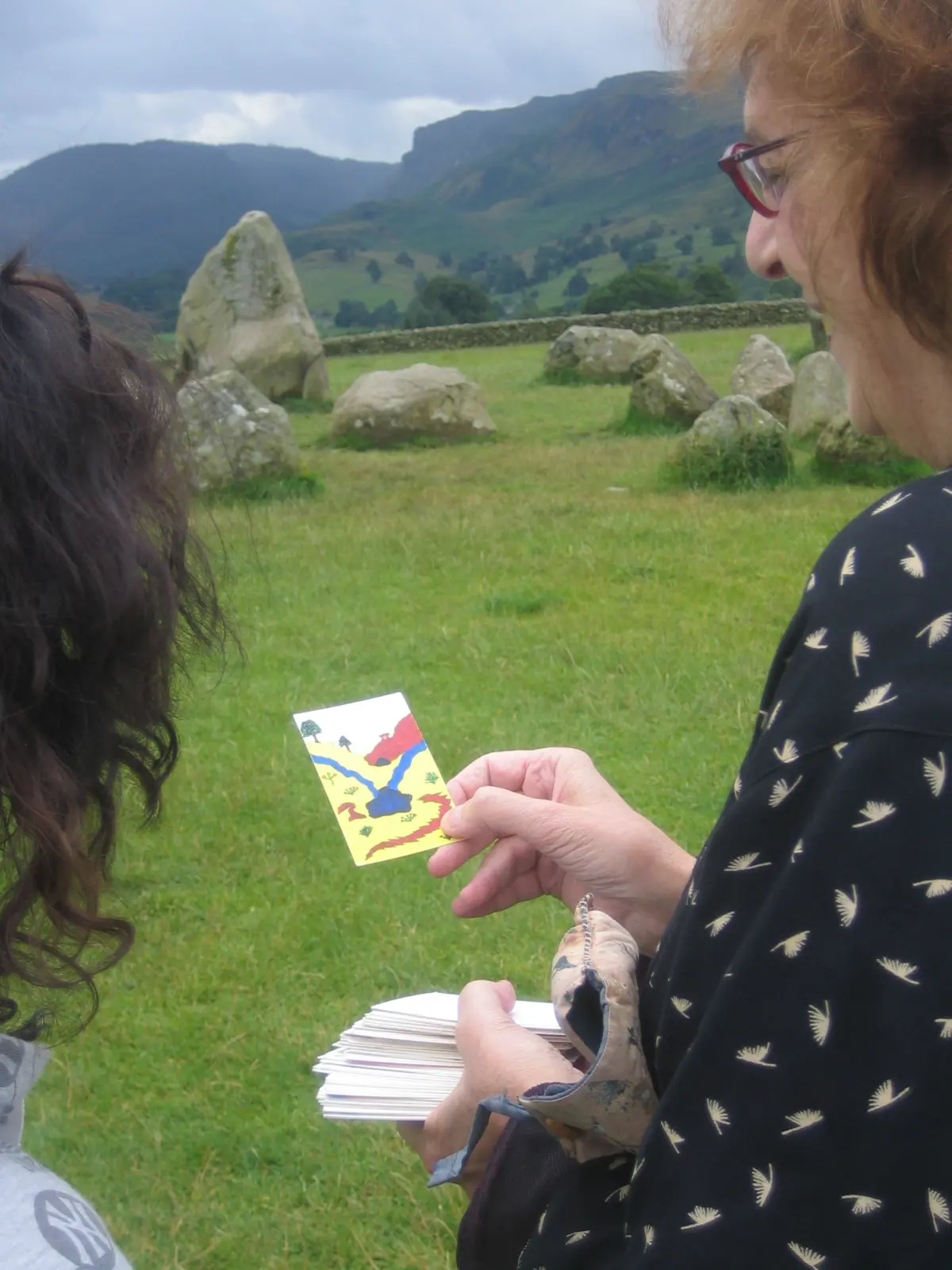
- July 2009: Pollack attends the Tarosophy Tarot Conference held at the historic Castlerigg Stone Circle in the picturesque Lake District, UK, where she shares her insights with a new generation of global tarot scholars.
- May 25, 2015: In celebration of World Tarot Day, Pollack publishes her reflective essay meditating on mortality, epitaphs, and the foundational role of narrative in human life. She weighs various poetic inspirations—from a Gabon Pygmy song ("All lives, all dances, and all is loud") to Normandi Ellis’s translation of the Egyptian Book of the Dead ("Give me not words of consolation. Give me magic"—before ultimately landing on her definitive realization: “Story. It’s all story.”)
- Post-2015 and Beyond: Pollack continues to write, lecture, and design innovative decks (such as the Shining Tribe Tarot), cementing her legacy as a visionary who bridged traditional esoteric arts with postmodern literary theory.
Supporting Data: The Architecture of Tarot as Narrative
To appreciate Pollack’s thesis, one must examine how the structural components of the Tarot align with the mechanics of storytelling. Unlike linear texts, the Tarot presents a non-linear database of archetypes, symbols, and emotional landscapes.

| Dimension of Tarot | Traditional View | Rachel Pollack’s Narrative View |
|---|---|---|
| Primary Function | Predicting future events or diagnosing psychological blocks. | Constructing meaningful, flexible stories that bridge the gap between individual experience and universal myth. |
| Nature of Truth | Absolute, hidden knowledge waiting to be uncovered by a skilled seer. | Participatory reality; truth is brought into being through the act of questioning and observation. |
| The Deck’s Origin | A sacred, secret doctrine or historical archive of ancient Egyptian/Kabbalistic wisdom. | A collection of evocative images designed to spark human imagination and connect disparate strands of life. |
| The Reading Dynamic | A transaction between an all-knowing reader and a passive recipient. | A dynamic triad (Subject + Reader + Cards) generating emergent insights precisely when vital decisions loom. |
Pollack’s dialogue with a physicist friend—wherein she explored whether subatomic particles might not exist until observed—lends empirical weight to her philosophical stance. In modern quantum mechanics, the act of measurement collapses the wave function into a definitive reality. Similarly, Pollack argued that a Tarot spread sits as a wave function of potential narratives until a seeker and reader interact with it, collapsing the ambiguous symbols into a precise, life-altering truth.
Official Responses and Cultural Reception
The broader esoteric community, literary critics, and contemporary Tarot authors have widely regarded Pollack’s 2015 essay—and her broader body of work—as a watershed moment in the modernization of cartomancy.
For decades, the mainstream perception of Tarot was doggedly bifurcated: either dismissed as parlor-room cold reading or elevated to an dogmatic, pseudo-religious science laden with rigid correspondences. Pollack’s philosophy offered a liberating third path. By framing the Tarot as "a machine for constructing stories," she democratized the practice. Readers no longer needed to memorize encyclopedic lists of inverted meanings or claim prophetic lineage; they simply needed to become fluent in the universal grammar of human narrative.
Fellow esoteric scholars and conference organizers frequently cite Pollack’s imagery at Castlerigg Stone Circle as emblematic of her ethos—someone rooted in ancient landscapes yet thoroughly modern in her intellectual agility. Her rejection of dry consolation in favor of active, transformative "magic" resonated deeply with practitioners seeking psychological empowerment over fatalistic doom-saying.
Implications: The World as a Living Narrative
What does it mean for the contemporary world—and for the future of esoteric studies—when we accept Rachel Pollack’s assertion that “The world is not what we think it is” and that “It’s all story”?
- Re-enchantment of Daily Life: By viewing our personal struggles through the lens of the Major and Minor Arcana, everyday challenges transform from meaningless suffering into heroic monomyths. Every setback becomes a Tower moment; every period of transition mirrors the quiet, hopeful journey of the Six of Swords.
- The Ethical Practice of Divination: If cards do not dictate a fixed future, readers are absolved of playing the role of deterministic prophets. Instead, they become collaborative co-authors with their clients, empowering individuals to rewrite poorly serving narratives in real-time.
- Bridging Science and Spirit: Pollack’s casual comparison between Tarot readings and quantum observation opens a vital bridge between intuitive arts and modern scientific epistemology. Both disciplines acknowledge that the observer is never truly separate from the observed; we shape the reality we measure, and we author the worlds we inhabit.
Ultimately, Rachel Pollack’s enduring gift to the Tarot community—re-articulated so gracefully in her 2015 World Tarot Day reflection—is the reminder that we are all walking through a living grimoire. Whether carved on a hypothetical tombstone or lived out in the quiet consulting room of a Sunday afternoon reading, her ultimate conclusion remains a beacon for seekers everywhere: when faced with the infinite mysteries of existence, do not look for cold consolation. Look for the magic. Look for the story.
