

Main Facts
- Core Premise: Written originally by the late, renowned tarot grandmaster and author Rachel Pollack for World Tarot Day on May 25, 2015, the foundational essay posits that the true essence of tarot is not merely predictive or dogmatic, but fundamentally narrative: "Story. It’s all story."
- The Author’s Legacy: Rachel Pollack (1945–2023) was an internationally acclaimed science fiction writer, comic book author (notably for DC Comics’ Doom Patrol), and one of the world’s foremost authorities on tarot, celebrated for bridging esoteric traditions with modern storytelling.
- Key Philosophical Influences: Pollack drew inspiration from diverse cultural and literary sources—ranging from a Gabon Pygmy song ("All lives, all dances, and all is loud") and Normandi Ellis’s poetic translation of the Egyptian Book of the Dead (Awakening Osiris), to Italian author Italo Calvino’s observation that "the tarot is a machine for constructing stories."
- Core Argument on Truth and Reality: Pollack challenged rigid divisions between objective truth and subjective narrative, suggesting that humanity actively brings truths into being—spanning personal destinies, esoteric systems like the Kabbalistic Tree of Life, and even quantum physics.
- The Mechanics of a Reading: She described a tarot reading as a dynamic trilateral collaboration involving the subject, the reader, and the cards themselves, capable of yielding striking, uncanny precision precisely when a seeker faces critical life decisions.
Chronology: A Lifelong Engagement with the Cards
1. Spring 1970: The Discovery at the Threshold
Rachel Pollack’s lifelong journey with the tarot began in the early spring of 1970. Introduced to the practice by a friend who laid out cards from a rare University Press edition of the Rider deck and consulted Eden Gray’s instructional books, Pollack experienced an immediate paradigm shift. Rather than focusing on predictive fortunes, she found herself spellbound by the cards as individual artistic compositions—each acting as a "frozen moment in a story." The imagery of the Six of Swords, in particular, anchored itself permanently in her memory from that very first session.
2. Decades of Scholarship and Creative Output
Over the next several decades, Pollack cemented her status as a towering figure in the contemporary tarot renaissance. She authored seminal texts—such as 78 Degrees of Wisdom, widely regarded as the "bible" of modern tarot reading—and designed acclaimed decks like the Shining Tribe Tarot. Simultaneously, she forged a distinguished career in speculative fiction and comic literature, applying her deeply narrative-centric worldview across multiple creative mediums.
3. July 2009: The Tarosophy Conference at Castlerigg
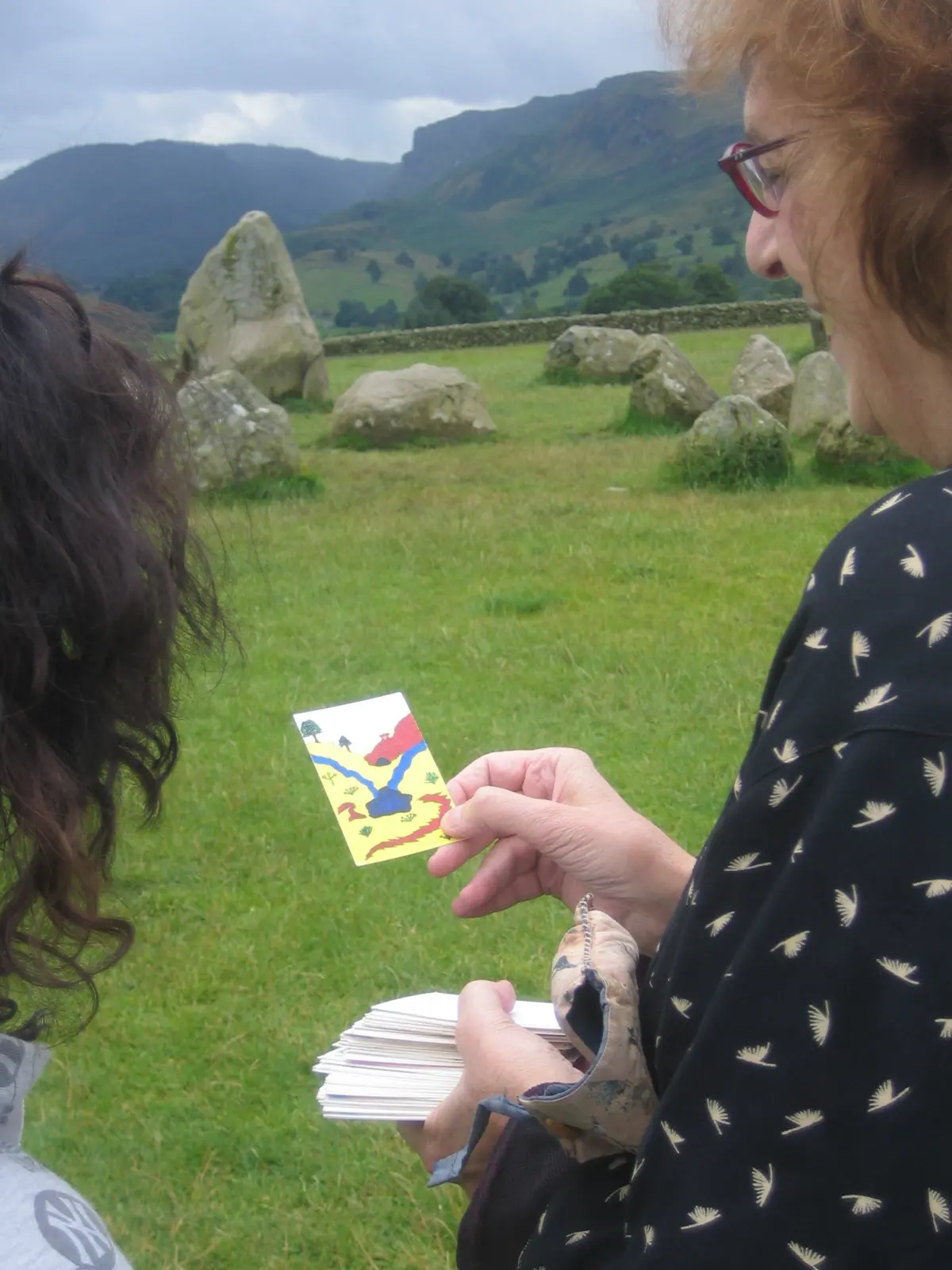
At the Tarosophy Tarot Conference held at the historic Castlerigg Stone Circle in England’s Lake District in July 2009, Pollack engaged directly with the global community of practitioners and scholars. Surrounded by ancient monoliths, her lectures and conversations continually reinforced the concept that tarot operates as an ancient, living technology of human imagination rather than a static system of divination.
4. May 25, 2015: World Tarot Day Reflection
On World Tarot Day in 2015, Pollack crystallized her decades of philosophical musings into a short, evocative essay. Originally published to celebrate the international holiday, the text reflects on mortality, existential meaning, and the ultimate simplicity of human narrative. It stands as one of her most distilled statements on why humanity is inherently drawn to the symbolic language of the cards.
5. 2023 and Beyond: Posthumous Resonance
Following Pollack’s passing in April 2023, her writings—including her 2015 World Tarot Day reflections—have taken on renewed significance for the global esoteric community. Archivists, publishers, and practitioners continue to circulate her insights, viewing her work not just as historical instruction, but as an ongoing philosophical blueprint for how humanity constructs meaning through art and archetype.
Supporting Data: Perspectives on Tarot, Narrative, and Reality
To understand Pollack’s profound impact, one must examine how her perspective bridges distinct intellectual frameworks:

- Literary Parallels: Italo Calvino’s famous observation in The Castle of Crossed Destinies—that the tarot deck is fundamentally "a machine for constructing stories"—aligns seamlessly with Pollack’s view. Both thinkers recognized that the visual symbolism of the cards provides a grammar without a fixed vocabulary, allowing users to assemble infinite narrative permutations.
- Cultural and Mythological Frameworks: Pollack frequently juxtaposed modern psychological needs with ancient paradigms. By citing traditional Hasidic philosophy ("God made humans because God loves stories") alongside African and Egyptian sacred texts, she situated tarot within a universal human impulse to narrate existence.
- The Philosophy of Science: In her 2015 essay, Pollack recounted a conversation with a physicist regarding sub-atomic particles—specifically whether complex phenomena might not fully exist until human consciousness predicts and observes them. By drawing this parallel, she argued that tarot is no less "real" than quantum mechanics; both represent human attempts to map complex, invisible realities through structured stories.
- The Tripartite Dynamic of Readings: Empirical observations by professional readers support Pollack’s assessment of the reading space. The interaction relies on three distinct nodes:
- The Subject: Bringing lived experience, emotional states, and immediate inquiries.
- The Reader: Acting as a linguistic and intuitive translator of symbols.
- The Cards: Providing an independent, randomized visual prompt that disrupts linear thinking.
Official Responses and Community Impact
The esoteric community, literary scholars, and tarot associations worldwide have continuously honored Pollack’s contributions, viewing her writings as foundational milestones in the legitimation of tarot as an art form and psychological tool.
- The Tarot Association’s Perspective: Organizations such as the Tarot Association have archived Pollack’s essays as vital pedagogical texts. Representatives have frequently noted that Pollack’s work shifted the conversation away from rigid, fear-based fortune-telling toward empowerment, creative self-reflection, and psychological integration.
- Literary and Academic Praise: Reviewers of her non-fiction work have long lauded her ability to weave Jungian psychology, Kabbalah, mythology, and social commentary into accessible prose. Academics studying contemporary alternative spiritualities regularly cite 78 Degrees of Wisdom as the text that modernized tarot for late 20th- and 21st-century seekers.
- Peer Acknowledgments: Fellow creators in both the comic book industry (where her work on Doom Patrol earned critical acclaim for its philosophical depth) and the esoteric arts have praised Pollack for treating fantastical and esoteric subjects with intellectual rigor and profound human empathy.
Implications: What "It’s All Story" Means for the Future of Tarot
Pollack’s assertion that "The world is not what we think it is" carries profound implications for how individuals navigate modern life, personal decision-making, and spiritual inquiry.
1. Moving Beyond Literalism vs. Skepticism
For decades, cultural discourse around tarot has been trapped in a reductive binary: either the cards possess literal, supernatural clairvoyance, or they are entirely meaningless psychological parlor tricks. Pollack’s narrative framework dissolves this false dichotomy. If reality itself is constructed through interlocking stories and observations, then the question of whether tarot is "true" misses the point. The cards are true because they generate meaningful frameworks through which humans can understand, navigate, and shape their unfolding futures.
2. Empowering the Seeker
By emphasizing that cards are initially images rather than rigid doctrines, Pollack liberated practitioners from dogmatic rulebooks. When a reader approaches the deck as a narrative toolkit, the power shifts back to the individual. The cards do not dictate a fixed destiny; instead, they invite the seeker to become the conscious author of their own life story.
3. The Enduring Relevance of Archetypal Art
As digital tools, artificial intelligence, and virtual reality begin to reshape how humans create and consume narratives, Pollack’s philosophy serves as a grounding reminder of the power of physical, visual archetypes. Whether printed on cardboard or viewed on a screen, the seventy-eight cards of the tarot remain potent catalysts for human imagination—proving that, across millennia and changing technologies, humanity remains tethered to the fundamental truth expressed by Rachel Pollack: Story. It’s all story.
