

Main Facts
In the contemporary art landscape, where conceptual abstraction and digital media frequently dominate gallery spaces, a dedicated group of young practitioners is spearheading a quiet revolution grounded in rigorous traditional techniques. Among the brightest luminaries in this classical revival is 28-year-old Virginia-based oil painter Caroline Nelson. Recognized nationally as one of the standout talents in the August/September 2026 issue of Southwest Art magazine as part of their prestigious "21 Under 31 | Young Artists to Watch" feature, Nelson has quickly captured the attention of collectors, critics, and traditional art enthusiasts alike.
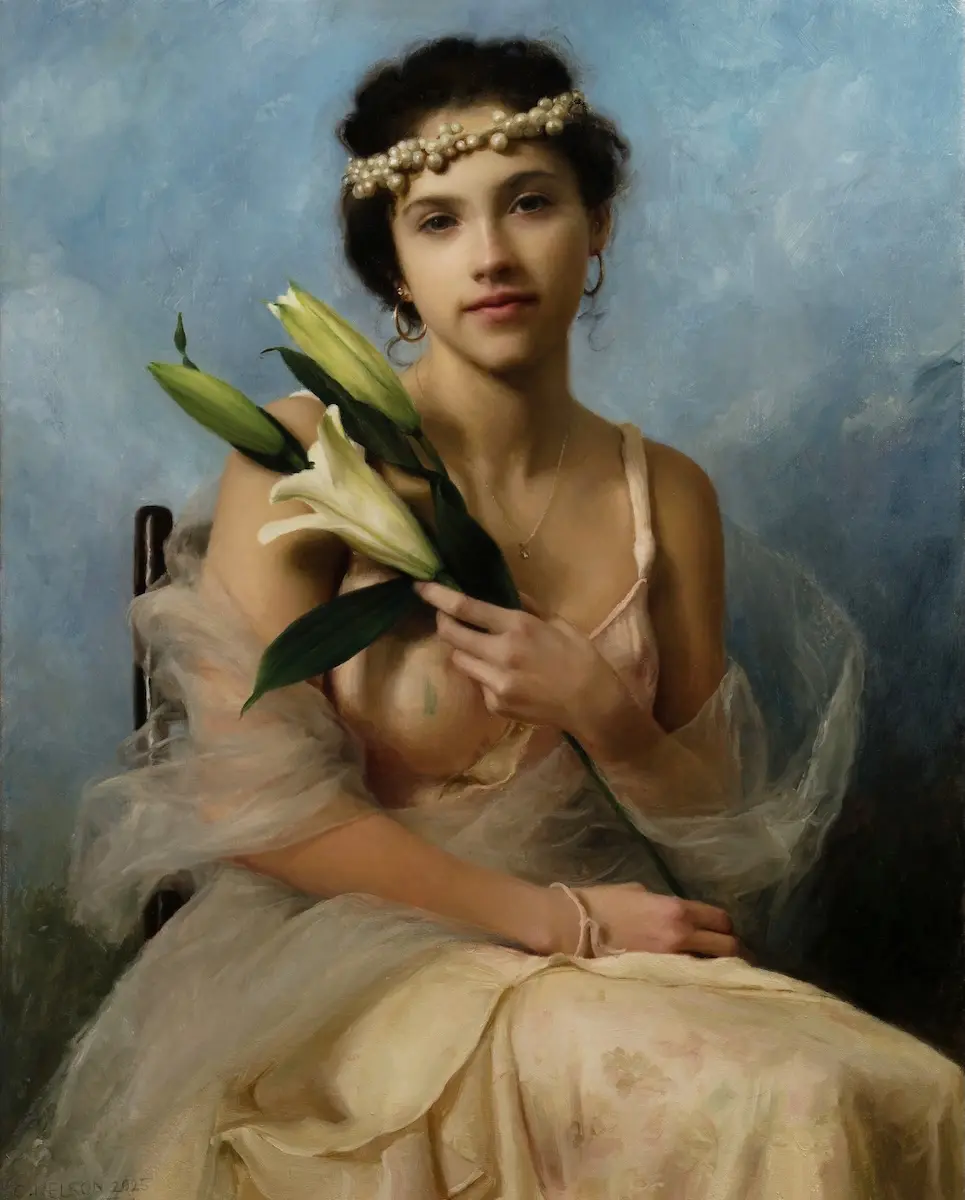
Working primarily in oil on linen, Nelson produces breathtaking figurative works that evoke the luminous skin tones, emotive storytelling, and flawless academic precision of the 19th-century European salon painters. Her representative works, such as the critically acclaimed 20 x 16-inch oil on linen painting Lilies of the Field, showcase her keen eye for detail, composition, and light.
Represented by the renowned Arcadia Contemporary in New York City, Nelson’s original works command a steady market presence, with current price points ranging widely from $3,000 to $20,000 depending on the scale and complexity of the piece. Her artistic footprint extends far beyond her studio walls in Virginia, drawing admiration from a growing global audience that resonates with her nostalgic, romantic, and beautifully rendered aesthetic.
Chronology of an Artistic Journey
To understand the exceptional maturity present in Nelson’s brushwork, one must examine the rigorous educational pipeline that shaped her formative years. Unlike many contemporary artists who navigate formal university programs focused on avant-garde theory, Nelson pursued an uncompromising path of atelier-style classical training.
Private Mentorship Under Henry Wingate (2018–2020)
Nelson’s professional foundation was forged between 2018 and 2020 through intensive, full-time private training under the guidance of classical realist painter Henry Wingate. Operating outside the traditional university paradigm, this apprenticeship immersed Nelson directly into the historic methods of observation, draftsmanship, and color theory. Under Wingate’s strict tutelage, she mastered the complex mechanics of painting directly from life, learning how to manipulate oil paint to replicate the subtle nuances of human anatomy, drapery, and natural light.
East Oaks Studio Residency (2020–2022)
Following her foundational training with Wingate, Nelson expanded her professional horizon by serving as an intern artist at East Oaks Studio in Raleigh, North Carolina, from 2020 to 2022. This multi-year tenure allowed her to refine her technical vocabulary further while working alongside other dedicated figurative and landscape painters. The environment fostered a deep commitment to lifelong learning, encouraging Nelson to experiment with various lighting conditions, surface textures, and narrative compositions while cementing her identity as a purveyor of contemporary classical realism.
Supporting Data & Artistic Influences
Nelson’s unique visual vocabulary is deeply informed by a rich tapestry of historical and literary inspirations, technical methodologies, and personal philosophies.
Inspirations and Aesthetic Drivers
A self-proclaimed devotee of 19th-century academic art, Nelson cites the French master William-Adolphe Bouguereau as her primary historical influence. Her fascination with Bouguereau’s handling of the human form is evident in her sensitive rendering of subjects, where flesh possesses a porcelain-like luminosity and emotional resonance.
However, her inspirations are not confined solely to canvas. Nelson draws profound creative energy from classic literature, specifically L.M. Montgomery’s beloved Anne of Green Gables book series, as well as cinematic period masterpieces such as the 1995 film adaptation of Sense and Sensibility and the 2005 production of Pride & Prejudice. These stories imbue her canvases with a sense of pastoral romance, quiet introspection, and timeless elegance.
Technical Approach and Studio Practice
When approaching the easel, Nelson relies on a time-tested technical axiom passed down through generations of realists:

"Always remember to squint at your painting! It helps you keep your values, chroma and hue in check and visually balanced."
This practical discipline ensures that despite the high degree of finish in her work, the overarching tonal structure remains harmonious. To maintain her creative flow during long hours in the studio, Nelson surrounds herself with the sweeping, emotive orchestrations of classical music. Her preferred studio playlist features legendary composers such as Claude Debussy, Dario Marianelli, Max Richter, Ennio Morricone, Pyotr Ilyich Tchaikovsky, Howard Shore, and Antonio Vivaldi.
Artistic Goals and Future Aspirations
Despite her early commercial and critical success, Nelson remains relentlessly focused on self-improvement. Her current artistic goals center on developing a more nuanced approach to her craft, specifically by studying the legendary, versatile brushwork of John Singer Sargent. By examining Sargent’s work, Nelson hopes to achieve greater breadth in texture, successfully balancing moments of loose, expressive brush handling with areas of tight, meticulous precision.
Official Responses and Gallery Representation
The institutional validation of Nelson’s talent is anchored by her representation with Arcadia Contemporary, one of the premier galleries in the United States dedicated to championing representational art, classical realism, and figurative painting. Operating out of New York City, Arcadia provides a vital bridge between elite emerging talents and serious collectors looking to invest in museum-quality contemporary works.
Inclusion in national showcases such as Southwest Art magazine’s "21 Under 31" feature serves as an official industry bellwether, identifying artists who demonstrate both exceptional technical mastery and significant long-term market potential. Critics and curators have frequently praised Nelson for her ability to honor the technical constraints of historical movements without slipping into mere pastiche. Instead, her paintings breathe new life into historical tropes, offering contemporary viewers a tranquil refuge from the hyper-accelerated, digital noise of the modern world.
Implications for the Contemporary Art Market
Caroline Nelson’s ascent within the art world carries broader implications for the trajectory of contemporary fine art, particularly regarding the resurgence of traditional craftsmanship.
The Revival of Atelier Training
For decades, contemporary fine art discourse was dominated by conceptualism, minimalism, and installation art, often leaving traditional draftspeople without institutional support. However, the rise of independent ateliers, private mentorship models, and digital art communities has democratized access to classical training. Artists like Nelson prove that rigorous, academy-style training is not an obsolete relic of the past, but a powerful, highly marketable toolkit for 21st-century creators.
Shifting Collector Demographics
The robust secondary and primary market demand for representational art—evidenced by Nelson’s healthy price tier of $3,000 to $20,000—signals a distinct generational shift among art collectors. Many modern buyers are actively seeking tangible, beautifully executed objects that require deep human labor and technical mastery to produce. By blending the emotional depth of 19th-century academic painting with a deeply personal, contemporary sensibility, Nelson has positioned herself at the vanguard of a movement that values beauty, skill, and enduring emotional resonance above transient artistic trends.
As she continues to refine her brushwork and expand her portfolio, Caroline Nelson stands as a formidable talent to watch, offering a compelling bridge between the timeless traditions of the past and the vibrant possibilities of the future.
