TUCSON, Ariz. — For nearly eight decades, the historic Pond Mansion in Tucson, Arizona, has stood as a quiet sentinel of Western heritage. Since 1948, it has served as the exclusive home of the Mountain Oyster Club, an institution widely recognized as a premier sanctuary for those devoted to the preservation of the American West’s artistic and cultural traditions.
On Sunday, November 22, from 3:00 p.m. to 5:30 p.m., this distinguished private club will open its doors for its 57th Annual Mountain Oyster Club Contemporary Western Art Show and Sale. The premier cultural gathering will feature new works by more than 200 emerging and nationally renowned artists, showcasing a diverse spectrum of styles that bridge traditional Western iconography with contemporary artistic interpretations.
Unlike conventional white-cube galleries or public exhibition halls, the Mountain Oyster Club offers an intimately curated experience. Attendees—comprising serious art collectors, patrons, and cultural enthusiasts—will gather amid the historic architecture of the mansion to enjoy fine cocktails and hors d’oeuvres while viewing and purchasing museum-caliber paintings, sculptures, and mixed-media pieces.
With space strictly limited and attendance managed through an invitation-request process, the event remains one of the Southwest’s most exclusive and eagerly anticipated annual art showcases.
Chronology of an Institution: From Post-War Founding to Modern Prestige
To understand the weight and significance of the Contemporary Western Art Show and Sale, one must look back at the origins of the Mountain Oyster Club itself.
1948: Founded in the post-World War II era, the Mountain Oyster Club was established in Tucson as a private sanctuary for individuals deeply connected to the land, ranching, and the evolving mythology of the American West. From its inception, the club sought to foster a community dedicated to Western traditions, fine art, and a distinct way of life.
Decades of Growth: Over the subsequent decades, the club quietly cultivated a reputation not only as a social hub for ranchers, business leaders, and intellectuals, but also as a serious custodian of Western art. The walls of its historic home gradually accumulated an impressive permanent collection, setting a high standard for aesthetic appreciation.
The Launch of the Annual Show: Recognizing a need for a dedicated platform celebrating both established masters and rising voices in Western art, the club inaugurated its annual art show and sale. Over 57 iterations, the event has evolved from a localized club gathering into a nationally recognized marketplace for premier Western creators.
Present Day (November 22 Event): Marking its 57th year, the exhibition continues to thrive at the historic Pond Mansion, bridging generations of collectors with the foremost practitioners of contemporary and traditional Western aesthetics.
Supporting Data and Featured Works
The 57th annual exhibition features a rigorously curated lineup, balancing blue-chip talent with innovative newcomers. Several standout pieces highlight the depth and intellectual rigor defining this year’s roster:
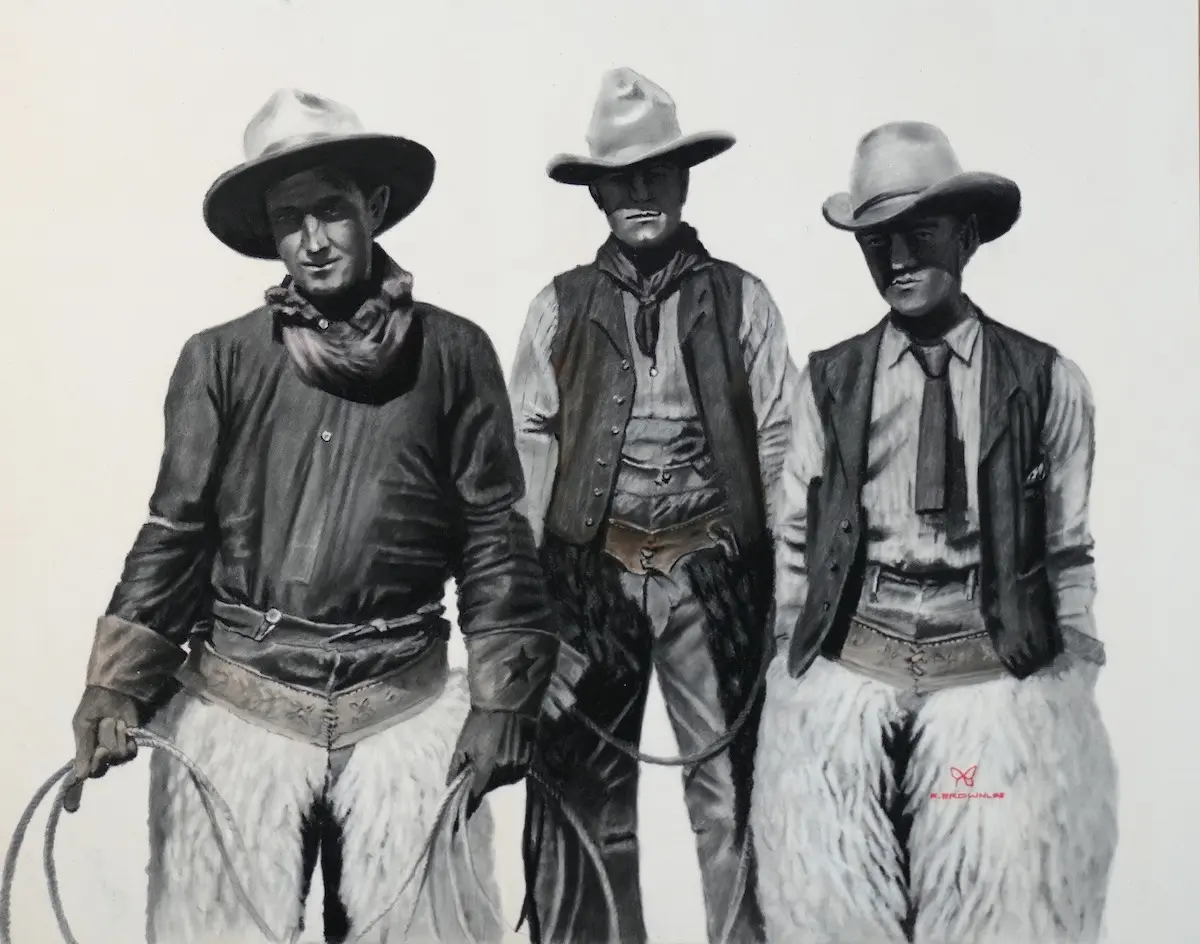
Rachel Brownlee – Wild and Woolly (Charcoal and Gouache, 11 x 14 inches):
Historically, charcoal and gouache have been relegated to the preparatory realm—used for preliminary sketches, anatomical studies, and the rough scaffolding that precedes a finished oil painting. In Wild and Woolly, Brownlee upends this convention. The piece emerges as a subtly finished, highly polished work of art. The triple portrait presents three distinct explorations of cowboy style, capturing individual personalities through meticulous attention to attire—from the drape of chaps to the crease of a hat—with a brash, bold confidence.
Maia Chávez Larkin – Under a Red Sun (Oil, 24 x 18 inches):
Larkin’s oil painting defies the traditional expectations of the medium, employing a palette and mark-making technique that more closely resembles soft pastel. The composition centers on a figure possessing a calm, almost divine neutrality. Gazing directly outward, the subject seems to appraise the viewer, while a vivid red sun radiates concentric, ruddy waves across a brilliant blue sky. The resulting atmosphere evokes a profound psychological weight, akin to turning over a mysterious tarot card whose true meaning demands personal interpretation.
Kim Seyesnem Obrzut – Born of Clay (Bronze, 21.5 x 10 x 8.5 inches):
Obrzut’s striking bronze sculpture depicts a woman cradling a delicate clay pot, weaving a narrative web of multiple potential interpretations. Is the woman an artisan proudly embracing her own creation? Is she a collector gently carrying home a newly acquired treasure? Or is she a steward returning the vessel to domestic service? The ambiguity is intentional and engaging. Moreover, as the viewer steps back, a clever formal transformation occurs: the entire sculptural grouping resolves into the shape of a handled vase or jar, marrying figurative sculpture with utilitarian form.
Official Responses and Perspectives
Laura Davis, chair of the Mountain Oyster Club’s art committee, emphasizes that the exhibition’s enduring success stems from an uncompromising commitment to artistic excellence and atmospheric presentation.
"The show also distinguishes itself through the exceptional quality and diversity of its artists," Davis notes. "The exhibition features both nationally recognized, established artists and outstanding emerging talent, giving collectors the opportunity to discover tomorrow’s favorites alongside celebrated names."
Davis also points to the venue itself as a critical component of the attendee experience, elevating the event far beyond a standard commercial gallery opening.
"One thing that sets the Mountain Oyster art show apart from others is the venue," Davis explains. "Rather than a typical art gallery, the show is held in a private dining club, a beautiful historic mansion listed on the National Register of Historic Places. This unique setting offers visitors an experience that is as memorable as the artwork itself."
Art critic and commentator James D. Balestrieri further underscores the intimate, exclusive nature of the gathering, noting that the combination of elite craftsmanship and historic architecture creates an unmatched cultural ecosystem within the desert Southwest.
Implications for the Art Market and Western Cultural Preservation
The 57th Annual Mountain Oyster Club Contemporary Western Art Show and Sale carries implications that extend well beyond a single afternoon of socializing and acquisitions.
Redefining Western Art: By showcasing works like Rachel Brownlee’s hyper-refined charcoal studies and Maia Chávez Larkin’s psychological, pastel-esque oils, the exhibition signals that "Western art" is no longer confined to rigid historical clichés or romanticized tropes. Contemporary Western art is increasingly exploratory, embracing diverse mediums, abstract emotional palettes, and complex narratives.
The Vitality of Private Patronage: In an era where many public institutions struggle with funding or shifting cultural mandates, private clubs like the Mountain Oyster Club play a vital role in sustaining traditional patronage models. By maintaining rigorous standards and connecting affluent collectors directly with creators, the club ensures a robust economic engine for Western artists.
Historic Preservation in Action: Utilizing the Pond Mansion—a site safeguarded on the National Register of Historic Places—as an active gallery space demonstrates how historical architecture can remain dynamically relevant. Rather than acting as a static museum piece, the mansion functions as a living salon where past and present architectural and artistic achievements converse.
Event Logistics & Contact Information
Event: 57th Annual Mountain Oyster Club Contemporary Western Art Show and Sale
Date: Sunday, November 22
Time: 3:00 p.m. – 5:30 p.m.
Location: Pond Mansion (Mountain Oyster Club), Tucson, AZ
Admission: By invitation/advance ticket purchase through the club (space is strictly limited).