

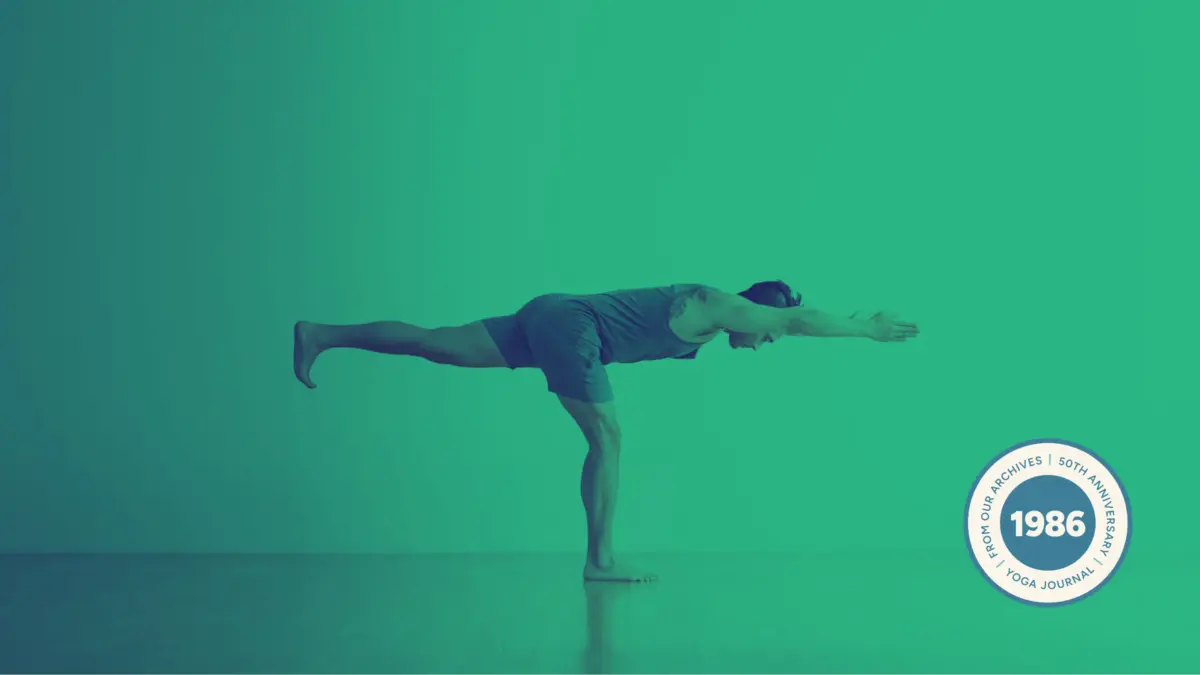
August 2026 Archives Feature
Originally published in the January–February 1986 issue of Yoga Journal
Main Facts
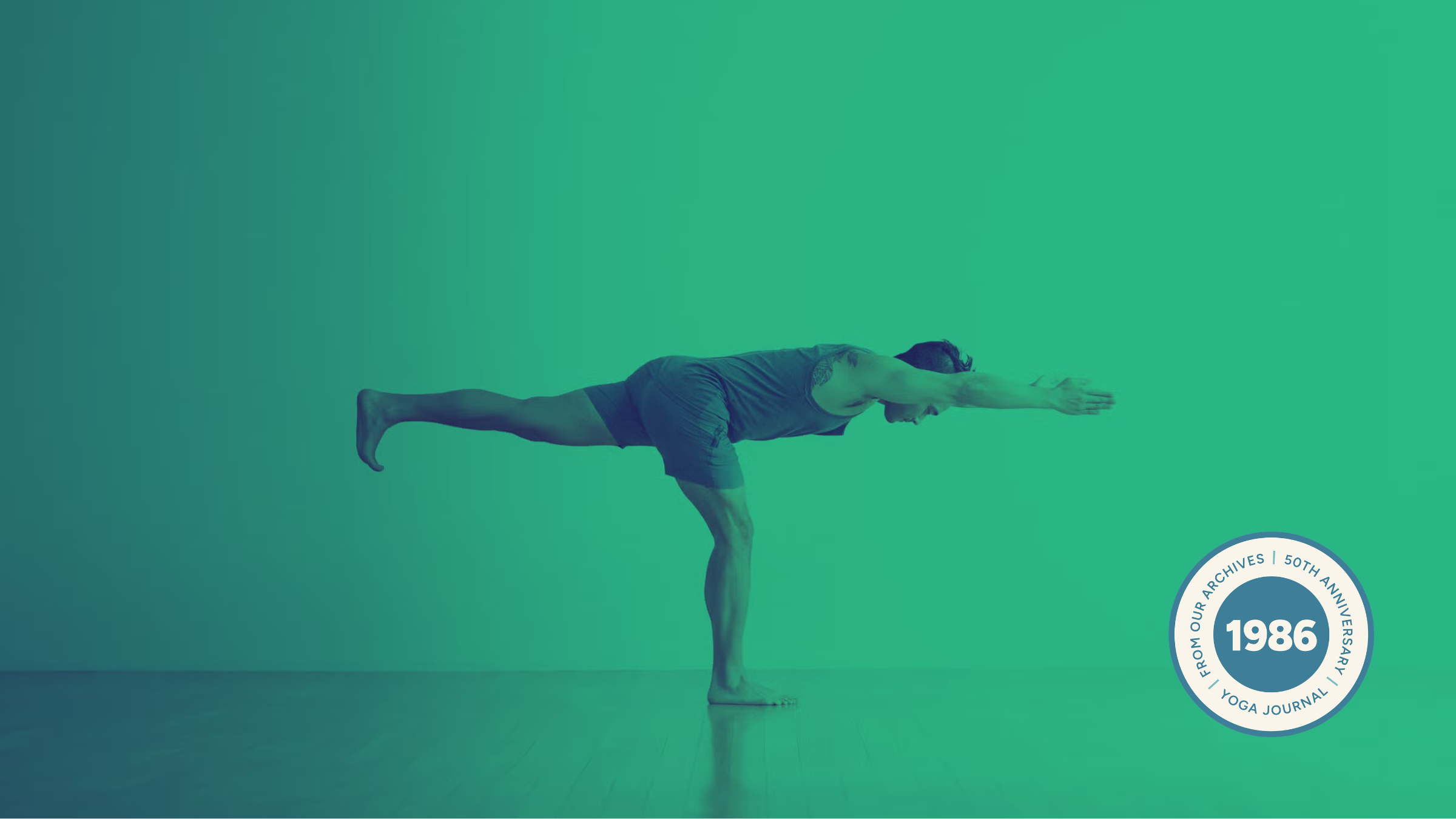
Warrior 3 (Virabhadrasana III) stands as one of the most demanding and transformative standing postures in modern yoga practice. Requiring a sophisticated synergy of physical balance, core strength, muscular endurance, and deep flexibility, the pose challenges practitioners to defy gravity on a single standing leg.
Traditionally reserved for students beyond the absolute beginner stage, Virabhadrasana III engages virtually every major muscle group in the body. The trunk, gluteus muscles, lower and upper legs, and core stabilizers must fire simultaneously, alongside the shoulder girdle, which extends dynamically to maintain the linear integrity of the shape.
Yet, the true hallmark of Warrior 3 is not merely muscular exertion, but structural alignment and internal poise. To execute the pose successfully, the practitioner must maintain level hips, a flat back, and an energetic line of extension stretching from the fingertips through the lifted heel. According to archival teachings from Yoga Journal, the secret to mastering this demanding posture lies not in brute physical effort at the body’s periphery, but in generating stability from a deeply anchored, conscious center.
Chronology
The exploration and instruction of Warrior 3 have evolved significantly since the ancient roots of hatha yoga, yet its core methodology was firmly established in Western publications by the mid-1980s.
- Ancient Beginnings: Rooted in classical yoga traditions, Virabhadrasana (named after the fierce warrior incarnation born from the locks of Lord Shiva) historically comprised three distinct variations designed to cultivate strength, focus, and spiritual resilience.
- January–February 1986: Yoga Journal published a landmark instructional feature on Warrior 3, detailing the biomechanics of level hips, core engagement, and the philosophical parallels between physical balance and centered living. This foundational text emphasized that the stretch must radiate outward from the abdomen rather than originating in the limbs.
- Decades of Refinement (1986–2026): Throughout the late 20th and early 21st centuries, alignment-based yoga systems (such as Iyengar and Ashtanga) further refined the anatomical cues for Warrior 3. Teachers increasingly emphasized the use of props—such as walls and chairs—to help students correct pelvic tilting and build foundational neuromuscular pathways safely.
- August 2026: Re-entering the modern wellness spotlight via Yoga Journal’s digital archives series, the 1986 teachings on Virabhadrasana III are reviewed by contemporary practitioners, proving that the intersection of biomechanics and mindfulness remains as relevant today as it was forty years ago.
Supporting Data and Anatomical Mechanics
Achieving stability in Warrior 3 requires precise anatomical coordination. Biomechanical breakdowns of the posture highlight several critical vectors of force:
Muscle Recruitment
- The Standing Leg: The quadriceps, hamstrings, calves, and intrinsic muscles of the foot work in micro-adjustments to keep the ankle stable.
- The Core: The transverse abdominis and oblique muscles act as an internal girdle, preventing the lower back from arching excessively and keeping the pelvis neutral.
- The Lifted Leg and Glutes: The gluteus maximus and hamstrings of the floating leg must engage intensely to keep the limb elevated in line with the torso without distorting the level position of the pelvis.
- The Upper Body: The deltoids, latissimus dorsi, and spinal extensors keep the arms reaching forward, preventing the chest from collapsing toward the floor.
Alignment Checkpoints
- Pelvic Symmetry: The hips must remain strictly parallel to the floor. A common error involves opening or "stacking" the hip of the lifted leg upward, which compromises both balance and structural safety.
- The Energy Axis: The body must form a long, unyielding line from the fingertips to the heel of the lifted foot, minimizing lateral tilting or wobbling.
Official Responses and Expert Perspectives
Master instructors and movement therapists have long regarded Warrior 3 as a diagnostic tool for overall physical and mental integration.
In classical instructional notes preserved from Yoga Journal’s archives, master teachers noted that the pose feels fundamentally lighter when practitioners mentally shift their focus away from the struggling limbs and toward the upper body—specifically the back of the shoulders, the skin of the back, and the back of the upper leg.
Furthermore, somatic experts emphasize the psychological shift that occurs during the posture. Modern physical therapists and yoga educators note that single-leg balancing postures stimulate proprioceptive awareness—the body’s ability to sense its location, movements, and actions in space. When a student manages to quiet the mind amidst the physical intensity of Warrior 3, the nervous system shifts from a state of sympathetic stress (fight-or-flight) to parasympathetic regulation, underscored by a profound sense of inner silence.
Implications
The lessons gleaned from practicing Virabhadrasana III extend far beyond the rubber boundaries of a yoga mat, offering profound philosophical implications for daily life.
Moving From the Center
Yoga philosophy posits that physical imbalances often mirror mental or emotional disruptions. In daily life, individuals frequently live on the periphery of consciousness—reacting superficially to external stressors without anchoring themselves in their internal core.
Just as Warrior 3 collapses if the practitioner initiates movement from the hands or feet rather than the abdomen, human life becomes unstable when driven entirely by external circumstances. By learning to anchor awareness in the physical and energetic center during a demanding pose like Warrior 3, practitioners train themselves to remain fully present and centered amidst the chaotic ebbs and flows of everyday existence.
The Holistic Triangle of Awareness
True balance cannot be achieved through physical conditioning alone; it requires a tripartite approach consisting of:
- Asana: Cultivating structural awareness and physical equilibrium through the body.
- Pranayama: Regulating the nervous system and mind through intentional, soft breathing techniques.
- Meditation: Fostering mental clarity, stillness, and deep observation.
When these elements converge within the crucible of Warrior 3, the posture ceases to be merely a test of physical strength. It transforms into a moving meditation—a physical manifestation of the principle that from deep centeredness comes unshakeable balance.
How to Practice Warrior 3: Step-by-Step Instructions
For practitioners seeking to cultivate this balance, the classical method outlined in the 1986 Yoga Journal archive provides a reliable blueprint for safe execution.
- Establish the Foundation: Begin with a wide stance between your legs. Turn your right foot out at a 90-degree angle and angle your back (left) foot inward by about 75 degrees. To enhance lateral stability, align your heels so they intersect on a single straight line.
- Arm and Torso Extension: Inhale deeply, bringing both arms straight overhead and stretching upward completely. Exhale as you pivot your torso to face squarely in the direction of your right foot.
- The Lunging Base: Inhale, and on your next exhalation, bend your right knee so that your right shin (tibia) forms a perpendicular 90-degree angle to the floor, while your right thigh (femur) is positioned as parallel to the floor as possible. Keep lifting upward through your fingertips and maintain a soft, steady breath.
- Transition into Flight: Exhale and lean your torso forward over the bent right knee, taking meticulous care not to collapse your chest or drop your arms. Inhale as you begin shifting your entire body weight over your right foot.
- The Full Expression: With a subsequent exhalation, move diagonally forward and upward, extending your back leg and torso into one long, straight line balanced entirely over your right foot.
- Maintain Alignment: Ensure your pelvis remains completely level to the floor. If balance proves too challenging initially, modify the pose by placing your hands firmly against a wall or resting them across the back of a sturdy chair.
- Hold and Breathe: Hold the posture for several steady breaths, gradually increasing your duration over time as your strength and endurance improve.
- Exit and Repeat: To exit, gently bend your supporting right knee, exhale while reaching backward with your left leg, and return your feet to the floor in the bent-knee, arms-extended lunge position. Keep your breath fluid as you straighten your legs, turn to face the opposite direction, and repeat the sequence on the left side.
