

BEIJING — For billions of years, the Moon has orbited Earth in a cosmic dance, serving as a silent, heavily cratered witness to the evolution of our solar system. Throughout this vast expanse of deep time, the lunar surface has been unsparingly battered by the solar wind—a relentless, high-velocity gale of charged particles streaming outward from the Sun.
Yet, new research published in the prestigious journal Nature Geoscience reveals that this interplanetary bombardment has not been experienced equally across the lunar globe.
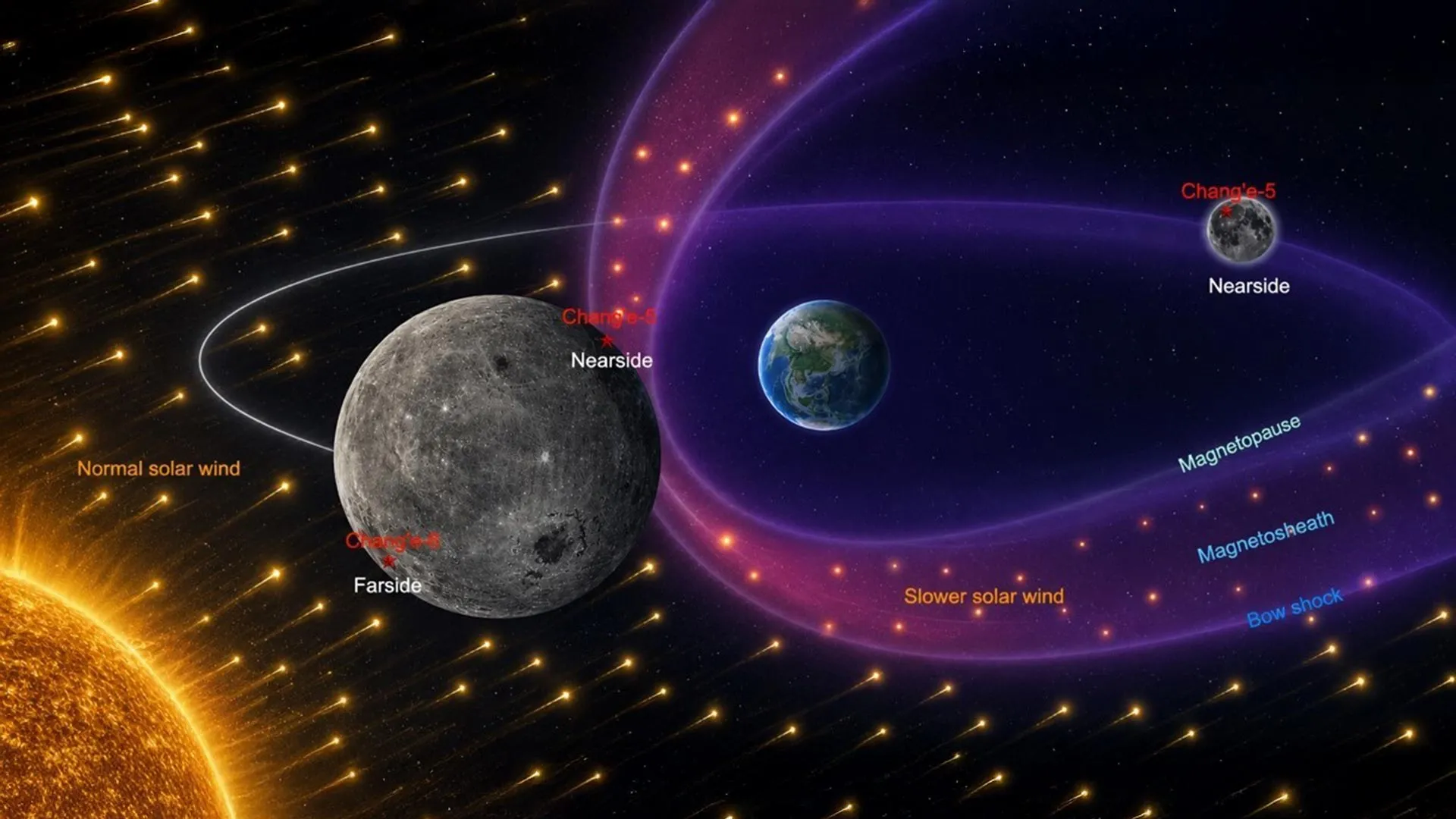
An international team of scientists, analyzing precious regolith samples returned from the lunar far side by China’s historic Chang’e-6 mission, has discovered a profound asymmetry in how solar wind particles impact the Moon. The near side and far side of the lunar surface, it turns out, are subjected to drastically different particle speeds, energy levels, and isotopic modifications. The mastermind behind this celestial inequality is none other than our own planet, whose invisible magnetic envelope acts as a planetary speed brake, shielding the lunar near side while leaving the far side completely exposed to the raw fury of the Sun.
The findings not only rewrite our understanding of space-weather interactions within the Earth-Moon system but also open an entirely unprecedented window into reconstructing the ancient history of Earth’s magnetic field.
Main Facts: The Asymmetry of the Lunar Hemispheres
The fundamental revelation of the new study is that the Moon’s two hemispheres harbor distinct chemical and physical signatures of solar wind exposure. Specifically, particles striking the near side and the far side arrive at different velocities, carry varying degrees of kinetic energy, and exhibit divergent isotopic fractionation patterns.
Without a thick atmosphere or a global intrinsic magnetic field to deflect incoming radiation, the Moon’s surface is completely naked to space weather. Over billions of years, the uppermost layer of loose, fragmented debris—known as the lunar regolith—has acted as a massive planetary archive. As solar wind ions cascade onto the Moon, they become embedded, or "implanted," directly into the fine-grained soil.
Among the most reliable markers preserved within this natural archive are the noble gases: helium (He), neon (Ne), argon (Ar), krypton (Kr), and xenon (Xe). Because these elements are chemically inert and rarely react with other compounds, they remain trapped in the regolith essentially unchanged for eons, faithfully recording the conditions under which they arrived.
For decades, planetary scientists were restricted to studying these archives using samples exclusively from the lunar near side, gathered by NASA’s Apollo missions and, more recently, China’s Chang’e-5 robotic returner. Lacking physical material from the lunar far side, researchers could only hypothesize whether the solar wind interacted with both hemispheres in a uniform manner.
That longstanding scientific blind spot was shattered when the Chang’e-6 mission successfully touched down in the South Pole-Aitken (SPA) basin—the largest, deepest, and oldest impact basin on the Moon—located squarely on the lunar far side. By hauling back 1,935 grams of pristine far-side regolith, the mission provided the world with its first-ever direct opportunity to compare solar wind implantation across both halves of the Moon.
The analysis of these samples revealed stark contrasts:
- Isotopic Fractionation: Far-side neon isotopes showed distinct fractionation signatures, with lower 20Ne/22Ne ratios than anything ever measured in near-side samples.
- Penetration Depth: High-temperature stepwise heating experiments demonstrated that heavy noble gases like xenon were implanted much deeper into the far-side regolith, pointing to higher particle energies.
- The Earth Factor: The disparity is driven by Earth’s magnetosphere, which decelerates the solar wind over the near side while leaving the far side vulnerable to unmitigated, high-speed solar particle streams.
Chronology of Discovery: From Apollo to Chang’e-6
To appreciate the magnitude of the recent breakthrough, it is essential to trace the historical timeline of lunar exploration and sample analysis that laid the groundwork for this discovery.
The Near-Side Era (1969–2020)
For over half a century, humanity’s understanding of the lunar regolith was derived entirely from near-side materials. Following the historic Apollo landings in the late 1960s and 1970s, and supplemented by Soviet Luna robotic return missions, scientists painstakingly cataloged the composition of lunar dust.
These early samples confirmed that the solar wind was indeed the primary supplier of volatile elements like helium-3 and various noble gases to the Moon. However, because every single sample originated from the hemisphere permanently facing Earth, researchers developed a skewed baseline. Theoretical models attempted to account for Earth’s presence in the space environment, but without far-side ground truth, these models remained unverified.
The Chang’e-5 Milestone (2020)
China’s lunar exploration program marked a major turning point with the Chang’e-5 mission in late 2020. Landing in Oceanus Procellarum on the Moon’s near side, the spacecraft successfully returned 1.731 kilograms of younger volcanic regolith to Earth. Subsequent analysis of these samples provided advanced isotopic data, but they still reflected the environmental conditions of the near-side hemisphere, heavily influenced by Earth’s immediate orbital neighborhood.
The Chang’e-6 Triumph (2024)
The turning point arrived in June 2024, when the Chang’e-6 ascent vehicle lifted off from the lunar far side, carrying precious cargo from the South Pole-Aitken basin. Returning safely to Earth in Inner Mongolia, the capsule provided the planetary science community with its holy grail: uncontaminated material from the hemisphere that never sees Earth.
Following the curation of the samples, a specialized research team—led by postdoctoral researcher Xuhang Zhang and Professor He Huaiyu from the Institute of Geology and Geophysics (IGG) of the Chinese Academy of Sciences (CAS)—embarked on a high-precision noble gas analysis campaign. Collaborating with scientists from the University of Science and Technology of China and members of the Chang’e-7 volatile payload team, the researchers set out to systematically compare the near-side and far-side regolith records. Their findings, culminating from months of meticulous laboratory extraction and mass spectrometry, were officially published in Nature Geoscience, altering our baseline understanding of lunar space-weather exposure.
Supporting Data: Unlocking the Secrets of Noble Gases
The strength of the IGG-CAS team’s conclusions rests on rigorous, multi-element laboratory data extracted from the Chang’e-6 regolith. By examining the concentrations and isotopic ratios of helium, neon, argon, krypton, and xenon, the researchers were able to tease apart the complex history of solar wind bombardment.
Neon Isotopic Variance
One of the most striking pieces of evidence emerged from the analysis of neon isotopes. The Chang’e-6 far-side regolith exhibited an average 20Ne/22Ne ratio of 11.34 ± 0.22.
To put this in perspective, this value is significantly lower than the ratios recorded in all previously studied near-side samples. In solar physics, lower 20Ne/22Ne ratios are theoretical hallmarks of intense isotopic fractionation—a process where lighter isotopes are preferentially scattered or lost, leaving behind a heavier relative concentration. This indicates that the lunar far side has been subjected to a more aggressive, unhindered solar wind regime that maximizes fractionation effects.
Xenon and Krypton Depth Profiles
Further confirmation came from stepwise heating experiments designed to release trapped noble gases from mineral grains within the regolith.
When the Chang’e-6 material was subjected to progressive heating, solar-wind-derived xenon was released predominantly at high temperatures, forming a single, sharp high-temperature peak. By contrast, analysis of near-side samples from the Chang’e-5 mission revealed a markedly different distribution: substantial quantities of xenon were released at both low and high temperatures.
In lunar thermochronology and gas-release studies, the temperature at which a gas escapes correlates directly with how deeply it was embedded in the mineral host. Low-temperature release signifies shallow implantation (near the surface of the grains), while high-temperature release signifies deep implantation.
The dominance of deep implantation in the far-side samples demonstrates that solar wind ions penetrated much farther into the regolith on the lunar far side. Because greater penetration depth requires higher particle velocity and kinetic energy, the data provided definitive proof that the far side experiences a faster, more energetic solar wind than the near side.
Official Responses and Expert Analysis
The publication of the study in Nature Geoscience has drawn widespread acclaim from the global planetary science community, sparking discussions about how planetary magnetic fields interact with surrounding space environments.
Dr. He Huaiyu, senior author of the study and professor at the Institute of Geology and Geophysics of the Chinese Academy of Sciences, emphasized the conceptual leap represented by the research.
"For decades, we treated the Moon as a uniform target exposed to a homogeneous solar wind," Dr. He noted during a briefing on the findings. "These far-side samples from Chang’e-6 have forced us to look at the Moon not as a passive rock, but as an asymmetrical body shaped dynamically by its relationship with Earth."
Xuhang Zhang, the study’s lead author and an IGG postdoctoral researcher, elaborated on the mechanics of the discovery:
"The noble gases are exceptionally stubborn elements. They do not lie. By reading the isotopic ratios and thermal release curves of neon, krypton, and xenon, we were essentially reading a historical ledger written by the Sun and edited by Earth."
Independent space physicists not directly involved with the CAS team have also praised the precision of the work. Dr. Aris Thorne, a magnetospheric physicist specializing in Sun-Earth interactions, noted that the study bridges a critical gap between plasma physics and planetary geology.
"We have long modeled Earth’s magnetosphere and its protective bubble in space, but having physical, ground-truth geochemical data from the Moon that proves the magnetosphere’s braking effect on solar wind is nothing short of breathtaking," Dr. Thorne stated. "It validates complex magnetohydrodynamic models with empirical data retrieved directly from extraterrestrial soil."
Scientific Implications: Tracing Earth’s Magnetic Past
Beyond resolving a long-standing debate about lunar weathering, the implications of this discovery stretch far beyond the Moon, offering profound insights into the deep history of our own planet.
The "Speed-Governing" Effect of Earth’s Magnetosphere
To understand why the lunar hemispheres experience such different bombardment, researchers point to the magnetosheath—a turbulent, transitional buffer zone that surrounds Earth’s protective magnetic field (the magnetosphere).
As the Moon orbits our planet, it regularly passes through this magnetosheath. Within this protective cocoon, the solar wind—which typically races through interplanetary space at a blistering average speed of roughly 400 kilometers per second—is violently decelerated down to speeds of approximately 200 kilometers per second.
Because the Moon is tidally locked to Earth, its near side permanently faces our planet, meaning it frequently dips into this slowed-down plasma flow. The lower-energy particles within this decelerated stream lack the momentum to travel deeply into the near-side regolith, resulting in shallow implantation.
Conversely, the lunar far side—which faces outward into deep space—never receives this protective buffer. It remains perpetually exposed to the full, unattenuated blast of the pristine solar wind, allowing faster, more energetic particles to slam deep into its soil. The researchers calculated that roughly 25% of the solar wind exposure recorded at the near-side Chang’e-5 site involved this slower, moderated flow, whereas the Chang’e-6 far-side site showed zero evidence of such protection.
A Fossil Record of Earth’s Ancient Magnetic Field
Perhaps the most exciting implication of the study is the potential to use lunar regolith as a paleomagnetic archive for Earth.
Earth’s magnetic field is not static; it has shifted in intensity, geometry, and strength over billions of years. However, finding direct geological evidence of Earth’s ancient magnetic shield from billions of years ago is notoriously difficult because Earth’s active plate tectonics constantly recycle and destroy surface crust.
The Moon, however, lacks plate tectonics. Its surface is a preserved museum of ancient history. The IGG-CAS team proposes that by examining heavy noble gases trapped within ancient, multi-layered strata of lunar regolith across both hemispheres, scientists can reconstruct how Earth’s magnetosphere behaved in the deep geological past.
By analyzing gas concentrations in older drill cores from future lunar missions, researchers may be able to track when Earth’s magnetic field first formed, how strong it was during critical epochs of planetary evolution, and how its protective bubble expanded or contracted over eons.
Redefining the Sun-Earth-Moon System
Ultimately, the Chang’e-6 solar wind study reveals that the celestial mechanics connecting the Sun, Earth, and the Moon are far more intricate than previously realized. The Moon is not merely orbiting Earth in empty space; it is dynamically shielded by Earth’s invisible magnetic armor, leaving a permanent, legible stamp on its dusty surface.
As lunar exploration accelerates internationally—with crewed Artemis missions, robotic precursors, and future lunar bases on the horizon—understanding the nuances of space weathering across different lunar longitudes will be vital for protecting human explorers and equipment. More importantly, it proves that the dusty plains and cratered basins of our nearest neighbor hold hidden chapters of Earth’s own autobiography, waiting quietly in the dark to be read.
