

By Science & Space Desk
Published: November 2025
Main Facts
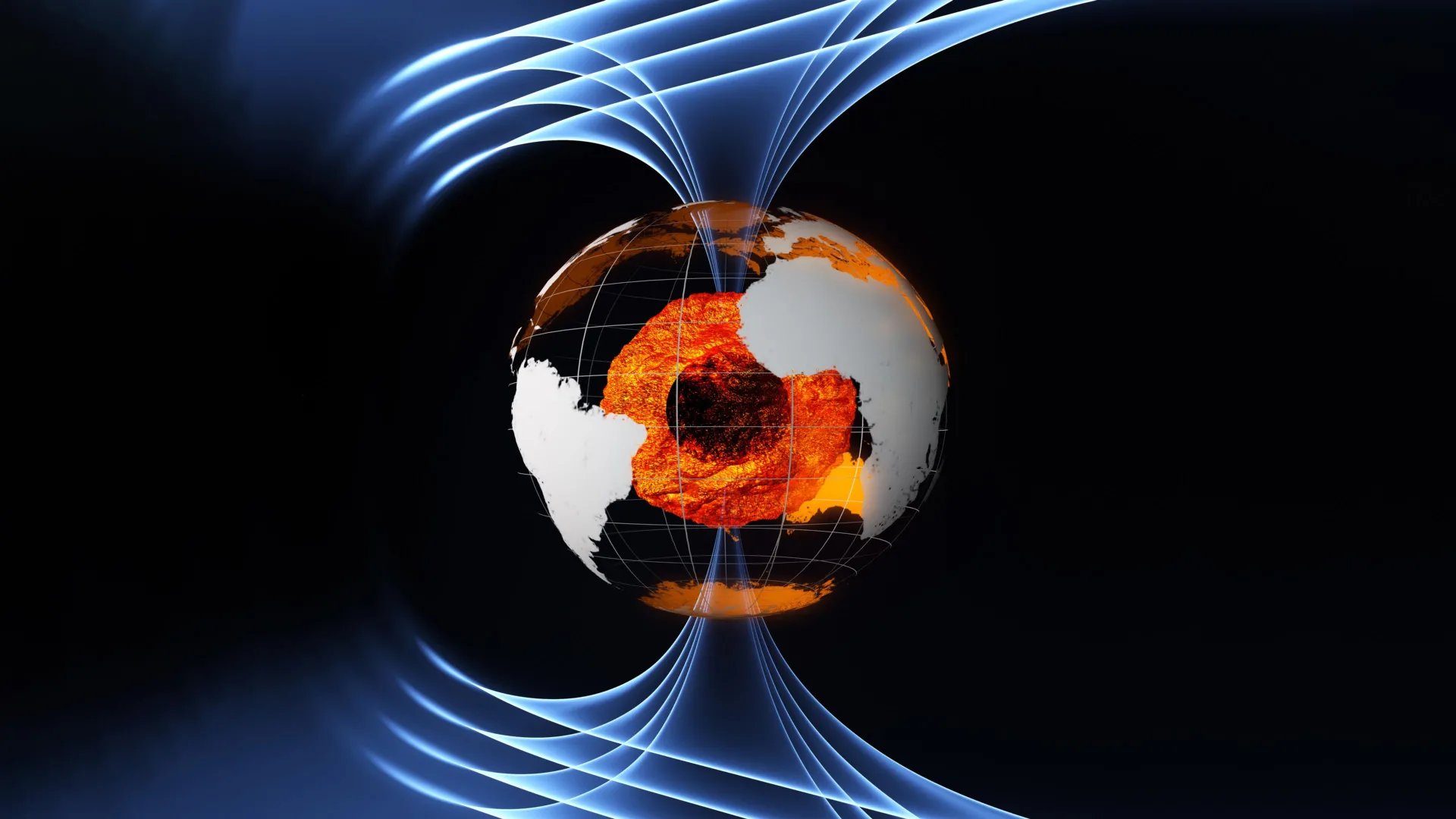
Deep beneath the crust of our planet, 2,200 kilometers (roughly 1,370 miles) down, the engine that powers Earth’s protective magnetic shield is acting with unexpected volatility. For generations, geophysicists operated under the consensus that the churning ocean of liquid iron making up Earth’s outer core flowed in a predominantly westward direction. However, an unprecedented analysis of nearly three decades of satellite and ground-based data has revealed a startling geological anomaly: in 2010, a massive subterranean river of molten metal beneath the equatorial Pacific Ocean violently reversed course, shifting from a weak westward creep to a powerful, roaring eastward flow.
The discovery, published in the Journal of Studies of Earth’s Deep Interior, challenges decades-old assumptions regarding the stability and predictability of planetary cores. Utilizing cutting-edge data collected between 1997 and 2025—bolstered significantly by the European Space Agency’s (ESA) elite constellation of observation satellites—researchers have mapped the turbulence of the deep Earth with unprecedented clarity.
While the sudden fluid dynamic shift poses no direct physical threat to life on the surface, it provides vital clues about the mechanics of the geodynamo, the invisible dynamo driving Earth’s magnetic field. Furthermore, leading researchers hypothesize that this dramatic reversal is linked to simultaneous, mysterious behavioral shifts occurring even deeper within the planet, at the boundary of Earth’s solid inner core.
Chronology of a Subterranean Shift
To understand the gravity of the 2010 event, geophysicists had to piece together a timeline spanning decades of indirect observation, ground monitoring, and modern space exploration.
- Pre-2010 (The Steady-State Paradigm): For decades, scientists studying minute variations in Earth’s surface magnetic field concluded that fluid circulation within the outer core was largely uniform and sluggish, maintaining a stable westward drift. Large-scale turbulence was thought to evolve over immense geological timescales, making sudden regional changes virtually unthinkable.
- The 2010 Reversal: Without warning, the long-standing baseline shattered. Beneath the equatorial Pacific Ocean, a broad, iron-rich fluid region broke away from its westward trajectory. Driven by forces still entirely unknown to science, this massive subterranean current began surging aggressively eastward.
- The 2013 Constellation Arrives: Recognizing the critical need for global, high-precision magnetic monitoring, the ESA launched its trio of Swarm satellites in November 2013. Designed specifically to untangle the complex web of magnetic signals originating from Earth’s core, crust, and atmosphere, the mission provided the high-resolution lens necessary to analyze the aftermath of the 2010 event.
- 2017 (The Geomagnetic Jerk): Continued satellite tracking identified abrupt secondary anomalies, including a prominent "geomagnetic jerk"—a sharp, rapid change in the secular acceleration of Earth’s magnetic field that correlated with ongoing core dynamics.
- Post-2020 (The Slowdown and Re-evaluation): According to the latest analytical models running through 2025, the fierce eastward flow beneath the Pacific has begun to lose momentum, weakening notably over the past five years. This deceleration has forced scientists to re-examine whether the 2010 event was a permanent structural shift, a fleeting fluctuation, or merely one phase of a massive, multi-decadal natural cycle.
Supporting Data and Technological Marvels
Unlocking the secrets of a region situated thousands of kilometers beneath solid rock, immense pressure, and crushing temperatures is one of modern science’s greatest triumphs. Because direct physical sampling of the outer core is physically impossible—temperatures rival those of the Sun’s surface—researchers must rely on the subtle magnetic footprints these molten rivers leave behind at the surface.
The breakthrough study was made possible by integrating historical ground-based magnetic observatories with a fleet of sophisticated low-Earth-orbit satellites. The research team synthesized measurements spanning from 1997 through 2025, drawing data from:
- ESA’s Swarm Mission: Launched in 2013, this trio of satellites uses ultra-sensitive magnetometers to map Earth’s magnetic field with unmatched precision. By flying in tightly coordinated orbits, the Swarm spacecraft can isolate and strip away the "noise" generated by Earth’s ionosphere, magnetosphere, oceans, and crust, leaving a pristine signal originating directly from the core-mantle boundary.
- ESA’s CryoSat Mission: Originally deployed for polar ice tracking, its supplementary datasets contributed to the broader framework of gravitational and environmental Earth-observation metrics.
- The CHAMP Mission: Germany’s pioneering satellite mission, which provided vital baseline data during its operational years.
- The Ørsted Mission: Denmark’s small satellite project, which helped bridge the observational gap between late-20th-century ground stations and modern spaceborne magnetometer networks.
By isolating core-originating signals, scientists mapped wave-like accelerations and rapidly shifting flow structures that would have been completely invisible within the noisier, lower-resolution datasets of the past. These instruments revealed that the outer core is not a sluggish, predictable cauldron, but a hyper-dynamic fluid system capable of rapid, localized upheavals.
Official Responses and Expert Insights
The implications of the Pacific reversal have sent ripples through the international geophysics community, prompting leading researchers and space agency officials to re-evaluate how Earth’s deepest layers communicate with one another.
Frederik Dahl Madsen, lead author of the study from the University of Edinburgh’s School of Geosciences, emphasized the profound questions raised by the data.
"The large-scale flow reversal beneath the Pacific raises new questions about the behavior of Earth’s deep interior," Madsen stated. "Scientists now want to understand whether the reversal represents a short-lived fluctuation, part of a repeating oscillation, or a new stable equilibrium for core circulation. Continued monitoring will be essential to determine how the flow evolves over the coming years."
Madsen also pointed out a fascinating coincidence—or perhaps a direct physical correlation—occurring at the very center of the planet. The timing of the eastward flow surge in 2010 mirrors behavioral changes recorded in Earth’s solid inner core by geodesists and seismologists.
"The rise of the strong eastward flow in the Pacific is contemporary with a change in behavior in the inner core… and we hypothesize that these changes in the deep interior are associated with the changes in flow beneath the Pacific," he added.
From the perspective of mission operations, the value of continuous satellite monitoring cannot be overstated. Anja Stromme, ESA’s Swarm Mission Manager, highlighted how space-based assets transformed our understanding of planetary dynamics.
"Although Swarm was launched after the dramatic reversal event of 2010, it has provided high-precision data that tell us about Earth’s inner core in the period that followed," Stromme noted. "Importantly, Swarm provides continuous global coverage over many years, allowing scientists to track how core dynamics evolve over time rather than relying only on ground-based magnetic observatories. Long-duration satellite magnetic measurements allow researchers to follow changes in the geodynamo in near-real-time and improve models of Earth’s magnetic field evolution."
Echoing these sentiments, Elisabetta Iorfida, ESA’s Swarm Mission Scientist, stressed that the findings fundamentally challenge long-held dogmas about core circulation.
"This study shows that regional changes can emerge rapidly within just a decade," Iorfida explained. "The findings may also help scientists investigate possible interactions between Earth’s outer core, inner core, lower mantle and, therefore, give more insights into the core-mantle boundary, which is a critical region for deep Earth dynamics. This research raises intriguing questions about how Earth’s deepest layers are dynamically connected."
Implications for Science, Navigation, and Space Weather
While the churning depths of the outer core are safely insulated beneath thousands of kilometers of rock and mantle—meaning the Pacific reversal poses zero direct physical danger to human populations or global climate systems—the implications of this research are far-reaching.
1. Protecting Our Technological Civilization
The primary product of the outer core’s geodynamo is Earth’s magnetic field. This invisible shield stretches far out into space, forming the magnetosphere, which deflects deadly solar wind, cosmic rays, and coronal mass ejections unleashed by our Sun. Without this continuous fluid motion generating our magnetic armor, Earth’s atmosphere would be slowly stripped away, and surface life would be exposed to sterilizing radiation.
As the flow patterns of liquid iron shift, the morphology of the magnetic field changes in tandem. Understanding the velocity and direction of these core-mantle currents allows scientists to construct more accurate models of geomagnetic evolution.
2. Modern Navigation and Aerospace Operations
Small, erratic shifts in the geomagnetic field directly impact compass accuracy, directional drilling in the energy sector, and military navigation systems. Furthermore, modern satellite operations in low-Earth orbit rely heavily on models of near-Earth space weather and magnetic field strength to calculate drag, adjust orbital trajectories, and protect sensitive onboard electronics from radiation damage.
3. Redefining Deep Earth Geodynamics
For decades, textbooks taught that the core’s interior circulation was slow, steady, and overwhelmingly westward. The revelation that an entire region can execute a massive, decade-long directional U-turn—and subsequently begin to weaken—proves that the core-mantle boundary is a zone of intense, unpredictable turbulence.
By continuing to monitor these magnetic anomalies through persistent satellite architectures like ESA’s Swarm, humanity gains a clearer, near-real-time window into the planet’s engine room. As researchers look ahead toward future orbital missions, it is increasingly clear that Earth’s deep interior is far more complex, variable, and intimately interconnected than science ever dared to imagine.
