

Published September 24, 2026
Reporting by Backcountry Fitness Desk
Main Facts
For decades, the standard post-hike recovery routine has remained largely unchanged: a quick stretch of the hamstrings and calves, a foam roller session if you are lucky, and plenty of rest. But for backpackers navigating rugged terrains with heavy multi-day loads, traditional stretching often fails to reach the deeply embedded, micro-stabilizing muscles of the feet, ankles, and spine.
Enter Gyrotonic and Gyrokinesis—two innovative, movement-based disciplines rapidly gaining traction among outdoor athletes. Originally formulated to help professional dancers rehabilitate from severe injuries, these methods combine elements of dance, swimming, tai chi, and yoga. While Gyrotonic utilizes specialized cable-and-pulley machinery, its sister practice, Gyrokinesis, can be performed entirely on a mat or stool, making it an ideal portable routine for basecamps and home living rooms alike.
The primary objective of both systems is not merely muscle hypertrophy or basic flexibility, but rather holistic internal conditioning. By utilizing circular, three-dimensional movements synchronized with breathwork, the practice targets joint health, boosts blood circulation, and releases chronic tension in areas that bear the brunt of heavy backpacking.
Chronology: From Dance Studios to Backcountry Trails
The integration of Gyrotonic principles into outdoor fitness is a relatively recent development, though the system itself has decades of history.
- The Origins (Late 20th Century): Developed by Juliu Horvath, a former dancer and gymnast, the system was originally coined "Yoga for Dancers." Horvath created the movement sequences to heal his own debilitating injuries sustained from years of high-impact performance.
- The Evolution of the Equipment: Over subsequent decades, Horvath engineered complex pulley towers and weight-sliding benches (the Gyrotonic apparatus) designed to mimic the natural, fluid movements of human joints without placing compressive stress on the spine.
- The Off-Machine Adaptation: Recognizing the need for accessible practice, Gyrokinesis was developed as the floor- and stool-based counterpart, allowing practitioners to experience the energetic sequences without specialized studio equipment.
- The Backcountry Discovery (Present Day): Outdoor athletes and long-distance hikers have begun discovering the profound benefits of these systems. As exemplified by recent backcountry expeditions where these movements were first introduced to trail-weary hikers, the methods are filling a critical gap in wilderness conditioning: targeted, gentle rehabilitation for the feet, ankles, and spinal column.
Supporting Data and Movement Principles
To understand why Gyrotonic and Gyrokinesis resonate so deeply with hikers, one must examine how the body responds to multi-day backpacking. A typical hiker logging 10 to 15 miles a day across uneven terrain subjects their feet to thousands of concussive impacts. The small intrinsic muscles of the foot, the intricate web of ankle ligaments, and the vertebrae supporting a loaded pack are pushed to their absolute limits.
Traditional linear stretching often addresses only major muscle groups like the quadriceps, calves, and glutes. In contrast, Gyrotonic and Gyrokinesis operate on three-dimensional planes.
The Core Biological Benefits:
- Joint Decompression: Spiraling and circular motions create space within the joints, relieving cartilage compression caused by weighted packs.
- Enhanced Capillary Blood Flow: Gentle, rhythmic pulsing and targeted massage techniques dramatically increase blood flow to peripheral extremities—especially the soles of the feet—accelerating cellular repair.
- Internal Stability: Movement originates deep within the core, training the body to stabilize from the inside out rather than relying on external bracing.
Official Responses and Expert Insights
To gain a deeper understanding of how these movement modalities translate to outdoor endurance sports, we spoke with Leslie Hubbard, a certified Gyrotonic instructor and owner of Hidden Root Studio in Maple Falls, Washington. Hubbard routinely works with clients looking to break free from chronic stiffness and movement restrictions.
"There’s a lot of energetic qualities to the system in the movement," Hubbard explains, highlighting the unique philosophy of the practice. "It’s very circular, it’s very three-dimensional. It looks at the body as a whole, and that all the systems are connected."
Rather than prescribing a rigid, one-size-fits-all workout, Hubbard emphasizes the individualized nature of the methodology.
"Not everybody is the same," she notes. "And that’s one thing that’s really beautiful about this system, is that we look at who is in front of us. It’s not a cookie-cutter."
When adapting these exercises for post-hike recovery, Hubbard advises practitioners to abandon the "no pain, no gain" mentality. Instead, she encourages tuning inward and honoring the body’s current physical capacity.
"The smallest range of motion could be so satisfying for the body, especially after a long day of hiking," says Hubbard. "You want it to feel good. You want it to work in a way that feels like a massage."
Implications for the Outdoor Community
The rising popularity of Gyrotonic and Gyrokinesis points toward a broader paradigm shift in outdoor fitness. As adventure racing, thru-hiking, and mountaineering push human endurance further, athletes are increasingly recognizing that raw strength and cardiovascular stamina are insufficient without proportional structural resilience.
Injury Prevention and Longevity
By incorporating multidirectional joint mobility into their training regimens, hikers can significantly reduce their risk of common overuse injuries, such as plantar fasciitis, chronic Achilles tendonitis, and lower back spasms. Because the practice emphasizes core-driven stability, hikers develop an intuitive sense of body awareness that translates directly to navigating slippery rocks, scree fields, and root-strewn paths with greater balance and fluid grace.
Accessibility in the Field
While full Gyrotonic apparatuses require studio access, the core tenets of Gyrokinesis can be practiced anywhere. Whether sitting on a camp stool, a mossy rock, or a tent floor at the end of a grueling alpine push, backpackers can utilize these self-massage and mobilization sequences to reset their nervous systems and wake up refreshed for the miles ahead.
Practical Guide: Gyrokinesis Routines for Hikers
You don’t need a studio membership to reap the rewards of these movement patterns. Try these targeted sequences at home, in the front country, or around your campfire. Always listen to your body and halt any movement that causes discomfort.
1. The Spine Sequence (Post-Pack Relief)
Carrying a heavy backpack for hours compresses the vertebrae and strains the lower back. This spinal mobilization sequence restores natural articulation.
- Seated Arch and Curl: Sit upright on a stable stool, rock, or log. Gently alternate between arching and curling your spine (similar to a seated cat-cow yoga pose). Crucially, drive the movement from your pelvis—not your neck—letting the wave travel up your entire vertebral column. Repeat fluidly.
- Spinal Spirals: Rotate your trunk gently from side to side. Again, initiate the twist from the base of your spine and pelvis rather than wrenching your neck or shoulders.
- Side Arches and Waves: Slowly lean your torso left and right to open up the lateral body. Finish by moving your spine in a continuous wave pattern, drawing your chest forward and back while keeping your arms relaxed at your sides.
2. The Foot and Footbed Awakening Sequence
Give your hard-working feet the detailed attention they deserve after a long day on the trail. Remove your shoes and socks before beginning.
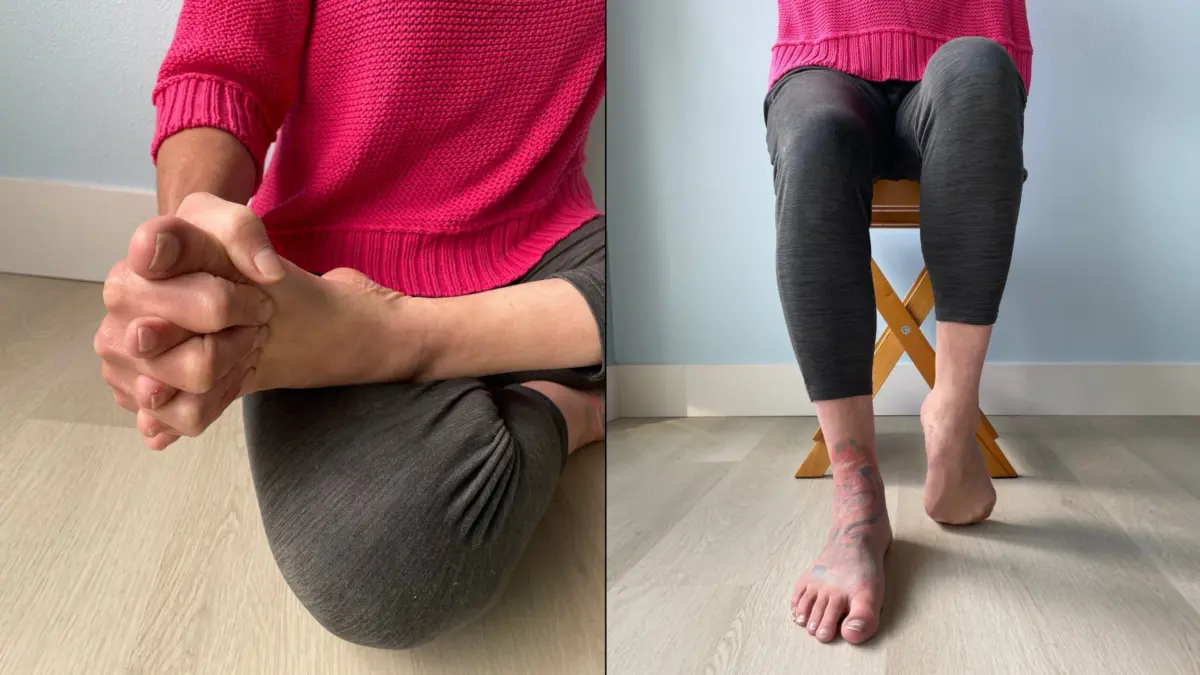
- Foot Openings and Toe Stretches: Rest one ankle across your opposite knee. Use your thumbs to massage the sole of your foot from heel to toe, paying special attention to tender spots in the arch. Next, gently pull and stretch each toe forward, backward, and side-to-side, opening the webbing between them.
- The Interlocking Circle: Thread your fingers snugly between your toes so that the webbing of your fingers meets the webbing of your toes. Use your other hand to stabilize your ankle. Draw slow circles with your toes in one direction, then reverse. Move your hand up to stabilize just above the ankle joint and draw larger, more expansive circles with the entire ankle. "You’re creating space and strength at the same time," notes Hubbard.
- The Circulation Tap: Gently pull your fingers out from between your toes and use the flat of your hand to slap the bottom of your foot. While unconventional, Hubbard notes that this simple action instantly drives fresh blood to the sole of the foot. Shake the ankle out afterward and notice the immediate difference in sensation and color between the treated foot and the untreated side.
- Floor Roll-Outs and Towel Pick-Ups: If you are on a flat surface or using a foam pad in camp, place the tops of your toes on the ground to stretch the front of the ankle. Roll your ankle outward from the big toe to the pinky toe. Next, place your soles flat on the floor, lifting and spreading your toes before gripping the ground as if picking up a towel, engaging your arches.
- Standing Ankle Circles: Stand up, placing your hands on your support surface while keeping your core engaged and knees slightly soft. Rise onto the balls of your feet and roll your ankles outward toward your little toes, lowering your heels and rolling inward to complete the circle. Reverse directions until your lower legs feel fully rejuvenated.
By shifting our focus from brute strength to holistic body awareness, practices like Gyrotonic and Gyrokinesis offer a sustainable pathway toward lifelong outdoor adventure. Listen to your body, embrace small and intentional movements, and let your next trail experience be your most fluid yet.
