

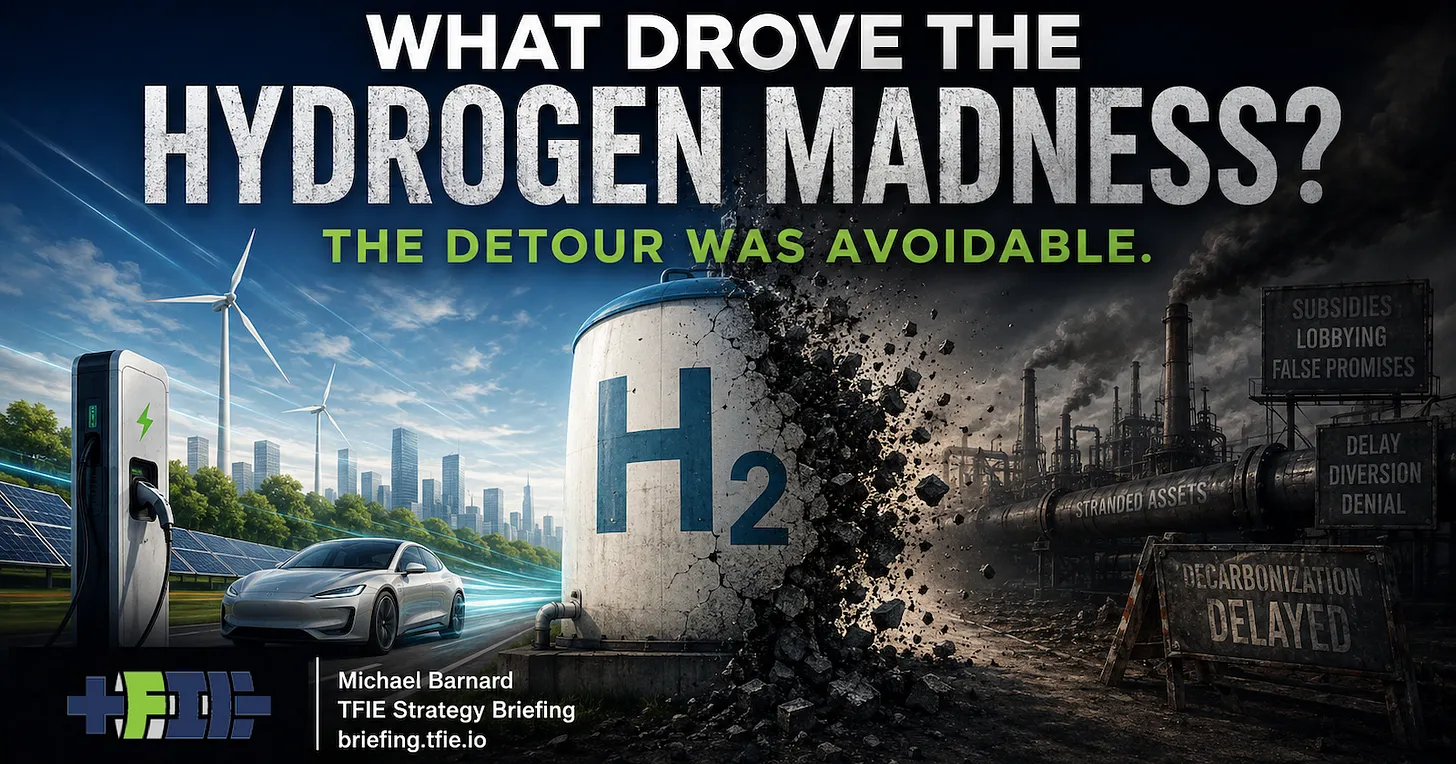
In 2023, a senior executive tasked with steering a major transportation company toward true decarbonization posed a question born of sheer exasperation: What was driving the “madness on hydrogen”?
Proposals for hydrogen-powered applications kept crossing their desk, many of them destined for sectors where the fundamental energy balance and economic realities looked thoroughly dreadful. That singular conversation birthed an essay titled What Drives This Madness On Hydrogen?, an early attempt to decode why industry-wide enthusiasm for the gas persisted despite growing, highly visible red flags.
Three years later, however, the calculus requires a fundamental shift. While psychological factors like confirmation bias, familiarity, and loss aversion certainly played their part, they were misallocated in the causal chain. The more probing question is not why individuals succumbed to wishful thinking, but rather how corporations, governments, and legacy institutions manufactured such powerful incentives to keep hydrogen politically and economically viable. How did this molecule maintain momentum long after the underlying economics and thermodynamic realities had fallen apart?
Main Facts: The Persistent Mirage of the Hydrogen Economy
To understand the modern hydrogen debate, one must separate the laws of physics from corporate aspirations. The thermodynamic constraints of a hydrogen economy have never been obscure. A landmark 2003 thermodynamic critique mapped out the vast amount of electricity required to produce, compress, transport, store, and eventually combust or convert hydrogen back into usable energy. The study demonstrated conclusively that hydrogen is intrinsically far more energy-intensive than direct electrification.
That basic thermodynamic disadvantage has never gone away. While green hydrogen can technically be generated using renewable electricity, doing so does not magically make it cheap enough to compete broadly with direct power-to-wheel or power-to-heat applications.
The economic realities mirror the physics. Electrolysis demands extremely cheap electricity to be viable, yet an expensive industrial plant simultaneously requires high utilization rates to pay off its capital costs. Herein lies a fundamental paradox: the cheapest hours of wind and solar power are inherently intermittent. If an electrolyzer runs exclusively during those cheap hours, the plant sits idle for much of the year. If operators attempt to raise utilization by drawing power from the grid during peak periods, the cost of electricity skyrockets due to overbuilding, transmission fees, and energy storage demands—a dynamic often described as the "economic seesaw of green hydrogen."
Furthermore, industry discussions frequently conflate the electrolyzer stack with the entire facility. A functioning green hydrogen plant also requires transformers, rectifiers, advanced water treatment, cooling towers, purification systems, high-pressure compressors, specialized piping, complex controls, safety infrastructure, and significant grid interconnections. By 2025, real-world project costs were vastly outrunning major institutional forecasts, proving that the gap between paper projections and physical deployment was widening.
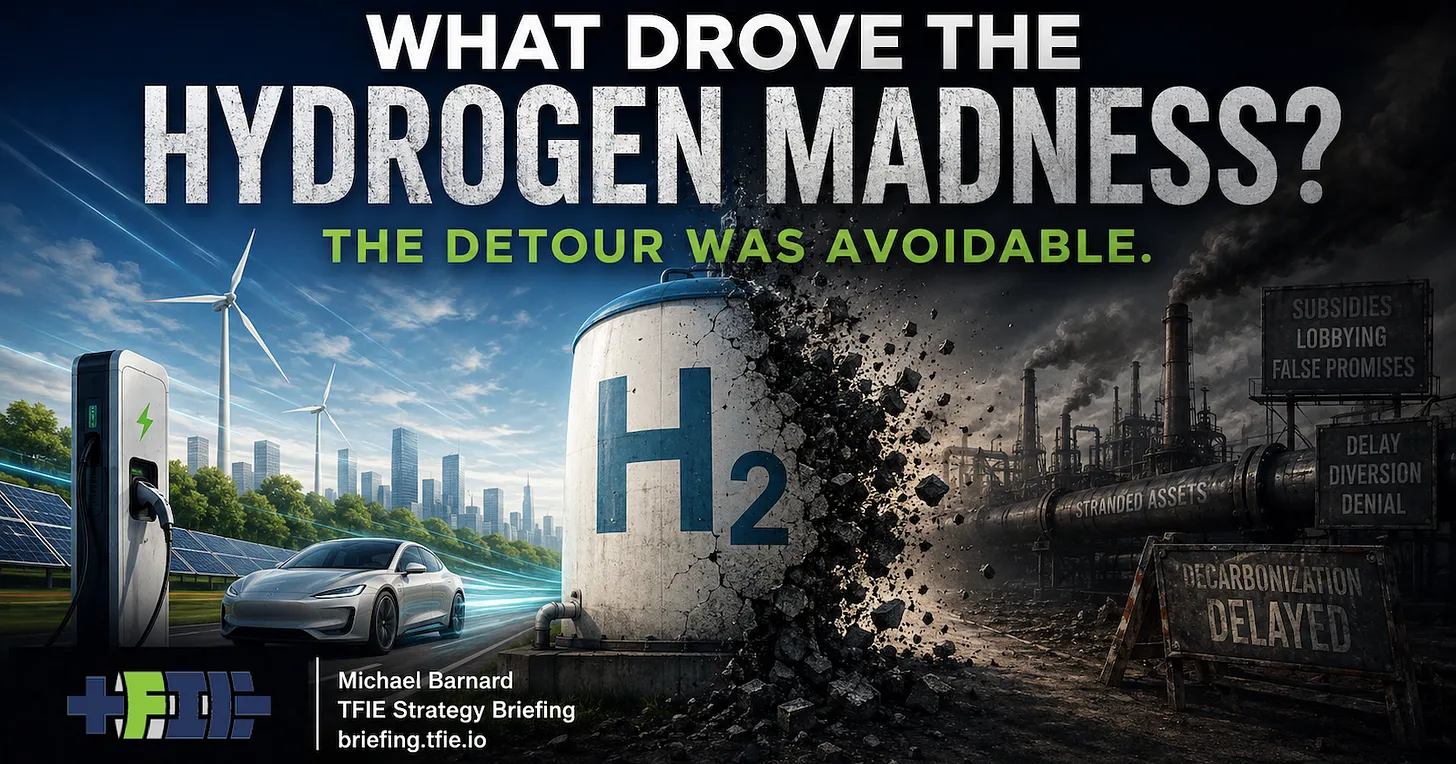
Chronology of a Misdirected Pathway
- 2003: Early thermodynamic critiques emerge, warning that the multi-step energy losses of producing, compressing, and storing hydrogen make it an inefficient energy carrier compared to direct electrification.
- May 2022: Analysts highlight the "economic seesaw" of green hydrogen, pointing out the inherent trade-offs between low-cost intermittent renewables and the high asset utilization required by expensive industrial plants.
- May 2023: Growing frustration over misplaced hydrogen proposals prompts public discourse regarding the "madness" of applying hydrogen to unviable sectors, such as passenger vehicles and residential space heating.
- 2024: Institutional audits, such as a scathing review by the European Court of Auditors, reveal that major government hydrogen targets were established without robust underlying economic analyses, even as they directed billions of euros in public subsidies.
- 2025: Observed real-world project costs drastically outpace initial institutional forecasts, signaling severe capital misallocation across global clean energy portfolios.
- 2026: Retrospective analyses reframe the hydrogen boom not as collective technical ignorance, but as a calculated effort by legacy industries to preserve existing assets, infrastructure, and institutional relevance.
Supporting Data and Structural Realities
If the technical and economic constraints were visible years in advance, the persistence of hydrogen enthusiasm demands an explanation that goes beyond mere technical illiteracy. The picture clears significantly when hydrogen is understood not merely as a clean energy carrier, but as a institutional life raft designed to preserve the value of legacy assets, technical skill sets, and regulatory frameworks.
Consider the position of legacy gas companies. They own vast reserves, expansive pipeline networks, processing plants, and subsurface geological expertise. In a world where heating, transportation, and industrial processes rapidly shift to direct electrification, the strategic value of these assets plummets. Hydrogen offered an alluring alternative future: natural gas could be converted into "blue hydrogen" paired with carbon capture; existing steel pipelines could continue moving molecules; and specialized engineering competencies could remain critical deep into the 2030s and 2040s. The decision-makers driving these strategies were far from ignorant of hydrogen economics—indeed, much of that engineering expertise resided directly within their own corporate walls.
Legacy automakers faced an identical structural dilemma. The rapid rise of battery-electric vehicles (BEVs) fundamentally shifts competitive advantages away from internal combustion engines, fuel injection systems, multi-speed transmissions, exhaust treatment technologies, and dedicated engine foundries. Instead, power flows toward battery cells, electric motors, power electronics, digital software, and high-voltage architectures.
Hydrogen combustion engines and e-fuels offered a lifeline—a future where a larger portion of the incumbent automotive supply chain and manufacturing footprint remained relevant. While protecting workers, suppliers, and entire industrial regions is a vital public policy goal, utilizing inefficient propulsion technologies merely to delay an inevitable industrial transition is an entirely different matter.
Official Responses and Institutional Lock-In
Governments ultimately stepped in to cement these industrial commitments, creating an entirely new layer of path dependency. Once political leaders established formal hydrogen targets, subsidy frameworks, regional manufacturing roadmaps, and infrastructure strategies, entire economic ecosystems rapidly organized around them.
A stark illustration of this dynamic is found in the European Court of Auditors’ review of EU hydrogen policy. The audit concluded that major regional targets had been set in the absence of sufficiently robust economic and market analysis. Yet, despite this lack of foundational rigor, those very targets had already successfully shaped billions of euros in corporate investment decisions and years of rigid industrial planning.
This is where the absence of what economists call "stopping rules" becomes critical. In a rational policy environment, failing metrics trigger a reassessment of the core strategy. In the hydrogen sector, however, every barrier spawned a supplementary subsidy:

- Expensive hydrogen production justified upstream production subsidies.
- A severe lack of end-use customers justified downstream demand support.
- Underutilized filling stations were used to justify the deployment of even more stations and specialized vehicles.
- Empty pipelines lacking committed throughput were defended as foundational infrastructure needed to jump-start the very production and demand required to fill them.
Each individual intervention could be defended in isolation as a necessary stepping stone. Meanwhile, the original, foundational question—should hydrogen be serving this application at all?—quietly vanished from the boardroom and legislative agenda.
Implications: Where Hydrogen Actually Belongs
None of this implies that hydrogen is useless. The molecule retains indispensable functions in the modern global economy. Existing large-scale production of ammonia for fertilizers, methanol synthesis, and chemical manufacturing must be decarbonized. Furthermore, certain green-iron production pathways in the steel sector may create legitimate new demand for clean hydrogen.
These are sectors where the chemical properties of the molecule are strictly required, allowing industries to absorb the unavoidable cost premium associated with low-carbon hydrogen production. Crucially, these applications never required hydrogen to morph into a general-purpose, economy-wide substitute for electrons in residential heating, light-duty road transportation, or routine short-term energy storage.
Ultimately, the multi-year hydrogen detour was driven less by collective cognitive delusion and more by rational organizational self-interest resulting in profoundly irrational energy policy. Cognitive biases certainly helped individuals defend positions they had already staked out, but the institutional commitments came first: reserves, pipelines, factories, supplier networks, public budgets, and career trajectories.
Recognizing this reality changes how we view the clean energy transition. The hydrogen boom was never an inexplicable madness; it was a masterclass in institutional self-preservation, compounded by regulatory bodies that repeatedly failed to force the fundamental question back onto the table when the physical and economic evidence turned decisively against it.
