

Main Facts: The Intersection of Cartomancy, Metaphysics, and Modern Esoteric Practice
In the ever-evolving landscape of modern esotericism and cartomancy, a novel technique has emerged that promises to bridge the gap between contemporary self-reflection and ancestral memory. Known as “Ancient Echoes,” this innovative divinatory framework utilizes a specialized Tarosophy “split-deck” methodology to investigate past lives and explore their direct bearing on present-day existence.
Developed within the broader philosophy of Tarosophy—an approach that treats tarot not merely as a fortune-telling novelty, but as a sophisticated system of wisdom, philosophy, and personal transformation—Ancient Echoes shifts the traditional paradigm of card reading. Rather than looking strictly forward into the future or examining isolated psychological states, this method coordinates the three distinct architectural pillars of a standard 78-card tarot deck: the Major Arcana, the Minor Arcana, and the Court Cards.
By systematically dividing the deck into these three categorical stacks, practitioners can isolate specific energetic frequencies. The Court Cards represent psychological archetypes and the nature of the soul across time; the Minor Arcana illustrate the day-to-day realities, environments, and experiential textures of a given lifetime; and the Major Arcana embody the overarching spiritual archetypes, soul contracts, and profound karmic lessons that bind human consciousness to the wheel of evolution.
At its core, Ancient Echoes operates on the premise that human identity is not a blank slate born in a vacuum, but rather a resonant frequency echoing down the corridors of time. Through a structured, multi-layered layout, the practitioner becomes both historian and psychic archaeologist, unearthing narrative threads from purported previous incarnations and laying them side-by-side with current psychological realities to foster deep healing, self-awareness, and karmic resolution.
Chronology: The Step-by-Step Methodology of Ancient Echoes
To fully understand the mechanics of Ancient Echoes, one must trace the sequential chronology of the layout ritual itself. This is not a casual three-card draw; it is a deliberate, methodical ritual of separation, shuffling, placement, and narrative synthesis.
Step 1: The Great Separation and Present-Time Anchoring
The process begins with a complete 78-card tarot deck. The practitioner must first sort the cards into three distinct, independent stacks:
- The Court Cards (Pages, Knights, Queens, Kings)
- The Major Arcana (The Fool through The World)
- The Minor Arcana (Ace through Ten of Wands, Cups, Swords, and Pentacles)
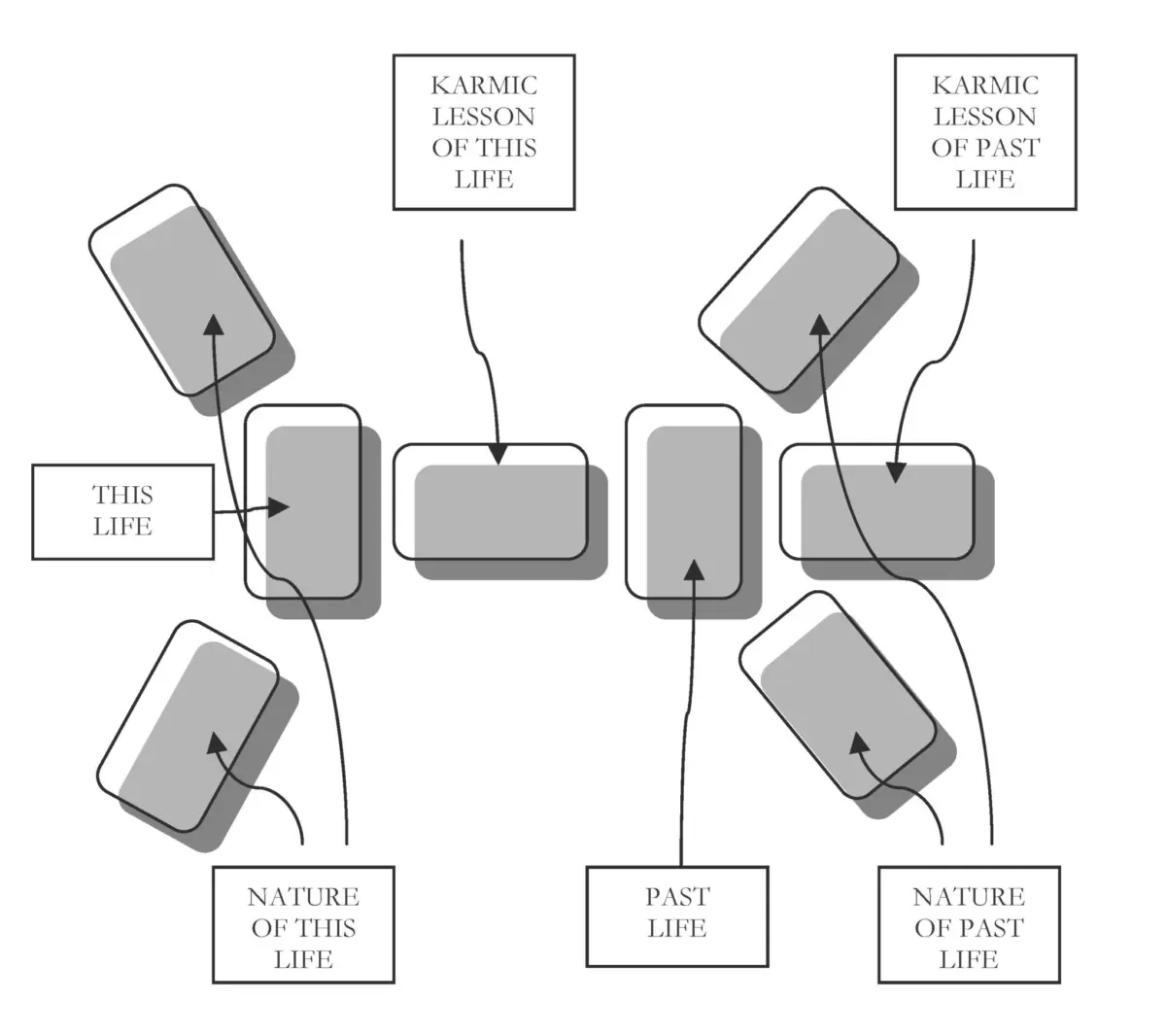
Once segregated, the practitioner takes the stack of Court Cards and shuffles them thoroughly. Drawing a single card from this shuffled stack, the reader places it directly in the centre of the reading table, declaring:
"This is the nature of my Soul in present-time."
This central card serves as the anchor, establishing the current psychological and spiritual temperament of the seeker in the here and now.
Step 2: Mapping the Current Incarnation
Next, the practitioner takes the stack of Minor Arcana cards, shuffles them with intention, and draws two cards. These two cards are placed symmetrically around the central Soul card. The reader affirms:
"This is the nature of my lifetime in this life."
This pairing illuminates the immediate environmental, emotional, and circumstantial conditions defining the seeker’s current incarnation, contextualizing how their present soul energy manifests in daily reality.
Step 3: Revealing the First Ancestral Echo
Returning to the Court Cards stack, the practitioner shuffles them once more while meditating upon the two Minor cards representing their current life. From this shuffled stack, a single card is drawn and placed to one side—whether top, bottom, left, or right—relative to the Minor cards. The reader states:
"This is an echo of my previous lifetime self."
This card personifies the persona, status, or psychological profile of the entity inhabiting the soul during a preceding historical incarnation.
Step 4: Identifying the Karmic Lesson
The focus then shifts to the Major Arcana stack. After a thorough shuffle, the practitioner selects a single card and places it directly between the present-time Court card and the previous-life Court card. The reader declares:
"This is the Karmic lesson I must learn in this lifetime."
This Major Arcana placement acts as the spiritual bridge, explaining why this particular past-life echo is bleeding into the present moment and what evolutionary milestone the soul is currently attempting to master.
Step 5: Illustrating the Past Life and Weaving the Narrative
To flesh out the historical context of the past life, the practitioner takes the Minor Arcana stack yet again, shuffles it while keeping the Karmic Lesson Major card in mind, and draws two new cards. These two cards are placed directly against the previous-life Court Card. The reader affirms:
"This was the nature of that previous life."
With this complete constellation of cards on the table, the practitioner enters the synthesis phase. By examining the interplay between the past-life Court card and its accompanying Minor arcana, the reader weaves a cohesive, chronological story of who that past self was, what environments they navigated, and what challenges they faced.
Step 6: Expanding into Infinite Echoes
The methodology does not stop at a single past life. Practitioners can continue this investigative journey outward. By laying out another Karmic Lesson Major Card connected to the previous life’s Court Card, and subsequently drawing new Minor cards to outline an even earlier lifetime, the process can be repeated recursively. This allows an intrepid seeker to trace their soul’s lineage backward through multiple historical layers, mapping out an entire genealogy of consciousness.
Supporting Data: Analytical Frameworks and Decodable Patterns
While cartomancy is frequently viewed through a purely intuitive or esoteric lens, Ancient Echoes incorporates structured data points that allow practitioners to analyze their spreads with a degree of analytical rigor. Within the Tarosophy tradition, spreads that utilize split decks function similarly to qualitative research matrices, where specific variables can be cross-referenced to yield deeper insights.
1. Gender and Archetypal Distribution in Court Cards
When examining the previous-life Court cards across multiple iterations of the spread, practitioners are encouraged to analyze the demographic and archetypal breakdown:
- Predominance of Male vs. Female Energies: By tracking whether past-life Court cards lean predominantly masculine (typically associated with active, outward-projecting energies such as Kings and Knights) or feminine (associated with receptive, internalizing energies such as Queens and Pages), readers can identify long-standing behavioral biases or evolutionary imbalances.
- Rank Progression: Observing whether past lives consistently feature subordinate ranks (Pages) versus authoritative ranks (Kings/Queens) can reveal patterns regarding societal power dynamics, authority issues, or self-actualization over centuries of soul development.
2. Suit Analysis and Occupational Indicators
The Minor Arcana cards attached to each previous lifetime serve as dense datasets regarding the socioeconomic and occupational conditions of the past self:
- Pentacles (Earth): Frequently denote lifetimes rooted in agriculture, trade, craftsmanship, financial struggle, or land ownership.
- Swords (Air): Often point toward lives defined by intellectual pursuits, legal battles, military conflict, scientific innovation, or verbal strife.
- Cups (Water): Generally indicate vocations or emotional landscapes centered around artistic expression, healing, spiritual devotion, interpersonal relationships, or deep emotional trials.
- Wands (Fire): Typically highlight lives driven by entrepreneurship, exploration, leadership, athletic prowess, or volatile creative output.
3. The Karmic Progression Line
By physically aligning the Major Arcana Karmic Lesson cards in a linear chronological row as the practice expands backward through multiple lifetimes, readers can perform a meta-analysis of their spiritual evolution. Practitioners look for visual and numerical progressions within the Major Arcana—such as moving from the foundational lessons of The Emperor (structure and authority) to the transcendent realizations of The World (completion and integration). Recognizing these patterns allows the seeker to chart a trajectory of spiritual maturation that spans epochs.
Official Responses: Perspectives from Esoteric Scholars and Tarosophists
The introduction of the Ancient Echoes method has sparked considerable discussion within global tarot and esoteric communities. Prominent practitioners and theorists have weighed in on its utility, philosophical underpinnings, and psychological safety.
Marcus Katz, co-founder of Tarosophy and a leading voice in modern card interpretation, emphasizes that methods like Ancient Echoes are designed to bypass the conscious ego’s defensive mechanisms.
"When we ask people about their current blockages, the ego immediately builds a wall of rationalizations," Katz notes. "By projecting the inquiry into the framework of ‘past lives’ and utilizing a split-deck architecture, we disarm the critical mind. Whether one literally believes in reincarnation or views past-life readings as deep psychological metaphor, the narrative mechanics of the cards force the subconscious to confront unresolved traumas and triumph structures it would otherwise ignore."
Psychological cartomancers have also praised the technique for its structural elegance. Unlike chaotic, multi-card spreads that can lead to cognitive overload, the Ancient Echoes method compartmentalizes psychic data. By separating the deck into structural tiers, the reader is prevented from mixing up the identity of the soul (Court cards), the mechanics of daily life (Minor cards), and the overarching spiritual imperatives (Major cards).
However, traditionalists within certain orthodox cartomancy circles have offered cautious critiques, warning that novice readers might lean too heavily into fatalistic interpretations of past lives. In response to these concerns, advanced Tarosophy instructors have stressed that Ancient Echoes is fundamentally empowering; the inclusion of the present-time Soul card ensures that the ultimate locus of power remains firmly rooted in the present moment, framing past-life exploration not as a prison of destiny, but as a toolkit for present liberation.
Implications: Psychological Integration, Therapeutic Value, and Modern Relevance
The rise of methods like Ancient Echoes reflects a broader cultural shift in how individuals approach mental health, self-discovery, and existential meaning. In an era marked by rapid technological advancement and societal fragmentation, many people experience a profound sense of rootlessness. Techniques that offer a deep, historical, and mythic context for personal suffering and triumph provide a powerful psychological anchor.
1. Mythotherapy and Narrative Re-authoring
From a psychological standpoint, Ancient Echoes functions as a sophisticated form of mythotherapy. Human beings are storytelling creatures, and our mental well-being is largely dependent on the coherence of our personal narrative. When an individual weaves a story out of the past-life Court and Minor cards, they are essentially engaging in narrative re-authoring. Unresolved anxieties, phobias, or relational patterns in the present can be projected onto a historical or mythical past-life persona, safely examined, and metaphorically resolved. This externalization process allows individuals to forgive themselves and integrate disowned parts of their psyche.
2. Transgenerational and Karmic Healing
While traditional psychotherapy focuses primarily on childhood development and genetic inheritance, esoteric modalities like Ancient Echoes expand the healing window to include transgenerational and metaphysical dimensions. By identifying recurring Karmic Lessons across multiple stacked lifetimes, seekers can pinpoint cyclical behaviors—such as self-sabotage, martyrdom, or an avoidance of power—that appear to transcend biological lineage. Recognizing these cycles is the first step toward breaking them, empowering the individual to alter their future trajectory.
3. The Secular vs. Esoteric Bridge
Crucially, the success and adaptability of the Ancient Echoes framework highlight the blurring lines between secular self-help and esoteric practice. One does not need to subscribe to dogmatic metaphysical beliefs regarding reincarnation to extract immense value from the exercise. A skeptic can approach the spread as a Jungian projection tool, using the archetypes of the tarot to dialogue with the unconscious mind, while a spiritual practitioner can engage with it as genuine metaphysical exploration. Both approaches yield the same practical result: heightened self-awareness, emotional catharsis, and a renewed sense of personal agency.
As modern seekers continue to search for innovative ways to navigate the complexities of human consciousness, methodologies like Ancient Echoes demonstrate that ancient wisdom systems, when creatively re-engineered, remain profoundly relevant tools for navigating the modern soul.
