

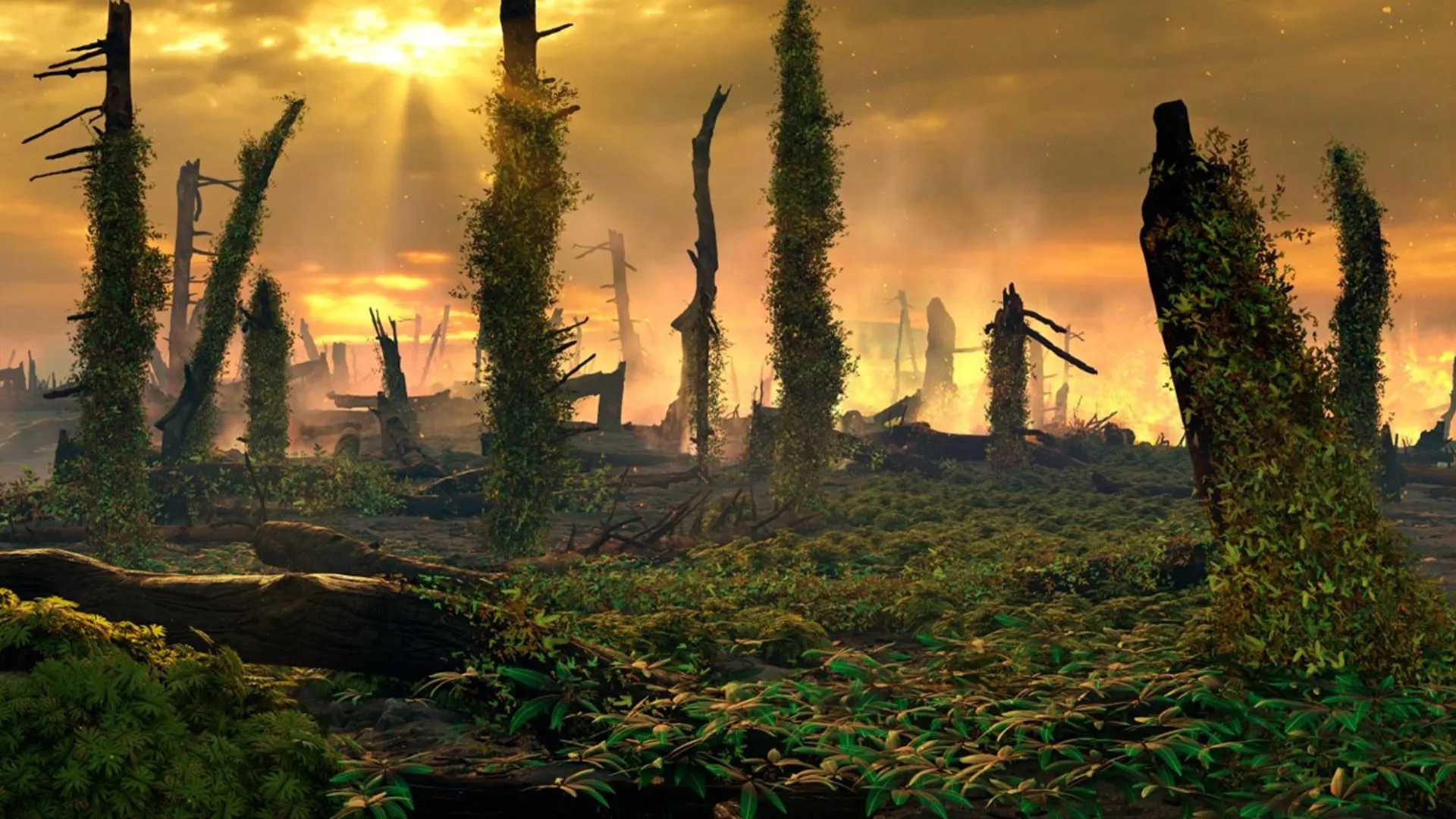
LONDON & UTRECHT — Approximately 201 million years ago, Earth underwent one of the most violent and catastrophic shifts in its biological history. The end-Triassic mass extinction wiped out a staggering proportion of marine and terrestrial species, a planetary trauma historically tied to massive volcanic activity. As the supercontinent Pangea began to rupture, colossal fissure eruptions flooded the atmosphere with staggering quantities of carbon dioxide ($CO_2$), driving global temperatures upward by an estimated 5 to 10 degrees Celsius.
Now, groundbreaking research published on July 21, 2026, in the journal Nature Geoscience reveals a terrifying new dimension to this ancient climate catastrophe. According to an international team of geologists led by Utrecht University, the hothouse world that followed the collapse of prehistoric forests was trapped in a destructive feedback loop. Opportunistic ferns—acting as a "disaster species"—not only dominated the devastated landscapes of what is now Northwest Europe, but they also supplied the volatile fuel that drove centuries of rampant, repetitive wildfires.
Main Facts: Unraveling the Triassic "Dark Zone"
The new study paints a grim picture of a world locked in a fiery stranglehold. As global temperatures soared and forests collapsed under extreme heat and environmental stress, complex ecosystems gave way to broad, savannah-like environments dominated entirely by ferns.
While scientists have long known that ecological disruption characterized the end-Triassic, the sheer scale, intensity, and persistence of the subsequent wildfire regime had remained difficult to quantify. To solve this, the research team utilized an innovative technique alongside traditional geological metrics: the Palynomorph Darkness Index (PDI).
By analyzing organic microfossils—specifically fossilized pollen and spores—the scientists discovered a strange color anomaly. Typically, organic matter darkens gradually over millions of years as deep-earth burial subjects it to escalating temperatures and pressure. Deeper sediments naturally yield darker fossils. However, across four independent drill cores spanning different geological basins in the United Kingdom and Europe, researchers found that the oldest and deepest fossils remained lightly colored, while those corresponding precisely to the extinction interval turned an intense, uniform dark brown.
This unusual "Dark Zone" spanned 15,000 individual measurements of pollen and spores, aligning perfectly with spikes in fossil charcoal and polycyclic aromatic hydrocarbons (PAHs)—chemical compounds generated by burning organic matter. The data revealed that the extinction interval was not merely a period of heat and barrenness, but an era of ceaseless, raging infernos.
Chronology: The Timeline of a Planetary Crisis
To understand how the end-Triassic world devolved into a scorched wilderness, geologists trace a sequence of events spanning hundreds of thousands of years:
- Phase 1: The Volcanic Catalyst (approx. 201 Million Years Ago)
The Central Atlantic Magmatic Province (CAMP) begins massive, protracted volcanic eruptions. Vast plumes of $CO_2$ overwhelm the global carbon cycle, triggering intense greenhouse warming and dramatic climate instability. - Phase 2: Forest Collapse and the Rise of the "Disaster Species"
As temperatures spike by up to 10 degrees Celsius, accompanied by severe soil erosion and ecosystem stress, complex forest canopies collapse. Ferns quickly emerge as resilient pioneer plants, rapidly colonizing denuded soils across Northwest Europe. - Phase 3: The Fiery Feedback Loop
The sprawling fern fields dry out seasonally, creating dense carpets of highly flammable biomass. The ignition of these vast fuel sources triggers massive, recurring wildfires. When the fires recede, the ferns regenerate rapidly from subsurface root systems, outcompeting struggling arboreal species and repeating the cycle. - Phase 4: Persistence and Recovery
This destructive feedback loop of warming, burning, and rapid fern recovery persists for an estimated 40,000 to as long as 300,000 years, effectively locking the biosphere in a state of arrested ecological succession before slow planetary recovery finally takes hold.
Supporting Data: Overcoming Limitations in Deep-Time Research
Reconstructing ancient wildfire activity is notoriously challenging. Traditionally, paleoclimatologists rely heavily on macro-charcoal fragments and PAHs preserved in sedimentary layers. However, both indicators possess significant methodological blind spots. Large pieces of charcoal can easily fragment into countless smaller particles during transport and fossilization, artificially inflating estimations of fire severity. Similarly, PAHs can travel immense distances via atmospheric winds, sometimes detaching the chemical signature from its local source.
To bypass these limitations, the Utrecht-led team developed the Palynomorph Darkness Index.
[Deep Core Sediments Extracted]
       │
       ▼
[Microscopic Imaging via Light Microscope & Camera]
       │
       ▼
[RGB Color Spectrum Converted to Average Grayscale Value]
       │
       ▼
[Palynomorph Darkness Index (PDI) Quantified]
       │
       ▼
[Correlation: "Dark Zone" Matches Extinction & Fern Spike]
By leveraging the RGB spectrum through a camera connected to a light microscope, researchers translated the color saturation of fossilized pollen and spores into precise grayscale values. This low-cost, highly repeatable technique allowed scientists to cross-examine samples across four distinct geological basins with disparate burial histories.
When plant groups were isolated—comparing tree pollen directly against fern spores—the darkening effect was universal. Every category of spore and pollen showed the exact same degree of thermal alteration during the extinction horizon. When mapped against independently gathered charcoal and PAH curves, the data solidified: the darkening was an indisputable proxy for an extended epoch of catastrophic wildfires.
Official Responses and Expert Insights
Dr. Bas van de Schootbrugge, a senior author of the study from Utrecht University, emphasized the sheer perplexity the team initially felt when confronting the data.
"We were quite puzzled by this phenomenon as it occurs in all 4 cores at exactly the same time, so it could not have been related to burial of the sediments as the four basins experienced very different geological histories," Van de Schootbrugge noted.
Reflecting on the adaptive biology of the plants that drove the crisis, Van de Schootbrugge described them as resilient survivors of deep time: "Ferns are truly remarkable plants that have withstood many crises throughout Earth history, and some species can adapt to some of the most extreme environments. They can be considered to be true disaster species."
Detailing the mechanics of the disaster, Van de Schootbrugge explained how these botanical survivors inadvertently engineered their own widespread persistence: "When the ferns dry out, the thick mats act as the ideal fuel to trigger massive wildfires. Ferns responded to and delivered the fuel that fanned the flames, triggering repeated massive wildfires. A truly hellish world."
The study’s authors stress that the ecological dynamics observed in the drill cores offer a sobering testament to how complex earth systems can cascade into prolonged ecological crises when pushed past critical thresholds.
Implications: Lessons from the Deep Past for a Modern World
While the end-Triassic extinction unfolded 201 million years ago, the mechanics of the disaster hold profound, cautionary implications for the modern Earth.
The research highlights how anthropogenic climate change, deforestation, and the destabilization of native ecosystems can inadvertently clear the path for opportunistic, resilient "disaster species." When ecosystems are fragmented and heated beyond their capacity to adapt, the resulting environmental vacuum is frequently filled not by a diverse array of balanced organisms, but by hardy generalists capable of thriving in degraded conditions.
In the case of the Triassic, these generalists did not merely survive the crisis; they actively exacerbated it. By carpeting the landscape and drying out into vast, continuous sheets of combustible organic matter, ferns transformed the planet’s surface into a tinderbox. Each successive wave of fire cleared away competing flora, ensuring that the ferns could claim even wider territories in an endless, compounding loop.
"The lesson we can learn from this," Van de Schootbrugge concludes, "is that the combination of climate change, deforestation, and the spread of opportunistic species can provide all the ingredients for a perfect storm." As modern society navigates accelerating rates of global heating and widespread habitat destruction, the ghostly, darkened spores of the Triassic serve as an ancient warning: when the delicate balance of planetary life is broken, the recovery can be as fiery as it is long.
