

OXFORD, UK — In a groundbreaking discovery that upends decades of planetary science orthodoxy, researchers at the University of Oxford have uncovered compelling evidence that Mars once harbored colossal, Earth-like magmatic systems deep within its crust. Published in the prestigious journal Nature Astronomy, the findings reveal that the Red Planet managed to orchestrate complex geological recycling processes long thought to be exclusive to worlds possessing active plate tectonics.
This revelation not only forces a profound reevaluation of Martian geological history, but it also broadens the theoretical horizons for astrobiologists and planetary scientists searching for habitable worlds beyond our solar system. By demonstrating that sophisticated crustal evolution can occur on a "stagnant lid" planet devoid of moving tectonic plates, the study suggests that the fundamental ingredients for planetary habitability may be far more common in the cosmos than previously dared to imagine.
Main Facts: Rewriting the Geological Blueprint of Mars
For generations, comparative planetology has relied on a neat dichotomy to classify rocky worlds. On one side stood Earth: a dynamic, mobile planet whose crust is fractured into shifting tectonic plates that collide, subduct, and slide past one another. This relentless tectonic choreography drives terrestrial volcanism, continuously recycles crustal material, and acts as the geological engine behind continent building and long-term climate regulation.
On the other side stood worlds like Mars, categorized as "stagnant lid" planets. Because Mars possesses a single, unbroken outer shell that does not engage in global plate tectonics, scientists naturally assumed its internal evolution was comparatively pedestrian. Conventional wisdom held that Martian volcanism was simple and localized, yielding a uniform crust formed through straightforward, unrefined cooling processes.
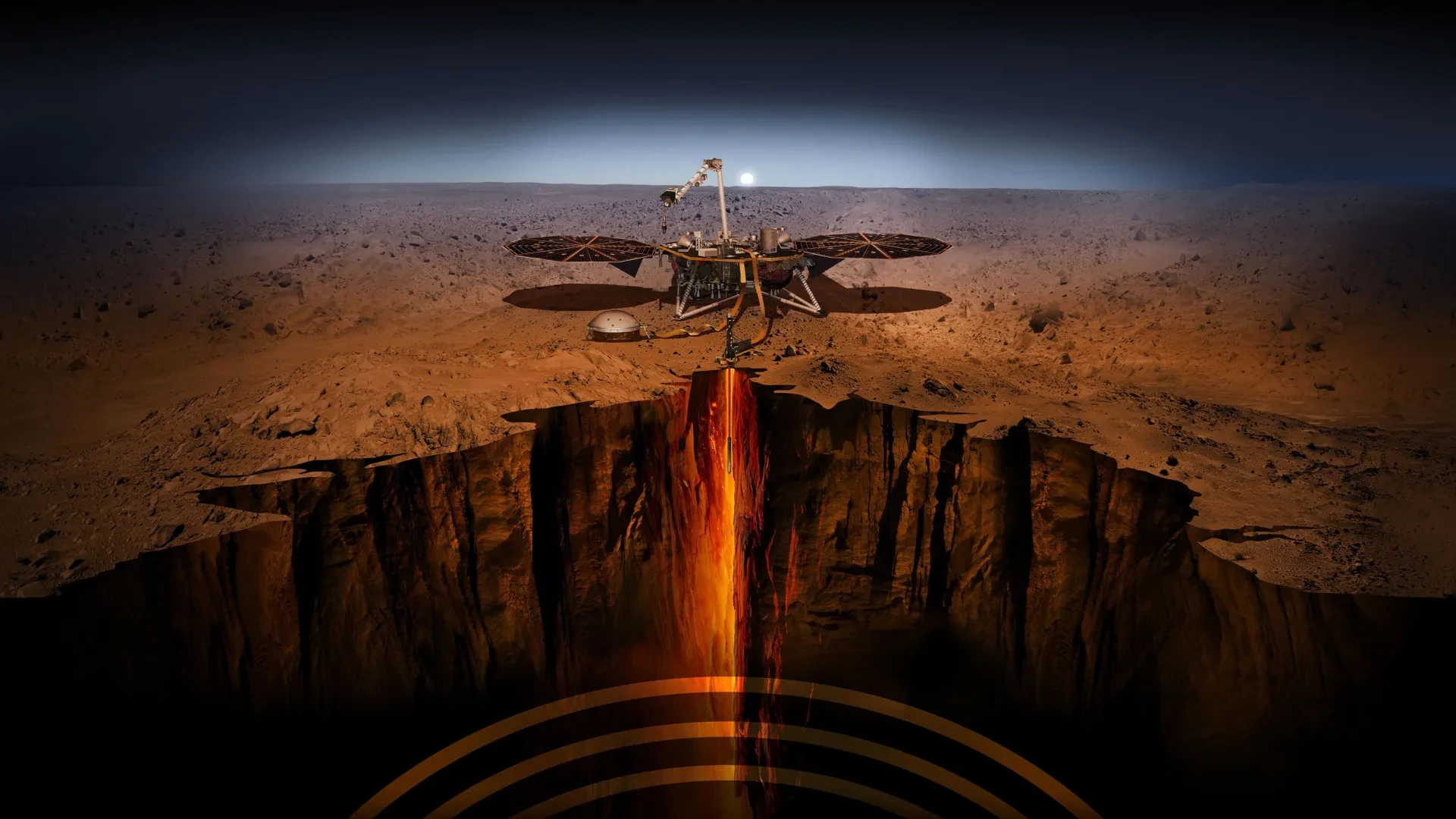
The new Oxford-led study shatters this paradigm. Analyzing deep seismic data captured by NASA’s retired InSight lander, the research team detected a mysterious, planet-wide compositional boundary located roughly 24 kilometers beneath the Martian surface. By matching this seismic signature with sophisticated thermodynamic and statistical rock-composition models, the researchers identified a dramatic shift in material:
- Above the 24-Kilometer Boundary: The seismic properties correspond to "mafic" rocks, which contain a relatively high proportion of silica.
- Below the 24-Kilometer Boundary: The seismic data reveals an "ultramafic" layer, characterized by heavy concentrations of iron and magnesium, coupled with low silica content.
According to the research team, this stratified layout is the smoking gun of massive, ancient magmatic processing. Molten rock pooled deep underground, undergoing fractional crystallization where dense, iron-rich crystals settled toward the bottom of the crust while lighter, chemically evolved melts floated upward. This phenomenon—known as "transcrustal magmatism"—was previously believed to require the convective churning powered exclusively by Earth-style plate tectonics. Instead, Mars achieved a remarkably sophisticated internal kitchen sink chemistry entirely on its own.
Chronology: How the Discovery Unfolded
To understand how researchers managed to peer nearly a quarter of a kilometer—and deeper—into the hidden interior of an alien world, it is necessary to retrace the timeline of a multi-year scientific endeavor combining space exploration, seismology, and advanced statistical modeling.
Phase 1: The InSight Mission and the Acoustic Window (2018–2022)
The foundation for this discovery was laid when NASA’s InSight (Interior Exploration using Seismic Investigations, Geodesy and Heat Transport) lander touched down on Elysium Planitia in November 2018. Equipped with an ultra-sensitive seismometer (SEIS), InSight spent four Earth years listening to the heartbeat of Mars. It recorded hundreds of marsquakes—tectonic tremors generated by the planet slowly cooling and shrinking—as well as seismic waves echoing from high-velocity meteoroid impacts.
As these seismic waves traveled through the Martian crust, they bounced off, refracted through, and were altered by subterranean density and compositional boundaries. Although earlier analyses of InSight data hinted at a mysterious discontinuity roughly 24 kilometers down, its true geological significance remained an enigma.
Phase 2: Assembling the Interdisciplinary Team (2022–2023)
Recognizing the untapped potential hidden within the seismic records, researchers from the University of Oxford’s Department of Earth Sciences joined forces with colleagues from the Department of Statistics. This interdisciplinary approach was vital. Seismic data alone provides arrival times and velocities of waves, but translating those physical measurements into actual rock mineralogies requires parsing hundreds of complex variables.
Phase 3: Thermodynamic Modeling and Statistical Matching (2023–2024)
The research team ran hundreds of thermodynamic simulations to model how various rock compositions would behave under the extreme temperatures and pressures found at different depths within the Martian crust. They coupled these models with advanced statistical frameworks to test which synthetic rock profiles matched InSight’s real-world seismic waveforms.
The convergence of statistics and petrology yielded a definitive answer: the seismic boundary at 24 kilometers marked a sharp transition between silica-rich mafic crust and iron-magnesium-rich ultramafic cumulates. The scale of the discovery soon became apparent—this was not a localized anomaly, but a vast, hemisphere-spanning layer underlying much of Mars’ northern lowlands.
Phase 4: Publication and Peer Review (Late 2024)
Having finalized their calculations and confirmed the robustness of their models, the team prepared their manuscript. Following rigorous peer review, the findings were officially published in Nature Astronomy, marking a milestone in our understanding of planetary evolution.
Supporting Data and Geophysical Evidence
The conclusions drawn by the Oxford team rest on a bedrock of rigorous quantitative analysis and seismic geophysics. The sheer scale of the magmatic structures uncovered by the InSight data challenges prior estimates of Martian thermal and chemical evolution.
- Scale of the Layer: The buried ultramafic layer is not a pocket-sized intrusion; projections indicate it extends across hundreds, potentially thousands, of kilometers, particularly dominating the northern hemisphere of the planet.
- Compositional Contrast: The sharp contrast between the upper mafic crust (richer in silica) and the lower ultramafic layer (richer in iron and magnesium) mirrors the deep-crustal fractionation seen beneath active continental arcs on Earth, such as the Andes or the Cascades.
- The InSight Dataset: Utilizing high-frequency and low-frequency marsquake data, the team was able to constrain shear wave ($S$-wave) and compressional wave ($P$-wave) velocities with unprecedented precision, ruling out alternative explanations such as simple porosity or localized impact melt sheets.
Lead author Dr. Tobermory Mackay-Champion, who conducted the research while at Oxford’s Department of Earth Sciences and has since moved to the University of Bristol, emphasized the quantitative shift in perspective required by these data points.
"We’ve traditionally assumed that volcanism on Mars was relatively simple compared to that on Earth," Dr. Mackay-Champion noted. "Simple doesn’t cut it anymore. The data forces us to acknowledge that Mars could sustain large, long-lived systems where molten rock evolved and reprocessed itself throughout the entire crust."
Official Responses and Expert Commentary
The astronomical and geological communities have greeted the Nature Astronomy paper with a mixture of surprise and profound enthusiasm, as it fundamentally bridges a gap in comparative planetology.
Professor Jon Wade, a co-author of the study from the University of Oxford’s Department of Earth Sciences, highlighted the philosophical and scientific weight of the findings regarding planetary uniqueness.
"One of the big questions in planetary science is whether Earth is unique," Professor Wade stated. "If Mars could develop this kind of complex crust without plate tectonics, then maybe the conditions needed for habitability can emerge on more planets than we realized—including those previously dismissed based on size or their apparent lack of tectonic activity."
Independent planetary geologists not involved in the study have similarly praised the clever fusion of InSight’s seismic legacy with terrestrial petrological modeling. By looking inward using seismic echoes rather than relying solely on surface imagery and orbital spectroscopy, scientists have unlocked a new dimension of Martian exploration.
Furthermore, the study underscores the enduring scientific legacy of NASA’s InSight mission. Though the lander officially ceased operations in December 2022 after dust accumulated on its solar panels, the seismic library it transmitted back to Earth continues to yield revolutionary insights into the deep interior of the Red Planet—proving that Mars still holds many secrets beneath its rust-colored dust.
Implications: Rethinking Planetary Habitable Zones
The most profound ripple effects of this discovery extend far beyond the borders of Mars, directly influencing our quest to find life elsewhere in the universe.
For decades, the search for habitable exoplanets has focused heavily on finding worlds that closely mimic Earth’s macro-geology—specifically, planets massive enough to sustain vigorous plate tectonics. Tectonic activity is prized by astrobiologists because it acts as a planetary thermostat, driving the carbon-silicate cycle, stabilizing surface temperatures over geological timescales, and cycling volatile elements like water, carbon, and nitrogen through the crust, mantle, and atmosphere.
Planets that lacked evidence of plate tectonics—often termed "stagnant lid" worlds—were frequently deprioritized in habitability models, written off as geologically "dead" or too chemically stagnant to support complex environmental chemistry.
The Oxford study challenges this conservative filter. If a stagnant-lid planet like Mars can internally generate massive, complex, transcrustal magmatic systems that reprocess and evolve its crust without plate tectonics, then complex geochemical evolution is clearly more versatile than previously assumed.
This opens up a wider demographic of exoplanets in the cosmic census. Worlds that are smaller, lack traditional tectonic activity, or were previously dismissed as too geologically simple may still possess the internal machinery required to drive atmospheric evolution, hydro-geochemical cycling, and—ultimately—the emergence of life.
As astronomers peer deeper into deep space with advanced instruments like the James Webb Space Telescope (JWST) and upcoming ground-based observatories, the definition of a "habitable world" is expanding. Mars, our rusty, quiet neighbor, has sent us a seismic message from 24 kilometers down: complexity does not require tectonics, and the universe may be far more hospitable than we ever dared to dream.
