

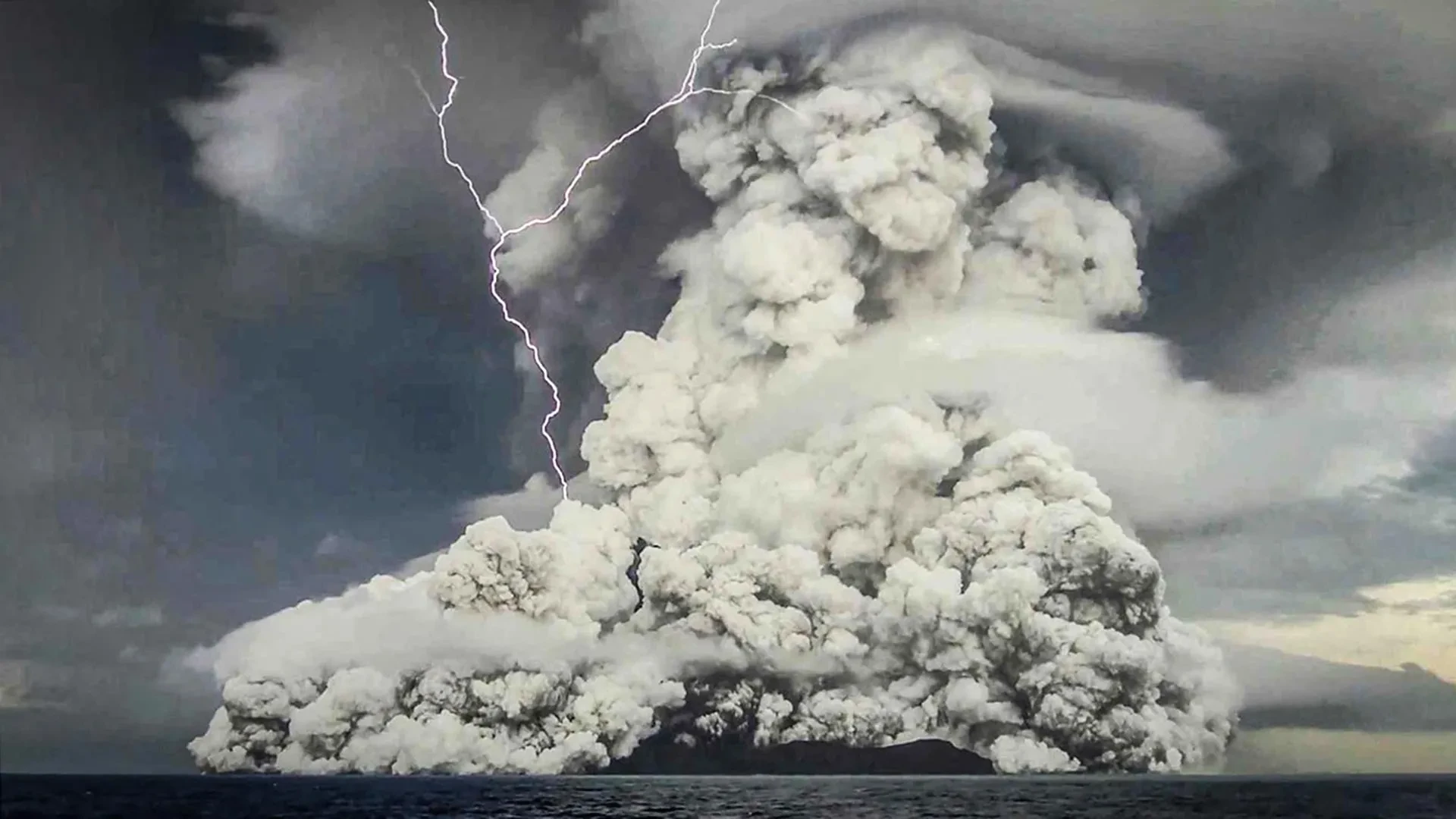
GLOBAL — When the Hunga Tonga-Hunga Ha’apai submarine volcano violently erupted beneath the South Pacific in January 2022, it sent shockwaves, tsunamis, and an unprecedented volume of water vapor around the globe. The cataclysm easily ranked among the most powerful volcanic events of the modern era, injecting vast amounts of material directly into the stratosphere.
Now, an international team of researchers has uncovered a fascinating, highly unexpected silver lining to the disaster: the colossal volcanic plume appears to have actively triggered the destruction of a significant portion of the very methane pollution the volcano itself emitted.
Published in the journal Nature Communications, the study reveals a previously unknown atmospheric chemistry mechanism involving volcanic ash, seawater, and sunlight. Beyond solving a scientific puzzle about a single eruption, the finding offers a potential blueprint for future climate interventions, shedding light on natural processes that could eventually help researchers slow near-term global warming.
Main Facts
The core discovery centers on a chemical fingerprint detected by satellites monitoring the Hunga Tonga-Hunga Ha’apai eruption cloud. As the massive plume drifted across the globe, instruments recorded exceptionally high levels of formaldehyde—a short-lived chemical byproduct generated when methane ($CH_4$) is broken down in the atmosphere.
- The Mechanism: Researchers attribute the methane destruction to a unique mixture of volcanic ash, sea salt (blasted upward from the ocean by the underwater explosion), and sunlight. When ultraviolet rays strike these airborne iron-salt aerosols, they release reactive chlorine atoms. These atoms act as chemical scissors, aggressively attacking and tearing apart surrounding methane molecules.
- The Scale: According to calculations in the study, the volcano initially belched roughly 300 gigagrams (Gg) of methane into the atmosphere—an amount roughly equivalent to the annual enteric emissions of more than two million cows. However, the continuous chemical reactions within the plume simultaneously scrubbed away approximately 900 megagrams (Mg) of methane daily for over a week.
- The Detection Tool: The breakthrough was made possible by the TROPOMI instrument aboard the European Space Agency’s Sentinel-5P satellite. By pushing the satellite’s capabilities far beyond its standard air-pollution monitoring parameters, scientists successfully tracked the formaldehyde signal across the globe all the way to South America for 10 days.
Chronology of the Discovery
The uncovering of this atmospheric phenomenon unfolded in several distinct phases, bridging past oceanographic research with cutting-edge satellite data analysis.
- January 2022: The Hunga Tonga-Hunga Ha’apai volcano erupts violently, injecting unprecedented amounts of water vapor, sulfur dioxide, volcanic ash, and oceanic salt into the stratosphere.
- Post-Eruption (Weeks 1–2): Satellites tracking the atmospheric fallout record anomalous chemical signatures within the drifting stratospheric plume. Unprecedented concentrations of formaldehyde are detected, initially puzzling atmospheric chemists given the extreme altitude and abnormal conditions.
- The Analytical Breakthrough: Dr. Maarten van Herpen and his colleagues analyze the TROPOMI satellite data. Because formaldehyde typically degrades within hours, tracking high concentrations continuously for 10 days confirms that an ongoing chemical reaction—rather than a one-time injection—is actively destroying methane inside the cloud.
- Connecting the Scientific Dots: Researchers realize the chemistry mirrors a discovery made just a year prior in 2023, where Saharan dust mixing with sea salt over the Atlantic Ocean generated reactive chlorine in the troposphere. However, confirming that this same mechanism could operate successfully in the dry, high-altitude stratosphere over a volcanic plume marks a entirely unprecedented scientific paradigm shift.
Supporting Data & Metrics
To understand the weight of these findings, scientists look closely at methane’s unique physical properties and its role in the global climate system.
- Potency vs. Lifespan: Methane accounts for roughly one-third of current global warming. While it is far less abundant in the atmosphere than carbon dioxide ($CO_2$), its heat-trapping efficiency is staggering. Over a 20-year timescale, methane is approximately 80 times more potent than $CO_2$. However, it breaks down naturally within roughly a decade, whereas carbon dioxide persists for centuries.
- The Methane Budget Equation: Global climate accounting relies on the "methane budget"—a ledger balancing sources (agriculture, wetlands, fossil fuels, and geological events) against atmospheric sinks (chemical breakdown). Because mineral and volcanic dust have historically been omitted from these calculations, researchers argue that global models must be adjusted to account for dust-driven methane destruction.
- Emission Parity: The volcano emitted 300 Gg of methane, matching the yearly output of two million cattle. Conversely, the daily removal rate within the plume (900 Mg/day) mirrors the exact daily output of that same massive livestock population, showcasing a striking balance of localized creation and destruction.
Official Responses and Expert Insights
The study’s authors and participating research institutions have emphasized both the fragility and the profound implications of their findings.
Dr. Maarten van Herpen of Acacia Impact Innovation BV, the study’s first author, highlighted the surprise element of the discovery:
"When we analyzed the satellite images, we were surprised to see a cloud with a record-high concentration of formaldehyde. We were able to track the cloud for 10 days… Because formaldehyde only exists for a few hours, this showed that the cloud must have been destroying methane continuously for more than a week. It is known that volcanoes emit methane during eruptions, but until now it was not known that volcanic ash is also capable of partially cleaning up this pollution."
Professor Matthew Johnson of the University of Copenhagen, who contributed to both the 2023 Saharan dust research and the new volcanic study, pointed out the stark differences in atmospheric layers:
"What is new—and completely surprising—is that the same mechanism appears to occur in a volcanic plume high up in the stratosphere, where the physical conditions are entirely different. We now know that atmospheric dust—for example from a volcanic eruption—impacts the methane budget… It is important that we correct the data on which these estimates are based."
Addressing the technical challenges of space-based observation, Dr. Isabelle De Smedt of the Royal Belgian Institute for Space Aeronomy explained:
"Retrieving formaldehyde from TROPOMI in a stratospheric volcanic plume is far outside the instrument’s standard operating conditions—we had to carefully correct the satellite’s sensitivity for the unusual altitude of the signal and account for interference from the high sulfur dioxide concentrations. Getting these corrections right was essential to confirm that what we were seeing was real."
Dr. Jos de Laat of the Royal Netherlands Meteorological Institute, the study’s senior author, emphasized how this discovery solves a major verification hurdle for atmospheric research:
"How do you prove that methane has been removed from the atmosphere? How do you know your method works? It’s very difficult. But here we address that problem by showing that methane breakdown can in fact be observed using satellites."
Implications for Climate Science and Future Technology
The revelation that nature can rapidly destroy atmospheric methane via aerosol-chlorine chemistry carries deep implications for both climate science and geoengineering research.
1. The "Emergency Brake" on Warming
Because methane has a relatively short atmospheric lifetime of about 10 years, cutting its concentrations yields rapid climate dividends. Rapidly lowering methane levels acts as an "emergency brake" on global warming, mitigating near-term temperature spikes and reducing the risk of crossing dangerous, irreversible climate tipping points. However, scientists uniformly stress that methane reduction is not a substitute for deep, permanent cuts in fossil-fuel carbon dioxide emissions.
2. A Blueprint for Methane Removal
For engineers and climate tech companies, the Hunga Tonga eruption serves as a dramatic, proof-of-concept natural laboratory. Atmospheric methane removal—deliberately accelerating the chemical destruction of existing methane—is an emerging frontier in climate intervention. By demonstrating that satellite systems like TROPOMI can successfully monitor and verify methane breakdown in real-time, the study offers a foundational framework for tracking whether engineered atmospheric interventions actually work.
3. Caution and Further Study
Despite the enticing prospect of copying nature, researchers urge extreme caution. Any attempt to artificially replicate volcanic chemistry or introduce aerosols into the atmosphere on a large scale requires rigorous study to model unintended ecological or climatic side effects.
As professor Matthew Johnson concluded:
"It’s an obvious idea for industry to try to replicate this natural phenomenon—but only if it can be proven to be safe and effective. Our satellite method could offer a way to help figure out how humans might slow global warming."
Ultimately, while the Hunga Tonga-Hunga Ha’apai eruption was a destructive natural disaster, it has left scientists with an invaluable window into atmospheric chemistry—and perhaps, the key tools needed to combat runaway global warming in the decades ahead.
