

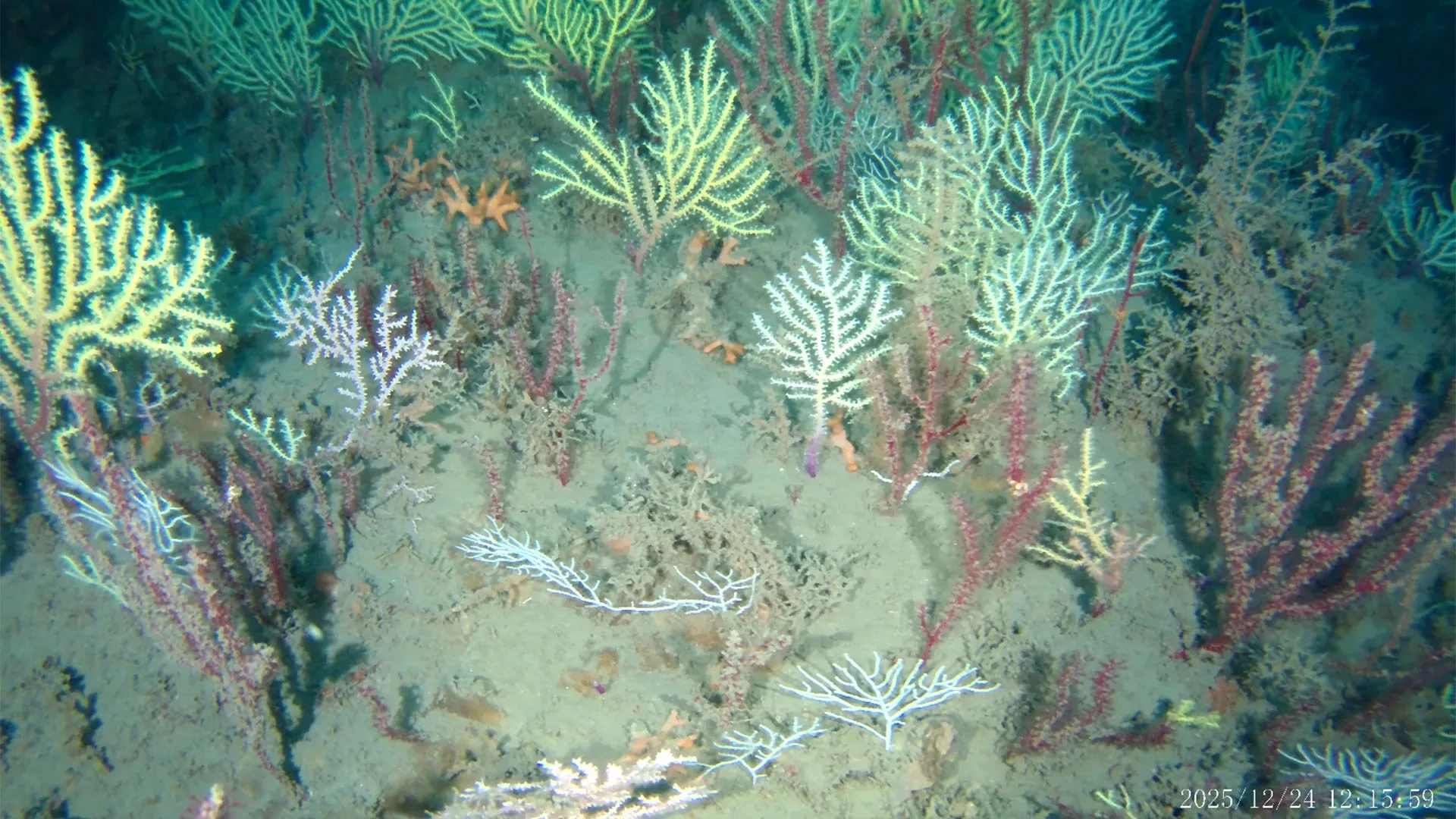
COTONOU, BENIN — In a stunning reversal of scientific expectations, marine researchers have discovered a vibrant, healthy coral reef off the coast of Benin that has been officially categorized as "dead" since the 1960s. The breakthrough discovery, detailed in the journal Frontiers in Marine Science, not only resurrects a lost chapter of West African marine history but also hints at a vast, uncharted network of hidden ecosystems lurking in the depths of the Gulf of Guinea.
Led by a determined team from the Institut de Recherches Halieutiques et Océanologiques du Bénin (IRHOB), scientists spent grueling weeks at sea battling technical malfunctions, high-stakes uncertainty, and the relentless elements. Their efforts were ultimately rewarded when advanced underwater imaging technology revealed a flourishing mesophotic coral ecosystem (MCE)—a deep-water habitat that thrives far below the sunlit zones of traditional coral reefs.
The finding has electrified the marine biology community, prompting scientists to reconsider the ecological health of West Africa’s coastal shelves and raising pressing questions about what else may be hidden in the under-explored depths of the Atlantic Ocean.
Main Facts: A Resurrected Ecosystem
The newly documented reef sits more than 50 meters below the surface of the Atlantic Ocean along the continental shelf of Benin. Far from being the barren, lifeless graveyard that mid-20th-century researchers concluded it was, the site is a bustling underwater oasis.
Using high-resolution sonar, underwater drones, and cutting-edge deep-sea camera systems, the research team identified:
- Eight distinct coral morphotypes, forming patchy, resilient colonies anchored to rocky outcroppings on the seabed rather than a single, continuous barrier.
- Eight diverse fish species utilizing the reef for critical habitat, feeding grounds, and shelter. The observed fauna includes golden African snappers, blackbar soldierfish, Guinean angelfish, West African goatfish, Monrovia doctorfish, three-banded butterflyfish, and two separate species of damselfish.
- A potential 40-kilometer stretch, corresponding to historical reports from the 1960s that hinted at a continuous reef system running parallel to the Beninese coastline—though current findings suggest it is composed of scattered, localized coral communities rather than a solid wall of reef.
To the scientific community’s knowledge, this is the first officially confirmed record of a living mesophotic coral ecosystem on the Gulf of Guinea continental shelf. Yet, researchers emphasize that the true significance of the discovery lies not in its uniqueness, but in what it implies about the scarcity of baseline data in West African waters.
Chronology: From 1960s Dismissal to Modern Rediscovery
The story of Benin’s lost reef spans more than six decades, marked by shifts in technology, shifting scientific paradigms, and a heavy dose of perseverance.
The 1960s: The First Surveys
During the 1960s, marine surveys were conducted off the coast of West Africa with a singular, pragmatic focus: mapping productive fishing grounds to support local economies. During these expeditions, researchers mapped the seafloor over 50 meters deep and encountered unusual structural signatures. Unequipped with the imaging technology we take for granted today, and hampered by the limitations of early oceanographic gear, the original researchers interpreted the signals as a dead, inactive geological formation. For all practical purposes, the reef was written off as a relic of the past, consigned to dusty archival folders.
Decades of Silence
For over 60 years, the site remained virtually untouched by modern science. While shallow-water coral reefs around the globe received intense study—particularly as climate change and bleaching events accelerated—deep-water ecosystems off the West African coast were largely neglected. Historical records remained static, perpetuating the assumption that the Beninese continental shelf held little of ecological interest.
The Modern Expedition
Armed with fresh curiosity and modern tools, a team led by Gérard Zinzindohoué of IRHOB decided to revisit the historical coordinates. Partnering with the National Geographic Exploration Technology Lab, the researchers brought state-of-the-art sonar arrays and the Deep Sea Camera System to the Gulf of Guinea.
The campaign was far from straightforward. "It was not an easy field campaign," Zinzindohoué recalled, recounting the reality of marine fieldwork. "It was a mix of long days at sea, technical problems, and a lot of uncertainty."
The turning point came when the sonar operators noticed unusual acoustic signatures matching reef profiles. Deploying an underwater drone paired with the Deep Sea Camera System—which operates similarly to a ruggedized trail camera placed on the seafloor—the team finally breached the barrier of distance and turbidity.
"That was a big moment for us, because suddenly we could actually see the seafloor," Zinzindohoué said. "I still remember seeing those first images. It was a mix of excitement and disbelief, because after all this time thinking about this reef, suddenly there was something real in front of us."
Supporting Data and Methodology
To map and verify the site, the research team undertook a meticulous, multi-staged exploration process:
- Sonar Profiling: Guided by archival coordinates from the 1960s, the team scanned 11.5 kilometers of the seafloor using advanced marine sonar. This phase isolated two high-probability zones displaying structural profiles consistent with reef formations.
- Visual Reconnaissance: To investigate the anomalies, researchers deployed an underwater drone and the National Geographic Deep Sea Camera System. This equipment allowed them to capture high-definition visual transects of the murky, light-starved benthic zone.
- Ecosystem Classification: Analysis of the footage revealed that the site is a classic mesophotic coral ecosystem (MCE). Unlike shallow tropical reefs that rely heavily on abundant sunlight for photosynthesis, mesophotic corals inhabit the "twilight zone" of the ocean (typically 30 to over 150 meters deep). Because light is severely limited, these ecosystems often manifest as patchy, isolated communities clinging to hard substrates rather than expansive, contiguous walls.
Despite these breakthroughs, the researchers maintain strict scientific rigor, noting several limitations in their current dataset:
- No Physical Samples: Because this was an initial visual survey, the team has not yet collected physical coral specimens. Consequently, species identifications made via camera footage are preliminary and await taxonomic confirmation.
- Historical Ambiguity: It remains unknown whether the corals observed in the 1960s were genuinely dead and subsequently underwent a rare ecological recovery, or if the original researchers simply misidentified a healthy mesophotic reef due to the technological limitations of their era.
Official Responses and Expert Perspectives
The discovery has drawn praise and cautious optimism from marine biologists worldwide, who see it as a reminder of the ocean’s resilience and our own profound ignorance regarding deep-water habitats.
Gérard Zinzindohoué, lead author of the study published in Frontiers in Marine Science, views the discovery as a symptom of a broader data gap in African marine science.
"To our knowledge, this is the first confirmed record of a living mesophotic coral ecosystem on the Gulf of Guinea continental shelf," Zinzindohoué stated. "However, I think what we found is probably not an exception. It is more likely a reflection of how little we still know about coastal regions in West Africa and elsewhere. If we were able to find this reef again after 60 years, how many others are still undocumented or simply forgotten?"
Zinzindohoué stresses that while the discovery inspires hope, scientists must resist making sweeping assumptions. "Each discovery needs to be confirmed. Without going back into the field, we are really just guessing."
Looking forward, the research team has ambitious goals, limited primarily by funding. "If I had all the grant money in the world, the first thing I would do is return to the site with a proper scientific diving and sampling program," Zinzindohoué noted. "These are ecosystems that are still poorly known in this part of the world, and every additional piece of information matters."
Implications: Unlocking the Oceanic Archive
The rediscovery of Benin’s hidden reef carries profound implications for marine conservation, regional biodiversity management, and climate science.
1. Re-evaluating West African Marine Biodiversity
For decades, conservation funding and research initiatives in Africa have disproportionately focused on terrestrial ecosystems or well-known marine hotspots in East Africa, the Caribbean, and the Indo-Pacific. This finding proves that complex, life-supporting marine habitats exist right along the West African shelf, largely hidden from view. Recognizing these ecosystems is the first step toward incorporating them into national and regional conservation frameworks.
2. Climate Resilience and Deep-Water Refugia
Mesophotic coral ecosystems are increasingly viewed by scientists as potential "refugia"—safe havens where deep-water corals may be insulated from the catastrophic marine heatwaves and bleaching events that devastate shallow-water reefs. Understanding how Benin’s mesophotic corals survive in low-light, high-pressure environments could offer crucial insights into coral resilience amid accelerating global climate change.
3. Reading the Ocean’s Historical Archive
Beyond ecology, the reef serves as a biological archive. Because corals grow slowly and incorporate chemical signatures from their surrounding waters into their skeletal structures over centuries, studying them can reveal historical shifts in ocean chemistry, temperature, and pollution levels.
As Zinzindohoué eloquently puts it: "For me, the most exciting part is about understanding the reef’s history, and what it can tell us about how the ocean in this region has changed over time. It feels like we have only just started to read an archive that has been there for a very long time."
What Lies Ahead?
The 40-kilometer stretch of prospective reef identified in historical documents remains largely unexplored. As IRHOB and its international partners seek additional funding to conduct physical sampling and broader surveys, the waters off Benin are poised to become a focal point of marine research.
For now, the "dead" reef off West Africa stands vibrantly alive—a powerful testament to the resilience of nature and a humbling reminder of how much of our blue planet remains to be discovered.
